


 (72).png)
Georgia Tech classes started on August 17. Georgia State moved students into residence halls between August 19 and August 22. Emory moved first year students in on August 22 and returning students on August 23. If you are reading this without a confirmed bed, you are not disorganized and you are not late. Student housing in Atlanta is formally rationed by the two largest universities in the city, and both of them say so in writing. Here is what the numbers actually look like and what your real options are.
Table of Contents
Where Atlanta student housing actually stands right now
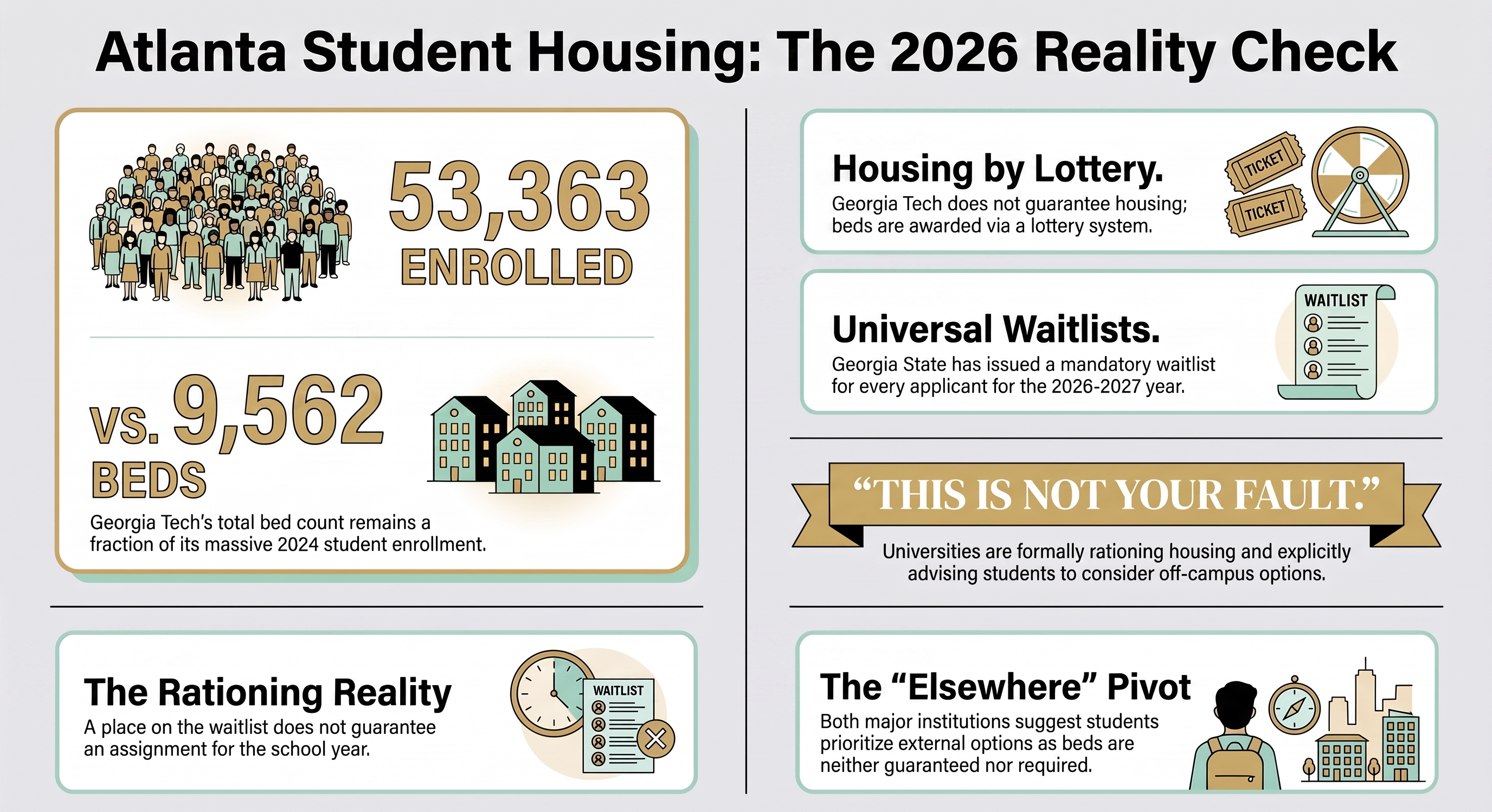
Start with the part that matters most: this is not your fault, and the universities are not pretending otherwise.
Georgia State University states on its housing site that because demand for campus housing is so high, a waitlist is currently in effect for every applicant for the Fall 2026 to Spring 2027 year. It also says plainly that a place on the waitlist does not guarantee you an assignment.
Georgia Tech goes further. Beds are awarded by lottery. Housing is neither guaranteed nor required for any student. And students who do not clear the waitlist are told directly to consider options beyond campus.
The scale behind those statements is worth understanding honestly. Georgia Tech runs 48 residence halls housing more than 8,700 residents and is adding another 862 beds by fall 2026, real construction against an institution that enrolled 53,363 students in fall 2024. One caveat most articles skip: roughly two thirds of that enrollment is online and lives outside Georgia, so the residential gap is smaller than the raw number suggests. It is still a gap. Georgia State serves more than 51,000 students across seven metro Atlanta campuses.
The universities are not hiding this. They are telling students to look elsewhere. So what does elsewhere cost?
What a semester actually costs
Almost nobody puts these two numbers side by side. Here they are, for the same four month period, with every figure sourced.
| Line item | Georgia State residence hall | Midtown one bedroom | Midtown studio |
|---|---|---|---|
| Housing for four months | $2,500 to $7,237 per semester | $2,199 per month, about $8,796 | $1,610 per month, about $6,440 |
| Utilities and internet | Included | Not included, commonly $150 to $250 per month | Not included |
| Furniture | Included | Not included | Not included |
| Meal plan | $2,233 required in first year halls | Not applicable | Not applicable |
| Housing maintenance fee | $75 per semester | Not applicable | Not applicable |
| Parking | $400 per semester, optional | Usually extra | Usually extra |
| Deposit and fees | Not applicable | Typically one month plus application fees | Typically one month plus application fees |
| Commitment required | One academic year | Usually twelve months | Usually twelve months |
Sources: Georgia State housing rates and RentCafe Midtown Atlanta, current as of August 1, 2026.
The headline comparison is blunt. A midrange Georgia State room lands near $4,000 for the semester with utilities, furniture, and internet already in the price. A Midtown one bedroom lands near $8,800 for the same four months before a single lamp, internet connection, or power bill is paid for.
Two honest caveats, because a table without them is a sales pitch. First, the dorm figure is per person and the apartment figure is per unit. Two roommates in that one bedroom change the math completely. Second, Midtown is the expensive end of the city. The average rent across all of Atlanta is $1,970 per month against Midtown's $2,606, up 2.12 percent over the past year. Trade distance for dollars and the picture improves.
This is not only an Atlanta problem. National student housing rent per bed reached $933 in May 2026, the ninth consecutive monthly increase.
None of these numbers matter, though, if your application gets rejected.
Why apartments keep rejecting you
Here is the reframe that changes what you should do next. For most students, the problem is not that Atlanta is unaffordable. The problem is that you cannot pass the screening, and those are very different problems with very different solutions.
Atlanta sits squarely among the metros that hold to the three times rent rule. To qualify for that $2,199 one bedroom, you are expected to show gross monthly income of roughly $6,600. Not savings. Not a stipend already sitting in your account. Documented recurring income.
Then there is credit. A score around 670 is a common approval benchmark, with 700 and above preferred in tight markets. Most undergraduates do not have a mediocre score. They have no score at all, and plenty of automated systems treat an empty file worse than a thin one.
The standard answer is a cosigner, and the standard answer has its own wall. Cosigner requirements are stricter than tenant requirements, commonly 700 plus credit and four to five times the monthly rent in verifiable income. A great many parents do not clear that bar. That is a fact about screening formulas, not a judgment about anyone's family.
International students hit the hardest version of this. With no US credit file, automated screening rejects the application before a human being ever reads it. Timing makes it worse this year. A Department of Homeland Security rule issued on July 17, 2026 replaces the longstanding duration of status framework with a fixed admit until date, effective September 15, 2026, which NAFSA notes has introduced real planning uncertainty. Signing a twelve month lease feels riskier when your own permitted stay has a hard date on it.
There are legitimate ways around the wall, and they are worth knowing in order:
-
Third party guarantor services such as TheGuarantors or Insurent, which stand in for a cosigner for a fee.
-
Private landlords who will count a loan disbursement or an assistantship as income, which large management companies generally will not.
-
Prepayment, offering two or three months up front in place of a credit history.
-
Purpose built student buildings, which are designed to screen students rather than conventional tenants.
-
Furnished stays booked by the month, which are bookings rather than leases. There is no credit pull because there is no lease being underwritten.
That last one is a mechanical difference, not a marketing claim. A lease underwrites a tenant over twelve months. A furnished stay underwrites a guest who has already paid. The screening simply is not part of the transaction.
Your five real options, cheapest first
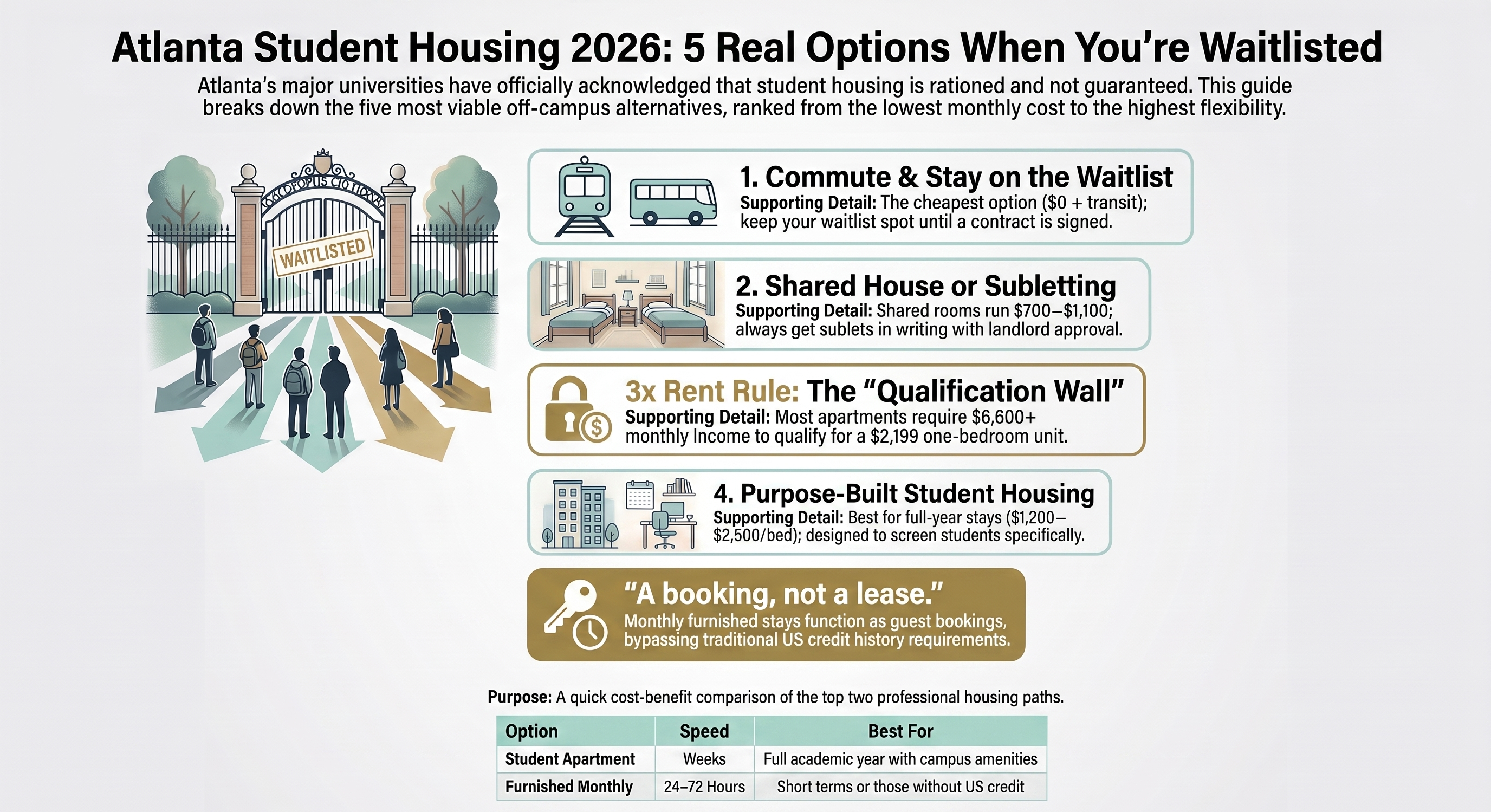
| Option | Typical monthly cost | How fast | Best for | Main drawback |
|---|---|---|---|---|
| 1. Stay on the waitlist and commute | $0 plus transit fare | Immediate | Students with family in metro Atlanta | Long commutes, little campus life |
| 2. A room in a shared house | $700 to $1,100 | Days | Students who can vet housemates fast | Uneven quality, informal agreements |
| 3. Sublet from a student who left | $800 to $1,400 | Days to weeks | One semester only | Landlord approval, weak protection if informal |
| 4. Purpose built student apartment | $1,200 to $2,500 per bed near Georgia Tech | Weeks | A full academic year with amenities | Long commitment, guarantor usually required |
| 5. Furnished stay by the month | Varies by market | 24 to 72 hours | Weeks to a few months, or when screening is the blocker | Costs more per month than a signed lease |
Option 1 deserves more respect than it usually gets. If you have family within MARTA or driving distance, commuting for one semester while you hold your waitlist place is the cheapest correct answer available to you. One practical warning: do not cancel a housing waitlist until something else is actually signed, and check your school's cancellation fee policy before you withdraw, because withdrawing after an assignment is issued can cost real money.
Option 2, a room in a shared house, is the workhorse of Atlanta student housing. Quality varies enormously. Meet your housemates before you commit, get the arrangement in writing even if everyone is friendly, and be honest about whether you can study there.
Option 3, subletting, is the most common way students lose money in this city. Someone studying abroad wants their spring covered, the price is great, and the paperwork never existed. Get the landlord's written approval. If the landlord will not approve it, the sublet does not protect you, and you have no standing when something goes wrong.
Option 4, a purpose built student apartment, is the right answer if you know you are staying a full academic year and can produce a guarantor. These buildings are built to screen students, which is their advantage, and they are a long commitment, which is their disadvantage if a dorm bed could open in six weeks.
Option 5, a furnished stay booked by the month, is furnished, has utilities and internet included, is booked rather than leased, involves no credit check, and can be confirmed in a day or two. Set against that, furnishing an empty apartment from scratch runs roughly $2,500 to $5,000 for the essentials in 2026, money you never get back when a two semester program ends. The honest tradeoff, stated plainly: it still costs more per month than a lease you can qualify for. It is the right answer in two situations and no others. Either your term is genuinely short, meaning weeks to a few months, or screening is your blocker rather than money. If you can qualify for a year and you need a year, sign the lease.
Where to look, by campus
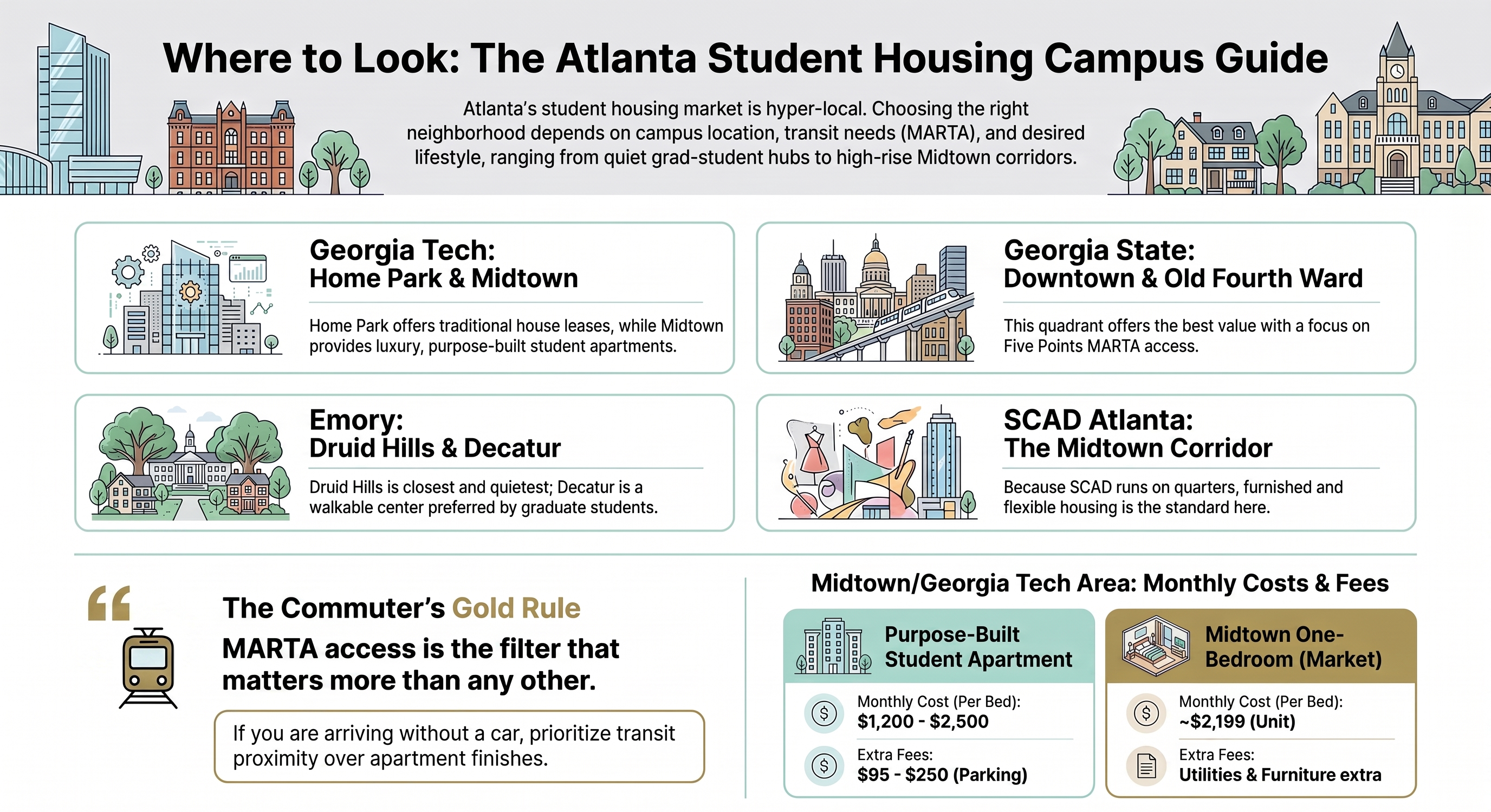
Atlanta is not one student market. It is four, and the right neighborhood depends entirely on which campus you are attending.
Georgia Tech. Home Park sits directly north of campus and holds traditional houses on standard leases, usually cheaper with fewer student amenities. East Midtown and West Midtown hold most of the purpose built student buildings. Student apartments in Midtown run roughly $1,200 to $2,500 per bed per month, and if you are bringing a car, budget parking separately at $95 to $250 per month.
Georgia State. Downtown and Old Fourth Ward. This is the transit heavy, better value quadrant, and closeness to the Five Points MARTA station is the filter that matters more than any other.
Emory. Druid Hills is the closest and quietest. Decatur is a walkable town center that graduate students tend to prefer. Emory's own off campus portal lets you filter for furnished units.
SCAD Atlanta. Overlaps the Midtown corridor with Georgia Tech. SCAD runs on quarters rather than semesters, so a twelve month lease fits the calendar even worse here than it does elsewhere, and furnished flexible housing is closer to the default than the exception.
If you are arriving without a car, MARTA access is the make or break in every one of these areas. Filter for it first and worry about the finishes second.
How to not get scammed
The riskiest profile in this market is a student searching from another state or country, sight unseen, under time pressure. That is precisely the reader of this article. Before you send anyone money:
-
Confirm the landlord or operator exists independently of the listing. A real company has a real phone number, a real business record, and reviews that predate your search.
-
Confirm the address exists and matches the photos. Street view is free.
-
Never wire money and never use a peer to peer payment app to a stranger. Both are designed to be irreversible.
-
Never pay before there is a written agreement naming the address, the dates, the total cost, and what happens if you leave early.
-
Be suspicious of rent far below market. You now know the Atlanta average is $1,970 and the Midtown average is $2,606. A furnished Midtown apartment at $700 is bait.
-
If you cannot visit, insist on a live video walkthrough rather than a photo set. Photos can be stolen from another listing. A live call cannot.
The off campus housing boards run by Georgia Tech and Emory are reasonable starting points because listings pass through the institution first. They are still classifieds rather than guarantees, so apply the checklist anyway. Booking through a managed operator removes most of this category of risk structurally, because there is a company, an address, and a contract standing behind the transaction.
For parents
You are probably the one being asked to cosign, so start with the arithmetic being asked of you. Cosigner standards typically run to 700 plus credit and four to five times the monthly rent in verifiable income, which for a $2,199 apartment means documenting somewhere between $8,800 and $11,000 a month. If you do not clear that, you are in very ordinary company.
The harder question is not whether you can cosign but whether you should. A twelve month lease commits you to twelve months of liability for a student whose housing status could change in six weeks if a dorm bed opens. Paying more per month for two or three months is often cheaper, and always simpler, than a year you did not want.
There is a second housing problem that belongs to you rather than your student, and almost nobody writes about it. Move in weekend, family weekend, homecoming, and commencement are the four dates when lodging near campus gets expensive and scarce, and all four are predictable a year ahead. Book them early. Waiting until the month before is how families end up thirty minutes away paying peak rates.
When you are evaluating any option from a distance, insist on five things: a written agreement, an operator you can verify independently, a total cost that includes utilities and internet, clear exit terms, and a phone number that a human being answers.
Frequently asked questions
Can I rent an apartment in Atlanta with no credit history? Yes, but not through standard screening. Your realistic paths are a third party guarantor service, a private landlord who will count loan or assistantship income, paying two to three months up front, or a furnished stay booked by the month, which involves no credit pull at all.
What credit score does a cosigner need in Georgia? Typically 700 or better, plus four to five times the monthly rent in verifiable income. Cosigner standards are stricter than the standards applied to the tenant.
Should I cancel my housing waitlist if I find something off campus? Not until the other option is signed. Check your school's cancellation policy first, because withdrawing after an assignment has been issued can trigger a fee.
What is the cheapest way to live near Georgia Tech or Georgia State? Commuting from family, then a room in a shared house. Both are genuinely cheapest in dollars. Both cost you in time and in campus life, and those costs are real even though they do not appear on a bill.
Where should parents stay for move in weekend or commencement? Book as far ahead as you can. Those four weekends are the predictable spikes in the campus adjacent lodging market, and inventory disappears before the price does.
I am an international student arriving in a few weeks with no US credit. What actually works? Furnished stays booked by the month, guarantor services, and, if your program allows it, institutional invoicing where your department is the payer rather than your personal card. Arrange something confirmed before you fly rather than after you land.
Is a furnished stay worth the higher monthly cost? Only when your term is short or screening is your blocker. If you can qualify for a lease and you need a full year, sign the lease. Paying a flexibility premium for flexibility you do not need is just paying more.
The short version
The shortage is institutional and openly acknowledged by the universities themselves, so stop treating it as a personal failure. The thing standing between you and an apartment is usually a screening formula rather than your bank balance, and screening formulas have documented ways around them. Student housing in Atlanta rewards people who know which question they are actually answering.
So answer this one first, before you open a single listing: how many months do you actually need? Two months, five months, and twelve months are three completely different problems with three completely different right answers. Get that number straight and the correct option on the list above picks itself.
All figures verified August 21, 2026. Campus waitlist status changes frequently in August, so confirm current details directly with your university housing office.
How Minty Living can help
Most of this guide points somewhere other than us, and that was deliberate. If you can commute, commute. If you can qualify for a lease and you need a full year, sign the lease. Those are the right answers and they are cheaper than anything we offer.
There is one situation where a furnished stay genuinely is the right answer, and it is the situation a lot of readers of this article are actually in. You need weeks or a few months rather than a year, or the screening formula is the thing standing in your way rather than the money.
Minty Living manages more than 160 professionally designed furnished homes and apartments across 10 plus intown Atlanta neighborhoods, Midtown and Old Fourth Ward and Inman Park and Cabbagetown and West End among them. Midtown sits next to Georgia Tech, West End sits next to the Atlanta University Center, and the eastside neighborhoods run into Georgia State and Emory on transit. Here is what that means for the situations in this guide.
Terms that match academic timelines. Our stays run from hourly to annual, so a ten week research term, a one semester bridge while you hold a waitlist place, or a rotation that ends in March are all things we can actually book. You are not asked to commit to twelve months to solve a two month problem.
A booking, not a lease. Because a furnished stay is a booking, there is no credit pull, no cosigner requirement, and no US credit history needed. That is the mechanical reason this works for international students, first year graduate students, and visiting researchers who get rejected by automated screening before a person ever reads the file.
Move in ready, with the setup already done. Every property is furnished and designed by our in house team and stocked with amenities, so there is no furniture to buy and no utilities or internet appointment to wait for. Arriving from another country with two suitcases is a normal way to show up.
Fast when you need fast. We have 24 hour placement capability, which matters when classes have already started. Our portfolio meets Plum Guide selection standards, which one in a hundred properties reach, and we hold a 4.9 Google rating and Airbnb Superhost status. A parent booking sight unseen from another state has something verifiable to check.
A real company on the other end. Every scam check in this guide is one we pass. There is an address, a contract, a phone number, and a team that answers it.
If you are not sure which of the five options fits your situation, we are happy to talk it through even if the answer turns out to be one we do not sell. Tell us how many months you need and we will tell you honestly whether a furnished stay makes sense.
Reach out at mintyliving.com or call (404) 999 0841.

 (4).png)

 (29).png)
 (28).png)
 (33).png)
 (37).png)
 (38).png)
 (39).png)
 (40).png)
 (44).png)
 (44).png)
 (1).png)
 (3).png)
 (55).png)
 (54).png)
 (56).png)
 (57).png)
 (58).png)
 (59).png)
 (60).png)
 (61).png)
 (63).png)
 (66).png)
 (45).png)
 (67).png)
 (68).png)
 (69).png)
 (70).png)
 (71).png)
 (73).png)
 (86).png)
 (87).png)
 (89).png)
 (92).png)