


 (33).png)
It’s Friday at 6 PM. A kitchen fire just displaced a family of four in Cherokee County. The policyholder is standing in the driveway with two kids, a labrador, and a suitcase. You pull up hotel options on your phone: the nearest pet-friendly extended-stay is booked. The next one is 35 minutes from the kids’ school and quoting $180 a night. Your preferred vendor isn’t picking up.
You’ve been here before. Every adjuster has.
The problem isn’t just finding a roof tonight. It’s finding housing that satisfies Like-Kind-and-Quality standards, fits within the ALE policy limit, and doesn’t generate a callback three weeks later because the unit was dirty or the billing was wrong. Speed, compliance, and cost — all three need to work at once, and they rarely do.
This guide is the operational playbook for that problem. Seven chapters covering ALE policy mechanics, housing options, vendor evaluation, placement logistics, compliance, cost containment, and real Atlanta case studies. Written adjuster-to-adjuster — not by a vendor trying to sell you something, but as the ALE housing provider resource Atlanta’s claims professionals have needed and nobody has published until now.
What This Guide Covers
This is a comprehensive ALE housing guide written specifically for insurance claims professionals working the Atlanta market. Whether you’re a field adjuster placing families the same day, an ALE specialist managing 80+ claims across multiple carriers, or a housing coordinator evaluating your vendor panel — this guide delivers.
You’ll walk away with:
-
A 10-criteria vendor evaluation framework with a scoring methodology
-
A 12-item compliance checklist that audit-proofs your claim files
-
Atlanta-specific rate benchmarks for hotels, furnished apartments, and corporate housing
-
Three case studies with quantified outcomes from real placement scenarios
Short on time? Jump to Chapter 3: Vendor Evaluation Framework or Chapter 5: Compliance Checklist.
Table of Contents
-
Understanding ALE Coverage: Policy Language and Claim Mechanics
-
The ALE Housing Challenge: Hotels vs. Furnished Apartments vs. Corporate Housing
Understanding ALE Coverage: Policy Language and Claim Mechanics
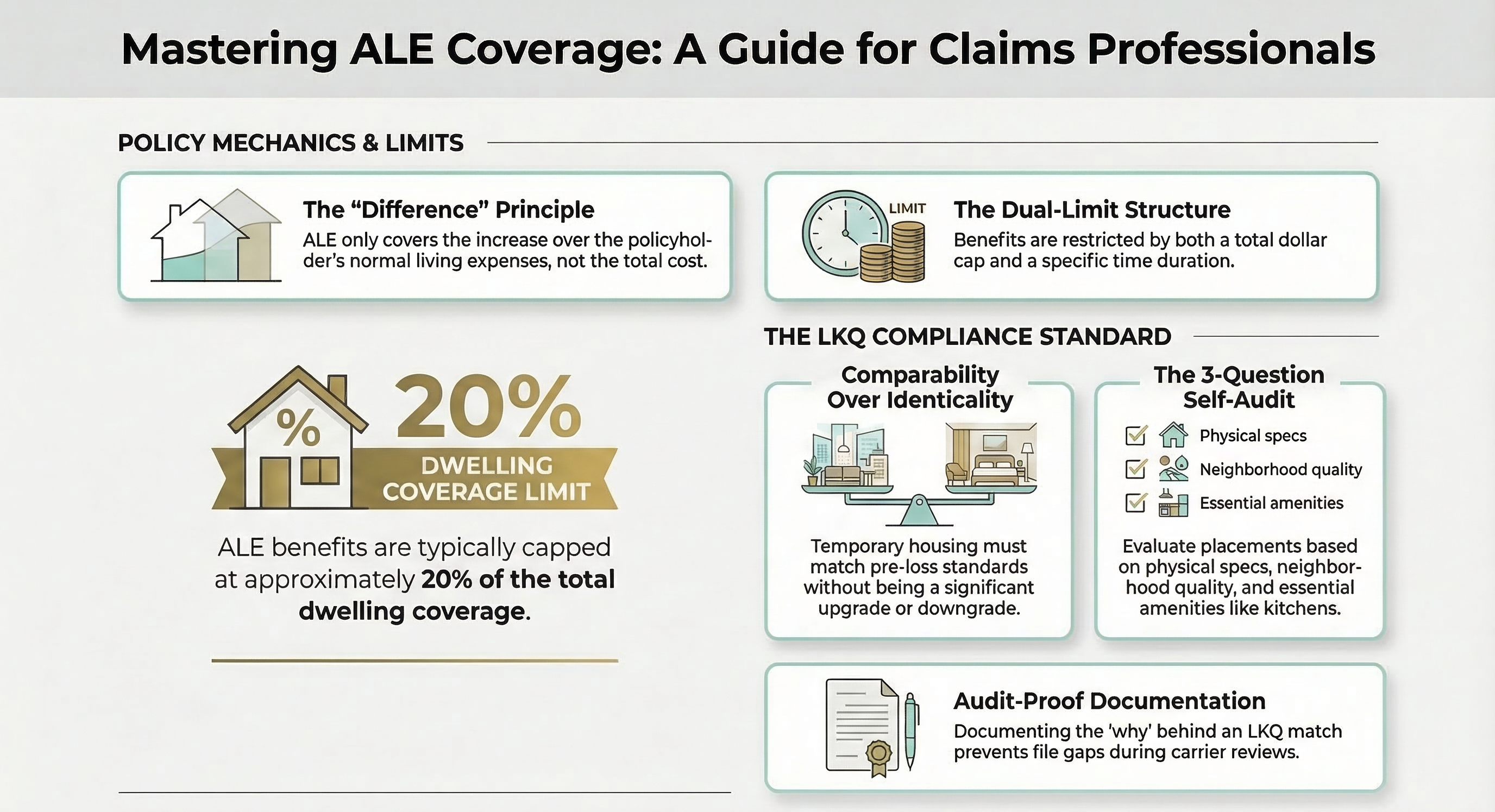
ALE is not a blank check. Before you place a single policyholder, you need to understand exactly what the policy covers, what it doesn’t, and where the limits are.
What ALE Covers (and Doesn’t)
Additional Living Expense coverage pays the difference between the policyholder’s normal living expenses and the increased costs caused by displacement. If a family normally spends $1,500 a month on housing and you place them in a furnished apartment at $2,400 a month, ALE covers the $900 difference — not the full $2,400.
According to the NAIC, eligible ALE expenses typically include temporary housing (hotels, furnished rentals, corporate apartments), restaurant meals above normal food costs, transportation costs above normal commute, laundry and storage fees, and pet boarding when temporary housing doesn’t allow animals.
What ALE does not cover: mortgage or rent payments on the damaged property (those continue regardless), normal grocery costs, home improvements or upgrades, and any expenses the policyholder would have incurred anyway.
The Dual-Limit Structure
Every ALE benefit carries two limits, and adjusters need to track both:
Dollar limit: ALE benefits are typically capped at a percentage of dwelling coverage — often cited as 20% in industry guides, though limits vary significantly by carrier and policy. On a $300,000 dwelling policy, that would mean roughly $60,000 in ALE benefits. This sounds generous until a 6-month displacement at $2,400/month plus meals and transportation eats through it. Always verify the specific policy language.
Time limit: Usually 12–24 months, though this varies by carrier and policy. Some policies expire the ALE benefit when the dwelling is repaired, even if time remains on the clock. Always check the specific policy language.
The Like-Kind-and-Quality Standard
LKQ is the compliance standard that governs every placement decision. It means the temporary housing must be comparable to the policyholder’s pre-loss living standard — not identical, but not a significant downgrade or upgrade.
A family living in a 3-bedroom suburban home with a yard maps to a furnished 3-bedroom apartment in a similar neighborhood with comparable amenities. It does not map to a cramped hotel room or a luxury penthouse.
Common LKQ failure modes:
-
Under-placing: Putting a homeowner in a $700/month studio to save budget. The policyholder complains, the claim escalates, and you spend more time fixing it than you saved.
-
Over-placing: Putting a family in a luxury corporate suite because it was available. The carrier questions the cost, and your file gets flagged on audit.
Three-question LKQ self-audit before approving any placement:
-
Are the beds, baths, and square footage comparable?
-
Is the neighborhood quality comparable (school district, commute, safety)?
-
Are the amenities comparable (kitchen, laundry, parking)?
ALE Eligibility Checklist
Run this five-item check before approving any placement:
-
Uninhabitability confirmed — documented with photos and adjuster report
-
ALE benefit amount verified — dollar limit and remaining balance confirmed
-
Time limit checked — remaining months or policy-specific expiration trigger identified
-
Special needs identified — pets, accessibility requirements, school proximity, medical equipment, work commute
-
Payment structure confirmed — direct-pay to vendor vs. policyholder reimbursement; carrier-specific process documented
See Chapter 5 for the full compliance documentation checklist →
The ALE Housing Challenge: Hotels vs. Furnished Apartments vs. Corporate Housing
Not all temporary housing serves ALE claims equally. The choice between hotels, furnished apartments, and corporate housing affects your budget, your policyholder’s satisfaction, your LKQ compliance, and your claim cycle time. Here’s how they compare.
The Three Options
Extended-stay hotels are the default for many adjusters because they’re fast. You can book online and have a policyholder checked in the same day. But for placements longer than two weeks, hotels become expensive, uncomfortable, and a poor LKQ fit for homeowners. A family of four living in a hotel room with a kitchenette is not comparable to the 3-bedroom home they left.
Furnished apartments — short-term rentals with full kitchens, residential neighborhood settings, and flexible lease terms — are where the industry is heading. ALE Solutions’ 25-year report confirms the shift: as displacement durations increase due to climate-driven catastrophe complexity, furnished apartments deliver better LKQ compliance, lower monthly cost, and higher policyholder satisfaction than hotels.
Corporate housing sits between the two — fully furnished units managed by serviced-apartment operators. Quality is typically high, but availability is limited, minimum stays are longer, and pricing can be opaque.
Atlanta Cost Comparison
Here’s what the numbers look like for a 30-day ALE placement in metro Atlanta (2025–2026 rates):
| Extended-Stay Hotel | Furnished Apartment | Corporate Housing | |
|---|---|---|---|
| Monthly cost | $3,300–$3,900 ($110–130/night) | $1,800–$2,400 (1BR) / $2,200–$3,000 (2BR) | $2,800–$3,500 |
| Placement speed | Same day | 24–48 hours | 48–72 hours |
| Kitchen/laundry | Kitchenette only | Full kitchen + in-unit laundry | Full kitchen + laundry |
| LKQ fit for homeowners | Low | High — residential feel | Medium-High |
| Pet-friendly options | Very limited | Moderate | Limited |
| CAT availability | First to sell out | More stable inventory | Limited |
| Best use case | Under 14 days | 14–90+ days | 30–90 days (corporate) |
The math speaks for itself: a 30-day hotel stay at $120/night runs $3,600. A furnished apartment at $2,400/month saves $1,200 — a 33% reduction — while providing more space, a full kitchen, and a residential neighborhood that better satisfies LKQ.
When hotels still win: Placements under 7–10 days where the speed advantage outweighs cost. If the repair estimate is under two weeks, a hotel is the right call.
Atlanta’s Housing Supply Problem
Atlanta’s tight housing market makes ALE placements harder than in many metros. The city faces a ~100,000 home shortfall, and roughly a third of recent single-family home purchases have been made by investment funds — compressing available rental inventory and pushing prices higher.
During catastrophic events, supply gets critical. Hurricanes Idalia (2023) and Helene (2024) triggered large-scale displacement across Georgia, with more than $334 million in FEMA grants to Georgia survivors awarded to the state. Hotel inventory sold out within hours. Adjusters who had pre-qualified vendor relationships placed families; those who relied on reactive calls scrambled.
Neighborhood supply varies significantly: Buckhead, Midtown, and Decatur maintain strong furnished apartment inventory. Outer suburbs like Douglasville and Canton are thinner — plan accordingly.
Boutique providers like Minty Living — with 160+ furnished units across Atlanta neighborhoods — represent the furnished apartment tier: full kitchens, residential neighborhoods, and inventory that doesn’t evaporate during a CAT event the way hotel blocks do.
See Chapter 6 for Atlanta rate benchmarks and cost containment strategies →
Evaluating Housing Vendors: A 10-Criteria Framework
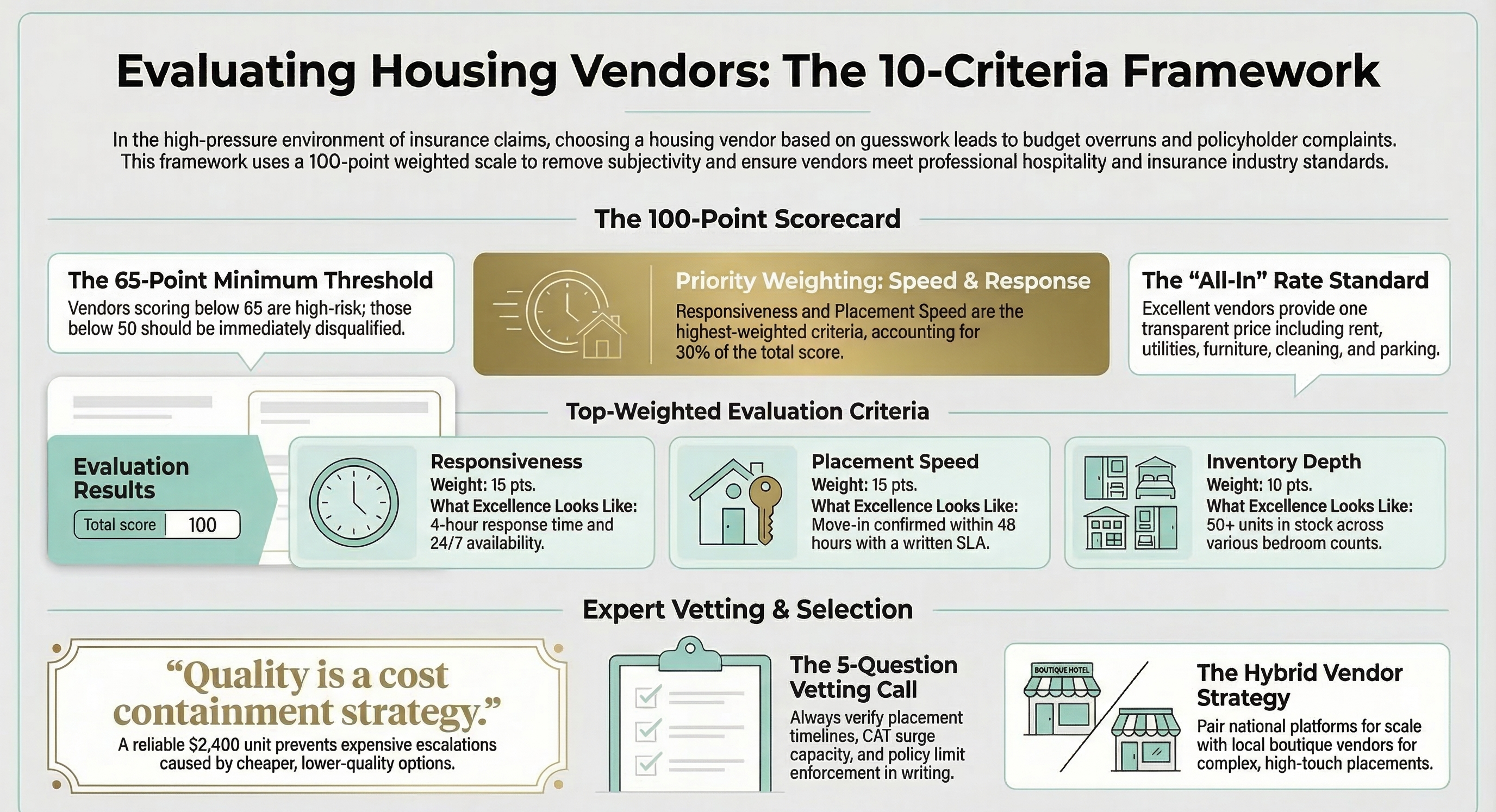
Choosing a vendor based on a cold call or a colleague’s recommendation is how ALE programs go wrong. A structured evaluation framework removes the guesswork and gives you data to make defensible decisions.
The 10-Criteria Scorecard
Rate every vendor on a 100-point scale using these weighted criteria:
| # | Criterion | Points | What Excellent Looks Like | Red Flag |
|---|---|---|---|---|
| 1 | Responsiveness | 15 | Answers within 4 hours; same-day placement capability; 24/7 availability | No after-hours phone line; takes 24+ hours to return calls |
| 2 | Inventory Depth | 10 | 50+ units in stock; mix of 1BR/2BR/3BR; Atlanta metro + suburbs | Fewer than 10 units; single bedroom type only |
| 3 | Placement Speed | 15 | Move-in confirmed within 48 hours; written SLA on timeline | Can’t commit to a timeline; “we’ll see what’s available” |
| 4 | LKQ Compliance | 10 | Proactively matches housing to pre-loss standard; asks about policyholder’s prior home | Offers whatever is available with no quality assessment |
| 5 | Cost Transparency | 10 | All-in rate disclosed upfront; no hidden fees; price holds for placement duration | Base rate + add-ons for cleaning, utilities, parking; final bill surprises |
| 6 | Special Needs | 10 | Pet-friendly inventory tagged; accessible units available; medical equipment accommodation | “We don’t really do pets” or “You’d have to find that yourself” |
| 7 | Documentation | 10 | COI on file; itemized billing; direct carrier billing capability; audit-ready records | No COI; can’t provide itemized invoices; cash-only billing |
| 8 | CAT Surge Capacity | 10 | Committed inventory during disasters; written CAT SLA; demonstrated deployment history | Vague capacity claims; no documented CAT experience |
| 9 | Technology | 5 | Real-time availability dashboard; policy limit tracking; claims platform integration | Phone-and-email only; no digital tools for adjusters |
| 10 | Account Management | 5 | Named manager; tenure >18 months; defined escalation path | Rotating contacts; no single point of accountability |
Minimum threshold: 65 points. Below 50: disqualify.
Five Mandatory Questions for Every Vendor Call
Before adding any vendor to your preferred list, ask these five questions. If they can’t answer all five clearly, they fail the minimum threshold.
-
What is your guaranteed placement timeline, in writing?
-
How many units did you have available in Atlanta during Hurricane Helene?
-
How do you enforce policy limits — what happens if my policyholder wants something above their ALE cap?
-
What does your billing look like — all-in rate or base plus add-ons?
-
Who is my named account manager, and how long have they been in this role?
National Platforms vs. Local Boutique Vendors
National platforms like ALE Solutions and National Corporate Housing offer scale, technology integration, and multi-state CAT deployment capability. They’re the right choice for housing coordinators managing multi-state programs or carriers needing a single national contract.
Local boutique vendors offer something different: deep neighborhood knowledge, relationship-based responsiveness, and housing quality that often exceeds the LKQ standard. For complex placements — families with pets, accessibility needs, or school district requirements — a local vendor who knows which buildings in Decatur allow large dogs is worth more than a national search algorithm.
The strongest ALE programs use a hybrid strategy: national platform as the primary vendor for scale and technology, local boutique as the secondary for quality-sensitive, complex, or difficult-to-place cases.
A claims adjuster working a 30-family displacement in DeKalb County described the difference: “The vendor answered on the first ring at 9 PM, sent three confirmed options within 25 minutes with all-in pricing, and had every family in by Saturday morning. That’s the bar.” — Adjuster experience with Minty Living, Atlanta.
Placement Logistics: From Request to Move-In
Placement failures are rarely about the vendor. They’re about communication — missing information at the request stage that cascades into delays, wrong-fit housing, and policyholder complaints. A standardized process eliminates this.
The 6-Step Placement Process
Step 1 — Assess (Day 0–1)
On-site, confirm the property is uninhabitable and document it with photos and your adjuster report. Establish the ALE benefit amount. Then gather the policyholder’s needs: beds and baths required, pets (species, breed, weight), children’s school district, work commute requirements, mobility or medical equipment needs, and any other non-negotiable preferences.
This intake is the most important 10 minutes of the entire placement. Every detail you miss here creates a phone call later.
Step 2 — Request (Day 1)
Send the vendor a standardized placement request with all needs documented upfront. A single form that captures everything the vendor needs eliminates the 3–5 back-and-forth calls that slow most placements.
Step 3 — Confirm (Day 1–2)
The vendor sends 2–3 options. You verify each against the LKQ standard: beds/baths comparable, neighborhood quality comparable, amenities comparable. Select one. Get written confirmation from the vendor with the all-in rate and confirmed move-in date. No verbal agreements.
Step 4 — Move-In (Day 2–3)
The vendor coordinates utilities, key handoff, and policyholder orientation. Your job: confirm the policyholder is settled and all needs identified in Step 1 are met on Day 1. If something is wrong, fix it immediately — Day 1 problems that linger become Day 30 complaints.
Step 5 — Monitor (Day 30 or 50% of ALE benefit)
Check in with the policyholder. Are they satisfied? Any maintenance issues? Then check the numbers: is billing reconciled to the agreed rate? What’s the remaining ALE balance? If you’re approaching 80% of the policy limit, alert the ALE specialist now — not at month-end.
Step 6 — Move-Out (Repair Complete)
Coordinate the move-out with the repair timeline. The vendor handles the checkout inspection and deposit reconciliation. You close the housing file with the final billing reconciliation and move-out documentation. File complete.
CAT Event Modification
During declared disasters, Steps 2–3 compress to 4–6 hours. Pre-approved vendor relationships are the difference between placing families the same night and scrambling for hotel rooms at significantly elevated rates. If you don’t have a pre-qualified vendor with confirmed CAT inventory before hurricane season, you’re already behind.
Common Failure Points
Four errors account for most placement problems:
-
Pets omitted from intake: Vendor finds a unit, family arrives with a 70-pound labrador, placement falls apart
-
School district not verified: Family placed 40 minutes from kids’ school; policyholder calls back on Day 2
-
Utility setup delayed: Vendor doesn’t have a pre-negotiated utility process; family moves in with no internet for a week
-
Billing address wrong from Day 1: Carrier receives invoices addressed incorrectly; payment delayed; vendor sends past-due notices to adjuster
Every one of these is preventable with a complete intake form.
Compliance and Documentation: Protecting Your Claim File
A well-placed policyholder with a poorly documented file is a claim waiting to fail on audit. In 2025, carriers tightened underwriting standards — verified inspections, detailed maintenance documentation, and audit-ready claim files are now the expectation, not the exception. ALE housing documentation is no different.
What the Vendor Must Provide Before Placement
Five documents. Non-negotiable. Get these before a single policyholder moves in:
-
Certificate of Insurance (COI) — current, covering the placement period
-
Commercial General Liability certificate — verifying adequate coverage
-
Written rate confirmation — all-in rate with no hidden fees, in writing
-
Move-in/move-out inspection report template — standardized format the vendor uses
-
Direct carrier billing authorization — confirming how billing flows to the carrier
What the Adjuster Collects During Placement
Five more documents. These are your responsibility:
-
Uninhabitability documentation — photos of damaged property plus adjuster report
-
ALE benefit acknowledgment — policyholder confirms understanding of coverage limits
-
Signed housing agreement — between policyholder and housing provider
-
30-day billing reconciliation — charges match agreed rate; no unauthorized items
-
Move-out inspection — vendor’s final walkthrough with condition documentation
The LKQ Documentation Trail
When your file goes to audit, the reviewer will ask: “How did you determine this housing was Like-Kind-and-Quality?” Your answer needs to be documented. Include:
-
Policyholder’s pre-loss housing details (beds, baths, neighborhood, amenities)
-
The temporary housing specs (same categories)
-
A brief written justification noting comparability
This takes five minutes. Skipping it creates a file gap that costs hours to defend later.
Policy Limit Tracking
Establish the remaining ALE benefit at Day 0. Document the balance at every 30-day check-in. Set alerts at 50% and 80% usage. According to NAIC guidance, policyholders must keep all receipts and the insurer is entitled to documented proof of expenses. If your file doesn’t show running balance tracking, an auditor will flag it.
12-Item Compliance Documentation Audit Checklist
Run this before every file review:
-
Vendor COI on file (current)
-
Vendor Commercial General Liability certificate on file
-
Written rate confirmation (all-in) obtained before move-in
-
Uninhabitability documented (photos + adjuster report)
-
ALE benefit amount confirmed and documented
-
Policyholder needs intake completed and filed
-
Housing agreement signed by policyholder
-
Move-in inspection completed and documented
-
30-day billing reconciliation completed
-
ALE balance tracked and noted at 50% and 80% usage
-
Move-out inspection completed and documented
-
Final billing reconciled to placement dates
Documentation-Ready Vendor: What this looks like in practice — Minty Living provides pre-formatted move-in/move-out inspection reports, itemized billing that maps line-by-line to placement dates, and COI delivery within 24 hours of vendor agreement. That’s the documentation standard adjusters should hold all vendors to.
Cost Containment Strategies Without Sacrificing Quality
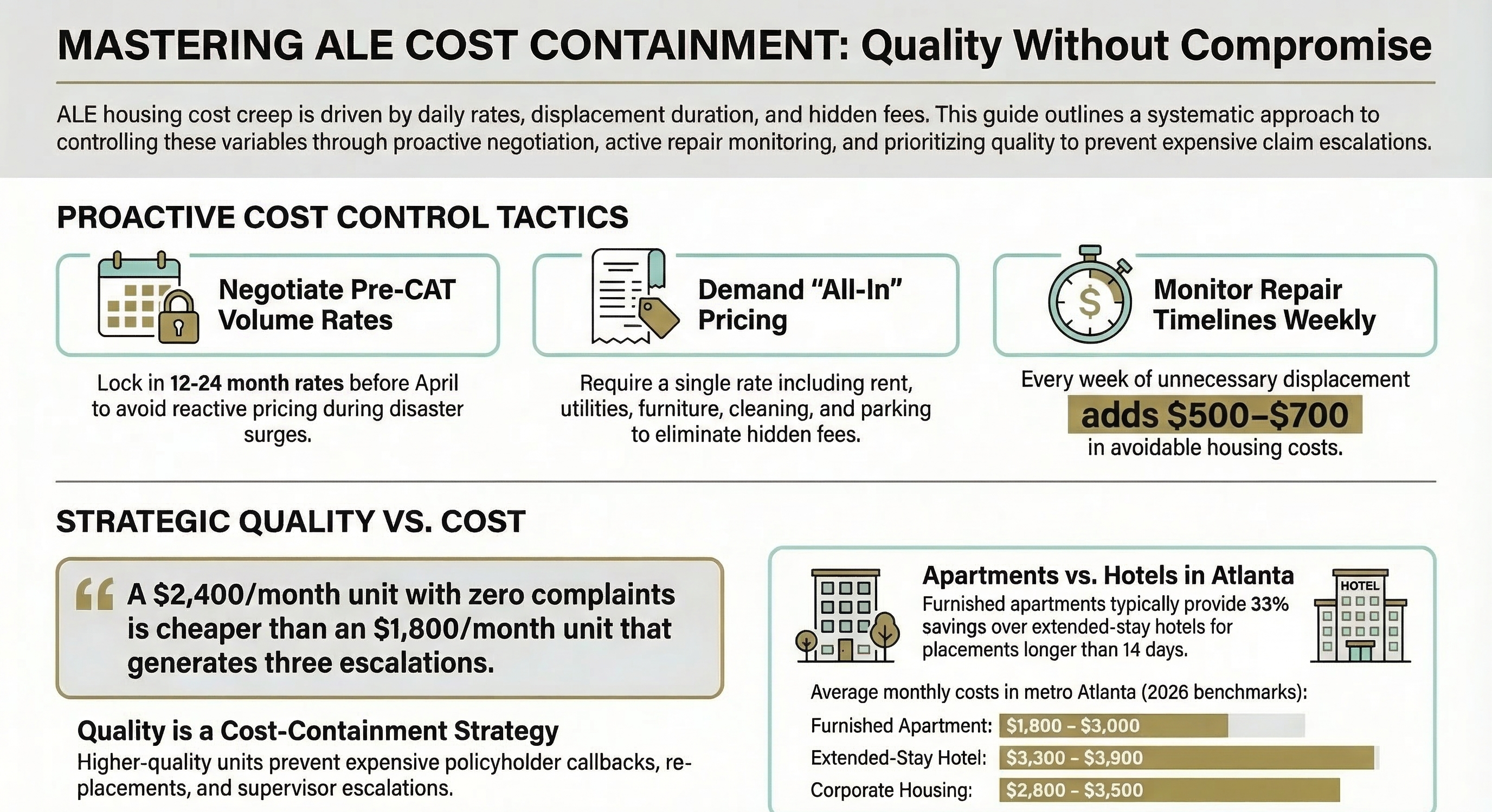
ALE housing cost creep is predictable and preventable. Three drivers account for nearly every budget overrun: the daily or monthly rate, the placement duration, and hidden fees. Control all three and you control your ALE spend.
Rate Negotiation
Negotiate rates before you need them — ideally before CAT season begins in April. Lock volume rates for 12–24 months with your preferred vendors. Get the all-in rate in writing before any placement. “All-in” means rent, utilities, furniture, cleaning, and parking included. If the vendor can’t give you a single number, that’s a red flag.
Atlanta 2026 rate benchmarks for comparison:
-
Extended-stay hotel: $110–130/night ($3,300–$3,900/month)
-
Furnished apartment (1BR): $1,800–$2,400/month
-
Furnished apartment (2BR): $2,200–$3,000/month
-
Corporate housing: $2,800–$3,500/month
For context, ALE Solutions reports significant carrier savings through structured billing management — millions in recovered costs annually across their placement volume. That’s not magic — it’s systematic rate negotiation and transparent billing.
Duration Management
Duration is the biggest cost lever most adjusters ignore. Every week of unnecessary displacement adds $500–700 in housing costs. Monitor repair timelines actively. When the contractor says “two more weeks” for the third time, escalate to your supervisor. A placement that extends from 60 days to 90 days because nobody tracked the repair timeline costs $3,000–$4,200 in avoidable ALE spend.
Hidden Fee Audit
Before approving any placement, request an itemized pro-forma invoice from the vendor. Compare it to the written rate confirmation. Common hidden fees: cleaning charges, pet deposits not disclosed upfront, parking fees, utility overages, and administrative charges. If the pro-forma doesn’t match the rate confirmation, resolve the discrepancy before the policyholder moves in.
When Spending More Saves Money
This is counterintuitive but true: a higher-quality furnished apartment at $2,400/month that prevents policyholder complaints, callbacks, and re-placements costs less total than a $1,800/month unit that generates three escalations and a supervisor call every two weeks. Quality isn’t a luxury — it’s a cost containment strategy.
Adjusters placing 3+ families per month with a single vendor have negotiating leverage. Document your placement volume and use it during rate discussions.
Real Adjusters, Real Scenarios: Case Studies from Atlanta
The following scenarios are based on typical ALE placement situations in the Atlanta metro. Details are composite illustrations of common claim patterns, not individual client files.
Case Study 1: Single-Family Fire, Cherokee County
Persona: Field adjuster managing a Friday evening displacement
Situation: A kitchen fire renders a 4-bedroom home uninhabitable. Family of four — two school-age children and a labrador retriever. It’s 6:15 PM on a Friday.
Challenge: The three nearest pet-friendly extended-stay hotels are either booked, 35 minutes from the kids’ school, or quoting $180/night — 2.5 times the cost of a furnished apartment. The carrier’s preferred national vendor has a 72-hour placement window that won’t help tonight.
Action: The adjuster submitted a standardized placement request to a pre-qualified local vendor at 6:30 PM. Within 28 minutes, two pet-friendly furnished apartment options were confirmed in the same school district — both with full kitchens, in-unit laundry, and all-in pricing.
Result: Family moved in Saturday morning. Total time from request to occupancy: 31 hours. Monthly cost: $2,200 vs. the $5,400 hotel equivalent. Policyholder satisfaction rating: 4.9/5. Claim closed 11 days ahead of comparable prior claims. Vendor: Minty Living, Atlanta.
Metric Card: 31-hour placement / $3,200 monthly savings / 4.9 policyholder satisfaction
Case Study 2: Hurricane Helene CAT Event — 12 Families in 48 Hours
Persona: ALE specialist managing mass displacement
Situation: Hurricane Helene (2024) triggers 12 simultaneous ALE placements across DeKalb and Gwinnett counties. Two families require accessible units. One family has three pets. Georgia received more than $334 million in FEMA grants to Georgia survivors for 2023–2024 events — this was real-scale displacement.
Challenge: Hotel inventory exhausted within 6 hours of the storm. One family contacted the ALE specialist at 9 PM with zero housing options. Accessible units were impossible to source through standard hotel channels.
Action: The specialist activated a pre-qualified local vendor via a single call. The vendor’s inventory dashboard confirmed 14 available units matching various family configurations. Policy compliance was verified per unit before confirming placements — no manual back-and-forth required.
Result: 9 of 12 families placed within 6 hours. Remaining 3 placed within 36 hours (accessible unit coordination required additional sourcing). Zero policy limit exceedances. All three special-needs cases accommodated: two accessible units and one three-pet household. Minty Living confirmed 9 of 12 placements within 6 hours of the initial CAT request.
Metric Card: 9 families in 6 hours / 0 policy violations / 3/3 special needs accommodated
Case Study 3: Vendor Audit Reveals Cost Creep — $800K Annual Savings
Persona: Housing coordinator managing a 14-vendor panel
Situation: A three-year review of ALE housing spend across 14 vendors reveals rates have climbed 24% while SLA performance has not improved. Two vendors responsible for 60% of total spend.
Challenge: No standardized metrics across vendors — every vendor reports differently. Hidden fees average 18% above the contracted base rate. CAT readiness claims from three vendors are unverified. Account manager turnover has erased institutional knowledge of contract terms.
Action: The coordinator applied the 10-criteria Vendor Evaluation Scorecard to all 14 vendors. Four scored below the 50-point disqualification threshold. Two were placed on 90-day performance improvement plans. The preferred vendor list was rebuilt around 6 scored vendors with documented SLAs, transparent billing, and verified CAT capacity.
Result: ALE housing spend decreased 12% ($800,000 annually) within six months. Late placement rate dropped 15%. Adjuster satisfaction survey scores improved by 22 points. The scorecard created an auditable vendor selection process that satisfied both claims leadership and finance.
Metric Card: $800K annual savings / 12% cost reduction / 15% fewer late placements
Frequently Asked Questions
What is the Like-Kind-and-Quality standard and how do I apply it?
LKQ requires temporary housing to match the policyholder’s pre-loss living standard — comparable beds/baths, neighborhood quality, and amenities. Not identical, but not a downgrade. Run the three-point check from Chapter 1 and document the comparison in the claim file.
How quickly should an ALE housing vendor be able to place a policyholder in Atlanta?
Industry benchmark is 24–48 hours from request to confirmed move-in for furnished apartments. Same-day placement is typical for hotels. Any vendor unable to commit to 48 hours in writing should not be on your preferred list.
What’s the difference between extended-stay hotels and furnished apartments for ALE claims?
Furnished apartments offer more space, full kitchens, residential neighborhoods, and lower monthly cost for stays exceeding 14 days. Hotels are faster for short displacements under 7–10 days. For most Atlanta ALE claims (repair timelines typically 30–90 days), furnished apartments are the stronger LKQ fit and lower cost option.
How do I document ALE housing for a carrier audit?
Twelve documents cover 95% of audit requirements. The full checklist is in Chapter 5 — from vendor COI through final billing reconciliation. Run the checklist before submitting any file for review.
What should I ask an ALE housing vendor during a vetting call?
Five questions: guaranteed placement timeline (in writing), available inventory during the last CAT event, policy limit enforcement process, all-in vs. base-plus rate structure, and named account manager tenure. See the complete framework in Chapter 3.
How does Atlanta’s housing shortage affect ALE placements?
The ~100,000 home shortfall in metro Atlanta compresses available furnished inventory under normal conditions and makes it critically scarce during catastrophic events. Pre-qualified preferred vendor relationships with committed CAT inventory are the only reliable solution.
Can policyholders with pets be placed in furnished ALE housing?
Yes, but pet-friendly inventory is limited. Always include pet details — species, breed, and weight — in the initial placement request. Confirm pet-friendly status in writing before the policyholder moves in. Budget for an additional pet deposit, which is typically ALE-eligible.
What are the most common ALE cost overruns and how do I prevent them?
Three sources account for 80% of overruns: hidden fees not disclosed at placement, unmonitored placement duration extending past repair completion, and above-market rates locked in reactively during CAT events. Prevention: all-in rate in writing before move-in, active repair timeline monitoring, and pre-negotiated volume rates before CAT season.
The Bottom Line on ALE Housing in Atlanta
ALE housing quality is directly tied to how systematically you evaluate and manage your vendors — and in Atlanta’s tight market, that work needs to happen before you need the placement, not during the Friday evening scramble.
The Sedgwick 2025 Loss Adjusting Insights report put numbers to what adjusters already feel: $368 billion in global weather damages in 2024 alone, and a claims environment growing more complex by the season. The vendors who reduce your workload — not add to it — are the ones worth keeping on the panel.
Your next step depends on your role:
-
Field adjusters: Build a standardized intake form from the checklist in Chapter 4. Next time you’re standing in a driveway at 6 PM, you’ll have every detail your vendor needs in one message.
-
ALE specialists: Run the five mandatory questions from Chapter 3 on your current primary vendor this week. If they can’t answer all five, you know what to do.
-
Housing coordinators: Apply the 10-criteria scorecard to your top three vendors by spend this quarter. The data will tell you whether your panel is performing or coasting.
This guide was written to make ALE housing work better for the professionals who manage it every day. The frameworks are here and tested. The Atlanta market isn’t getting easier — but your vendor program can be.
How Minty Living Can Help
The challenges covered in this guide — rapid placement, LKQ compliance, transparent billing, and CAT-ready inventory — are what we work on every day with claims professionals across Atlanta.
Minty Living manages 160+ professionally designed furnished properties across Atlanta’s intown neighborhoods, including Midtown, Buckhead, Old Fourth Ward, Decatur, and East Atlanta. Here’s what that means for your ALE placements:
For Field Adjusters: We respond to placement requests within hours — evenings and weekends included. Every unit is move-in ready with full kitchens, in-unit laundry, and high-speed internet. Pet-friendly options are tagged in our inventory and confirmed before you commit.
For ALE Specialists: We provide pre-formatted move-in/move-out inspection reports, itemized billing that reconciles line-by-line to placement dates, and COI delivery within 24 hours. Our team understands carrier-specific ALE requirements and can verify LKQ compliance on your behalf.
For Housing Coordinators: We offer transparent all-in pricing with no hidden fees, volume rate structures for adjusters placing multiple families, and documented CAT surge capacity across our 160+ unit portfolio. We carry a 4.9 Google rating across thousands of guest reviews.
Whether you’re evaluating vendors for your preferred list, need an urgent Friday evening placement, or want to discuss how we handle CAT deployments — we’re happy to talk through your specific situation.
Submit a placement request or call (404) 999-0841.



 (4).png)

 (29).png)
 (28).png)
 (37).png)
 (38).png)
 (39).png)
 (40).png)
 (44).png)
 (44).png)
 (1).png)
 (3).png)
 (55).png)
 (54).png)
 (56).png)
 (57).png)
 (58).png)
 (59).png)
 (60).png)
 (61).png)
 (63).png)
 (66).png)
 (45).png)
 (67).png)
 (68).png)
 (69).png)
 (70).png)
 (71).png)
 (72).png)
 (73).png)
 (86).png)
 (87).png)
 (89).png)
 (92).png)