


 (37).png)
You’ve got 80 crew arriving in six weeks, your production is shooting at Trilith, and you’re toggling between 15 browser tabs trying to figure out where everyone is going to live. Atlanta film crew housing is one of the most time-consuming logistics problems coordinators face — and no single resource has ever mapped it all in one place. Until now.
This guide covers every major studio zone, the best neighborhoods for each, housing type comparisons with real 2026 pricing, a step-by-step booking workflow, and the compliance details that keep your production out of trouble. Whether you’re coordinating housing for a 30-person indie feature or a 150-person TV series, this is the only reference you need for production crew housing in Atlanta.
Table of Contents
Atlanta’s Film Production Landscape in 2026
Georgia’s rise from regional production outpost to the nation’s dominant film hub happened fast. Stage space exploded from 45,000 square feet in 2010 to 4.5 million square feet by 2024, and the state now commands 120+ soundstages — roughly 30% of all U.S. capacity. At peak, more than 35,000 crew members were employed across Georgia’s production ecosystem.
But the market has shifted. Production spending dropped from a $4.4 billion peak in 2022 to $2.3 billion in FY 2024-2025, with annual productions declining from 412 to 245 — a roughly 40% pullback driven by post-strike recovery, Marvel’s shift to UK facilities, and streaming platform budget consolidation.
Here’s what that means for you as a coordinator: it’s a buyer’s market.
Lower production volume means more housing inventory, better rates, and stronger negotiating leverage than coordinators have had since 2017-2018. Corporate housing providers are offering flexible terms. Month-to-month rentals that were fully booked during the boom now have availability.
And Atlanta isn’t going anywhere. Georgia’s film tax credit — 20% base plus a 10% promotional uplift for a total of 30% — is permanent, uncapped, and has no sunset clause. A new postproduction tax credit of 20-35% took effect January 1, 2026. The 2026 production pipeline remains active: Amazon’s Madden (Nicolas Cage), Apple TV’s Cape Fear (Amy Adams), and Keke Palmer’s I Love Boosters are all shooting in Atlanta this year. Trilith Studios CEO Frank Patterson calls the pullback “cyclical” and projects a “new normal” by 2027.
The challenge remains the same one it’s always been: Atlanta’s three major studios sit in three completely different parts of the metro area, and each one demands a different housing strategy.
The Three Major Studios & Their Housing Zones
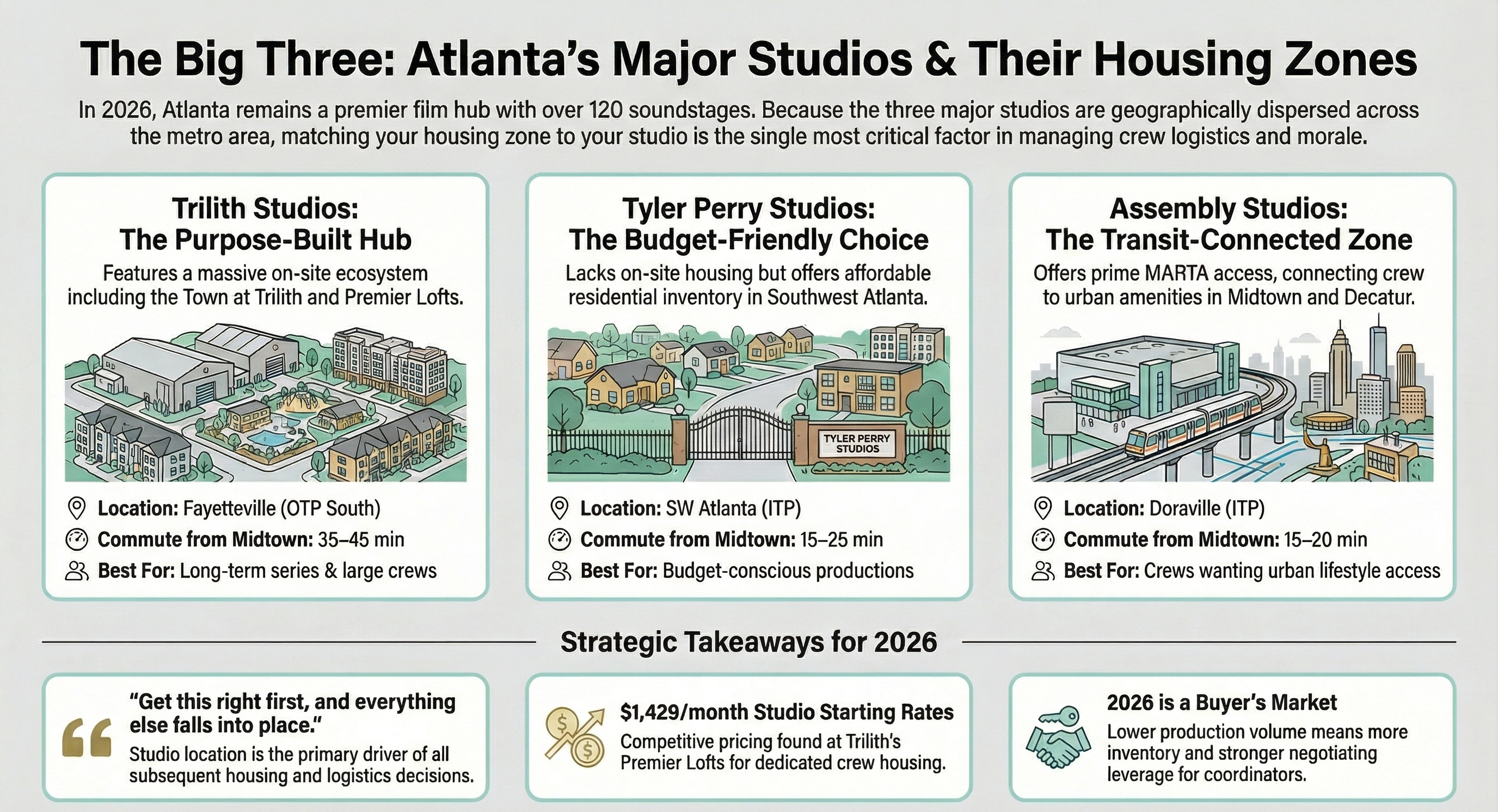
The single most important factor in your crew housing search is which studio you’re shooting at. A neighborhood that’s a 10-minute commute from Assembly Studios is a 50-minute slog from Trilith. Get this right first, and everything else falls into place.
Trilith Studios — Fayetteville (South of Atlanta)
Trilith is the largest production facility in Georgia and one of the largest outside Hollywood. Located in Fayetteville, roughly 25-30 miles south of downtown Atlanta, it anchors the southern end of the metro’s production geography.
What sets Trilith apart for coordinators is its purpose-built housing ecosystem — the most developed of any Atlanta studio:
-
Town at Trilith: A 235-acre master-planned community with 1,400 homes planned for 5,000 residents, built directly adjacent to the studio lot.
-
Premier Lofts: Fully furnished apartments designed for production crew. Studios run $1,429-$1,489/month; three-bedrooms are $2,335/month.
-
Trilith Guesthouse: A $75 million, 192-room hotel with extended-stay options, purpose-built for production guests.
-
Trilith PLUS: A white-glove crew sourcing and housing coordination program that handles the logistics for you.
The surrounding area — Fayetteville, Peachtree City, Senoia — is suburban and car-dependent. Crew who want Atlanta nightlife and dining face a 35-45 minute commute on a good day. That’s the honest trade-off: Trilith has the best on-site housing options of any studio, but it’s isolated from urban amenities.
Best for: Productions shooting primarily at Trilith. Long-term TV series (6+ months) where crew will settle in. Crews who prioritize short commutes over urban lifestyle.
Tyler Perry Studios — Southwest Atlanta
Tyler Perry Studios occupies a 330-acre lot on the former Fort McPherson in southwest Atlanta — the first Black-owned major film production studio in the country. It sits roughly 10 miles from downtown, inside the perimeter.
Unlike Trilith, Tyler Perry Studios has no dedicated on-site crew housing as of 2026. A 130+ acre entertainment district is in development (a partnership with T.D. Jakes) that will include a workforce housing component, and an $800 million studio expansion was announced but later halted due to AI-related concerns. For now, coordinators must source housing entirely from the surrounding metro.
The nearby neighborhoods — West End, Adair Park, East Point, College Park — are more affordable than Midtown or Buckhead but have fewer corporate housing providers. You’ll find lower base rents here, which can be a real win for productions watching per-diem costs, but expect to work harder to find quality furnished inventory. MARTA bus service reaches the area, though the studio itself isn’t walkable from transit.
Best for: Budget-conscious productions. Crews comfortable in residential neighborhoods. Productions where housing cost savings matter more than urban amenities.
Assembly Studios — Doraville (Inside Perimeter)
Assembly Studios is the newest major player, located in Doraville just inside the I-285 perimeter. It boasts 19 soundstages with 53-foot ceiling clearance (the tallest in Georgia) and four filmable building facades replicating NYC brownstones, Tribeca streetscapes, European architecture, and New Orleans row houses.
Assembly’s Phase II mixed-use development will eventually add 800 apartments, 120 condos/townhomes, and 350 hotel rooms adjacent to the studio — but much of this is still under development. The on-site commissary (Studio A Cafe) is already operational. Until the residential phase is fully online, coordinators source housing from the surrounding Doraville, Chamblee, Brookhaven, and Tucker corridor.
Assembly’s biggest advantage for coordinators is its ITP location with MARTA access. The Doraville station on the Gold line puts the studio within transit reach of Midtown, Decatur, and most of the neighborhoods crew members actually want to live in.
Best for: Productions wanting crew near ITP neighborhoods. Crews who value urban amenities plus studio proximity. Shows with crew members who don’t have vehicles.
Studio Comparison at a Glance
| Studio | Location | Commute from Midtown | On-Site Housing | Surrounding Options | Best For |
|---|---|---|---|---|---|
| Trilith | Fayetteville (OTP south) | 35-45 min | Premier Lofts, Guesthouse, PLUS program | Fayetteville, Peachtree City, Senoia | Long-term shoots, large crews |
| Tyler Perry | SW Atlanta | 15-25 min | Limited (development planned) | West End, East Point, College Park | Budget-conscious productions |
| Assembly | Doraville (ITP) | 15-20 min | Phase II planned (not yet built) | Brookhaven, Chamblee, Tucker | Crews wanting urban lifestyle + access |
Best Neighborhoods for Crew Housing
Neighborhood selection depends entirely on which studio your production uses. Below are the top options organized by geography, with commute times, cost ranges, and “best for” tags for each.
Midtown / West Midtown
The hub of Atlanta’s furnished apartment inventory. Central enough to reach all three studios (15-20 min to Assembly, 20-30 min to Tyler Perry, 35-45 min to Trilith), Midtown offers the best balance of access, amenities, and availability. Walkable dining, nightlife, and Beltline access make it the top choice for crew morale on long shoots.
Monthly range: $1,800-$3,000 furnished | Transit: MARTA + walkable
Providers active here: Atlanta Production Properties, TP Corporate Lodging, National Corporate Housing
Best for: Multi-studio productions, above-the-line talent, crews who prioritize lifestyle
Cabbagetown / Old Fourth Ward / East Atlanta
Beltline-adjacent neighborhoods with artistic character and strong appeal to younger crew demographics. Daydream Host ATL specializes in Cabbagetown production housing with amenity-focused units that cost significantly less than Midtown. Independent restaurants, coffee shops, and walkable streets contribute to high crew satisfaction scores.
Monthly range: $1,500-$2,500 furnished | Transit: Beltline, some MARTA
Commute: 15-20 min to Assembly, 20-25 min to Tyler Perry, 40-50 min to Trilith
Best for: Assembly Studios crews, mid-budget productions, crews who value neighborhood character
Brookhaven / Chamblee / Doraville
The closest neighborhoods to Assembly Studios, with 5-15 minute commutes and growing furnished rental inventory drawn by the studio’s development. All three neighborhoods sit on the MARTA Gold line (Brookhaven, Chamblee, and Doraville stations), making them accessible for crew without vehicles. The Buford Highway corridor offers excellent international dining options.
Monthly range: $1,400-$2,200 furnished | Transit: MARTA Gold line
Best for: Assembly Studios primary shoots, crews with families, budget-friendly ITP option
Fayetteville / Peachtree City / Senoia
Trilith Studios’ backyard. The Premier Lofts anchor pricing for the area ($1,429-$2,335/mo), with additional furnished rental options scattered across these suburban communities. The small-town feel is quiet — a car is required, nightlife is limited — but the zero-commute advantage for Trilith shoots is hard to beat. Third-party furnished rental inventory is limited compared to ITP neighborhoods.
Monthly range: $1,400-$2,335 furnished | Transit: Car only
Best for: Trilith-primary productions, long-term TV series (6+ months), crews who prefer quiet
West End / Adair Park / East Point
The closest affordable neighborhoods to Tyler Perry Studios, with 10-15 minute commutes and the lowest housing costs of any zone on this list. The trade-off: fewer furnished rental providers operate here, so you may need to source through Airbnb, VRBO, or individual property managers. MARTA’s West End station provides transit access.
Monthly range: $1,200-$1,800 furnished | Transit: MARTA West End
Best for: Tyler Perry Studios shoots, budget-priority productions, local crew supplementing per diems
Neighborhood Comparison Matrix
| Neighborhood | Nearest Studio | Drive Time | Monthly Range | Transit | Crew Vibe |
|---|---|---|---|---|---|
| Midtown / West Midtown | Assembly (15-20 min) | 15-45 min to all | $1,800-$3,000 | MARTA + walkable | Urban, nightlife |
| Cabbagetown / O4W / East ATL | Assembly (15-20 min) | 15-50 min | $1,500-$2,500 | Beltline, some MARTA | Artsy, walkable |
| Brookhaven / Chamblee | Assembly (5-15 min) | 5-15 min | $1,400-$2,200 | MARTA Gold line | Suburban, family |
| Fayetteville / PTC / Senoia | Trilith (5-15 min) | 5-15 min | $1,400-$2,335 | Car only | Quiet, small-town |
| West End / East Point | Tyler Perry (10-15 min) | 10-15 min | $1,200-$1,800 | MARTA West End | Residential, affordable |
Housing Types Compared: Cost vs. Logistics
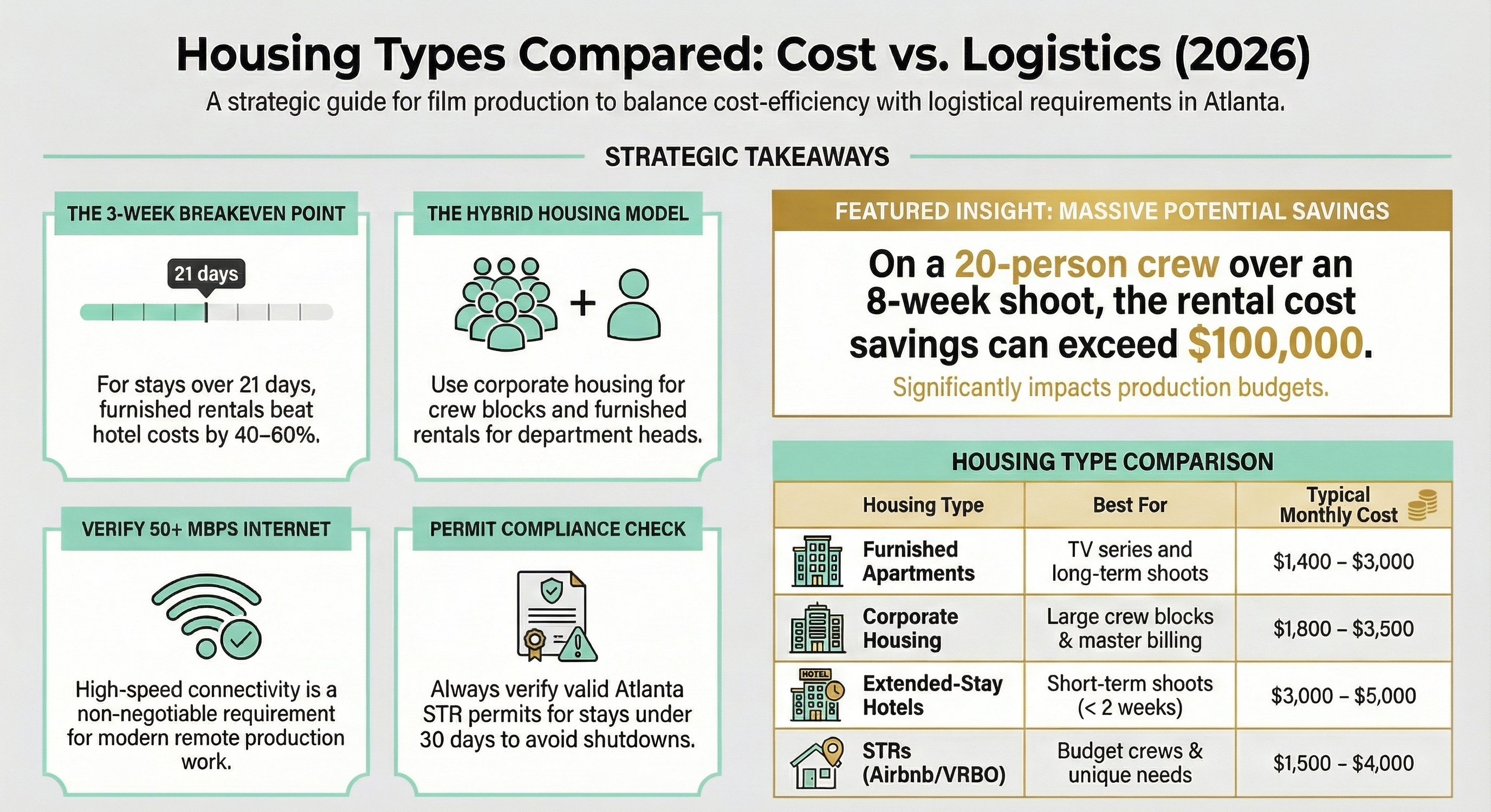
Four housing types are commonly used for Atlanta film crew accommodation. The right choice depends on your shoot length, crew size, and budget tier.
The breakeven question: At what point does a furnished rental beat a hotel? Hotels run $150-$250/night, which translates to $4,500-$7,500 per month. Furnished rentals in Atlanta range from $1,400-$3,000/month. For any stay over 2-3 weeks, furnished rentals win by 40-60%. That’s not a marginal difference — on a 20-person crew over an 8-week shoot, the housing cost delta can exceed $100,000.
Hidden costs to factor into your comparison: utilities (included in hotels, sometimes extra in rentals), internet speed (critical for remote production work — verify 50+ Mbps), parking, and damage deposits.
| Type | Monthly Cost | Min Stay | Flexibility | Best For | Drawback |
|---|---|---|---|---|---|
| Furnished Apartments | $1,400-$3,000 | 30 days typical | 30-day notice | TV series, long shoots | Setup time, deposits |
| Extended-Stay Hotels | $3,000-$5,000 | Nightly | High | Short shoots (< 2 wks) | 2-3x cost of rentals |
| Corporate Housing | $1,800-$3,500 | 30 days | Moderate | Groups, master billing | Less neighborhood choice |
| STRs (Airbnb/VRBO) | $1,500-$4,000 | Varies | Varies | Budget crews, unique needs | Inconsistent quality, no invoice |
The practical approach: Many coordinators use corporate housing for the crew block (centralized billing, consistent quality) and individual furnished rentals for department heads who want their own space and neighborhood choice. For shoots under two weeks, extended-stay hotels are often simpler despite the higher cost.
The Crew Housing Budget: 2026 Pricing Guide
Housing typically represents 8-10% of total crew-related production costs. Here’s what to budget per person in Atlanta in 2026.
Per-Person Monthly Costs by Tier
| Tier | Description | Monthly Range | Where |
|---|---|---|---|
| Economy | Shared unit, OTP | $700-$1,000/person | SW Atlanta, Tucker, Fayetteville non-premium |
| Standard | Private room, ITP | $1,200-$1,800/person | Chamblee, Doraville, College Park, East Point |
| Premium | Private unit, urban | $2,000-$3,500/person | Midtown, Buckhead, Virginia Highland, Trilith Premier |
| Talent/ATL | Above-the-line | $3,500-$6,000+/person | Buckhead estates, Midtown luxury, concierge service |
Seasonal Pricing Patterns
Peak production season (Q2-Q3) carries a 10-20% demand premium. Q4-Q1 offers the most availability and best negotiating position. In 2026, with production volume sitting at roughly 60% of the 2022 peak, inventory is more available across all seasons than it was during the boom years. This is your negotiating advantage — use it.
Budget Levers
-
Georgia’s 30% tax credit applies to qualified crew expenses including housing for out-of-state crew. Factor this into your net budget calculations — every dollar of eligible housing spend returns roughly $0.30 in tax credit value.
-
Volume discounts: Booking 5+ units with a single provider typically unlocks 8-15% off published rates. For 10+ units, push for 15-20%.
-
Contingency: Budget 5-10% above estimated housing costs for mid-production crew additions, damage deposits, and early termination fees.
Your Booking Workflow
The 8-12 Week Procurement Timeline
Weeks 12-10: Define requirements. Nail down crew count, studio location, production duration, budget tier per person, and any special needs (pets, families, accessibility, ADA compliance).
Weeks 10-8: Contact 3-5 providers for quotes. Request bulk pricing if you’re booking 10+ units. Get full unit lists with photos, lease terms, cancellation policies, and utility inclusion details in writing.
Weeks 8-6: Site visits or virtual tours of your top 2-3 options. Verify commute times to your studio personally — Google Maps during off-peak hours doesn’t tell the whole story during a Monday 5:30 AM crew call.
Weeks 6-4: Sign agreements. Confirm move-in logistics, furniture, utilities, internet speed, and parking. Get everything in writing — verbal commitments from property managers are not binding.
Weeks 4-2: Share housing details with crew. Include addresses, check-in procedures, parking instructions, nearest grocery stores, and your point-of-contact for issues.
Week 1: Move-in coordination. Be on-site or available by phone for the first 48 hours to troubleshoot issues before they escalate.
Atlanta Production Housing Providers
| Provider | Specialty | Best For |
|---|---|---|
| TP Corporate Lodging | National film crew housing specialist; corporate billing | Large crews needing centralized coordination |
| Studio Housing Atlanta | Month-to-month furnished; Trilith area specialty | Trilith productions |
| Atlanta Production Properties | Midtown, Downtown, Cabbagetown, O4W coverage | ITP neighborhood variety |
| Daydream Host ATL | Beltline/Cabbagetown; amenity-focused | Assembly crews wanting character neighborhoods |
| National Corporate Housing | National provider; corporate policy compliance | Studio-backed productions needing procurement compliance |
| BCA Furnished Apartments | Budget-friendly furnished options | General crew at accessible price points |
| ProductionHUB Directory | Searchable directory of 50+ providers | Discovering additional options |
10 Questions to Ask Before Signing
-
What’s the monthly rate for 3+ month commitments? (Always ask — typically 10-20% lower than published rates.)
-
Are utilities, internet, and parking included or billed separately?
-
What internet speed is available? (Remote production work needs 50+ Mbps minimum.)
-
What’s the cancellation/early termination policy?
-
Can you provide a single master invoice for multiple units?
-
What’s the move-in turnaround time? (48 hours or less is standard for production housing.)
-
Is the property pet-friendly? (Crew members on long shoots often travel with pets.)
-
What happens if we need to add or remove units mid-production?
-
Is there a dedicated point of contact for maintenance issues?
-
Can you provide references from other production companies?
Permits, Insurance & Seasonal Strategy
Compliance Essentials
Atlanta STR permits: The City of Atlanta requires short-term rental permits for stays under 30 days. If you’re booking through Airbnb or VRBO, verify the host holds a valid permit. Non-compliant properties risk mid-production shutdown — a problem you cannot afford. Corporate housing providers and traditional furnished apartment operators operate under standard residential leasing law and are generally not subject to STR regulations.
Production liability insurance: Most furnished rental providers require a certificate of insurance (COI) from the production company. Your production’s general liability policy typically covers crew housing, but confirm with your insurer that housing is explicitly included — not just on-lot locations. Have the COI ready before you start signing leases.
HOA restrictions: Some condo buildings restrict short-term rentals or production-related tenants. Ask providers directly before booking: “Does the HOA allow month-to-month production tenants?” Discovering a restriction after move-in is expensive and disruptive.
Tax credit qualification: Crew housing expenses for out-of-state crew performing services in Georgia generally qualify under Georgia’s film tax credit. Consult your production accountant for specific eligibility rules and documentation requirements.
Seasonal Booking Strategy
| Quarter | Demand | Strategy |
|---|---|---|
| Q1 (Jan-Mar) | Lowest | Best rates and most availability. Ideal window to lock long-term TV series housing. |
| Q2 (Apr-Jun) | Rising | Production season ramps; demand increases 15-25%. Book 10-12 weeks out. |
| Q3 (Jul-Sep) | Peak | Highest demand; 10-20% premium pricing. Book 12+ weeks out minimum. |
| Q4 (Oct-Dec) | Declining | Holiday slowdown. Good negotiating window for Q1 production starts. |
General rule: Every week earlier you book translates to roughly 5-10% better rates and wider selection. In the current 2026 market, with production volume at 60% of peak, you have more leverage than coordinators have had in years. Don’t default to hotel bookings out of habit — the alternatives are better, cheaper, and more available than ever.
FAQ: 10 Questions Production Coordinators Actually Ask
1. How much should I budget per crew member for Atlanta housing?
Economy (shared): $700-$1,000/mo. Standard (private room): $1,200-$1,800/mo. Premium (private unit): $2,000-$3,500/mo. Talent: $3,500-$6,000+/mo. These are per-person, all-in furnished rates as of early 2026.
2. When should I start booking crew housing?
8-12 weeks before move-in for best rates and selection. During peak season (Q2-Q3), start at 12+ weeks. The earlier you book, the better your rate and the wider your options.
3. Can we use Airbnb/VRBO instead of corporate housing?
Yes, but verify the property has a valid Atlanta STR permit, confirm the host can provide invoicing for your production accounting, and expect less consistency than corporate providers. For crew blocks of 10+, corporate housing is typically simpler and more reliable.
4. What’s included in a “furnished” rental?
Standard inclusions: furniture, kitchen equipment, linens, and basic utilities. Always ask specifically about internet speed, parking, laundry, and cable. “All-inclusive” varies by provider — get the full list in writing before signing.
5. How do I handle crew members with pets?
Several Atlanta providers offer pet-friendly units. Ask upfront — pet deposits typically run $250-$500. Trilith’s Town community is pet-friendly. For long shoots, pet-friendly housing is a real crew retention lever.
6. Which studio is hardest to find nearby housing for?
Tyler Perry Studios. Southwest Atlanta has fewer furnished rental providers than Midtown or the Fayetteville corridor. Start your search earlier and cast a wider neighborhood net — College Park, East Point, and Castleberry Hill are your best options.
7. What if production dates shift after we’ve signed housing agreements?
Most production housing providers understand the industry’s inherent schedule uncertainty. Negotiate flexible terms upfront: 30-day notice for month-to-month agreements, early termination clauses with defined penalties, and extension options at the same rate.
8. Is crew housing eligible for Georgia’s film tax credit?
Generally yes. Accommodation for out-of-state crew members performing services in Georgia qualifies as an eligible production expenditure under the 20-30% tax credit. Consult your production accountant for documentation requirements and specific eligibility.
9. Hotels or furnished rentals for a 3-week shoot?
At three weeks, furnished rentals typically break even or beat hotels on cost. Factor in the kitchen (crew saves on meals), the living space (better rest and morale), and the laundry access. For anything under two weeks, extended-stay hotels may be simpler despite the higher nightly rate.
10. How do Atlanta commute times compare to LA?
Atlanta traffic is real but generally more manageable than Los Angeles. Budget 30-45 minutes for OTP-to-ITP commutes during peak hours. Productions shooting at Assembly (ITP) benefit from the shortest average commutes from most neighborhoods. Trilith crews should expect 35-45 minutes from Midtown on peak-hour mornings.
Your 2026 Atlanta Housing Strategy
The framework is straightforward: which studio determines your housing zone; your zone determines your neighborhood; your neighborhood determines your provider type.
2026 is the most coordinator-favorable housing market Atlanta has seen since the pre-boom years. Production volume is down, inventory is up, and providers are competing for your business. Don’t default to hotel bookings out of inertia — the furnished rental and corporate housing alternatives are cheaper, more spacious, and more available than at any point in the last five years.
As production volume recovers toward the “new normal” Trilith’s CEO projects for 2027, the coordinators who build vendor relationships now will have the strongest negotiating position when the market tightens again. Start early, book smart, and use this guide as your reference for every Atlanta production.
How Minty Living Can Help
If you’re coordinating crew housing for an Atlanta production and want a single point of contact instead of juggling multiple vendors, Minty Living manages 160+ professionally designed properties across Atlanta’s most sought-after intown neighborhoods — including Midtown, Cabbagetown, Old Fourth Ward, Inman Park, and Virginia-Highland.
What production coordinators get with Minty Living:
-
Production-friendly lease terms — Standardized month-to-month agreements designed for film schedules, with flexibility for wrap-date shifts and crew changes
-
160+ production-ready units — Fully furnished properties with reliable internet, in-unit laundry, and the amenities crews actually need on long shoots
-
Preferred vendor status with major Atlanta studios — established relationships and streamlined procurement for coordinators working with studio requirements
-
24-hour placement capability — When a last-minute crew addition shows up and you need a unit by tomorrow, Minty Living can move fast
-
Single master invoicing — One vendor, one invoice, one point of contact for your entire crew block
-
Design-forward quality — Every property is designed by Minty Living’s in-house team, led by architect and textile designer Sidra Gross. Properties meet Plum Guide “Top 1%” selection criteria, which means your crew gets a real living space, not a generic corporate box
Whether you need 5 units in Midtown for department heads or 30 units across multiple neighborhoods for a full crew, Minty Living’s team understands production timelines and the pressure coordinators are under.
Contact Minty Living’s production housing team:
-
Phone: (404) 999-0841
-
Email: [email protected]
-
Production housing page: mintyliving.com/film&production
 (4).png)

 (29).png)
 (28).png)
 (33).png)
 (38).png)
 (39).png)
 (40).png)
 (44).png)
 (44).png)
 (1).png)
 (3).png)
 (55).png)
 (54).png)
 (56).png)
 (57).png)
 (58).png)
 (59).png)
 (60).png)
 (61).png)
 (63).png)
 (66).png)
 (45).png)
 (67).png)
 (68).png)
 (69).png)
 (70).png)
 (71).png)
 (72).png)
 (73).png)
 (86).png)
 (87).png)
 (89).png)
 (92).png)