


 (29).png)
A hotel room is a bedroom. Your team needs a broadcast workspace.
More than 12,300 journalists received credentials at Qatar 2022 [Source: FIFA Media Operations]. Atlanta hosts 8 World Cup 2026 matches across six weeks, from June 15 through July 15 [Source: Atlanta FWC26 Match Schedule] — three knockout rounds, a semifinal, and weeks of deployment pressure that no hotel was built to absorb. During Super Bowl LIII, Atlanta hotel prices tripled overnight [Source: 11alive.com]. This guide maps where media crews should stay, what connectivity to require in writing, and why Atlanta’s furnished rental market is the infrastructure your workflow needs.
Atlanta’s role in FIFA World Cup 2026 is not a weekend assignment. The city hosts 8 matches between June 15 and July 15, including three knockout rounds and a semifinal [Source: Atlanta FWC26 Match Schedule]. Your deployment will span weeks, not days.
The city’s furnished rental market is ready for that timeline. Atlanta has been absorbing film and television production crews for years — earned its “Hollywood of the South” designation by building the kind of housing infrastructure that broadcast crew housing in Atlanta now benefits from directly. Dedicated workspace, staging areas, and upload-grade internet are not special requests here. They are standard inventory.
Whether you are booking for a 6-person broadcast team, filing solo on deadline, or producing independent content for a global audience looking for World Cup 2026 media housing, the same rule applies: start with the workspace, not the bedroom.
Start with why media crews consistently move away from hotels when deployments exceed four days — then we will map the neighborhoods, the checklist, and the booking timeline.
Why Media Crews Choose Furnished Housing Over Hotels
The Cost Collapse
During Super Bowl LIII, Atlanta’s baseline hotel rate sat at roughly $90 per night. By game week, average rates hit $270 per night. Peak properties reached $523 per night. Outliers climbed to $4,800 per night [Source: 11alive.com].
Run the math on a 5-person crew. At $270 per night across a 21-day deployment, hotel costs alone reach $28,350 — before room service, parking, or the surge pricing that locks in the moment a major tournament begins.
A furnished 3-bedroom in Midtown Atlanta for the same period runs at a flat weekly or monthly rate. No surge. No night-by-night exposure to event-driven price spikes.
Cost alone does not close the argument. The workspace problem does.
| Factor | Hotel (Super Bowl LIII Data) | Furnished Rental |
|---|---|---|
| Cost/Night | $270–$4,800 (surge) | Flat weekly/monthly rate |
| Upload Speed | 5–15 Mbps shared | 100+ Mbps dedicated fiber |
| Workspace | Desk in bedroom | Dedicated office + staging area |
| Lease Flexibility | Nightly minimum | Weekly/monthly, extendable |
| Kitchen | Room service ($30+) | Full kitchen, self-catered |
| Equipment Storage | Floor of hotel room | Dedicated staging area |
The Workspace Reality
The Dallas World Cup Broadcast Hub will deploy up to 45 cameras for a single venue [Source: NBC DFW]. Field crews do not travel light. Cases, tripods, monitors, cables, and drives travel with every team — and they need somewhere to live that is not the floor of a hotel room.
A hotel gives you three options: the desk, the bed, or the lobby. None of them work at scale.
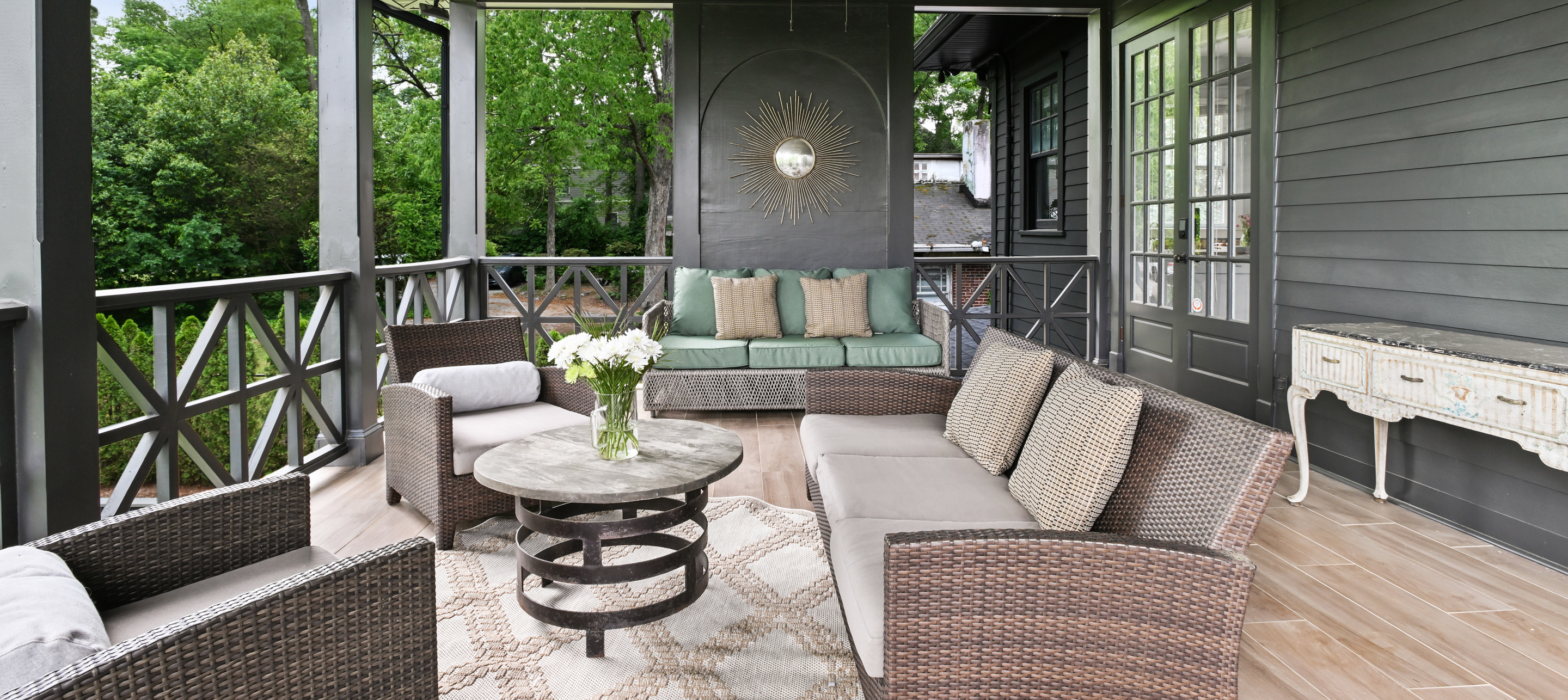
Furnished housing gives you a dining table wide enough to spread gear for a pre-shoot inventory, a dedicated desk for editing during a match, and a living area that functions as an equipment staging zone between venue runs.
Atlanta’s production housing market has been solving this exact problem for film crews for years. Some properties are configured with dedicated equipment staging areas and layouts that accommodate production gear by design. That infrastructure did not appear for the World Cup — it was built for the industry that has occupied these rentals since Atlanta became a major production hub.
The third factor is the one that will actually break your workflow if you get it wrong: upload speed.
The Connectivity Case
1080p live streaming requires a minimum of 6–12 Mbps dedicated upload [Source: Sports Video Group]. Higher-resolution workflows escalate fast — budget 35 Mbps or more for broadcast-quality encoding with headroom [Source: EventLive].
Hotel networks share bandwidth across hundreds of rooms. On a match night, you are competing with tourists streaming video, fans on video calls, and every other crew member in the building trying to file at the same time.
Furnished rentals with dedicated fiber connections give you a number you can write into your deployment plan — not “fast WiFi” as a marketing claim, but an actual Mbps figure from a Speedtest screenshot, provided before you sign.
That number is the difference between filing on deadline and calling your editor to explain why the upload is still at 34 percent.
Now that the format is settled, the question becomes location. Not all Atlanta neighborhoods serve media crews equally — and the popular choice is not always the right one.
Best Atlanta Neighborhoods for Media Crews: MARTA Access, Upload Speed, and the Midtown Case
Midtown — The Counterintuitive Choice That Wins
The MARTA Red and Gold Lines run from Midtown Station to SEC District Station — the stop for Mercedes-Benz Stadium — in 22 minutes. The fare is $2.50, flat [Source: MARTA / Scarves and Spikes]. No traffic variable. No parking cost. No rideshare surge when 70,000 people exit the stadium at the same moment.
Here is the counterintuitive argument: Downtown proximity costs an additional $100–200 per night and traps your crew inside event chaos. Midtown delivers quiet streets for deadline writing, deeper furnished rental inventory, faster internet infrastructure in its mixed residential and commercial corridor, and the identical $2.50 MARTA ride.
The Peachtree Street corridor and West Midtown near Howell Mill Road hold the best production-adjacent housing stock. Solo journalists who need concentration and content creators who need a camera-ready backdrop both land here for the same reasons.
Downtown / South Downtown — Proximity With a Price
The closest Downtown properties sit 2–5 minutes from Mercedes-Benz Stadium via MARTA or on foot [Source: MARTA]. On a match day with a 7 a.m. call time, that proximity matters.
The trade-off is real. Event-week pricing spikes hit Downtown hardest — the Super Bowl data proves it [Source: 11alive.com]. Street-level noise during match nights works against deadline filing and anything that requires clean audio.
Downtown is the right call for broadcast crews whose production truck is on-site and who need zero travel time between venue and home base. Inventory is thinner than other neighborhoods. If Downtown is non-negotiable for your operation, book first.
Decatur — The Under-the-Radar Crew Option
Decatur sits 13 minutes from SEC District Station via MARTA [Source: MARTA / Scarves and Spikes]. That is not a long commute. That is a commute short enough to run back to base between sessions.
The walkable town center offers restaurants and coffee shops that double as secondary workspace when the primary desk gets crowded. Residential streets stay quiet during match nights.
Furnished rental availability runs higher in Decatur than Downtown, and event-week surge pricing hits softer because Decatur sits outside the primary hotel market radius. For multi-week deployments where crew comfort and work-life separation matter more than being steps from the press zone, Decatur wins the value calculation.
The downside is real: slightly longer transit and less proximity for spontaneous story-gathering near the press entrance.
Virginia-Highland / Inman Park — Best for Independent Creators
Virginia-Highland and Inman Park are Atlanta’s most visually distinctive residential neighborhoods. Bungalows, murals, walkable restaurant strips, front porch culture — the camera-ready backdrop that content creators need and cannot manufacture in a hotel room.
MARTA access runs through King Memorial or Inman Park/Reynoldstown stations, placing the stadium 15–20 minutes away depending on connection [Source: MARTA]. Furnished housing in this corridor skews toward one- and two-person occupancy — well matched to solo journalists and two-person creator pairs.
Price point sits at mid-range. Early booking secures the best inventory before event-week demand converts these residential blocks into a competitive booking market.
Knowing the neighborhood is step one. Before you sign anything, you need a checklist of what a property must have — because not all furnished rentals are built equally for broadcast work.
Media Crew Housing Essentials — The Non-Negotiables Before You Sign
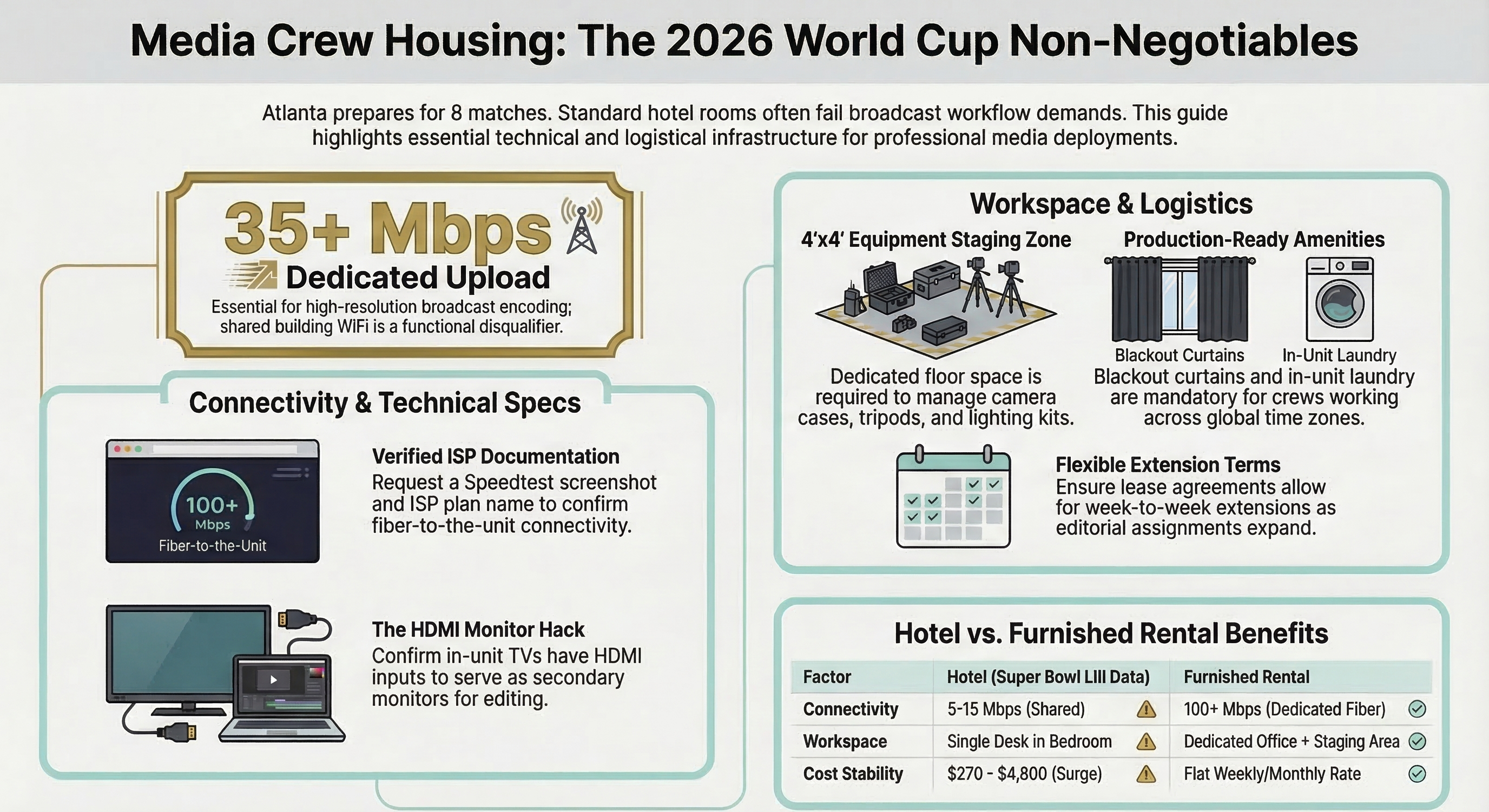
Connectivity — Get the Number in Writing
The single most important question you ask any Atlanta host is this: what is the upload speed, and can you test it before you commit?
Not “do you have WiFi.” Not “is it fast.” The Mbps number, in writing, from a screenshot taken at the time of day you will actually be working.
The threshold is not negotiable. Smooth 1080p live filing requires a dedicated upload of 6–12 Mbps. Higher-resolution workflows need 35 Mbps or more [Source: Sports Video Group, EventLive]. Those numbers assume you are the only device on that connection — not you plus the unit below you plus the building lobby.
Ask the host for their ISP plan name and tier. Dedicated fiber to the unit is the target. Shared building internet — one router split across six units — is a disqualifier regardless of what the spec sheet says.
Request a Speedtest screenshot taken during your working hours. If a host cannot provide one, that tells you everything you need to know before you wire a deposit.
Connectivity secured. Next: workspace and crew logistics.
Workspace and Crew Logistics
A dual-monitor setup requires a real desk or table — not the kitchen counter, not a folding surface against the wall. Confirm the unit has workspace before you book.
Check whether the in-unit TV has HDMI input. That is a second monitor without packing an extra display. For review, logging, or reference feeds, it matters.
Equipment staging requires floor space. A minimum 4x4 feet of clear area handles camera cases, tripods, and a basic lighting kit. If the unit’s layout cannot accommodate that, you will be moving gear in and out every day — which compounds when you are covering a six-week event window.
Blackout curtains are mandatory for any crew filing on European or South American time zones. Atlanta in June means sunrise before 6:30 a.m. If you need to sleep until noon to make a midnight deadline, thin blinds are not a solution.
For deployments longer than a week, you need an in-unit washer/dryer. You are not hauling laundry bags to a hotel basement between match coverage.
A full kitchen earns its value at 11 p.m. on a deadline day. A $30 room service burger from a hotel that stopped serving hot food at 10 p.m. is not a plan.
Confirm parking or reliable vehicle access. If you are transporting equipment by car, a property with no dedicated parking slot becomes a daily logistics problem.
Lease Terms and Flexibility
FIFA credential timelines follow the accreditation window, not your personal travel plan [Source: FIFA Media Accreditation FAQ]. Your departure date is a moving target until it is not.
Atlanta’s group stage runs June 15 through June 27. Knockout rounds extend through July 15, including a semifinal [Source: Atlanta FWC26 Match Schedule]. A crew booked for group stage coverage may need to extend if an editorial assignment expands — or if a team they are following keeps advancing.
Rigid 30-day leases penalize that flexibility. Week-to-week extensions cost more per night, but they are worth the premium over a fixed commitment you cannot modify.
Every property manager deserves one direct question: “Can I extend by seven days during the booking period without penalty?” If the answer is no — or vague, or dependent on availability checks that will only happen when it is too late — keep looking.
You know what you need in a property. The next question is when — because Atlanta furnished rentals for World Cup are not going to be available six weeks out.
Booking Timeline — When Media Crews Need to Secure Atlanta Housing
The Credential Timeline Trap
Most media crews wait for credential confirmation before booking housing. That is the wrong sequence.
Furnished rental inventory in Midtown and Decatur is finite. Hotels can activate room blocks and add overflow inventory. Furnished apartments cannot scale the same way — the units that exist are the units that exist.
During Super Bowl LIII, furnished rentals in desirable Atlanta locations disappeared faster than hotel rooms [Source: 11alive.com]. The reason is simple: there are far fewer of them, and the professionals who know how to use them come for them first.
Book housing contingent on credential confirmation, not after it. Secure a refundable hold now. Confirm the booking once credentials come through.
The Booking Windows
Atlanta’s match schedule anchors everything [Source: Atlanta FWC26 Match Schedule]:
-
Group stage: June 15, 18, 21, 24, 27
-
Round of 32: July 1
-
Round of 16: July 7
-
Semifinal: July 15
That is six weeks of potential deployment if you are covering the full Atlanta slate.
Networks and broadcast organizations: Book now. At 18 months or more out, you have full access to the inventory. You can be selective about neighborhood, layout, and internet infrastructure.
Independent credentialed press: Twelve months out is the minimum for quality inventory in Midtown or Decatur. Wait past that, and you are competing for what is left.
Solo creators and freelancers: Nine months out is the final safe window before event-demand pricing activates. Once FIFA announces credential confirmations publicly, remaining inventory moves into surge pricing within days.
What to Book Before You Have Credentials
Many furnished rental platforms and property managers offer holds or refundable deposits. Use them.
Look for three things: free cancellation windows of 60–90 days, partial refund policies that protect you if the credential falls through, and property managers who have worked with event-based bookings before.
Frame your inquiry directly: “I am a credentialed journalist covering World Cup 2026 in Atlanta. I need a hold pending credential confirmation.” Professional operators recognize that pattern. They have handled it for film productions for years — and Atlanta has been a film production city long enough that the good operators are calibrated for it.
How to Find Furnished Rentals Built for Broadcast Work in Atlanta
Platform Tiers
Not all platforms serve broadcast-grade housing equally.
Corporate housing platforms — providers like TP Corporate Lodging and BCA Furnished Apartments — are built for professional deployments. They understand monthly minimums, equipment accommodation, and professional tenant vetting.
Consumer platforms — Airbnb and VRBO have inventory, but the burden of vetting falls entirely on you. The listings that meet broadcast-grade standards exist on these platforms. You will need to ask harder questions to surface them.
Atlanta-specific production operators — the highest-quality source for this assignment. These operators have been housing film crews in Atlanta for years. They already understand what a broadcast deployment requires, because they have fielded the same questions from DPs, gaffers, and line producers on Georgia film projects since the tax incentive turned Atlanta into a production hub.
Three Vetting Questions
Ask these before you book anything:
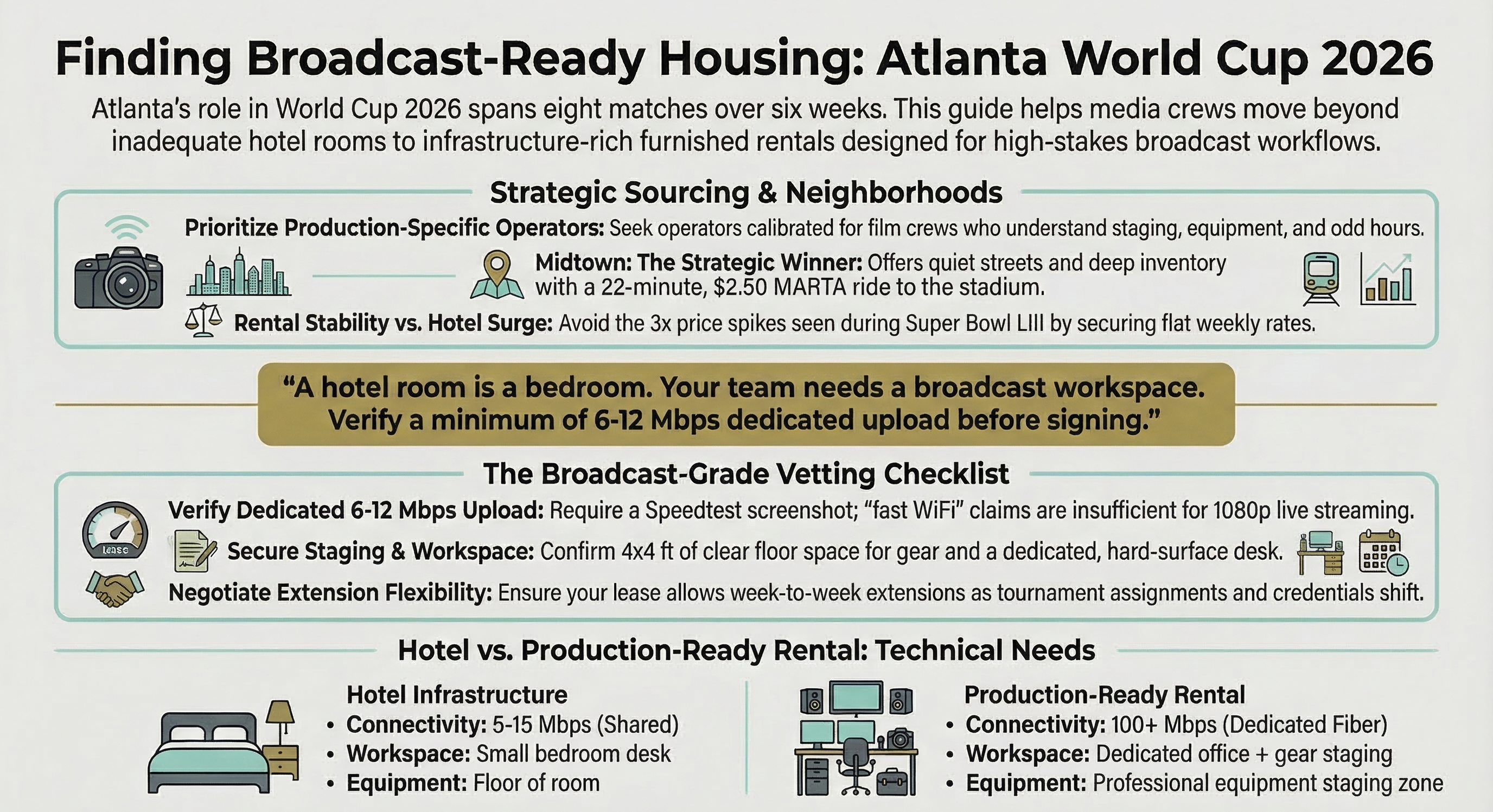
1. “What is the dedicated upload speed for this unit, and can you share a recent Speedtest result?” If a host cannot answer specifically — if you get “we have great WiFi” or “it’s very fast” — move on.
2. “Have you hosted film or production crews before?” Atlanta operators who have are already calibrated for broadcast-grade needs. They have dealt with late-night filing schedules, equipment staging, and lease extensions during production delays.
3. “What is your policy on lease extensions during a booking period?” Credential-based deployments shift. Match schedules extend. Editorial assignments expand. You need a host who has dealt with this before and has a clear answer.
Red Flags
Three red flags that disqualify a property before you visit:
“Fast WiFi” with no specific Mbps number. This is a host who does not know their upload speed — which means they have not been asked by tenants who depend on it.
Shared building internet — one router serving multiple units. Your upload speed at 8 p.m. is whatever is left after every other tenant is online.
No in-unit washer/dryer for deployments longer than seven days. For a six-week World Cup window, this is not a preference. It is a functional disqualifier.
Atlanta Has the Infrastructure. The Inventory Won’t Wait.
Furnished rentals are not the budget fallback for media crews who cannot secure a hotel room block. They are the correct format for broadcast deployment — purpose-built for the connectivity, workspace, and scheduling flexibility that hotel rooms structurally cannot provide.
The Midtown argument holds. The 22-minute MARTA ride is not a compromise. Quieter streets, more furnished inventory, better dedicated upload speeds, less event-weekend congestion — same $2.50 fare.
Atlanta’s match schedule runs June 15 to July 15 [Source: Atlanta FWC26 Match Schedule]. The semifinal is the last call. The good inventory — the units with dedicated fiber, real desk space, and operators who understand production schedules — is not holding for your credential confirmation. It is filling now.
How Minty Living Can Help
The challenges we’ve mapped in this guide — verifying upload speeds before signing, finding staging areas for equipment, securing week-to-week extension flexibility, and working with operators who understand production schedules — are exactly what we work on every day.
Minty Living is a preferred vendor for major Atlanta studios, managing 160+ production-ready properties across the intown neighborhoods this article covers: Midtown, Virginia-Highland, Inman Park, Old Fourth Ward, and Cabbagetown. We’ve been housing film and production crews in Atlanta since the city built its production infrastructure — and broadcast deployments require the same things production crews require.
Production-Calibrated Lease Terms: We understand that credential timelines shift and editorial assignments expand. Our film and production housing includes flexible terms designed for deployment schedules — week-to-week extensions are a standard part of how we operate, not an exception to negotiate around.
Connectivity You Can Verify: Our properties operate on dedicated connections, not shared building internet. We can provide upload speed documentation before you commit — the actual Mbps figure, not a marketing claim about “fast WiFi.”
Equipment Staging by Design: Our properties are designed and furnished by our in-house team, led by architect co-founder Sidra Gross. Layouts are built with production workflows in mind — real desk space, clear staging areas, and configurations that accommodate gear without converting the living room into a storage unit.
Portfolio Across the Key Neighborhoods: Whether your operation calls for Midtown’s 22-minute MARTA run to Mercedes-Benz Stadium, the quieter streets of Inman Park, or the walkable crew-comfort of Virginia-Highland, we have inventory across the neighborhoods discussed in this guide. We’re Plum Guide “Top 1%” certified with a 4.9 Google rating.
If you’re planning a World Cup 2026 deployment and working through housing logistics — crew size, neighborhood fit, upload requirements, timeline flexibility — we’re happy to talk through your specific situation.
Reach out at mintyliving.com or call (404) 999-0841.
Planning the full Atlanta trip around the matches? See our World Cup 2026 Atlanta visitor guide. Sourcing housing for a corporate delegation? The logistics overlap: corporate entertainment housing for World Cup Atlanta.
 (4).png)

 (28).png)
 (33).png)
 (37).png)
 (38).png)
 (39).png)
 (40).png)
 (44).png)
 (44).png)
 (1).png)
 (3).png)
 (55).png)
 (54).png)
 (56).png)
 (57).png)
 (58).png)
 (59).png)
 (60).png)
 (61).png)
 (63).png)
 (66).png)
 (45).png)
 (67).png)
 (68).png)
 (69).png)
 (70).png)
 (71).png)
 (72).png)
 (73).png)
 (86).png)
 (87).png)
 (89).png)
 (92).png)