


 (44).png)
You're standing in your Inman Park kitchen holding a contractor's quote. Four months. Studs-out demo, new cabinets, new layout, the works. Your contractor mentions, almost in passing, that you'll probably want to move out for the duration. And suddenly the $85,000 renovation number is the easy part. Where do you go for four months? How much does that actually cost? Does your insurance cover any of it? And what about the dog, the kids' school, and the 40-foot shipping container of kitchen stuff you have to put somewhere?
This is the question no contractor answers in the bid meeting and no insurance agent volunteers until you ask. Atlanta homeowners spend six months wrestling with it, bounce between six housing options that range from $1,800 to $5,790 a month, and often discover too late that their homeowner's insurance won't help. This guide exists to answer every one of those questions in one place: when to stay, when to move, what it really costs, what ALE does and does not cover, which Atlanta neighborhoods have the inventory you need, and how to plan the logistics so your renovation stays on schedule and your family stays sane.
What This Guide Covers
A decision framework for whether to stay in your home or relocate. A side-by-side comparison of all six housing options with real Atlanta pricing. A clear explanation of Additional Living Expense (ALE) insurance — what it covers, what it doesn't, and the gray zone where renovation discovers a covered loss. Atlanta-specific neighborhood recommendations. A six-week logistics countdown. The professional perspective from contractors and restoration managers. Two real-scenario cost breakdowns. And a move-back checklist so you don't bring construction dust into your freshly renovated home.
Short on time? Jump to Chapter 1: Should You Stay or Go? for the decision framework, or Chapter 3: ALE Insurance and Renovations for the insurance clarification most homeowners miss.
Executive Summary
If you take nothing else from this guide, take these six facts:
-
The stay-vs-move decision comes down to five triggers — air quality, utility disruption, timeline length, vulnerable household members, and scope creep risk. Three or more triggers and you should plan to move out. Most renovations over six weeks hit that threshold.
-
True monthly housing cost in Atlanta ranges from $1,800 to $5,790. On-property RVs anchor the low end, premium Airbnbs anchor the high end, and corporate furnished housing ($2,500–$4,500) is the best value for 30–90 day stays.
-
ALE insurance does not cover planned renovations. It covers temporary housing only when your home is uninhabitable due to a covered loss — fire, storm, burst pipe, vandalism. Voluntary demolition and rebuild is out-of-pocket. Exception: renovation that uncovers hidden covered damage may trigger ALE.
-
Corporate furnished housing is the sweet spot for most renovation stays. Full kitchens eliminate the $400–$800 monthly restaurant premium hotels force on you. Utilities are bundled. Terms flex with your contractor's timeline.
-
Atlanta neighborhoods with strong furnished inventory: West Midtown, Old Fourth Ward, Kirkwood, Grant Park, East Atlanta Village, and Buckhead. Book 4–6 weeks ahead — ITP inventory is tight year-round and tighter during filming seasons.
-
Budget a 25% buffer. Atlanta renovations routinely run 20–30% over their quoted timelines once walls come down. Plan housing accordingly.
Table of Contents
Chapter 1: Should You Stay or Go? The Decision Framework
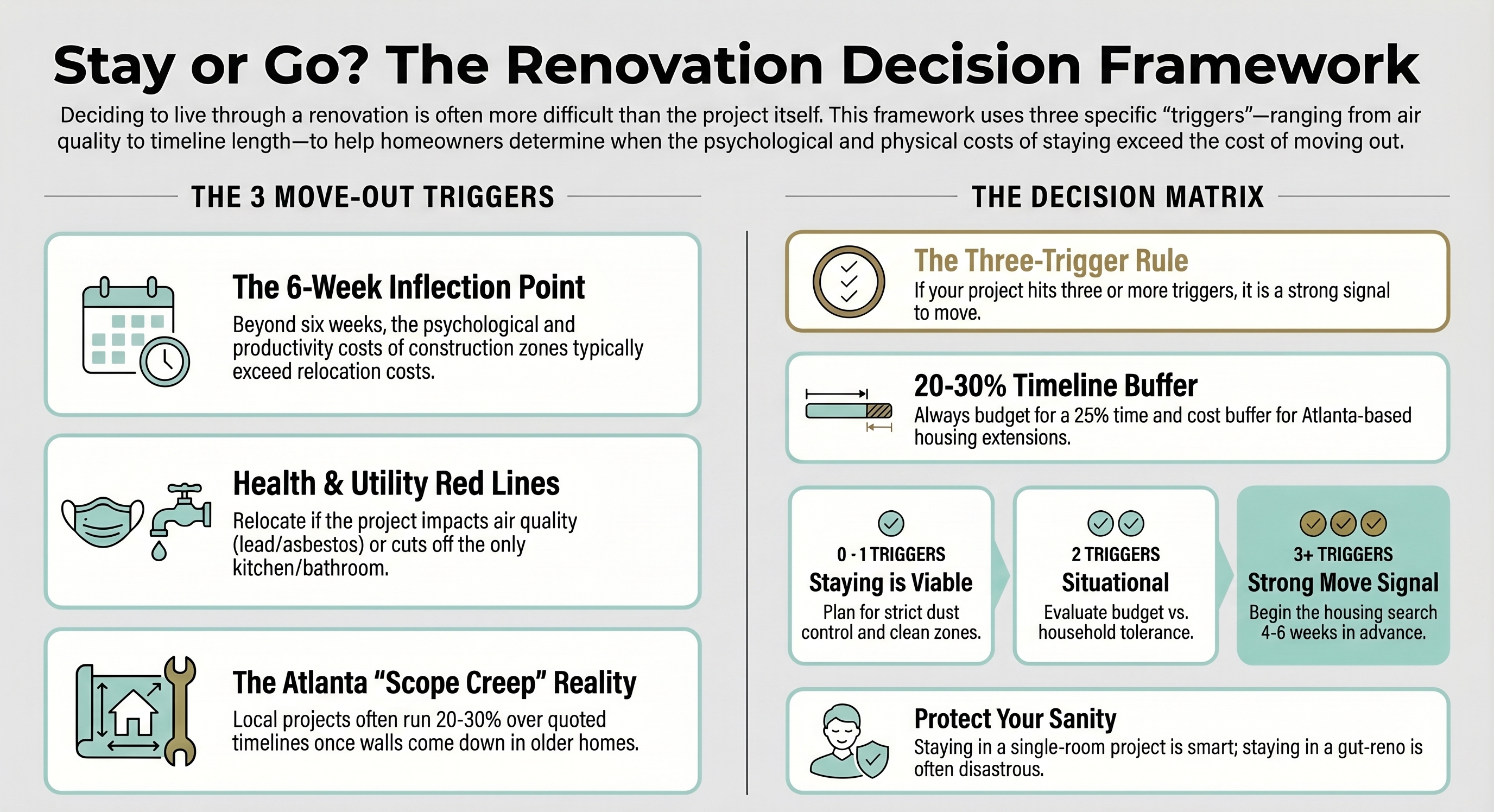
Most Atlanta homeowners start a renovation assuming they'll tough it out. A few weeks of inconvenience sounds manageable until the jackhammers start. The honest answer is that staying is sometimes smart and sometimes disastrous, and you can tell which is which by running your project through five triggers.
The 5 Move-Out Triggers
Trigger 1 — Dust and Air Quality. Drywall demolition produces fine particulates that linger in HVAC systems for weeks. Homes built before 1978 carry lead paint risk under the EPA's Renovation, Repair, and Painting Program, which treats pre-1978 housing as lead-risk by default. Homes built before 1980 may also contain asbestos in old floor tiles, pipe insulation, and popcorn ceilings. Atlanta's intown housing stock skews older than both thresholds. Add fresh paint, adhesives, and new cabinetry off-gassing volatile organic compounds on top, and the air quality inside an active renovation is not something anyone with asthma, allergies, or a compromised immune system should breathe for weeks.
Trigger 2 — Utility Disruption. Kitchen demolition means no cooking for weeks. Single-bathroom homes lose their only shower during tile and plumbing phases. HVAC rework strands you in Atlanta summers without air conditioning. If your renovation touches the kitchen, the only bathroom, or the HVAC system, staying means paying the relocation costs anyway — just to restaurants, gyms, and friends' couches instead of a furnished apartment.
Trigger 3 — Timeline Math. A week is survivable. Six weeks is the inflection point where the psychological cost of living in a construction zone — plus the productivity cost of working from a dusty, noisy environment — exceeds the dollar cost of relocating. Atlanta kitchen remodels commonly run 3–5 months and full gut renovations run 6–14 months across industry cost guides (see Sweeten's Atlanta renovation cost guide and local contractor data from Intown Renovations). Do the math for your project.
Trigger 4 — Vulnerable Household Members. Young children sleep poorly through construction noise and get sick more often from dust exposure. Elderly family members with respiratory conditions are at real risk. Dogs and cats experience renovation sites as constant threat, and most insurance will not cover contractor injuries to pets loose on a worksite. If you have kids under 12, grandparents under the roof, or pets that can't be safely confined, this trigger weighs heavy.
Trigger 5 — Scope Creep Probability. Atlanta contractors routinely see projects run 20–30% over their quoted timelines once walls come down — a pattern documented across Atlanta cost guides and broadly acknowledged in the remodeling industry. Opening walls in older intown homes frequently surfaces knob-and-tube wiring, galvanized plumbing, termite damage, or rot that extends the scope. If your contractor's quote says "10 weeks" and your house was built in 1925, plan for 13.
The decision matrix is simple. Three or more triggers means strong move signal. Two triggers is situational — evaluate budget and household tolerance. Zero to one trigger means staying is viable if you plan for it.
When Staying Makes Sense (And How to Do It)
Single-room projects with intact living zones are the stay-at-home sweet spot. Repainting a bedroom, refinishing hardwoods in an unused space, a primary bathroom renovation in a two-bath house — these rarely justify relocation. Write specific dust-control language into your contract: zip walls, negative-pressure fans, daily cleanup, HEPA vacuums at phase transitions. Identify a clean zone in the house and keep it sealed. For a four-week bathroom remodel in a two-bath home, staying can save $3,000–$5,000 against a furnished apartment stay — real money worth protecting with contract discipline.
Once you've decided to move, the next question is the one every homeowner wants answered first: what will it actually cost?
Chapter 2: Your Housing Options — Cost, Fit, and the Hidden Expenses
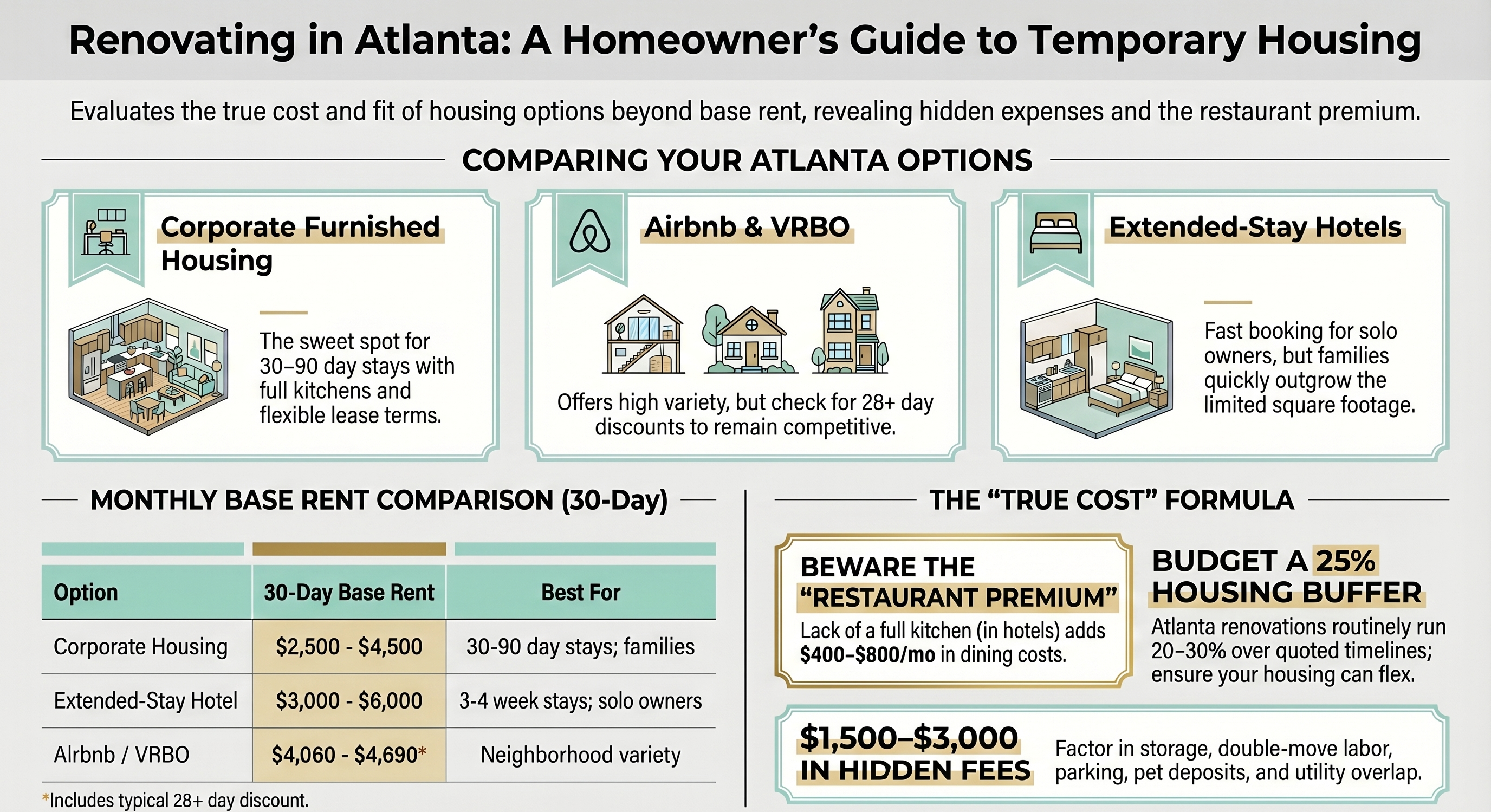
The listed rate is never the full cost. Before comparing options, understand the True Cost Formula: base rent plus utilities plus storage plus double-move labor plus pet deposits plus parking. Skip any component and you'll get surprised. Here are your six options in Atlanta, ranked by how they actually serve renovation stays.
The Six Options Compared
Corporate / Furnished Housing ($2,500–$4,500/month). The strongest overall fit for 30–90 day renovation stays. Providers like Minty Living, CORT, BCA, and AR National operate fully furnished apartments in residential Atlanta neighborhoods, with full kitchens, utilities bundled, linens and cookware provided, and lease terms designed to flex with contractor timelines. Full kitchens matter: they eliminate the $400–$800 monthly restaurant premium hotel stays force on you. Most providers allow month-to-month extensions without resetting the rate, which matters when your contractor slips three weeks.
Extended-Stay Hotels ($3,000–$6,000/month). Fast, reliable, same-day bookings, and the right choice for solo homeowners on 3–4 week timelines. Past that point the math turns. Kitchenettes are a microwave and a mini-fridge, not a kitchen. Families of four are uncomfortable in 300 square feet. Expect to spend an additional $400–$800 a month on restaurants, and expect the hotel room to feel like a hotel room by week three.
Airbnb and VRBO ($5,010–$5,790/month at Atlanta rack rates, based on current STR market averages). Variety and neighborhood choice. Airbnb applies a weekly and monthly discount for stays of 28 nights or more — typically in the 10–20% range, set per host — which can bring premium properties into competitive range. Confirm the exact discount directly on the listing before booking, because the figure varies. The downside is cancellation risk for long stays, inconsistent quality, and host turnover during your tenancy. For renovation stays specifically, corporate furnished housing usually wins on price once the discount is applied and delivers more predictable service.
Traditional Furnished Apartments ($2,000–$4,000/month). Best for budget-conscious homeowners on 3–6 month timelines. Providers like BCA and AR National operate across Atlanta with bundled utilities, parking, and residential settings. The tradeoff: credit checks are required, pet fees run $200–$500, and shorter stays (under 60 days) can carry premium pricing. Read the lease for early-termination penalties in case your contractor finishes ahead of schedule — rare, but it happens.
Family and Friends ($0 base). Free is the most expensive option by hour six of week three. Relationship strain, commute compromise, logistical improvisation, and the resentment that builds when your household overstays its welcome are all real costs. Acceptable for 7–14 day stays in emergencies. Not a plan for a four-month kitchen renovation.
On-Property RV ($1,800–$4,500/month). Viable for suburban properties with lot space, driveway length, and legal utility hookups. City of Atlanta zoning restricts RV occupancy in most residential districts, so check with your municipality before committing. Works best when you need to stay on site for contractor access and security — rare for homeowners, common for restoration managers overseeing a job.
The Hidden Costs Nobody Mentions
Even if you nail your primary housing choice, five hidden costs can add $1,500–$3,000 to your total:
-
Storage: $150–$350/month for a 10x10 or 10x20 unit. You'll probably need one.
-
Double-move labor: $1,200–$2,500 for two move days (out and back). Professional movers are worth it for fragile kitchens and bedrooms.
-
Parking: $150–$300/month in Midtown, Buckhead, and West Midtown. Suburban stays are usually included.
-
Pet deposits: $200–$500 per pet, sometimes non-refundable.
-
Utility overlap: You keep electricity and water on at the renovation site for contractors.
Atlanta Cost Comparison Table
30-day, 60-day, and 90-day estimates include base rent only — add hidden costs to every line.
| Option | 30 days | 60 days | 90 days |
|---|---|---|---|
| On-Property RV | $1,800–$4,500 | $3,600–$9,000 | $5,400–$13,500 |
| Traditional Furnished Apt | $2,000–$4,000 | $4,000–$8,000 | $6,000–$12,000 |
| Corporate / Furnished Housing | $2,500–$4,500 | $5,000–$9,000 | $7,500–$13,500 |
| Extended-Stay Hotel | $3,000–$6,000 | $6,000–$12,000 | $9,000–$18,000 |
| Airbnb / VRBO (with 28+ discount) | $4,060–$4,690 | $8,120–$9,380 | $12,180–$14,070 |
| Family / Friends | $0 | $0 | $0 (and priceless damage to the relationship) |
Budget Rule and Selection Guidance
Add 25% to whatever housing total you calculate. Atlanta renovations run long, and short-term housing extensions charged mid-stay often price higher than the original booking. Choose your option by matching household size, duration, budget, pet count, and WFH needs against the table above. Book 4–6 weeks ahead of your renovation start date — inventory in Old Fourth Ward, Kirkwood, and East Atlanta Village is thin and turns over quickly, especially during filming seasons when crews absorb supply.
For homeowners who want flexible terms, residential settings, and pricing that holds through contractor slips, browse corporate housing in Atlanta on Minty Living — our inventory is designed for exactly these stays.
Chapter 3: ALE Insurance and Renovations — Separating Fact from Fiction
Many Atlanta homeowners assume their insurance covers temporary housing during renovations. It does not. This is the single most common misconception in renovation planning, and it regularly blows up budgets when homeowners discover the truth two weeks before the contractor arrives.
What ALE Actually Covers
Additional Living Expense (ALE) coverage, bundled into nearly every standard homeowner's policy, pays for temporary housing and increased living costs when your home is uninhabitable due to a covered loss. The NAIC defines covered losses as involuntary events your policy lists as insured perils — fire, smoke damage, windstorm damage, hail, burst pipes, vandalism, and similar sudden, accidental events.
When a covered loss happens, ALE pays the difference between your normal living expenses and the increased costs caused by displacement. If your family normally spends $1,800 a month on housing and ALE places you in a $3,000 furnished apartment, the benefit covers the $1,200 difference — not the full $3,000. Eligible ALE expenses typically include temporary housing, restaurant meals above normal food costs, transportation above normal commute, storage fees, and pet boarding when housing doesn't allow animals.
What ALE Does Not Cover
Planned renovations. Elective remodels. Voluntary demolition and rebuild. Kitchen expansions. Primary suite additions. The dream bathroom you've been saving for. None of it is covered by ALE, because none of it involves an involuntary covered loss. You chose to take the walls down. The insurance company did not.
This matters because the dollar figures involved are large. A standard Atlanta HO-3 policy typically caps ALE benefits at 20–30% of dwelling coverage. On a $400,000 dwelling policy, that would mean $80,000 to $120,000 available for covered-loss displacement — substantial money homeowners often assume will cover a renovation stay and find out too late that it won't. Always verify the specific dollar and time limits in your policy.
The Gray Zone: Renovation Uncovers Damage
Here is the exception worth understanding carefully. When a renovation opens up walls and discovers hidden damage that would qualify as a covered loss — concealed water damage behind a shower, structural rot from a slow leak, mold growing in a cavity — the newly discovered damage may trigger ALE for the portion of the displacement attributable to the covered loss remediation. Not the voluntary renovation. Just the remediation.
Example: your Grant Park bungalow is mid-kitchen-remodel when the contractor pulls plaster and finds a decade of water damage from a concealed plumbing leak. The mold remediation phase — typically 2–6 weeks — may qualify for ALE coverage if your policy covers sudden and accidental water damage. The rest of the renovation does not.
If you suspect discovered damage on your project, act fast. The Georgia Department of Insurance and standard policy language both favor homeowners who document immediately: photos before any remediation work, a written contractor assessment of what was found, and a call to your insurer within 24–48 hours of discovery. Delayed notification is the most common reason mid-renovation ALE claims get denied.
Subsection 3.1: When Renovation Work Uncovers a Covered Loss
The documentation protocol is not complicated, but the order matters:
-
Stop the contractor on that area of work before anything is removed or repaired.
-
Photograph everything from multiple angles with date stamps. Phone cameras are fine — insurers rarely reject smartphone documentation.
-
Get a written contractor assessment describing what was found, the suspected cause, and the estimated cost to remediate.
-
Call your insurer the same day. Ask specifically whether the discovered condition triggers a covered loss under your policy.
-
Do not begin remediation until the adjuster has inspected or explicitly authorized work to proceed.
Step 5 is the one homeowners skip, and it's the one that gets claims denied.
Pre-Renovation Action for Homeowners
Before your renovation starts, call your insurance agent and ask two questions: What is my ALE dollar limit and time limit? Would damage discovered during renovation (mold, rot, water intrusion, structural) qualify as a covered loss under my policy? Write down the answers. Keep the notes with your renovation paperwork.
For homeowners working through an actual covered loss, the crisis displacement workflow is different from the planned renovation workflow. Minty Living's Insurance Adjuster's Complete Guide to ALE Housing in Atlanta covers the adjuster-side workflow, and the Ultimate Guide to Insurance Displacement Housing covers the homeowner side of the crisis scenario.
Chapter 4: Atlanta Neighborhoods for Temporary Housing
Neighborhood choice affects your commute back to the renovation site, your kids' school access, your daily quality of life, and your total cost. Six Atlanta neighborhoods carry reliable furnished inventory for renovation stays. Pick based on your project location and household needs, not on Instagram aesthetics.
| Neighborhood | Monthly Range | Inventory | Best For |
|---|---|---|---|
| West Midtown | $2,800–$4,200 | Strong | OTP homeowners, Beltline access, upscale feel |
| Old Fourth Ward | $2,500–$3,800 | Moderate | Young families, remote workers, food scene |
| Kirkwood | $2,200–$3,500 | Moderate | Families with school-age kids, quieter residential feel |
| Grant Park | $2,000–$3,200 | Moderate | Budget-conscious stays, historic character |
| East Atlanta Village | $1,900–$3,000 | Thin — book early | Eclectic vibe, longer stays, tighter budgets |
| Buckhead | $3,500–$5,500 | Strong | Executive stays, widest corporate housing selection |
Practical tip: stay within a 15-minute drive of your renovation project. Daily contractor check-ins, change-order conversations, and the inevitable "come look at this" calls all get easier when you're nearby, and contractor productivity rises measurably when the homeowner can show up in person instead of waiting for photo uploads.
For the full breakdown of Atlanta furnished options by neighborhood, browse Minty Living's neighborhood pages.
Chapter 5: How to Plan the Logistics
Finding housing is the first half of the problem. Coordinating the move, storing your belongings, managing utilities, and keeping the project on track from off-site is the other half. The difference between a smooth renovation and a chaotic one is usually a four-week head start on logistics.
Work Backward from the Renovation Start Date
Start the housing search 4–6 weeks before the project's scheduled start. This gives you enough time to tour properties, negotiate terms, and secure a lease that covers the full expected duration plus a buffer. Last-minute bookings in intown Atlanta routinely force homeowners into second-choice neighborhoods or hotel stays at twice the furnished-apartment rate.
Storage Strategy
Most renovation stays need some storage. Decide early: full pack-out (everything goes) or partial pack-out (keep kitchen and primary bedroom accessible, store the rest)? Full pack-out simplifies the renovation site and protects belongings from dust, but costs more and requires a larger unit. A 10x10 unit ($150–$250/month) fits roughly one bedroom. A 10x20 unit ($200–$350/month) fits most of a 2-bedroom home. Avoid far-OTP storage facilities — you'll need access during the renovation more often than you think.
Contractor Coordination From Off-Site
Three practices keep projects on track when the homeowner is living elsewhere: daily photo updates from the contractor, weekly on-site visits by the homeowner, and a single named point of contact on the contractor's team. Projects where the homeowner drops in randomly and talks to whichever crew member is nearby lose more time than projects with disciplined communication.
Utility Management
Keep electricity and water active at the renovation site — contractors need both. Pause or forward everything else: internet, cable, trash collection, alarm monitoring. Utility companies typically allow vacation holds without penalty for 30–90 days.
Family Logistics
For stays over six weeks with school-age kids, decide whether to maintain current school enrollment or temporarily enroll in the new neighborhood. Call your district's enrollment office to ask about temporary-relocation options — most Atlanta-area districts will maintain current school placement if the relocation is temporary and you can document the address of record. For pets, confirm breed restrictions before booking — some Atlanta corporate housing restricts certain breeds regardless of pet deposit amount. Set up mail forwarding through the official USPS change-of-address service the week before your move.
The 6-Week Pre-Move Countdown
-
Week 6: Confirm the contractor's start date. Begin housing search. Get a storage quote.
-
Week 4: Book housing and reserve storage. Notify the school district if relocating mid-year.
-
Week 2: Schedule professional movers. Pack non-essentials. Set up mail forwarding.
-
Week 1: Final walk-through with contractor. Confirm utilities staying on. Set emergency contacts. Move.
Chapter 6: The Professional Perspective
Homeowners are not the only stakeholders affected by relocation decisions. Contractors and restoration managers have their own incentives in the conversation, and understanding their perspective makes for better project outcomes on both sides.
For Contractors
Projects with relocated homeowners finish faster than projects with on-site homeowners. The reason is straightforward: homeowners living in the renovation zone generate far more mid-project change-order requests than homeowners who visit weekly, because small ideas ("what if we just moved this outlet here?") pile up when you're staring at unfinished work every day. This is ordinary scope creep, amplified by daily proximity.
The smart play is to include a housing recommendation in the project proposal. Not as a sales pitch — as risk management. A sentence like "for projects running over six weeks, we recommend clients budget for temporary housing to protect the timeline" signals professionalism, sets realistic expectations, and protects your reputation when the inevitable slip happens. Contractors who communicate realistic timelines with buffer weeks — and explain delays transparently when they occur — earn more referrals than contractors who promise on-time delivery and underdeliver.
For Restoration Managers
Restoration displacement follows a different playbook than renovation displacement. Damage-displaced families need housing placed within 24–48 hours and often arrive traumatized, under-documented, and carrying unclear insurance communication. ALE documentation protocols matter more than housing selection: photos before remediation, written damage assessments within 48 hours, daily expense logs, and direct-bill arrangements with housing providers wherever possible.
The shared insight across contractors, restoration managers, and housing providers is that smooth relocations produce better projects. Client reviews, referrals, and project margins all improve when the homeowner is well-housed, well-informed, and not living in a construction zone. For restoration managers specifically, Minty Living's Ultimate Guide to Insurance Displacement Housing covers coordination protocols in depth.
Chapter 7: Real Atlanta Renovation Housing Scenarios
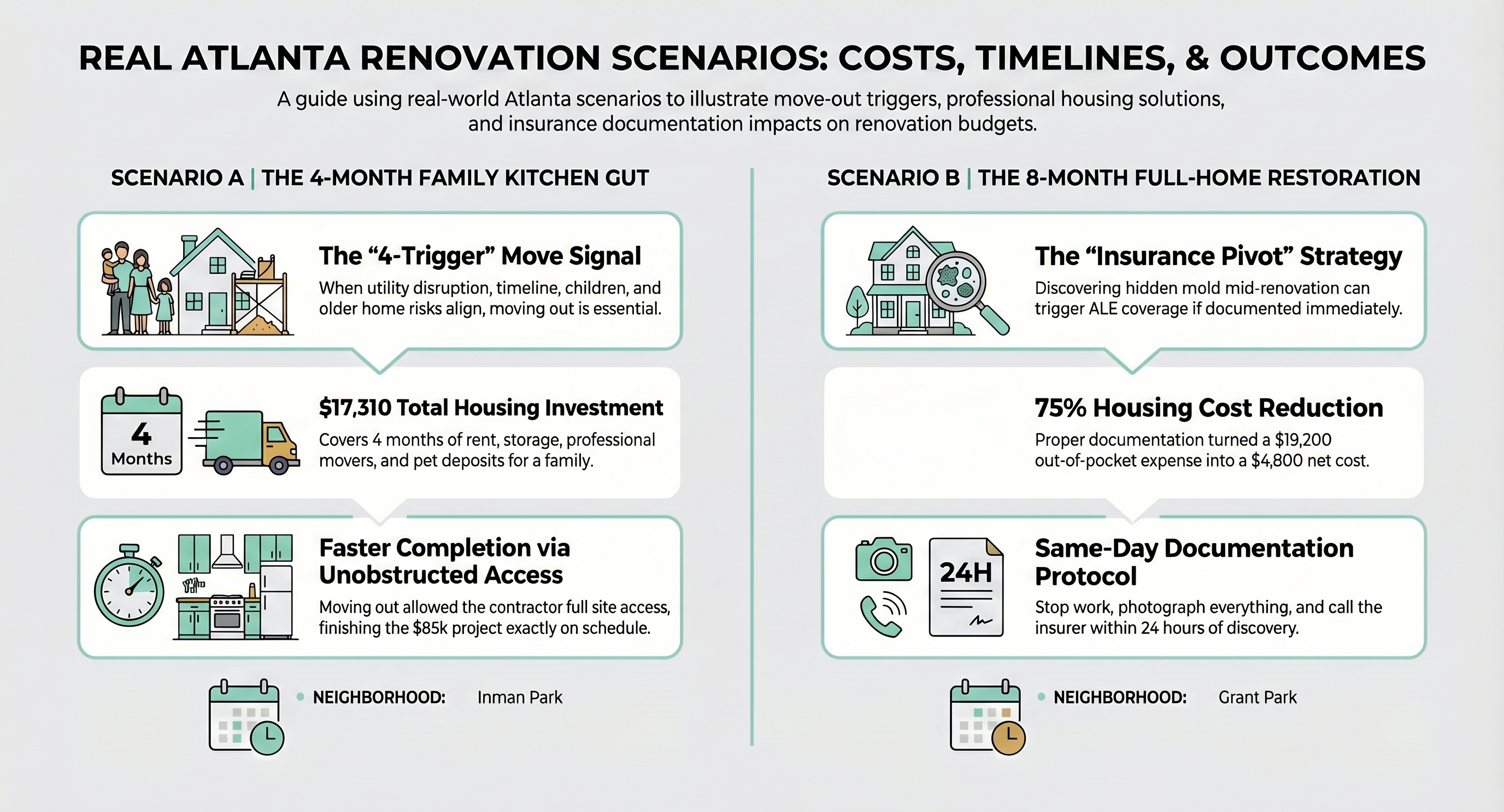
Abstract advice is hard to apply. Here are two composite scenarios drawn from real Atlanta renovation patterns, with full cost breakdowns.
Scenario A: The Inman Park Kitchen Gut (4 Months, Family of 4)
Profile: Dual-income couple, two kids ages 8 and 11, one dog, both parents working hybrid with at least two WFH days each week. Home is a 1920s bungalow in Inman Park.
Project: Full kitchen demolition and rebuild. New layout, new cabinets, new appliances, new tile. Contractor estimate: $85,000 budget, 16-week timeline.
Trigger check: Kitchen demolition means no cooking for 12+ weeks (Trigger 2). 16-week timeline exceeds the six-week threshold (Trigger 3). Two children under 12 (Trigger 4). 1920s construction means scope creep risk is high (Trigger 5). Four triggers — strong move signal.
Solution: 2-bedroom furnished apartment in Old Fourth Ward, $3,200/month, booked for 4.5 months with a 2-week buffer. Walking distance to Ponce City Market for food and errands. 8-minute drive back to Inman Park for contractor check-ins. Apartment allows the dog for a $300 pet deposit.
Cost breakdown:
-
Base rent: $3,200 × 4.5 months = $14,400
-
Storage (10x10, climate-controlled): $180 × 4.5 months = $810
-
Professional movers (two moves): $1,800
-
Pet deposit: $300 (non-refundable portion)
-
Parking: included
-
Total housing cost: ~$17,310
Outcome: The project finished on the 16-week estimate because the contractor had full, unobstructed site access from day one and the homeowners could respond to questions within 10 minutes via the project management app. Avoided delay cost alone was approximately $3,200 based on the contractor's original buffer estimate.
Scenario B: The Grant Park Full-Home Gut (8 Months, Mid-Project ALE Event)
Profile: Single homeowner, large dog, WFH consultant, 1915 Craftsman bungalow in Grant Park.
Project: Full home renovation — electrical, plumbing, kitchen, bathrooms, hardwoods. $180,000 budget, 32-week planned timeline.
Initial housing decision: 1-bedroom furnished apartment in Kirkwood, $2,400/month, booked for eight months. Out-of-pocket — planned voluntary renovation with no insurance involvement expected.
The pivot: In week nine, contractors opening a bathroom wall discover extensive hidden water damage and active mold behind the original tile. The homeowner follows the documentation protocol from Chapter 3: stops the crew, photographs everything, gets a written contractor assessment, calls the insurer the same day. The insurer confirms the concealed water damage qualifies as a sudden-and-accidental covered loss under the policy.
Outcome: ALE coverage applies to the six-week mold remediation phase only — not the voluntary renovation. The insurer reimburses approximately $14,400 toward housing costs during remediation. The remainder of the eight-month stay remains out-of-pocket. Total housing cost: roughly $19,200 before the ALE reimbursement, roughly $4,800 after.
Lesson: Same-day documentation turned what could have been a denied claim into a substantial reimbursement. Homeowners who assume "it's just a renovation" and skip the documentation protocol lose these claims routinely.
Chapter 8: Your Move-Back Checklist
The renovation is done. Your contractor is asking for final payment. Everyone is ready to celebrate. This is exactly the moment when homeowners rush back in, skip the punch list, and discover three weeks later that the HVAC is blowing drywall dust through every vent and the garbage disposal was never connected. Slow down. Run this checklist before you move back.
Do Not Move Back Until
-
[ ] The punch list is signed off, not "mostly done." Walk the house room by room with the contractor and document every outstanding item in writing.
-
[ ] Final inspection has passed if required by permit. Do not move back into a home that has not cleared its permit inspection — your insurance coverage can be affected.
-
[ ] Every appliance has been tested. Run the dishwasher through a cycle. Run the garbage disposal. Run the HVAC on heat and cool. Run the oven at 350 for 10 minutes. Flush every toilet and run every faucet.
-
[ ] The HVAC has been cleared of construction dust. Change all filters. Consider a professional duct cleaning if the system ran at all during demolition.
Pre-Move-Back Deep Clean
Construction dust settles in places you wouldn't think to check: inside kitchen cabinets, on top of ceiling fans, in window tracks, in HVAC return vents. A professional post-construction deep clean runs $400–$900 for a typical Atlanta home and is worth every dollar. DIY cleaning misses 40–60% of the particulate load.
Replace HVAC filters the day you move back. Then replace them again 30 days later. Construction dust keeps working its way out of the system for weeks.
Storage, Utilities, and Mail
-
Schedule the move-back within 48–72 hours of punch list sign-off to minimize double-rent overlap between your temporary housing and your storage unit.
-
Reactivate paused utilities the day before move-back.
-
Reverse your USPS mail forwarding.
-
Cancel or reschedule services you paused (internet, cable, trash pickup).
Final Contractor Walkthrough
Walk the entire house with the contractor on move-back day. Document any incomplete items before making the final payment. Withholding 5–10% of the final payment until the punch list is fully completed is standard practice and protects you.
Post-Renovation Insurance Update
Call your insurer once the renovation is complete. A substantial renovation can increase your home's replacement cost, and your dwelling coverage should reflect the new value. A $100,000 renovation that isn't reflected in your policy leaves you underinsured if the worst happens.
Stay Extension Policy
If the renovation slips past your expected end date, most corporate housing providers will offer priority extensions to existing tenants — but only if you ask early. The moment your contractor signals a delay, call your housing provider and extend. Waiting until the end-of-stay date means competing with new bookings for the same unit at higher last-minute rates.
Conclusion
Renovating a home in Atlanta involves two big decisions most homeowners underestimate. The first is whether to stay in the house during the work, and the five-trigger framework in Chapter 1 gives you an honest answer in about five minutes. The second is which housing option to choose if you move out, and the True Cost Formula in Chapter 2 keeps you from getting surprised by storage fees, double-move labor, and the dining-out premium hotel stays force on you. Plan ahead, budget a 25% buffer for slips, document everything in case renovation uncovers a covered loss, and remember that ALE insurance does not cover planned renovations — you are paying out-of-pocket and should budget accordingly.
The good news is that Atlanta has strong furnished housing inventory across every price point, from budget-friendly stays in East Atlanta Village to executive corporate housing in Buckhead. The homeowners who get through renovations smoothly are the ones who start the housing search four to six weeks early, choose an option that matches their household and timeline, and treat the move as a project phase worth planning carefully.
Browse Atlanta furnished rentals on Minty Living — flexible 30–90 day terms built for renovation stays. See available properties →
Frequently Asked Questions
Q1: How far in advance should I book temporary housing for a renovation in Atlanta?
Four to six weeks minimum. For intown neighborhoods like Old Fourth Ward, Kirkwood, and East Atlanta Village, push it to eight weeks when you can — inventory is thin and turnover is fast. Book as soon as your contractor confirms a firm start date, and build a two-week buffer into your end date to absorb timeline slips.
Q2: Does homeowner's insurance cover temporary housing during a kitchen renovation?
No. Additional Living Expense (ALE) coverage applies only to involuntary displacement from covered losses — fire, storm, burst pipes, vandalism. Planned renovations are out-of-pocket. The exception is if the renovation uncovers hidden damage that would qualify as a covered loss (concealed water damage, mold, structural rot) — document immediately and call your insurer the same day.
Q3: What is the cheapest temporary housing option in Atlanta for renovation stays?
Family and friends at $0 base cost, but rarely sustainable past 14 days. After that, the cheapest real option is usually a traditional furnished apartment ($2,000–$4,000/month) or an on-property RV ($1,800–$4,500/month) where zoning allows. For stays over 60 days, corporate furnished housing wins on dollar-for-dollar value once you account for the hidden costs of cheaper options.
Q4: Can I use a furnished rental while my house is being renovated?
Yes — and for most renovations running longer than six weeks, it is the strongest fit. Providers like Minty Living operate fully furnished apartments in residential Atlanta neighborhoods with flexible terms, bundled utilities, full kitchens, and lease structures designed to flex with contractor timelines.
Q5: How do I coordinate with my contractor while living off-site?
Three disciplines: daily photo updates from the contractor through a project management app, weekly on-site visits by you, and a single named point of contact on the contractor's team. Random drop-ins and conversations with whichever crew member is nearby cause more delays than they prevent.
How Minty Living Can Help
Everything in this guide points to the same reality: planned renovations are out-of-pocket, timelines slip, and the temporary housing you choose has to absorb the uncertainty without adding cost or stress. That is the exact problem Minty Living was built to solve.
We manage 160+ professionally designed furnished properties across Atlanta's intown neighborhoods — Old Fourth Ward, Grant Park, Midtown, Inman Park, Cabbagetown, and more — and every property is set up for the kind of stay a renovation demands. Here is what that looks like in practice:
-
Terms that flex with contractor timelines. Hourly-to-annual rental flexibility with mid-stay extensions. When your contractor's 16-week project becomes 19 weeks, you extend without a phone-tree argument or a rate reset.
-
Full kitchens, not kitchenettes. Real stoves, real refrigerators, real pantries, real cookware. The $400–$800 monthly restaurant premium hotels force on families during a kitchen remodel disappears because you can actually cook.
-
Intown Atlanta locations within 15 minutes of most renovation sites. Stay close enough to your project for daily contractor check-ins, weekly site visits, and the inevitable "come look at this" calls.
-
No 12-month lease commitment. Renovation stays are 30, 60, 90, or 180 days — not a year. Our terms match what you actually need.
Minty Living carries a 4.9 Google rating and is a Plum Guide "Top 1%" selection — meaning our properties clear a quality bar that 99 out of 100 rentals do not. For Atlanta homeowners navigating a planned renovation, that is the difference between a place to sleep and a place that actually feels like living.
Ready to plan your renovation stay? Browse available properties at mintyliving.com or call (404) 999-0841 to talk through your timeline. The earlier you start the conversation, the better your options — especially in high-demand intown neighborhoods where furnished inventory turns over quickly.
Prefer a customized shortlist? Fill out our Guest Request Form and we'll send you a tailored list of Atlanta furnished rentals that match your renovation timeline, household size, pet situation, neighborhood preferences, and budget. No pressure, no spam — just a curated set of options so you can skip the guesswork.

 (4).png)

 (29).png)
 (28).png)
 (33).png)
 (37).png)
 (38).png)
 (39).png)
 (40).png)
 (44).png)
 (1).png)
 (3).png)
 (55).png)
 (54).png)
 (56).png)
 (57).png)
 (58).png)
 (59).png)
 (60).png)
 (61).png)
 (63).png)
 (66).png)
 (45).png)
 (67).png)
 (68).png)
 (69).png)
 (70).png)
 (71).png)
 (72).png)
 (73).png)
 (86).png)
 (87).png)
 (89).png)
 (92).png)