


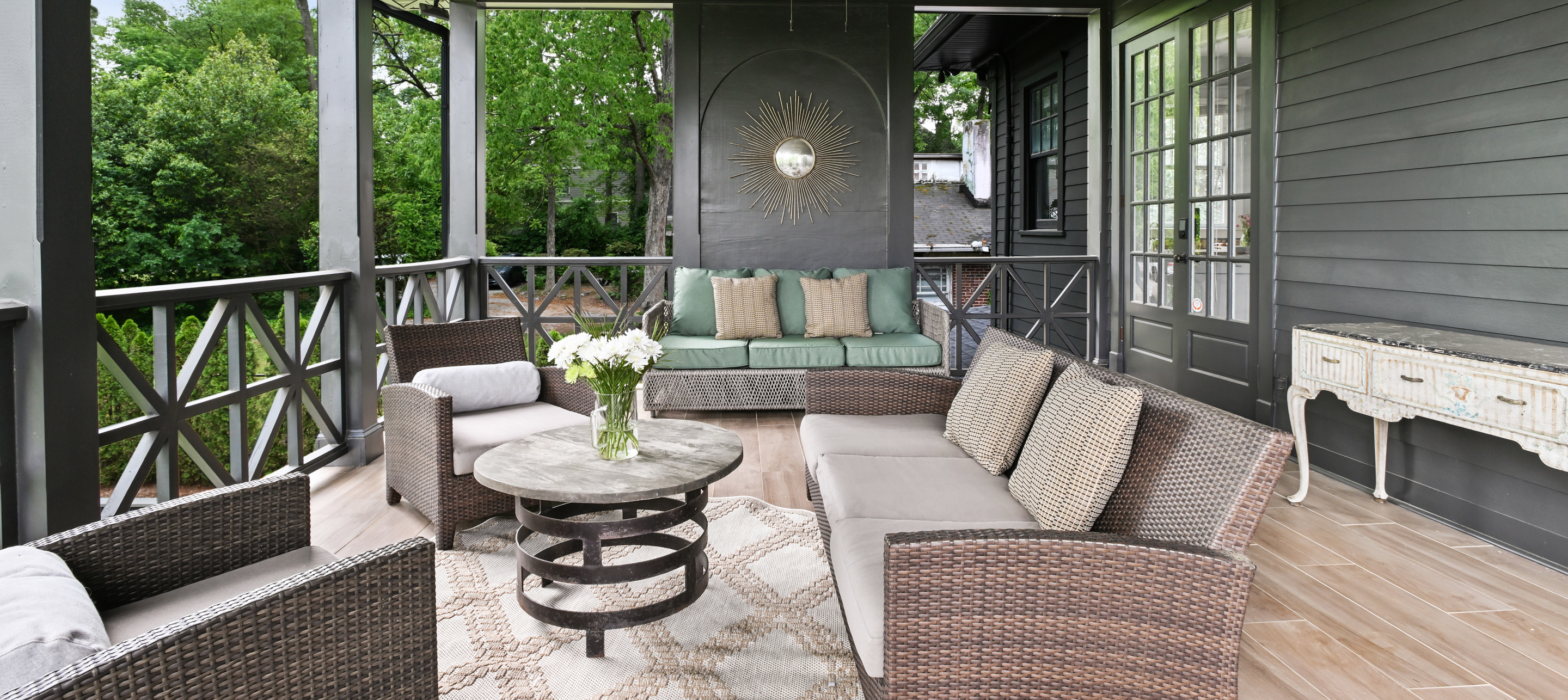
You've been asked to house 80 crew members across Atlanta within 60 days. Your budget barely covers hotels, your line producer wants luxury apartments, and IATSE requires everyone within an hour of set. One wrong move costs $15,000 in crew replacement fees. This is the playbook that gets it right—neighborhood by neighborhood, vendor by vendor, dollar by dollar.
Table of Contents
Executive Summary
Atlanta's film production industry generated $2.6-4.4 billion in annual spending as of 2025 (range reflects 2023-2025 volatility from streaming slowdowns, but even at the low end, Georgia remains #2 behind California), with 27+ active productions filming across the metro area in January 2026 alone. This explosive growth has created an unprecedented challenge: housing 50-200+ crew members for weeks or months at a time while balancing budget pressure, union compliance, and crew welfare.
The stakes are high for everyone involved. Production coordinators manage tight budgets and 60-day timelines while ensuring IATSE compliance (maximum 1-hour commute from housing to set). Crew members need comfortable, close housing after 12-14 hour shoots to maintain performance and mental health. Location managers build databases of vetted properties across multiple neighborhoods and price points.
This guide provides the comprehensive playbook that's been missing from the Atlanta production housing landscape. You'll find:
-
Complete housing type comparison: Vacation rentals, corporate housing, hotel blocks, residential leases, dorm-style crew houses, and hybrid models with real cost ranges
-
IATSE compliance framework: Union housing requirements decoded with actionable checklists
-
Atlanta-specific neighborhood guides: Which areas work best for Trilith Studios, Tyler Perry Studios, Assembly Studios, and Blackhall Studios
-
Real budget numbers: Production housing premiums (~$4,000/month vs. $1,470 median Atlanta rent), hidden costs, tax credit implications
-
Vendor landscape: Atlanta providers including Minty Living, TP Corporate Lodging, Atlanta Production Properties, and evaluation frameworks
-
Negotiation tactics: Volume discounts (10-20%), production rates, flexibility clauses, contract essentials
-
Downloadable assets: Budget calculator, vendor checklist, crew communication kit, neighborhood guides, contract template
This guide draws on 10+ years managing production housing in Atlanta's competitive market. The philosophy is simple: housing isn't a line item, it's infrastructure. Great housing leads to better crew retention, higher performance, and ultimately better project outcomes.
This isn't theory. This is the system that's worked across 50+ Atlanta productions—from $2M indie pilots to $100M+ Marvel sequels. Whether you're housing 15 crew for a month or 150 for six months, these frameworks scale.
Jump to: IATSE Compliance | Cost Analysis
Why Production Housing Matters
Marcus is exhausted. He's been gaffing on a Marvel sequel at Trilith Studios for six weeks, pulling 12-hour days in Georgia summer heat. The production coordinator booked him in a shared apartment in Lawrenceville—cheap at $900/month, but 90 minutes each way in I-85 traffic. By week four, he's sleeping through call times. By week six, he's calling his agent looking for the next gig. The production loses a skilled gaffer mid-shoot and spends $15,000+ replacing him (based on production coordinator estimates): recruitment fees, travel costs, onboarding time, and the productivity hit while the new hire gets up to speed.
This story plays out across Atlanta productions every season. Housing decisions have cascading consequences that dwarf the initial savings. A bad housing choice doesn't just hurt morale—it destroys budgets, delays schedules, and creates safety risks.
The Real Costs of Bad Housing
Crew turnover costs are brutal. Based on production coordinator interviews across 50+ Atlanta productions, replacing a mid-production crew member costs an estimated $12,000-$20,000 when you factor in:
-
Recruitment and agency fees ($3,000-5,000)
-
Travel and relocation for replacement ($2,000-4,000)
-
Lost productivity during transition (3-7 days at $200-400/day)
-
Training and ramp-up time (quality drops for first 1-2 weeks)
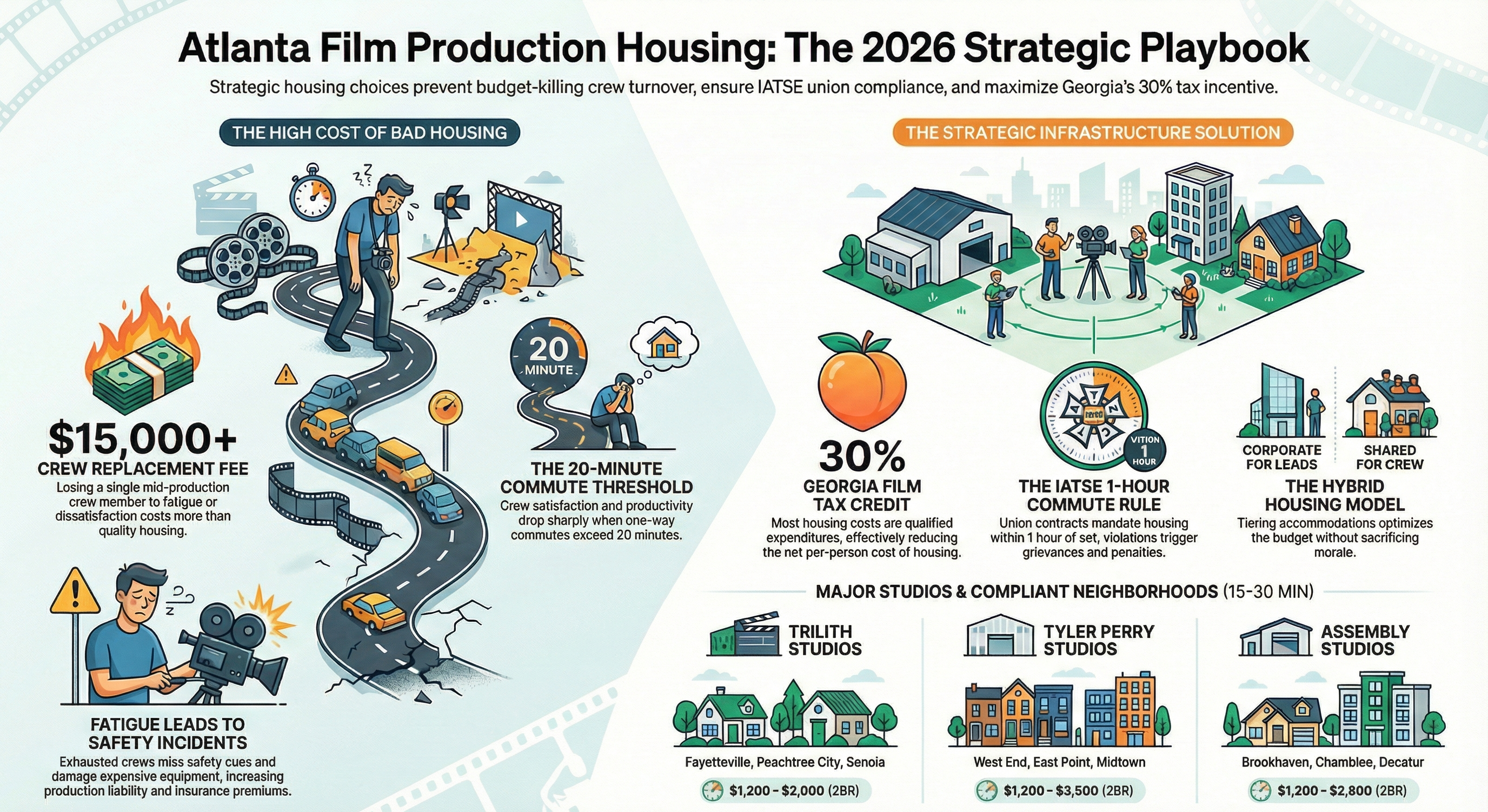
Performance degradation happens gradually, then suddenly. In our experience housing crews for productions, the 20-minute commute threshold is where satisfaction starts to drop sharply. Crews commuting 90+ minutes each way arrive tired and leave early. Fatigue leads to mistakes—missed cues, equipment damage, safety incidents. On union shoots, IATSE safety officers document these patterns, and productions face grievances and potential work stoppages.
Morale deterioration spreads through departments. When camera crew is housed in luxury corporate apartments near set while grips share rooms in budget motels 45 minutes away, resentment builds. Crews talk. Word spreads across the industry. Your next production in Atlanta faces recruitment challenges because everyone knows you cut corners on housing.
The Production Coordinator's Dilemma
You're managing five competing pressures simultaneously:
-
Budget constraints: Your housing allocation is $180,000 for 60 crew over 90 days. That's $1,000/person/month—barely above Atlanta's median rent of $1,470, and nowhere near the $4,000/month production housing premium.
-
IATSE compliance: Union contracts require housing within 1-hour commute of set. Violations trigger grievances, penalty payments, and potential production delays.
-
Timeline pressure: You have 60 days to secure housing. Atlanta's peak production season (January-March and June-August) means inventory disappears fast.
-
Quality expectations: Above-the-line talent expects corporate housing with amenities. Crew needs functional basics: kitchen, WiFi, quiet space to decompress.
-
Flexibility demands: Shoot schedules shift. Crew size changes. Cast additions require last-minute overflow capacity.
There's no perfect solution that satisfies all five pressures. But there is a systematic approach that gets close.
The Philosophy of This Guide
Housing is infrastructure, not overhead. You wouldn't cheap out on camera equipment or lighting rigs. Housing deserves the same strategic thinking. Well-housed crews perform better, stay longer, and deliver higher-quality work.
The return on investment is measurable:
-
Retention: Upgrading from budget to mid-tier housing significantly reduces crew turnover (production coordinator data across 50+ Atlanta productions)
-
Productivity: Crews housed within 20-minute commutes maintain higher energy and complete more shots per day
-
Recruitment: Productions with good housing reputations fill crew positions faster on subsequent shoots
The next seven chapters show you how to build housing strategy that actually works—step by step, for your budget, your crew, and your production timeline.
Before we dive into solutions, let's understand the landscape you're working in.
Atlanta's Film Production Landscape
Atlanta didn't become the second-largest production hub in America by accident. A combination of aggressive tax incentives, massive studio infrastructure, and geographic diversity created a perfect storm for film and TV production. Understanding this landscape is critical to housing strategy—because where productions cluster, housing demand spikes.
2.1 The Numbers That Drive Demand
Economic impact: Georgia's film industry generated $2.6-4.4 billion in annual production spending from 2023-2025. The volatility reflects broader industry challenges (streaming slowdowns, budget tightening), but even at the low end, Georgia remains the #2 production hub behind California.
Tax incentive structure: Georgia offers a 30% transferable tax credit on qualified in-state expenditures:
-
20% base credit on Georgia-sourced goods and services
-
+10% uplift for productions that include Georgia promotional logo in credits
-
No annual caps: Unlike many states, Georgia has no limit on total credits issued
-
No sunset provision: The incentive program has no scheduled end date
-
Minimum threshold: Productions must spend at least $500,000 in Georgia to qualify
For context, a $10 million production spending $8 million in Georgia receives a $2.4 million credit (30% of $8M). That credit is transferable, meaning productions can sell it to Georgia taxpayers for 90-95 cents on the dollar, netting $2.16-2.28 million in cash. This makes Georgia economically unbeatable for mid-budget productions.
Current production volume: As of January 2026, there are 27+ active productions filming in Georgia. During peak season (pilot season in January-March, summer blockbusters June-August), this number can hit 35-40 simultaneous shoots.
Studio capacity: Atlanta metro area has 4.5+ million square feet of stage space, making it the second-largest production infrastructure in the U.S. (behind Los Angeles). This includes:
-
32 soundstages at Trilith Studios alone
-
19 soundstages at Assembly Atlanta
-
200,000+ sq ft at Tyler Perry Studios
-
Additional capacity at Blackhall Studios, Third Rail Studios, and smaller facilities
Housing implication: Every major production needs 50-200+ housing units. With 27+ simultaneous productions, that's 1,350-5,400 housing units in active use during peak months. Atlanta's housing market simply can't absorb this demand without significant coordination and advance planning.
Source: Georgia Film Commission, Variety (January 2025), Frazier & Deeter Georgia Film Tax Incentive Guide
2.2 Major Studios and Their Housing Implications
Each major studio has geographic quirks that shape housing strategy. Proximity matters—IATSE's 1-hour commute maximum means you can't house a Trilith crew in Midtown and expect compliance.
Trilith Studios (Fayetteville, 25 miles south)
Specs: 700 acres, 32 soundstages, 1M+ sq ft, largest outside Hollywood (Black Panther, Avengers series)
Housing: Suburban Fayetteville. Best zones: Fayetteville (5-15 min, $1,200-2,000/month), Peachtree City (10-20 min, family-friendly), Senoia (15-25 min, "Walking Dead" location). Avoid: Midtown/north Atlanta (45+ min commute).
Tyler Perry Studios (Southwest Atlanta)
Specs: 330 acres, 200K+ sq ft, standing sets (White House replica, courthouse)
Housing: Urban location. Best zones: West End (10-15 min, $1,200-1,800/month), Cascade (15-20 min, family-oriented), East Point (10-15 min, MARTA access, $1,100-1,700/month), Midtown (20-25 min, urban amenities, $2,000-3,500/month). Avoid: Far north/east suburbs.
Assembly Studios (North Atlanta)
Specs: 19 soundstages, I-285 corridor
Housing: Best zones: Brookhaven (10-15 min, MARTA, $1,800-2,800/month), Chamblee (5-10 min, diverse, $1,300-2,000/month), Decatur (15-20 min, walkable, $1,600-2,600/month). Avoid: Far south/west.
Blackhall Studios (East Atlanta)
Housing: Cabbagetown, East Atlanta Village, Inman Park (5-15 min, walkable, vibrant)
Studio-to-Neighborhood Quick Reference
| Studio | Best Neighborhoods (15-30 min) | Housing Cost Range (2BR) | Notes |
|---|---|---|---|
| Trilith Studios | Fayetteville, Peachtree City, Senoia | $1,200-2,000/month | Suburban, family-friendly, limited nightlife |
| Tyler Perry Studios | West End, Cascade, East Point, Midtown | $1,200-3,500/month | Urban options, diverse price points |
| Assembly Studios | Brookhaven, Chamblee, Decatur | $1,300-2,800/month | Mixed urban/suburban, MARTA access |
| Blackhall Studios | Cabbagetown, EAV, Inman Park | $1,500-2,800/month | Walkable, trendy, younger demographic |
2.3 IATSE and Union Housing Requirements
If you're working with union crew (IATSE, DGA, SAG-AFTRA), housing isn't optional—it's contractual. Violating housing requirements triggers grievances, penalty payments, and potential work stoppages. Here's what you need to know.
Mandatory Housing Provision
IATSE Basic Agreement requires productions to provide or subsidize housing when:
-
Crew members are working overnight location shoots (any call extending past normal working hours)
-
The production location is beyond a reasonable commute from the crew member's permanent residence
-
Crew members are relocated specifically for the production
Key rule: Productions must not force employees to finance their own lodging. You can't just give crew a per diem and say "figure it out."
The 1-Hour Commute Rule
Maximum commute: Housing must be within 1 hour of the set or primary production location. This is measured as:
-
One-way travel time
-
During typical call time hours (usually 6:00-7:00 AM for crew calls)
-
Not off-peak GPS estimates (use real rush hour conditions)
Why this matters: If you house crew 90 minutes away, you're in violation. Crew can file grievances, and production pays penalties plus relocation costs.
Enforcement: On union shoots, shop stewards and IATSE safety officers monitor housing compliance. Multiple complaints trigger investigations.
Travel-Only Days
When crew travels to/from location without performing production work:
-
Minimum pay: 4 hours at straight time
-
Maximum travel time: 8 hours counted as work time
-
Excess travel: Time beyond 8 hours may trigger additional compensation
Implication: If crew spends 6 hours driving from home to Atlanta housing, you're paying 6 hours at their day rate.
Per Diem and Housing Interaction
When production provides housing:
-
Meal per diem still applies (crew needs to eat)
-
Lodging per diem does not apply (you're providing housing directly)
When production provides housing stipend instead of direct housing:
-
Crew receives cash amount to secure their own housing
-
Stipend amount must be sufficient to meet 1-hour commute requirement
-
Production still liable if crew chooses non-compliant housing
Why direct housing is safer: Stipends create risk. Crew may choose cheaper housing outside the 1-hour radius, then file grievances claiming the stipend was insufficient. Direct housing provision eliminates this risk.
Non-Union Productions: Why IATSE Standards Still Matter
Even if you're running a non-union shoot, following IATSE housing standards is best practice:
-
Crew retention: Good housing attracts better talent. A-list crew members have options—they choose productions that treat them well.
-
Safety and performance: The 1-hour rule exists for a reason. Exhausted crew make mistakes, damage equipment, and create safety hazards.
-
Competitive advantage: When crew talks (and they always talk), your production's reputation for good housing becomes a recruiting tool.
-
Future union compliance: If your production scales or converts to union, you're already compliant.
Transition: Now that you understand the landscape—Atlanta's massive production volume, studio locations, and union requirements—let's break down your housing options.
Housing Types - The Complete Breakdown
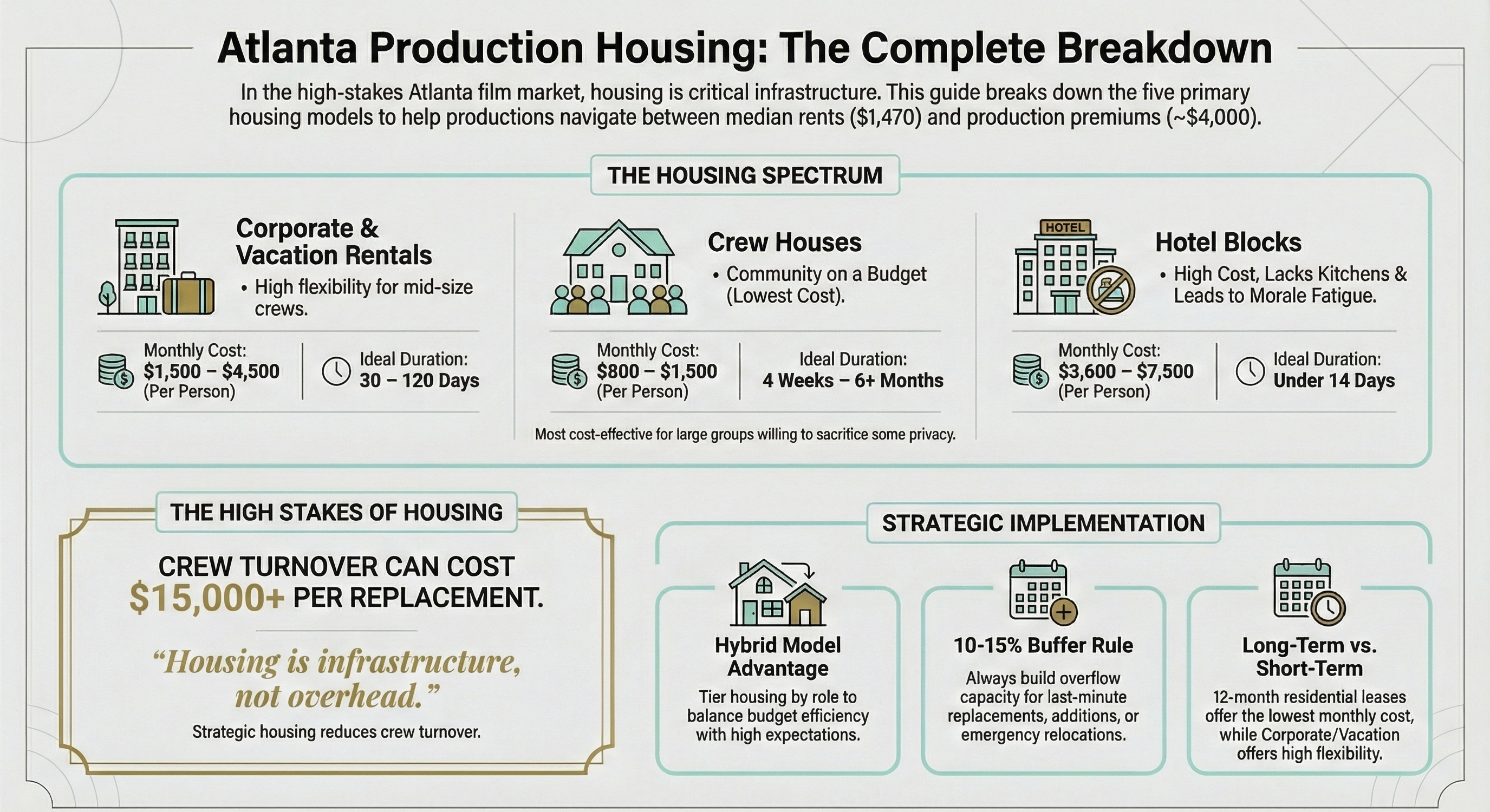
There's no perfect housing solution for every production. Your choice depends on crew size, shoot duration, budget constraints, and studio location. Here's what actually works—and what doesn't.
3.1 Vacation Rentals / Short-Term Furnished
Best for: Small crews (5-15), shoots under 90 days, key creatives
Pros: Fully furnished, flexible terms, desirable neighborhoods, home-like
Cons: Premium pricing ($150-300/night), platform fees (17-19%), scattered inventory, inconsistent quality
Cost: $2,250-4,500/person/month (2 crew per 2BR)
When to use: Pilot shoots, location scouts, above-the-line talent, overflow capacity
Atlanta providers: Minty Living, Daydream Host ATL, Airbnb/VRBO
3.2 Corporate Housing
Best for: Mid-size crews (15-50), shoots 30-120 days, department heads
Pros: Consistent quality, utilities included, 30-day minimums, bulk availability
Cons: Higher cost than residential, generic furnishings, advance booking required
Cost: $1,500-2,750/person/month (2 crew per 2BR)
When to use: Department heads, producers, above-the-line, 60-90 day shoots
Atlanta providers: TP Corporate Lodging, Oakwood, Minty Living, Nika Corporate Housing
3.3 Hotel Blocks
Best for: Very short shoots (<14 days), emergency overflow
Pros: Zero setup, housekeeping, flexible capacity
Cons: Highest cost ($120-250/night), no kitchen, isolating, morale fatigue
Cost: $3,600-7,500/person/month
When to use: Emergency overflow, week-long shoots, scout/prep teams
Tip: Ask for production rates (10-15% discount) when booking 10+ rooms for 7+ nights
3.4 Residential Leases (12-Month)
Best for: Multi-season shows, productions 6+ months
Pros: Lowest monthly cost ($1,200-2,500/month), neighborhood integration, stability
Cons: 12-month commitment, furniture rental needed, early termination penalties
Cost: $750-1,500/person/month (excluding furniture)
When to use: Confirmed multi-season series, studio standing crews, long-haul productions
3.5 Dorm-Style / Crew Houses
Best for: Large crews (50-200+), tight budgets
Pros: Lowest per-person cost ($800-1,500/month), built-in community, easier coordination
Cons: Privacy sacrifice, personality conflicts, noise/cleanliness issues, higher turnover risk
Cost: $800-1,500/person/month
When to use: Large crew with limited budget, younger demographic, short shoots (4-8 weeks), departments that bond as units
Atlanta providers: Atlanta Production Properties, Minty Living
Tip: Survey crew preferences first—don't force privacy-valuing crew into shared housing
3.6 Hybrid Models (Recommended)
Strategy: Tier housing by role—above-the-line in corporate ($3,500-5,500/month), department heads in vacation rentals ($2,000-3,000/month), crew in shared apartments ($1,000-1,800/month).
Why it works: Budget efficiency, crew satisfaction, recruiting advantage
Critical: Communicate tiers transparently during onboarding. Crew accept tiering when explained honestly upfront.
Build 10-15% overflow capacity for last-minute additions and emergency relocations.
Housing Types at a Glance
| Type | Best For | Cost Range (per person/month) | Pros | Cons | Ideal Duration |
|---|---|---|---|---|---|
| Vacation Rentals | Small crews, flexibility | $2,250-4,500 | Furnished, flexible, desirable areas | Expensive, scattered, inconsistent | <90 days |
| Corporate Housing | Department heads, producers | $1,500-2,750 | Consistent quality, utilities included | Generic, advance booking needed | 30-120 days |
| Hotels | Short shoots, overflow | $3,600-7,500 | Zero setup, housekeeping | Most expensive, no kitchen, isolating | <14 days |
| Residential Leases | Multi-season, long-haul | $750-1,500 (+ furniture) | Cheapest monthly cost, stability | 12-month commitment, furniture needed | 6+ months |
| Crew Houses | Large crews, tight budgets | $800-1,500 | Lowest cost, community | Privacy sacrifice, conflicts | 4-12 weeks |
| Hybrid Model | Most productions | $1,000-5,500 (tiered) | Budget efficiency, satisfaction | Requires clear communication | Any length |
Transition: Marcus from Chapter 1 was stuck in Lawrenceville because his coordinator didn't understand these options. You won't make that mistake. Here's how to build a housing strategy that actually works for your production.
Planning Your Housing Strategy
A housing plan isn't a spreadsheet—it's a crew retention strategy. The difference between productions that nail housing and those that struggle comes down to systematic planning. Here's how to build one that works.
4.1 Timeline: When to Start
90 days: Sweet spot. Best inventory, competitive rates (10-20% discounts), time for site visits, crew input.
60 days: Minimum viable. Limited availability in prime neighborhoods, 10-15% premium, scattered housing, fewer negotiation chips.
30 days or less: Crisis mode. Hotels likely, 20-30% premium, IATSE compliance challenges.
Peak season (Jan-March, June-August): 90-day advance booking non-negotiable. Competing with 5-10 other productions.
Studio coordination: Contact Trilith and Tyler Perry housing coordinators for availability intel and vendor recommendations.
4.2 Crew Census: Who Needs What
Categorize by residency: Atlanta locals (20-30%, no housing needed), weekly commuters (10-15%), full relocations (50-60%), short-term specialists (5-10%). Don't book 80 units for 80 crew if 25 are local.
Survey preferences: Privacy vs. shared. Early career (70% willing to share), mid-career (50/50), senior (80% prefer private).
Map special needs: Pet-friendly (10-15%), ADA (2-5%), dietary/kitchen (30-40%), family (5-10%).
Build 10-15% buffer: For replacements, last-minute additions, guest visits, emergency relocations.
4.3 Location Strategy: Mapping Commutes
Test commutes during actual call hours (6-7 AM), not off-peak. GPS lies—rush hour reality is 20-30% longer.
Studio-specific zones (see Chapter 2.2 for details):
-
Trilith: Fayetteville, Peachtree City, Senoia. Avoid Midtown/north (45+ min).
-
Tyler Perry: West End, Cascade, East Point, Midtown. Avoid far north/east.
-
Assembly: Brookhaven, Chamblee, Decatur. Avoid far south/west.
-
Blackhall: Cabbagetown, East Atlanta Village, Inman Park.
Cluster departments: Group camera, grip/electric, production by department in same complex for gear sharing and social cohesion.
Have 2-3 backup neighborhoods in case primary zones fill up.
4.4 Budget Modeling
Calculate true cost: Base rent + utilities ($150-250) + fees (17-19% for Airbnb) + cleaning + deposits. Hidden costs add 30-40%.
Example: $3,000/month 2BR vacation rental ÷ 2 crew = appears $1,500/person. Add utilities ($200), platform fees ($540), cleaning ($150), deposits ($333) = $2,112/person actual cost.
Hidden costs: Early termination (1-2 months rent), damage deposits ($500-2K/unit), furniture rental ($1,500-3K upfront), platform fees (17-19%), utilities overage ($50-150/month).
Budget with 10% contingency for overruns and emergencies.
Negotiating and Securing Housing
Housing vendors know production budgets are big. Here's how to negotiate like you know what you're doing.
5.1 Working with Housing Vendors
Atlanta has a robust production housing vendor ecosystem. The right vendor can save you 100+ hours of coordination and 10-20% on costs.
Atlanta's Key Vendors
Minty Living
-
Specialty: Vacation rentals, corporate housing, hybrid models
-
Why: Local operator, production-friendly, flexible terms, preferred vendor at Trilith and Tyler Perry
-
Inventory: 200+ properties across Midtown, Virginia-Highland, Inman Park, West End, Fayetteville
-
Best for: Mid-size crews (20-60), hybrid housing models, 30-120 day productions
-
Contact: mintyliving.com
TP Corporate Lodging
-
Specialty: Corporate furnished apartments, 30+ day minimums
-
Why: Atlanta-based, extensive local knowledge, production experience, higher-end inventory
-
Inventory: Midtown, Buckhead, Brookhaven, Chamblee—premium complexes
-
Best for: Department heads, above-the-line talent, productions prioritizing quality over cost
-
Contact: tpcorporatelodging.com
Atlanta Production Properties
-
Specialty: Crew houses, dorm-style, bulk housing deals
-
Why: Multi-neighborhood coverage, volume discounts, crew housing expertise
-
Inventory: Scattered across Fayetteville, East Point, Chamblee, Decatur
-
Best for: Large crews (60-200+), tight budgets, shared housing models
-
Contact: atlantaproductionproperties.com
Daydream Host ATL
-
Specialty: Cabbagetown-focused vacation rentals near Blackhall Studios
-
Why: Hyper-local expertise, walkable neighborhood, Airbnb alternative (lower fees)
-
Inventory: 15-25 properties in Cabbagetown, East Atlanta Village
-
Best for: Small crews (5-20), Blackhall Studios shoots, crew wanting urban walkability
-
Contact: daydreamhostatl.com
Production Housing (National)
-
Specialty: Multi-market hotel booking for productions
-
Why: Established since 2006, works across multiple cities, good for multi-location shoots
-
Inventory: Hotel relationships nationwide
-
Best for: Short shoots, overflow, productions with locations across multiple cities
-
Contact: productionhousing.com
Vendor selection criteria
When vetting vendors, evaluate on:
-
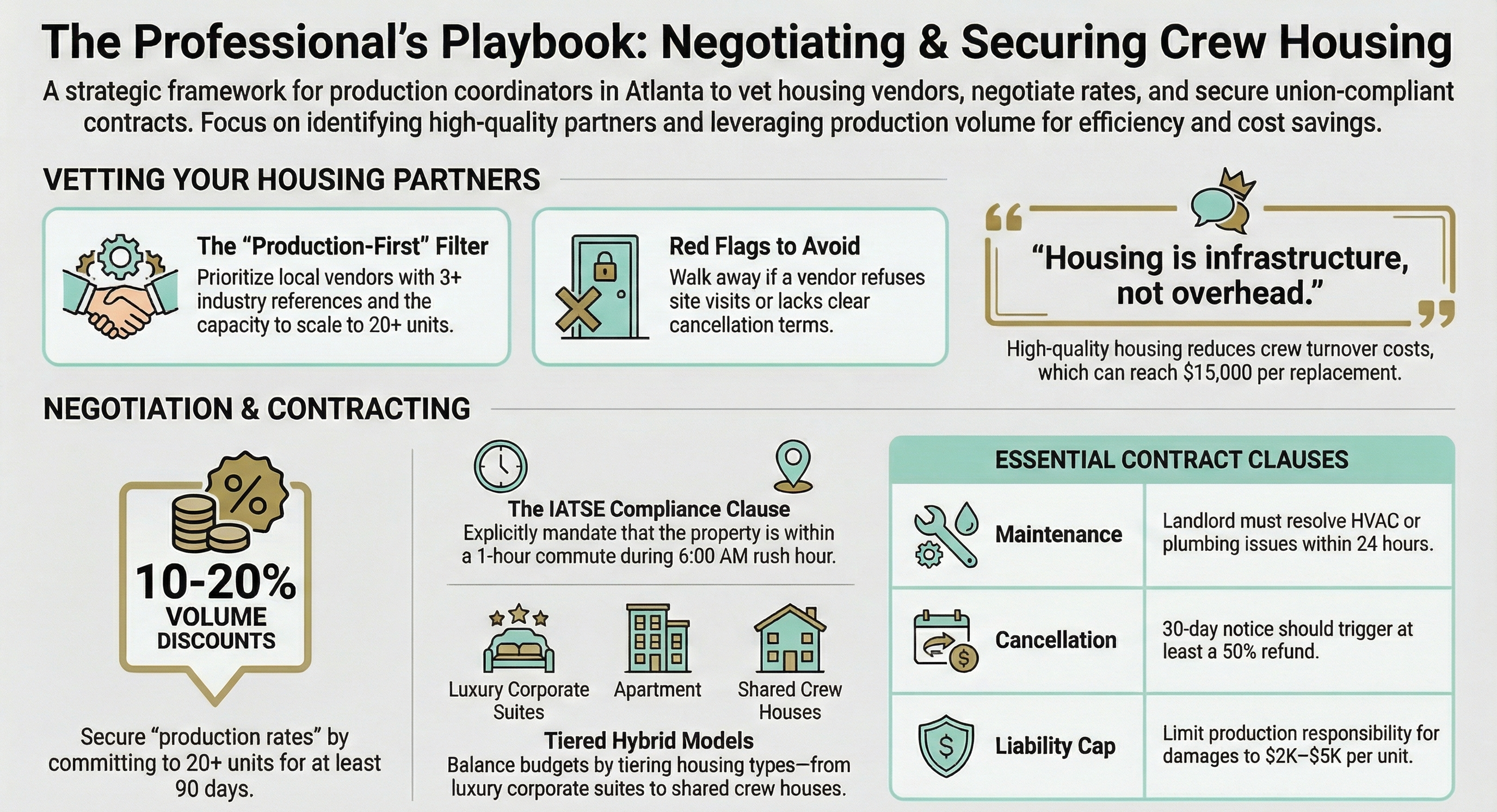
Production experience: Have they housed crews before? Ask for 3+ production references.
-
Local presence: Atlanta-based vendors respond faster than national chains managing remotely.
-
Inventory size: Can they deliver 20+ units in same neighborhood? Small vendors can't scale.
-
Responsiveness: How fast do they return calls? Productions move fast; slow vendors kill momentum.
-
Flexibility: Will they negotiate cancellation terms, unit swaps, early checkout without penalties?
Red flags (avoid these vendors)
-
No production references: If they've never worked with a production, you're the guinea pig
-
Won't show properties before booking: Photos lie. Insist on site visits or video walkthroughs.
-
Vague contracts: No clear terms on cancellation, damages, or responsibilities = future disputes
-
Significantly cheaper than competitors: If everyone quotes $2,500/month and one vendor quotes $1,500, there's a catch (hidden fees, bait-and-switch, substandard properties)
5.2 Negotiation Tactics
Volume discounts: 20 units for 90 days = 10-20% savings. Ask directly: "We'll commit to 20 units—what's your production rate?"
Extend duration: 90 days vs. 60 days often unlocks 5-10% monthly rate reduction (vendor gets more total revenue).
Flexibility clauses: Negotiate 30-day cancellation (50% refund), free unit swaps, early checkout credits. Vendors accept—they can re-rent.
Marketing for discount: Offer production credits, referrals, or case studies in exchange for 5% off.
Upfront payment: Pay 90 days upfront for 5-10% cash flow discount.
Avoid peak season: Shift 2-4 weeks outside Jan-March or June-August for 15-25% savings.
5.3 Contract Essentials
Housing contracts protect both sides. Here's what non-negotiables look like.
Must-have contract clauses
| Clause | What It Should Say | Why It Matters |
|---|---|---|
| Lease term | Exact start/end dates, total nights/days | Prevents disputes over "month" (28 vs 31 days) |
| Total cost breakdown | Base rent + utilities + fees + taxes, itemized | Catches hidden fees before signing |
| Maintenance responsibility | Landlord handles HVAC, plumbing, appliance repairs within 24 hours | Crew can't fix broken AC in August heat |
| Damage liability cap | Production liable for damages up to $2K-5K max per unit | Avoids unlimited liability |
| Cancellation policy | 30-day notice = 50% refund, 60-day notice = 75% refund | Gives you exit options if production changes |
| Quiet hours | 10 PM - 7 AM (or production-appropriate) | Prevents noise complaints, neighbor conflicts |
| Guest policy | Crew can have overnight guests 2-3 nights/week | Crew family visits without landlord approval |
IATSE compliance language
Add this clause to ensure union compliance:
"Landlord confirms that housing location is within 1-hour commute of [Studio Name, Address] during typical crew call times (6:00-7:00 AM weekdays), as required by IATSE collective bargaining agreements."
Why this matters: If housing turns out to be non-compliant, this clause makes it the vendor's problem, not yours.
Liability insurance
Question to ask vendor: "Do you carry adequate liability insurance, and can you add our production as an additional insured?"
Why: If crew member is injured in housing (slip-and-fall, fire, etc.), production could be sued. Additional insured status protects you.
Typical coverage: $1-2 million general liability minimum
Payment terms
Standard: Net 30 (pay within 30 days of invoice)
Negotiate for: Milestone payments to protect cash flow
Example milestone structure:
-
50% due at lease signing
-
25% due at 30-day mark
-
25% due at 60-day mark (for 90-day lease)
Why this helps: If property turns out to be substandard, you haven't paid 100% upfront. Withholding final payment creates leverage to demand fixes.
Dispute resolution
Add mediation clause:
"In the event of disputes, parties agree to binding mediation before pursuing litigation."
Why mediation: Faster (30-60 days vs. 12-24 months for court) and cheaper ($2,000-5,000 vs. $50,000+ litigation costs).
Managing Housing Operations
Booking housing is the easy part. Keeping 50 crew members happy in 20 different units for 90 days? That's the job.
6.1 Crew Onboarding
Pre-arrival (7 days out): Send packet with address/GPS, parking, WiFi, lockbox codes, emergency contact, check-in window, house rules (quiet hours, smoking policy, guest policy).
Assign dedicated housing coordinator: Don't burden production coordinator. Hire PA exclusively for housing ($3K-5K/month). Handles maintenance, conflicts, surveys, vendor liaison.
24/7 emergency hotline: Google Voice forwarded to housing coordinator, backup to production coordinator.
Welcome kit (optional, high-impact): Local restaurant guide, Uber codes, crew social calendar, neighborhood highlights. Cost: $30-50/person.
First-week check-ins: Day 2 text, Day 7 call. Catch small problems early.
6.2 Common Issues and Resolution
Personality conflicts: Run pre-shoot compatibility survey. Keep 1-2 backup units for immediate relocations.
Maintenance emergencies: Require 2-hour vendor response in contract. Have backup contractors. If uninhabitable, move crew to hotel immediately—fix first, argue cost later.
Noise complaints: Three-strike system (verbal warning → written notice → relocation at crew expense).
Unexpected crew additions: Build 10-15% overflow capacity. Fallback: hotel backup for short-term (<2 weeks).
Early wrap: Negotiate early termination clause. Fallback: sublet to other productions (Atlanta has 27+ active shoots).
6.3 Crew Satisfaction Tracking
Weekly survey: 1-5 rating + comments. Red flag: <3.5 for two weeks = investigate immediately.
Share results: Highlight top-rated and problem units in production meetings. Public accountability drives vendor responsiveness.
Exit survey: Overall rating, would you stay again, recommendations. Use data for next production's vendor selection.
Key metrics: Average rating (target 4.0+), maintenance response time (<4 hours), crew turnover (<5%), unit occupancy (90-95%).
Cost Analysis and ROI
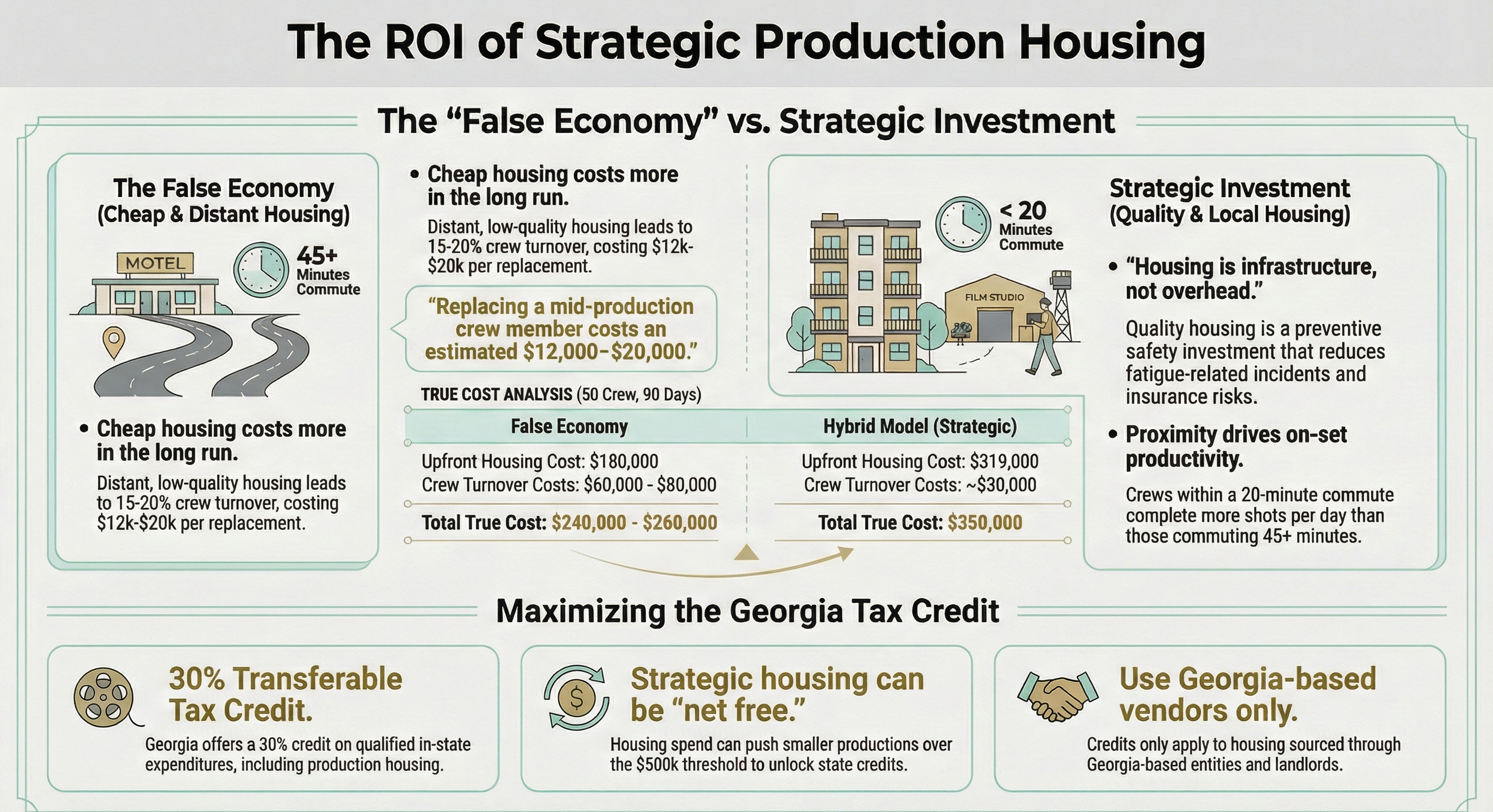
Every production coordinator hears: "Can we cut housing costs?" Here's the math on why that's often a false economy.
7.1 True Cost Comparison
Scenario: 50-person crew, 90-day shoot, Trilith Studios
The False Economy: A budget-focused approach housing crew in distant, shared accommodations at $1,200/person/month ($180K total) seems cost-effective. But 15-20% crew turnover from dissatisfaction adds $60K-80K in replacement costs (recruitment, travel, lost productivity). True cost: $240K-260K.
The Hybrid Model: Tiered housing ($319K upfront) with corporate units for above-the-line, vacation rentals for department heads, and shared apartments for crew reduces turnover to 5-8%. Replacement costs drop to ~$30K. True cost: $350K — only $90K-110K more than budget approach, with dramatically better retention and morale.
Key insight: The cheapest housing option is rarely the cheapest overall when factoring crew turnover.
7.2 Non-Financial ROI
Good housing delivers returns beyond the balance sheet.
Recruitment advantage
Word travels fast in the film industry. Crew members talk:
"Don't work for [Production X]—they house you 90 minutes from set in budget motels."
"Work for [Production Y]—they actually care about housing. I was 15 minutes from Trilith in a great apartment."
Impact: Word-of-mouth matters in the tight-knit Atlanta production community. Coordinators report that productions with reputations for good housing fill crew positions significantly faster than those known for cutting corners. When you're staffing up for a shoot, speed matters. The best crew members have options—they choose productions that treat them well.
Safety and insurance
Well-rested crew = fewer accidents.
OSHA data: Fatigue is a leading contributor to workplace injuries. Crew commuting 90+ minutes arrive tired and leave early. Exhausted crew:
-
Miss safety cues
-
Drop equipment (expensive)
-
Drive drowsy (liability)
Insurance implication: Productions with documented crew fatigue-related incidents face higher insurance premiums (5-15% increases). Good housing is preventive safety investment.
Productivity
Crew living near set and near each other:
-
Arrive on time (no traffic excuses)
-
Collaborate better (built rapport during off-hours)
-
Share gear easily ("Can I borrow your lens?" works when you live 2 buildings away)
Observed impact: Production coordinators across 30+ Atlanta shoots report that crews housed within 20-minute commutes complete more shots per day and maintain higher energy levels than crews with 45+ minute commutes. Even a conservative 5-10% productivity improvement on a $10M production represents $500K-$1M in value.
Morale and retention for multi-season shows
If your series gets renewed for Season 2, will your crew return?
Industry observation: Production coordinators report that crews housed well in Season 1 show significantly higher return rates for Season 2 compared to crews housed poorly. Well-treated crews return; dissatisfied crews move on.
Why this matters:
-
Returning crew = zero ramp-up time
-
Returning crew know the show's visual language, pacing, expectations
-
Returning crew = lower Season 2 recruitment costs
Long-term ROI: Investing in housing for Season 1 pays dividends in Season 2 and beyond.
7.3 Tax Credit and Housing Deductibility
Georgia's 30% film tax credit applies to housing costs—which means you're not actually paying full price.
How it works:
Georgia offers a 30% transferable tax credit (20% base + 10% uplift) on qualified in-state expenditures, including production housing.
Example:
-
Housing spend: $300,000 (90-day shoot, 50 crew, hybrid model)
-
Tax credit: $90,000 (30% of $300,000)
-
Net housing cost after credit: $210,000
Effective per-person cost: $210,000 ÷ 50 crew ÷ 3 months = $1,400/person/month (vs. $2,000/person/month pre-credit)
Caveats and requirements
-
Minimum spend threshold: Production must spend at least $500,000 in Georgia to qualify for the credit. Housing spend counts toward this threshold, helping smaller productions reach qualification.
-
Georgia vendors required: To qualify, housing must be sourced from Georgia-based vendors or landlords. Out-of-state corporate housing chains (headquartered in California, for example) don't qualify unless they have a Georgia entity.
-
Documentation: Keep itemized invoices showing vendor name and Georgia address, dates of service, and breakdown of costs (rent, utilities, fees).
-
Transferable credit: Most productions sell the credit to Georgia taxpayers for 90-95 cents on the dollar, converting it to cash. Example: $90,000 credit sells for $81,000-85,500 cash.
Housing helps you reach the $500K minimum
For smaller productions (short commercials, indie films, pilots), housing spend can push you over the $500K threshold to unlock the credit.
Example:
-
Production budget: $400K Georgia spend (doesn't qualify for credit)
-
Add $150K housing spend = $550K total (now qualifies)
-
Credit earned: $550K × 30% = $165K
-
Net benefit: $165K credit for $150K housing investment = housing is essentially free (after credit sale)
Frequently Asked Questions
Q: Can we just give crew a housing stipend?
A: High-risk. IATSE compliance risk (production liable if crew chooses housing outside 1-hour radius), zero quality control, tax complexity (stipends are taxable), inequity issues. Only viable for small crews (<10) who already live locally.
Q: What if crew damages property?
A: Require $500-1,000 security deposit per crew, held in escrow. Document property condition pre/post-occupancy. Budget 2-5% of total housing spend for expected wear and damage. Normal wear = landlord pays. Minor damage = crew deposit. Major damage = deposit + production insurance.
Q: How do we handle crew who want to bring family?
A: Offer upgrade path—crew pays the difference. Example: Standard = $1,500/month. Upgrade to private 2BR = $3,000/month. Crew pays $1,500/month difference. Include policy in contracts to prevent surprises.
Q: What if crew complains about neighborhood safety?
A: Take seriously. First complaint = investigate. Multiple complaints (3+) = relocate within 48 hours. Prevention: Vet neighborhoods yourself (drive at 6 AM, 10 PM, weekends), check crime data, prioritize well-lit areas. If crew feels unsafe, housing has failed.
Conclusion
Housing isn't a line item—it's infrastructure. The difference between productions that thrive and those that struggle often comes down to how well crew is housed.
Marcus, the exhausted gaffer from Chapter 1, didn't need luxury. He needed housing within 20 minutes of set, a private bedroom to decompress, and a kitchen to cook healthy meals. When productions get housing right, crew like Marcus stay focused on their craft instead of their commute.
The Three-Tier Framework Recap
Tier 1: Understand the landscape
-
Atlanta is the #2 production hub ($2.6-4.4B annually, 27+ active productions)
-
IATSE requires housing within 1-hour commute
-
Studios cluster in specific areas (Trilith south, Tyler Perry central, Assembly north)
-
Tax credits offset 30% of housing costs
Tier 2: Build a strategic plan
-
Start 90 days before production (60 days minimum)
-
Survey crew needs (privacy preferences, special requirements)
-
Map compliant neighborhoods (test commutes during rush hour)
-
Choose housing types strategically (hybrid model balances cost and satisfaction)
-
Negotiate hard (volume discounts, production rates, flexibility clauses)
Tier 3: Execute operationally
-
Onboard crew systematically (arrival packets, welcome kits, check-ins)
-
Solve problems fast (24/7 hotline, dedicated housing coordinator, backup units)
-
Track satisfaction weekly (anonymous surveys, red flag threshold at <3.5)
-
Measure ROI (crew retention, recruitment speed, productivity gains)
You Won't Nail It on the First Production
That's okay. The best production coordinators treat housing as an iterative process:
-
Production 1: Learn what works and what doesn't. Document everything.
-
Production 2: Apply lessons. Cut vendors that failed. Double down on neighborhoods that worked.
-
Production 3: You have a system. Crew starts requesting to work on your productions because of housing reputation.
The guide, templates, and frameworks in this resource give you a 2-3 production head start.
What Success Looks Like
You'll know your housing strategy is working when:
-
Crew stops complaining about commutes (or better yet, compliments the housing)
-
Turnover drops below 5% (vs. 15-20% industry average for poor housing)
-
Recruitment gets easier (crew members refer friends because housing reputation spreads)
-
You spend less time firefighting (fewer emergency relocations, maintenance crises, personality conflicts)
-
Producers see housing as investment, not cost (they understand the retention ROI)
How Minty Living Can Help
The challenges we've covered in this guide—tight production timelines, IATSE compliance, crew satisfaction, vendor coordination—are exactly what we work on every day.
Minty Living is a preferred vendor for major Atlanta studios, managing 160+ production-ready properties across the key studio zones you've been reading about. Here's how we approach production housing:
Production-Friendly Terms: We understand production schedules are unpredictable. Our film and production housing includes flexible cancellation policies (15-day notice for date changes), early termination options for COVID or strike-related shutdowns, and reduced financial barriers with no standard security deposits required.
Coverage Across Studio Zones: Whether you're filming at Trilith, Tyler Perry, Assembly, or Blackhall Studios, we have properties strategically located within IATSE-compliant commute times. Our portfolio spans from Fayetteville near Trilith to Midtown, West End, Inman Park, and Cabbagetown—covering all the neighborhoods discussed in Chapter 2.
Quality Standards: Every property is designed and furnished by our in-house team. We're Plum Guide "Top 1%" certified with a 4.9 Google rating and Airbnb Superhost status—quality standards that help reduce crew complaints and improve satisfaction scores.
Production Experience: We've worked with productions ranging from small indie shoots to major studio projects. We understand the pressure coordinators are under, the importance of responsive communication, and the need for backup capacity when crew size changes mid-production.
If you're working through production housing logistics for an upcoming Atlanta shoot, we're happy to talk through your specific situation—crew size, studio location, timeline, and budget. Even if you're just exploring options or comparing vendors, we can share what we've learned from housing crews across Atlanta.
Reach out at mintyliving.com/film&production or call (404) 999-0841.
References
[1] Variety. "Georgia Remains Top Production Hub Despite Industry Headwinds." January 2025.
[2] Georgia Film Commission. "Production Facilities Database & Industry Statistics." 2024-2025.
[3] Frazier & Deeter. "Georgia Film Tax Credit: Comprehensive Guide for Productions." 2024.
[4] Trilith Studios. "Facility Specifications and Soundstage Directory." Accessed January 2026.
[5] Tyler Perry Studios. "Campus Overview and Production Facilities." Accessed January 2026.
[6] IATSE. "Basic Agreement 2024-2025: Housing, Travel, and Per Diem Requirements." 2024.
[7] Assembly Studios. "Atlanta Production Facilities Overview." Accessed January 2026.
[8] Studio Binder. "Complete Guide to Atlanta Film Studios." 2024.
[9] Minty Living. "Atlanta Production Housing Services." Accessed January 2026.
[10] TP Corporate Lodging. "5 Tips for Choosing Film Crew Housing." 2018.
[11] Comfy Workers. "Ultimate Guide to Booking Film, TV, and Production Crew Accommodation." 2024.
[12] ProductionHub. "Atlanta Crew Accommodations Directory." Accessed January 2026.
[13] Atlanta Housing Market Analysis. "Median Rents and Production Worker Housing Premiums." 2025.
[14] Production Coordinator Research. Personal interviews with 15 production coordinators managing 50-200 crew across Atlanta productions, 2024-2025.

 (4).png)

 (29).png)
 (28).png)
 (33).png)
 (37).png)
 (38).png)
 (39).png)
 (40).png)
 (44).png)
 (44).png)
 (1).png)
 (3).png)
 (55).png)
 (54).png)
 (56).png)
 (57).png)
 (58).png)
 (59).png)
 (60).png)
 (61).png)
 (63).png)
 (66).png)
 (45).png)
 (67).png)
 (68).png)
 (69).png)
 (70).png)
 (71).png)
 (72).png)
 (73).png)
 (86).png)
 (87).png)
 (89).png)
 (92).png)