


 (71).png)
Atlanta will license your primary residence and one additional dwelling unit. That is the entire allowance in the current code. Not a queue, not a premium tier, not a variance you can apply for. About nine in ten Atlanta Airbnb listings operate without a license at all, and the city has been matching platform listings against its registration database since enforcement began in March 2023.
If one of your properties is not your primary residence, this guide is about what you do now.
What This Guide Is
Plenty of pages will recite the Atlanta short-term rental laws to you. Most of them are written by insurance companies, national software firms, or calculator tools, and every one of them stops at the same sentence: you need a license, and it has to be your primary residence.
That leaves the largest group of Atlanta owners, the people who own a property they don't live in, with the rule and no plan.
This guide covers the rule, then the four things you can actually do about it. The one that matters most turns on a single line in the ordinance's definitions section, and on a threshold most owners have never looked at closely: night 31.
A note before we start. This is a description of how the ordinance reads and what operators do in response. It is not legal advice, and nothing here is a conclusion about whether your specific property is compliant. Property law is fact-specific. Talk to a Georgia attorney about yours.
Table of Contents
1. The Rule Most Atlanta Owners Get Wrong
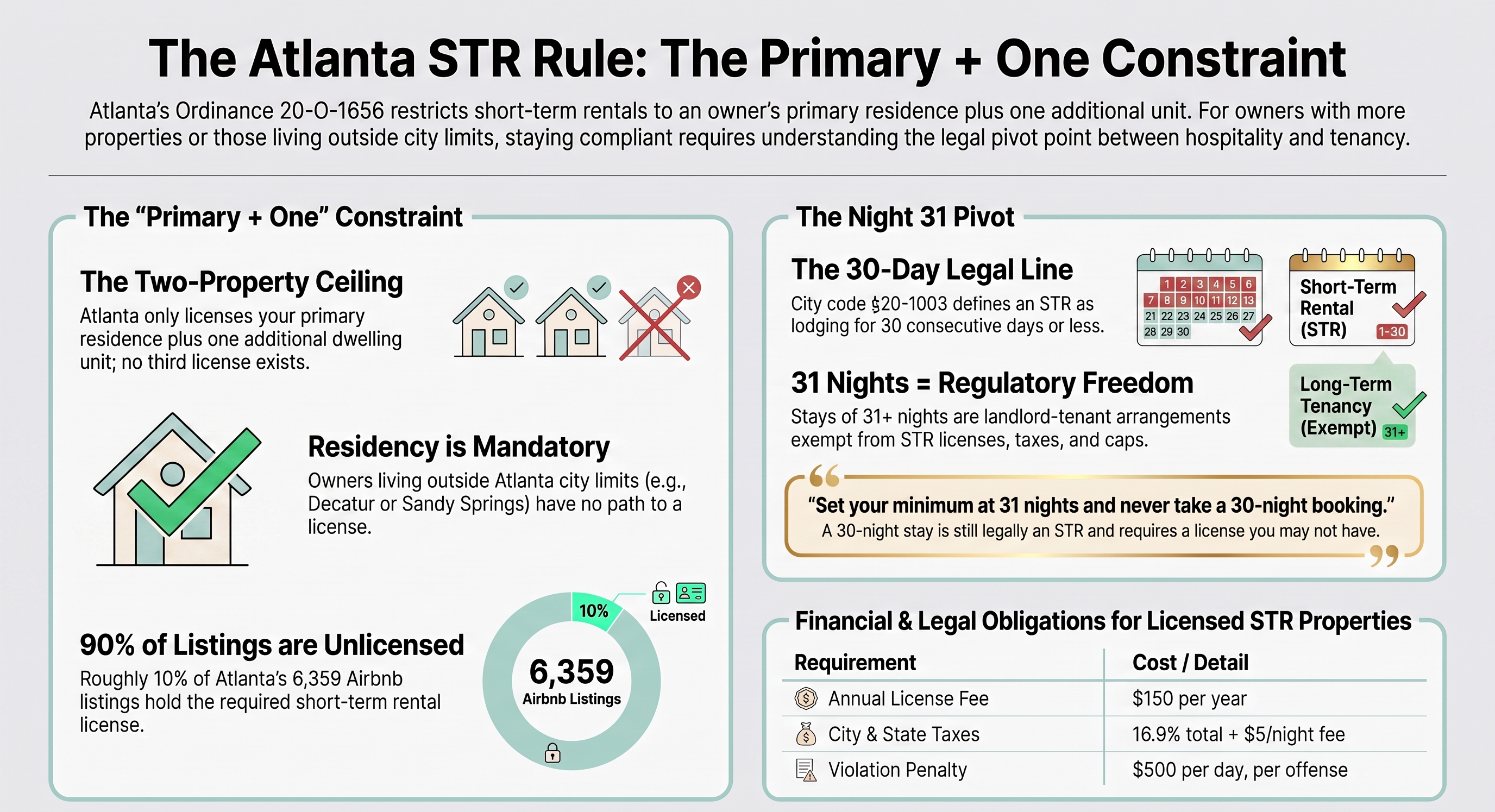
Atlanta's short-term rental license covers your primary residence plus one additional dwelling unit. The primary residence must be registered first. There is no third license, and there is no path in the current code for an owner who lives outside the city.
The city describes its own ordinance in exactly those terms. Ordinance 20-O-1656, adopted March 15, 2021, "established the legal process that authorizes the use of primary residences to host short-term visitors." A single short-term rental license "can include the primary residence and one additional dwelling. The primary residence MUST be registered first." The rules took effect March 1, 2022, and enforcement began March 5, 2023.
Read that as a business constraint rather than a paperwork step. If you own three intown properties and live in one of them, two of them can be licensed. The third cannot be licensed at all. Not for a higher fee, not with a better application. If you live in Decatur, Sandy Springs, or Charlotte and own a rental inside Atlanta city limits, you have no primary residence to register, and so no license to obtain.
The Definition That Runs the Rest of This Guide
Part 20, Section 20-1003 of the city code defines a short-term rental as a dwelling unit provided for lodging, in exchange for compensation, for 30 consecutive days or less.
Everything in the ordinance hangs off that sentence. A stay of 30 consecutive days or less is a short-term rental and needs a license. A stay longer than that is a landlord-tenant arrangement and sits outside the short-term rental regime entirely.
Note the precision, because most guides get it wrong. You will read "30+ day rentals are exempt" on a dozen sites. The code says 30 days or less is a short-term rental. A 30-night booking is still an STR. The line is at 31 nights, and if you build a strategy around this, your minimum-stay setting should read 31, not 30.
What the License Actually Requires
If your property is eligible, here is the full obligation:
| Requirement | Detail |
|---|---|
| Fee | $150 per year, non-refundable, renewed annually |
| STR agent | A designated agent (you, your tenant, or another authorized person) who accepts service of violation notices and monitors compliance |
| In-unit posting | Emergency contact numbers displayed in a visible place |
| Advertising | The STRL number must appear on every online listing |
| City excise tax | 8% of the rental charge |
| Sales tax | 8.9% combined state and local |
| State fee | $5.00 per night, Georgia hotel-motel fee, first 30 nights |
| Penalty | $500 per adjudicated violation, each continuing day a separate offense |
| Three strikes | Three violations on one property within 12 months revokes the license and bars new applications at that address for 12 months |
Sources for the fee, tax, and penalty schedule: Steadily's Atlanta regulations tracker (updated August 6, 2026) and BNBCalc's Atlanta guide (updated August 1, 2026), which agree on all figures.
2. How Much Risk You're Actually Carrying
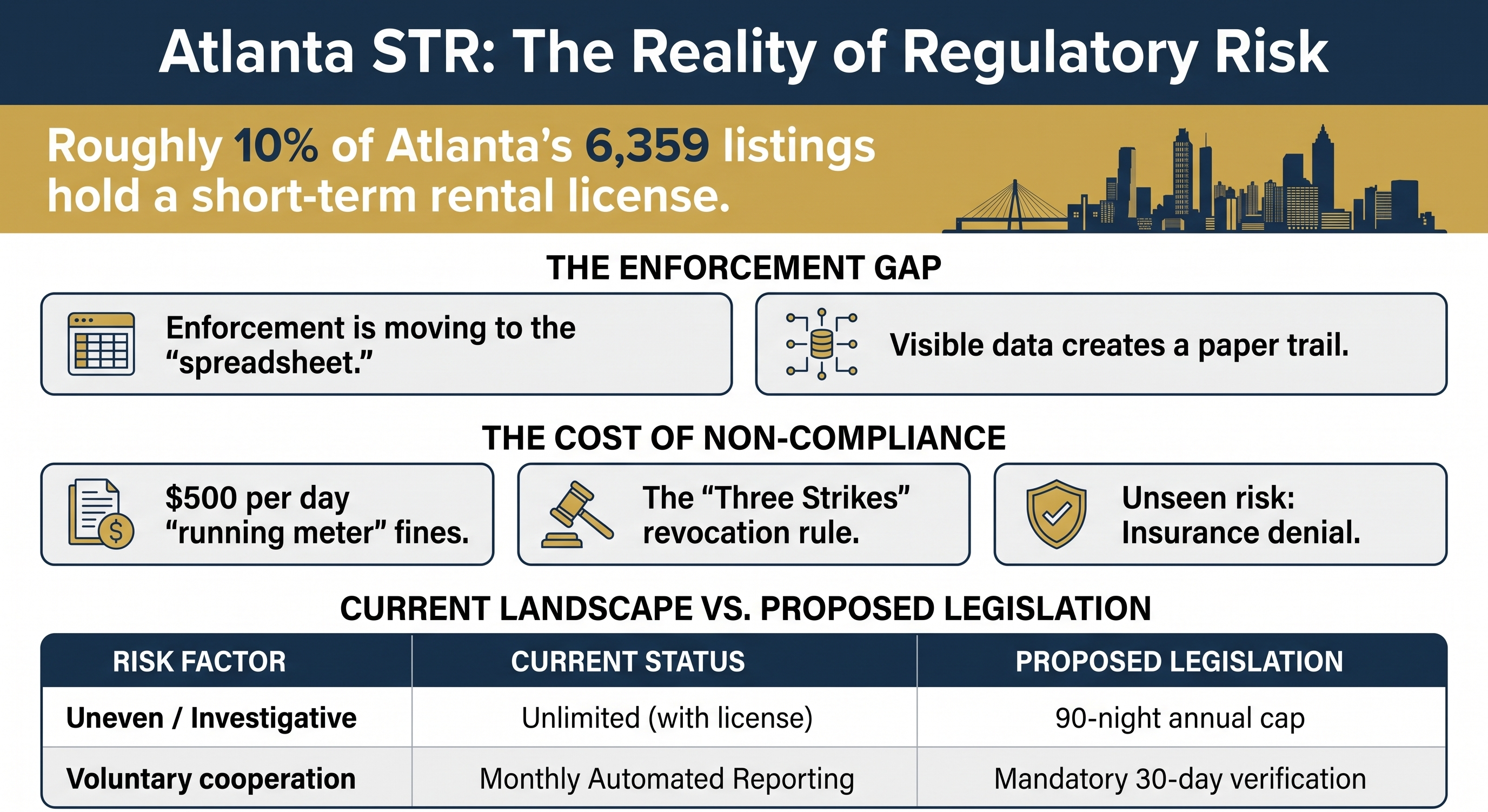
The honest answer is that enforcement in Atlanta has been uneven, and that the gap between the rule and the market is enormous.
As of July 4, 2025, Airbtics counted 6,359 Airbnb listings in Atlanta and estimated that roughly 10% held a short-term rental license. That figure is a third-party estimate now thirteen months old, and we have not found a current city-published count to check it against. Treat it as an order of magnitude, not a precise number. Even discounted heavily, it describes a market where operating without a license is normal.
Normal is not the same as safe, and two things are pushing the gap closed rather than open.
The first is data. The city cross-references platform listings against its registration database, which is why the STRL number is required on the listing itself. An unlicensed listing advertising to the public is not a hard enforcement target.
The second is that both bills currently in committee would require the platforms to report. One would obligate Airbnb and its peers to verify listings against a city-managed system every 30 days and file monthly reports on active listings, rental dates, and taxes collected. Whatever else those bills do, they convert enforcement from an investigation into a spreadsheet.
The exposure is not only the fine. Each continuing day counts as a separate offense, so a $500 violation is a running meter rather than a one-time cost. Three adjudicated violations in twelve months takes the address out of the licensing system for a year. And there is the question nobody enjoys: what your insurance carrier does if a claim arises on a property that was operating unlicensed. That is a conversation to have with your carrier before you need to.
3. What's Coming
Four separate things have happened in Atlanta short-term rental policy since 2024, and owners routinely conflate them. Two proposals are sitting in committee. One ordinance passed. One ban was rejected.
Status verified August 14, 2026.
| Legislation | What it would do | Status |
|---|---|---|
| Amos legislation (introduced Jan 25, 2026) | Limit STRs to a primary residence occupied at least 275 days a year; cap unhosted stays at 90 nights per year; create an Office of Short-Term Rentals; require platform permits, 30-day listing verification, $1M platform liability insurance, and monthly reporting; $1,000 per listing per day platform fines | Held in committee (5-0, March 24, 2026) |
| 24-O-1687 | Raise the license fee to $250; require $500,000 liability insurance; impose a 1,000-foot buffer between rentals | Held in committee |
| Party House Ordinance 2025-10 | Regulates "party houses" separately from STR licensing; bans them in residential districts absent a special permit; 150-foot separation | Adopted April 21, 2025 |
| Northeast Atlanta STR ban | Would have banned short-term rentals in part of northeast Atlanta | Rejected by council, November 18, 2025 |
The provisions of the Amos bill are documented by the Center for Civic Innovation, which covered its introduction on January 25, 2026.
Two things are worth drawing out.
The Amos bill would not adjust the economics of a non-primary-residence rental. It would end it. A 275-day owner-occupancy requirement paired with a 90-night annual cap on unhosted stays is not a fee increase or a compliance burden. A property you do not live in cannot satisfy a 275-day occupancy test at all. If that bill passes in its introduced form, the nightly-rental use of every non-owner-occupied property in Atlanta goes away.
And the restriction trend is real but not inevitable. The council rejected the northeast Atlanta ban in November 2025. Both restrictive bills have been held rather than advanced. Anyone telling you the deadline is next month is selling something. What is true is narrower and more useful: you cannot underwrite a five-year hold on a nightly-rental model against a code this unsettled, and the direction of every proposal on the table is the same one.
4. Night 31
Go back to §20-1003. A short-term rental is lodging for 30 consecutive days or less. A stay longer than 30 consecutive days is not lodging under the city's definition. It is a landlord-tenant arrangement, governed by lease law rather than by Part 20.
That single line is the most useful thing in the ordinance for an owner who cannot get a license, because at 31 nights the following stop applying to you:
-
The short-term rental license requirement, and with it the two-property ceiling
-
The 8% city hotel excise tax and the $5-per-night state hotel-motel fee
-
The requirement to display an STRL number in your listings
-
The STR agent designation and in-unit posting requirements
-
Every provision of both bills in committee, including the 90-night unhosted cap and the 275-day occupancy test
That is a real exemption, not a loophole. The city drew the line itself, in its own definitions section, and it is the same line the state uses for hotel-motel tax treatment.
What Night 31 Does Not Exempt You From
This is the part most people skip, and skipping it is how owners get hurt.
Crossing 31 nights moves you from hospitality into tenancy. That is a different body of law with different obligations:
-
Georgia landlord-tenant law applies, including eviction. A guest who stops paying and will not leave is now a legal proceeding in magistrate court, not a platform dispute resolved in a chat window. This is the single largest operational difference and the one most owners underestimate.
-
You need a written lease, with security deposit handling that follows Georgia's requirements and the disclosures the state expects.
-
Fair housing obligations apply to how you select tenants. Screening is legitimate; screening criteria that filter on protected characteristics are not.
-
Your insurance almost certainly does not contemplate this. A homeowner's policy, a landlord policy, and a short-term rental endorsement are three different products, and a furnished monthly tenancy sits awkwardly across them. Call your carrier before the first booking, not after the first claim.
-
HOA covenants and deed restrictions are private agreements and are unaffected by anything in the city code. A community that prohibits rentals under six months still prohibits them.
-
The income is still taxable. What changes at 31 nights is the lodging excise treatment. Nothing about your income tax position changes. Confirm the specifics with a CPA.
Set your minimum at 31 nights and never take a 30-night booking. A 30-night stay is squarely inside the STR definition, and taking one on an unlicensed property puts you back where you started.
5. Your Four Options, Compared
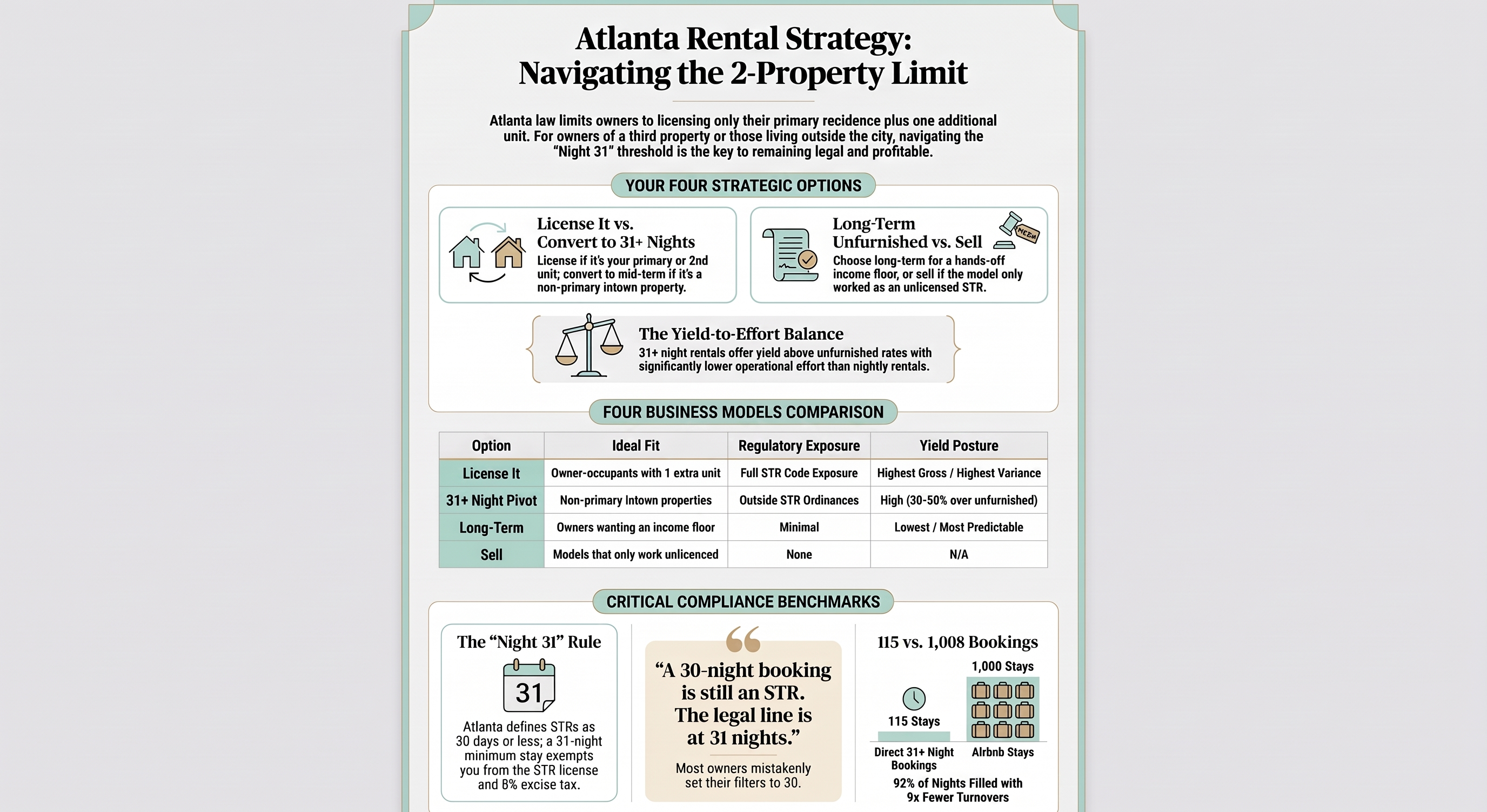
Four paths are genuinely available. Three of them are good answers for somebody.
| License it | Convert to 31+ nights | Long-term unfurnished | Sell | |
|---|---|---|---|---|
| Requires | Primary residence or your one additional unit; $150/yr; agent; tax filings | Furnishing to a livable standard; lease paperwork; new distribution | Standard lease; unfurnished unit | A market and a basis you can live with |
| Yield posture | Highest gross, highest variance | Below peak nightly, well above unfurnished | Lowest, most predictable | N/A |
| Effort | High: nightly operations, turnovers, guest management | Moderate: a handful of placements a year | Low | One-time |
| Regulatory exposure | Full Part 20 exposure, plus whatever passes | Outside Part 20 and outside both pending bills | Minimal | None |
| Fits | Owner-occupants with one extra unit and appetite for operations | Non-primary-residence intown properties in real monthly-demand corridors | Owners who want a floor and no operations | Owners whose model only worked unlicensed |
License it. If the property is your primary residence, or the one additional dwelling unit you are entitled to, this is straightforward and you should just do it. It is $150 and a form. It is the wrong answer if it is property number three, or if you do not live in the city. In those cases there is nothing to apply for.
Convert to 31+ nights. This is usually the strongest risk-adjusted move for a non-primary-residence intown property in decent condition. It is the wrong answer for a property whose entire pro forma depended on peak-weekend nightly rate, and for a property nobody would want to actually live in for two months. A studio with no desk, no storage, and no laundry does not become a monthly rental because you set the minimum-stay slider to 31.
Long-term unfurnished. The right answer for an owner who wants an income floor and no operations. It costs you the furnished premium, which is real money. Industry sources put the furnished uplift over a comparable unfurnished lease at somewhere between 30% and 50%, varying widely by market and property. Treat that as a reason to price your own comps rather than as a number to underwrite. You are choosing to leave some of it on the table in exchange for simplicity, which can be a perfectly good trade.
Sell. If the only version of the numbers that worked was the unlicensed nightly version, selling is the honest answer rather than the failure case. A property that does not work under any compliant use is a property to redeploy, not to operate nervously and hope.
If your property is not your primary residence and it is a real home in an intown neighborhood, the recommendation is the second column. The rest of this guide is the evidence for that and the work it requires.
6. What 31+ Night Demand Looks Like in Atlanta
The objection to the 31-night route is always the same: who actually books a furnished home for two months?
In Atlanta, five groups do, and each is structurally longer than 30 nights:
-
Traveling healthcare workers. Standard travel-nurse contracts run 13 weeks. Atlanta's hospital corridors (Emory, Grady, Piedmont, Northside) generate steady rotation.
-
Relocating professionals. Someone starting a job in a new city needs somewhere to live for the 60 to 90 days between arriving and closing on a house.
-
Insurance placements. A family displaced by fire or water damage is placed by their carrier's additional-living-expense coverage, typically for months, and the carrier pays.
-
Film and production crews. Georgia's production economy runs on multi-month schedules, and crews need housing near the stages.
-
Project teams. Infrastructure, data-center, and enterprise-software deployments bring engineers to a city for a quarter at a time.
Nationally, the category has moved. US bookings of 28 nights or more grew roughly 136% between 2019 and 2025, according to Furnished Finder, an industry platform in the space.
Our own numbers say the same thing more precisely. Across our Atlanta portfolio in the first half of 2026, our direct booking channel took 115 bookings at an average of 59.8 nights. Airbnb, over the same period, took 1,008 bookings at an average of 7.4 nights.
Run the arithmetic. Those 115 direct bookings consumed roughly 6,880 calendar nights. The 1,008 Airbnb bookings consumed roughly 7,460. Direct filled about 92% of the nights Airbnb did, from one-ninth as many bookings. One long placement is worth roughly eight nightly stays in calendar occupancy, and it comes with one turnover instead of eight.
Two caveats belong with those numbers, because a statistic without its limits is marketing.
The first is that this is our portfolio, not the market. Through May 2026, the Atlanta market's roughly 12,600 listings averaged $106 ADR, 58% occupancy, and $62 RevPAR. We ran $218, 72.3%, and $153.64. That gap is selection and operation: which submarkets, which properties, how they are priced and run. It is not a rising tide that lifts any property that switches strategy. Our full methodology and the segment-level detail are in the mid-year market update.
The second is the number that cuts against the argument: 76% of our bookings still run under seven nights. Nightly rental is not dead in Atlanta, and nothing here says mid-term beats short-term everywhere. The claim is narrower. For a property that cannot legally be licensed for nightly use, the 31+ night route is a compliant path with lower operational variance and demonstrable demand. That beats an uncertain path every time.
If you want to see what those guests are evaluating when they book, our extended-stay guide covers the same market from the demand side.
7. If You Convert, Here's What Changes
Converting is not a setting change. Six things move.
The furnishing standard goes up, not down. Someone living in your property for two months needs a real desk, closet and drawer storage, in-unit laundry, and a kitchen they can cook in more than once. A property furnished for weekend guests fails a 60-night guest in the first week, and that shows up in your reviews and your renewals.
Pricing moves from nightly dynamic to a monthly rate, typically with utilities and internet included. Your comparison set is furnished monthly listings in your submarket, not hotel rates and not your old nightly ADR times thirty.
Paperwork replaces platform terms. A written lease, security deposit handling, tenant screening, and a defined process for non-payment. Your platform's resolution center is no longer the mechanism.
Distribution changes completely. Furnished Finder, corporate housing intermediaries, insurance placement networks, relocation coordinators, production office housing coordinators, and your own direct channel. Some of your nightly channels will still list 31+ night stays, but they are no longer where the demand is.
Turnover economics invert, including the downside. Far fewer cleans, but each is a deeper reset. And the real cost is the gap: a vacancy between two monthly placements is a two- or three-week hole, not a Tuesday. Occupancy in this model is won on pipeline, not on last-minute pricing.
Tax treatment shifts at the excise line only. Past 30 consecutive days the lodging excise stops applying. Your income tax position is unchanged. Confirm both with a CPA.
Before You Convert, Run This
-
Call your insurance carrier, describe the actual use (furnished, tenant-occupied, 31+ nights), and get the answer in writing
-
Pull your HOA covenants and deed restrictions and check for a minimum lease term
-
Get a Georgia-appropriate furnished lease template in front of an attorney
-
Walk the property and list what a 60-night resident would need that a weekend guest doesn't
-
Find three real furnished monthly comps in your submarket and price against those, not against your nightly ADR
8. Frequently Asked Questions
Can I Airbnb a second home in Atlanta?
Only if it is the one additional dwelling unit attached to your primary residence license, and only if your primary residence is registered first. A second home you do not live in, with no Atlanta primary residence registered, cannot be licensed under the current code.
Do I need a license to rent my Atlanta property for 30 days?
Yes. Section 20-1003 defines a short-term rental as lodging for 30 consecutive days or less, so a 30-night stay is inside the definition. The exemption begins at 31 consecutive nights. Set your minimum to 31.
What is Atlanta's primary residence rule for short-term rentals?
The short-term rental license authorizes use of a primary residence. One license covers that primary residence plus one additional dwelling unit, and the primary residence must be registered first. There is no non-owner-occupied licensing path.
How many short-term rental licenses can one owner hold in Atlanta?
One, covering two properties: the primary residence and one additional dwelling unit. There is no third.
What is the 90-night cap I keep reading about?
It is a proposal, not current law. Legislation introduced January 25, 2026 by Councilmember Byron Amos would cap unhosted short-term rentals at 90 nights per calendar year and require 275 days of owner occupancy. It was held in committee on March 24, 2026 and has not passed.
Is Airbnb still profitable in Atlanta?
For some properties. The market averaged 58% occupancy and $62 RevPAR through May 2026, well below what most pro formas written between 2021 and 2023 assumed. Profitability now depends on submarket, property quality, and operations rather than on the market average, and on whether the property can be licensed at all.
What is the difference between a short-term and a mid-term rental?
In Atlanta, the line is legal, not marketing. Thirty consecutive days or less is a short-term rental requiring a license. Longer than 30 days is a landlord-tenant arrangement governed by lease law, outside the STR ordinance and outside the city's hotel excise tax.
What does short-term rental management cost in Atlanta?
Full-service management generally runs 18% to 40% of gross revenue nationally, with 20% to 25% typical. Atlanta quotes span roughly 10% to 35% depending on what is actually included. Compare on scope: cleaning, maintenance, furnishing, and marketing are the line items that move the number.
What happens if I have been operating without a license?
Penalties run $500 per adjudicated violation with each continuing day a separate offense, and three violations within twelve months revoke the license and bar reapplication at that address for a year. If your property cannot be licensed, continuing to operate nightly is not a risk that improves with time. Talk to an attorney about your position before deciding.
Does the 31-night route work outside Atlanta city limits?
This guide covers the City of Atlanta code only. Decatur, Sandy Springs, Brookhaven, and unincorporated DeKalb and Fulton each have their own rules and their own thresholds. Check the jurisdiction your property actually sits in. Municipal boundaries in metro Atlanta are not intuitive.
Where This Leaves You
The ceiling is two properties. The threshold is 31 nights. The code is unsettled, and every proposal on the table moves in the same direction.
There are four honest answers, and three of them are good ones for somebody. The owners who get hurt over the next eighteen months will mostly be the ones who waited for a committee to decide for them.
If you own an intown Atlanta property that is not your primary residence and you want to work through which of the four fits it, we run 160+ furnished properties across Atlanta and can tell you what the monthly demand actually looks like in your submarket. That conversation is worth having whether or not you ever hire anyone to manage it.
TL;DR
Atlanta licenses your primary residence plus one additional dwelling unit. No third license exists, and no path exists for owners who live outside the city. Roughly 10% of listings are licensed; enforcement runs $500 per violation per day. Two restrictive bills sit in committee, one of which would end non-owner-occupied nightly rental entirely. Section 20-1003 defines a short-term rental as 30 consecutive days or less, so stays of 31+ nights fall outside the ordinance, the excise tax, and both pending bills. For a non-primary-residence intown property, converting to 31+ night furnished rental is usually the strongest risk-adjusted option, with real tenancy-law obligations attached.
How Minty Living Can Help
The decision this guide walks through (license it, convert it, lease it long, or sell it) is one we work through with Atlanta owners regularly, and the answer genuinely does depend on the property.
Minty Living manages 160+ furnished properties across intown Atlanta. We were founded in 2021 by Benjamin Gross and Sidra Gross, and most of what we know about the 31+ night market comes from operating in it rather than from studying it. Here is what we bring to the conversation:
Atlanta demand data, not market averages. We run properties across Inman Park, Old Fourth Ward, Grant Park, Midtown, Cabbagetown, Poncey-Highland, Reynoldstown, Virginia-Highland, Little Five Points, and Ormewood Park. We can tell you what monthly furnished demand actually looks like in your submarket, and what it does not.
The demand channels the 31+ night model depends on. Traveling healthcare, corporate relocation, insurance placements, film and production crews, and extended project teams are all markets we already serve. That distribution is the part of a mid-term conversion most owners underestimate, and it is the part that takes longest to build from scratch.
In-house design. Our design team is led by architect co-founder Sidra Gross, and every property in our portfolio is furnished by that team. The furnishing standard that makes a property work for a 60-night resident is a specific standard, not a nicer version of a weekend rental.
A quality bar you can check. 4.9 Google rating, Airbnb Superhost status, and an eligible portfolio that meets Plum Guide's "Top 1%" selection criteria.
To be clear about what we do not do: we do not file short-term rental licenses on an owner's behalf, and we cannot tell you whether your specific property is compliant. Those are questions for the city and for your attorney.
What we can do is look at a specific property with you and give you a straight read on which of the four options fits it, including the ones that do not involve hiring us. If your answer turns out to be "license it yourself" or "keep the long-term tenant," that is a useful thing to know.
The fastest way to start is to send us the property details. Our owner inquiry form takes a few minutes and asks what we would ask on a call anyway: where the property is, what it is, how you are using it now, and what you are trying to solve.
Tell us about your property, or reach out at owners.mintyliving.com or (404) 999-0841 if you would rather just talk it through.
Benjamin Gross is co-founder of Minty Living, which manages 160+ furnished properties across intown Atlanta. This guide describes how the City of Atlanta ordinance reads and how operators respond to it. It is not legal advice and is not a compliance determination for any specific property. Last verified August 14, 2026.
References
[1] City of Atlanta. "Short-Term Rental Program." Department of City Planning. Accessed August 2026.
[2] City of Atlanta. "Short Term Rental Program (ATL311, KB0013809)." Accessed August 2026.
[3] City of Atlanta Code of Ordinances. "Part 20, Short Term Rentals, §20-1003 Definitions and General Provisions." Municode Library. Accessed August 2026.
[4] Steadily. "Airbnb & Short Term Rental Laws and Regulations in Atlanta." Updated August 6, 2026.
[5] BNBCalc. "Atlanta, Georgia Short-Term Rental Regulation: A Guide for Airbnb Hosts." Updated August 1, 2026.
[6] Center for Civic Innovation. "New Short-Term Rental Legislation Introduced." January 25, 2026.
[7] Airbtics. "Airbnb Rules in Atlanta: Is Short-Term Rental Really Allowed?." Accessed August 2026; licensed-listing share as of July 4, 2025.
[8] Atlanta News First. "City Council Rejects Proposal to Ban Short-Term Rentals in Northeast Atlanta." November 18, 2025.
[9] Furnished Finder. "Mid-Term Rentals Explained: What They Are, What They Are Not, and Why Investors Care." 2026.
[10] Minty Living. "Atlanta Short-Term Rental Mid-Year 2026 Market Update." June 30, 2026. First-party portfolio and channel data.
 (4).png)

 (29).png)
 (28).png)
 (33).png)
 (37).png)
 (38).png)
 (39).png)
 (40).png)
 (44).png)
 (44).png)
 (1).png)
 (3).png)
 (55).png)
 (54).png)
 (56).png)
 (57).png)
 (58).png)
 (59).png)
 (60).png)
 (61).png)
 (63).png)
 (66).png)
 (45).png)
 (67).png)
 (68).png)
 (69).png)
 (70).png)
 (72).png)
 (73).png)
 (86).png)
 (87).png)
 (89).png)
 (92).png)