


 (44).png)
Atlanta hotel rates have climbed from $129.91 to $219.77 since the World Cup draw — and analysts project $400–500/night peak rates during match weeks. If you held a hotel block through March, you already know what happened next: FIFA released unsold rooms back to market, booking pace stayed soft, and the lodging strategy your team approved in Q4 is now a line item under pressure. This is the procurement playbook for World Cup 2026 Atlanta overflow housing — what comes next when the hotel block fails.
Table of Contents
-
The Hotel-Block Math Broke: Why Atlanta's World Cup Rates Crushed Plan A
-
Corporate Housing as Plan B: The Procurement Case Beyond Price
-
The Full TCO Comparison: Hotels, Corporate Housing, and the Hybrid Split
-
Procurement Compliance Checklist: W-9, COI, GSA Per Diem, and Atlanta's STR Rules
-
The Numbers: Cost Scenarios for 20 and 50 Executives During World Cup Atlanta
-
7-Point Corporate Housing Vendor Vetting Checklist (World Cup 2026 Atlanta)
-
Frequently Asked Questions — Atlanta Corporate Housing for World Cup 2026
The Hotel-Block Math Broke: Why Atlanta's World Cup Rates Crushed Plan A
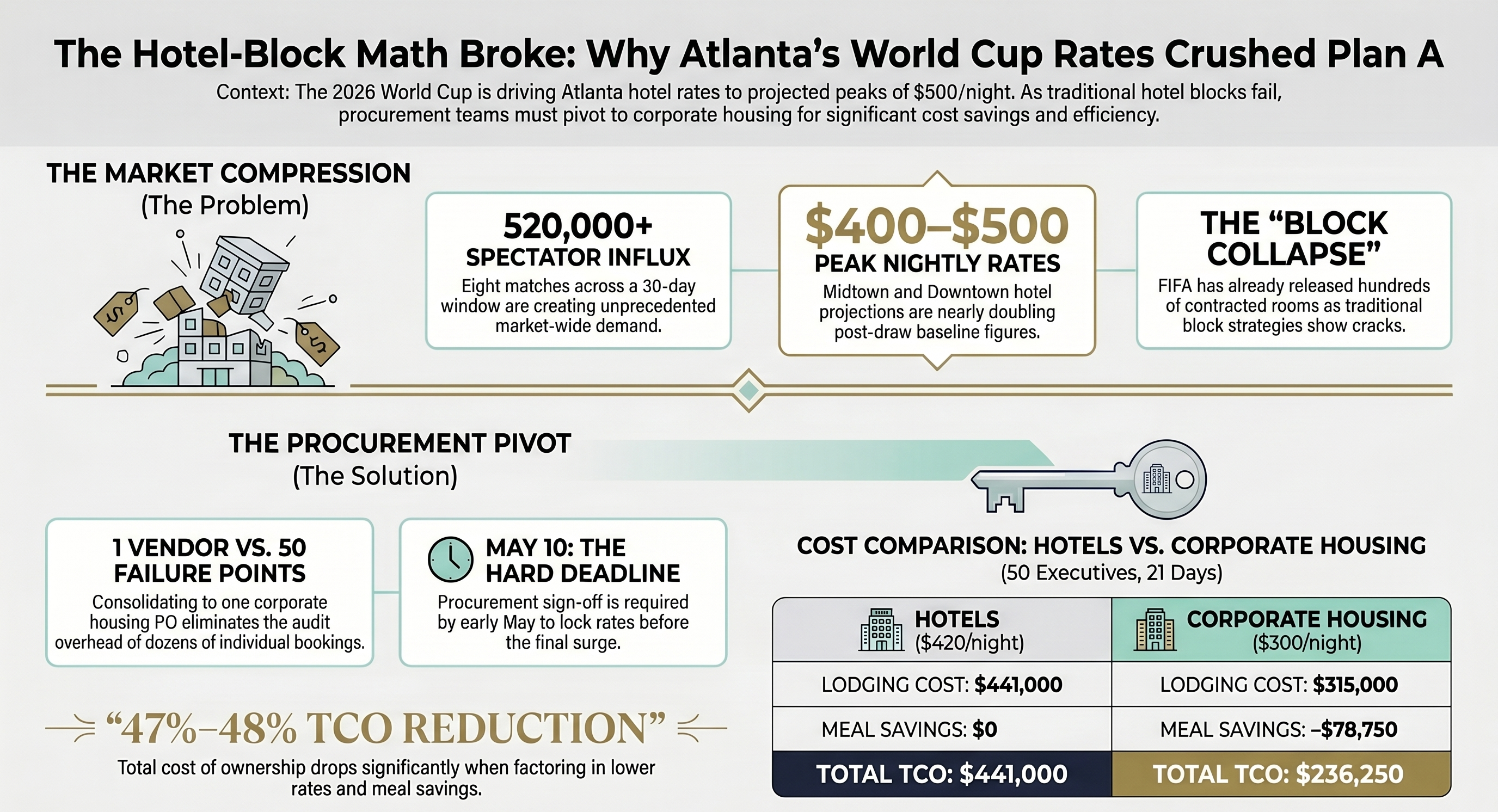
The demand math is straightforward. Mercedes-Benz Stadium hosts 8 FIFA World Cup matches — group stage on June 15, 18, 21, 24, and 27; Round of 32 on July 1; Round of 16 on July 7; and a semifinal on July 15. That is a 30-day demand window in a metro expecting 520,000+ spectators and $503.2 million in economic impact across the state.
Atlanta hotel ADR rose 27% post-draw — from $129.91 to $219.77 — according to Lighthouse Intelligence. That headline figure is deceptive — game-day pricing in Atlanta shows the smallest match-day spike among the 16 host markets (+1.73%), masking the sustained above-baseline rate that persists across the full 30-day window. Peak-week projections run $400–500 per night for Midtown and Downtown properties, with short-term rental inventory mirroring the compression: non-game-day STR bookings are already running +131% year-over-year, and demand for Spain vs. Saudi Arabia on June 21 has spiked +338% according to AirDNA data. Luxury downtown units are listing above $1,200 per night during semifinal week.
The hotel-block strategy has already shown cracks. FIFA itself released 400–500 contracted rooms at the Marriott Marquis Atlanta as reported by the Atlanta Journal-Constitution in March 2026. Across all 16 host markets, Travel Weekly documented approximately 2,000 room nights released in Philadelphia alone, with some hotels reporting 95%+ cancellation rates on World Cup blocks. If FIFA's own contracted inventory dissolves, corporate blocks held by individual companies had no preferential protection.
Inventory reality check. Minty Living, one of the Atlanta corporate-housing operators with dedicated World Cup inventory, currently shows 27% of its 155 active World Cup-window properties already booked as of April 16, 2026 — with 114 properties still available for the June 14 – July 19 window (source: Minty Living Guesty production data, 2026-04-16). This is one operator. Across the Atlanta corporate-housing market, the directional signal is consistent: scarcity is real and accelerating, not theoretical.
Rate negotiation is no longer a lever. Supply source and consolidation are the only levers left.
With rate negotiation off the table, procurement's next move is finding a supply source that actually passes a W-9 check — and that math looks very different.
Corporate Housing as Plan B: The Procurement Case Beyond Price
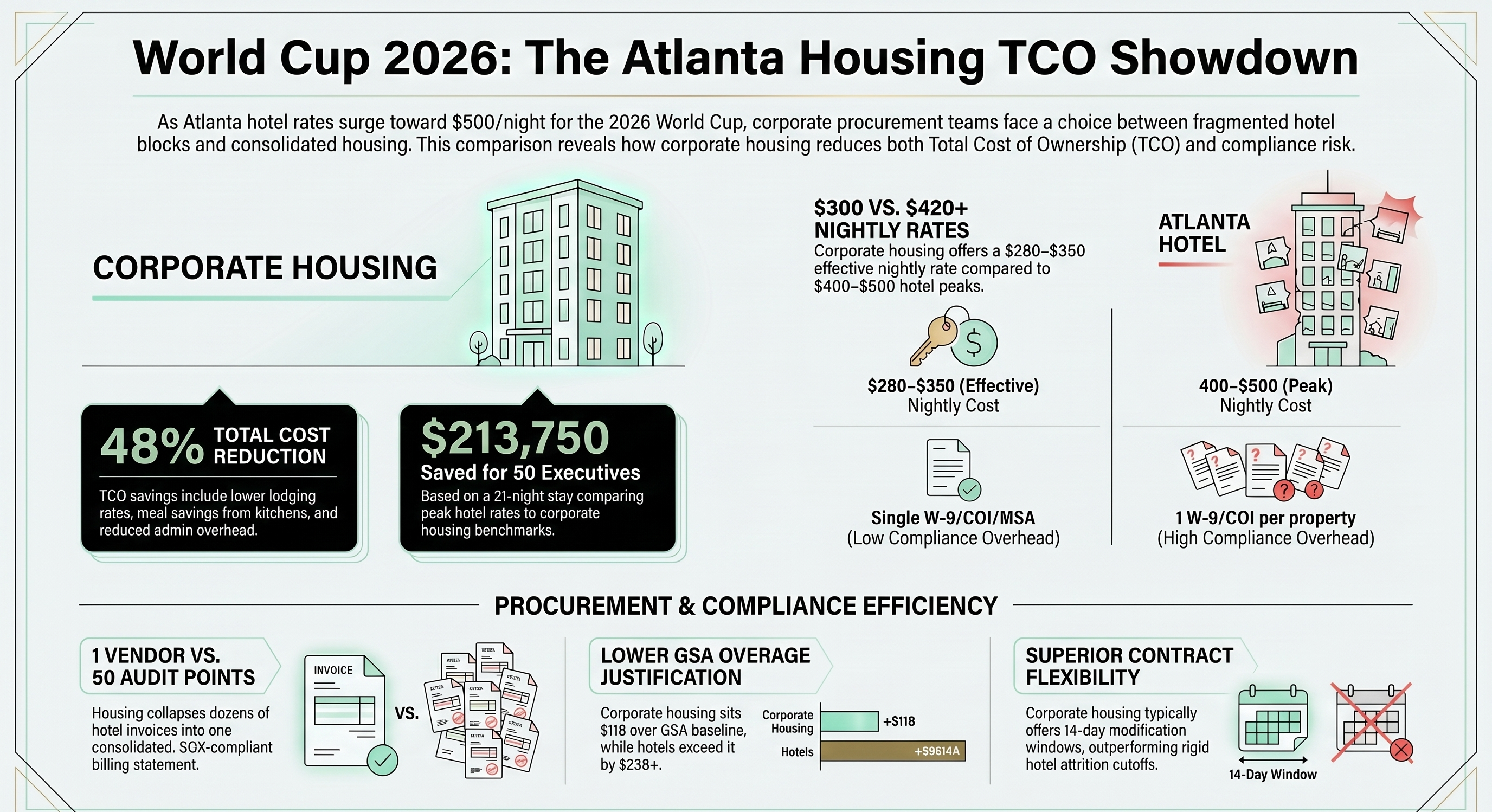
The cost bridge is the first thing procurement teams verify. Corporate housing in Atlanta runs $3,000–5,000 per month — an effective nightly rate of $100–167 on a 30-day basis. For a 2–4 week World Cup window, the blended effective rate works out to approximately $280–350 per night for a 2–4 week window (derived from the $3,000–5,000/month industry benchmark), compared to the $400–500 per night hotel peak now forecast. When meal savings from in-unit kitchens are factored in ($1,500–3,000 per month in avoided dining costs), the total cost of ownership reduction runs 37–40% for multi-month extended stays (AvenueWest, 2025). For the 2–4 week World Cup window, the cost scenarios in Section 6 derive the applicable comparison — 47–48% TCO reduction at the specific hotel and housing rates active in June 2026.
Space matters for executives working during the visit. Corporate housing averages 700–1,200 square feet versus 330 square feet for a standard hotel room. For visiting executives running client meetings and call schedules across time zones, workspace and a kitchen are duty-of-care obligations, not amenities.
The consolidation argument is where the procurement case becomes compelling. Fifty individual hotel bookings mean 50 invoices, 50 compliance reconciliations, 50 vendors to vet, and 50 points of liability. One corporate housing vendor means one purchase order, one invoice, one SLA, and one compliance check. This is a procurement-efficiency argument, not a preference.
The industry data confirms the trend. Deloitte's 2025 Corporate Travel Study found that 54% of travel managers now cite cost as their top priority — up from 48% the prior year — and that 50% of travel providers actively encourage cheaper lodging alternatives. Separately, GBTA's 2025 policy report identified out-of-policy hotel stays as a major challenge for 28% of organizations.
Several corporate-housing providers operate in the Atlanta market with dedicated World Cup inventory, including Blueground, Blu Corporate Housing, Executive Corporate Living, Minty Living, Placemakr, Premier Corporate Housing, and South Downtown ATL. These providers span national tech-enabled platforms to Atlanta-specialist operators with dedicated World Cup inventory.
Corporate housing requires a longer vetting cycle than hotel bookings — 1–2 weeks minimum for contract and compliance review. For the group moving in June, that window is closing.
For Navan- or TripActions-native travel programs, corporate housing typically delivers a single monthly invoice exportable to Concur expense categories or an ERP, with approvals routed through Slack or email as an interim bridge while major housing providers ship native Navan API integration. The workflow change is smaller than the procurement change.
Cost and consolidation make the case on paper; the table in the next section puts both options side-by-side with the numbers procurement actually needs for a steering-committee deck.
The Full TCO Comparison: Hotels, Corporate Housing, and the Hybrid Split
| Option | Effective per-night cost | Booking window (as of April 2026) | Compliance overhead | Lock-in / cancellation risk | Operational risk |
|---|---|---|---|---|---|
| Atlanta Hotel — Last-Minute (open market) | $400–500/night peak weeks (AJC) | Available now; rates non-negotiable | 1 W-9/COI per property; multiply by number of hotels | Fully flexible; no lock-in | 50 bookings = 50 failure points; duty-of-care fragmented |
| Atlanta Hotel — Surviving Block (pre-negotiated) | $180–280/night (if block intact) | Closed; most blocks released or non-renewable | Same per-property overhead | Block terms vary; often non-refundable after cutoff | Fewer properties but same fragmentation for >5 execs |
| Corporate Housing | $280–350/night effective (30-day basis; AvenueWest) | 1–3 weeks to contract; inventory filling | Single W-9, COI, MSA; one Ariba entry | 30-day minimum; 2-week modification window typical | One SLA, one insured vendor, one duty-of-care record |
| Hybrid 60/40 Split (hotel <5 nights; housing >7 nights) | Blended ~$320–380/night | Requires parallel sourcing | Two vendor tracks; reduced fragmentation | Moderate; housing anchor reduces exposure | Pragmatic; reduces hotel-only risk while preserving short-stay flexibility |
The compliance-overhead column warrants attention. The per-property W-9 and COI requirement is not theoretical — it is an Ariba or Coupa entry per property. Fifty executives across 10 hotels means 10 separate Ariba entries, 10 compliance reviews, and 10 renewal cycles. Corporate housing collapses that to one.
The lock-in asymmetry also favors housing. Surviving hotel blocks typically have hard attrition cutoffs. Corporate housing contracts, by contrast, commonly include 2-week modification windows — making them more flexible than the blocks procurement already signed.
Many procurement teams land on the hybrid row, and that is the right answer for mixed-duration groups. Hotels for guests staying 1–4 nights; corporate housing for anyone at 7 or more nights. The compliance math still wins: two vendor tracks, not fifty.
The table frames the cost and risk comparison — but compliance is where decisions actually stall, and Atlanta's STR ordinance adds a layer most vendor proposals don't address.
Procurement Compliance Checklist: W-9, COI, GSA Per Diem, and Atlanta's STR Rules
Compliance/SOX-heavy section. FS and Fortune 500 procurement readers: read in full. Tech/ops readers running Navan or Slack-first workflows: skim the GSA subsection, then jump to the vendor checklist for the actionable artifact.
GSA Baseline and Per Diem Treatment
Atlanta's FY2026 lodging per diem stands at $182 per night, with meals and incidentals at $86 per day (GSA). Corporate housing at an effective $280–350 per night sits above the GSA lodging baseline. The overage — $98–168 per night — is treated as taxable wages unless documented as a business-necessity exception with a written business purpose, attendee list, and pre-approval memo. The emerging best practice is a hybrid reimbursement model: per diem for meals and incidentals, actual expense for lodging with exception documentation.
Hotels at $420+ per night create a larger GSA overage — $238 or more per night. The documentation burden is identical for both lodging types. The overage that requires CFO justification is simply 2x larger for hotels.
Document the above-GSA overage before the trip, not after. The documentation requirement is identical for hotels and housing; the overage amount is materially different.
This section is educational. Verify current per diem rates and tax treatment with your corporate tax advisor and legal counsel.
W-9, COI, and Ariba/Concur Vendor Setup
Corporate housing vendors are W-9 business entities, not 1099 contractors. Confirming W-9 status before Ariba submission eliminates the 30-day Workday review cycle that 1099 classification would trigger.
Required documents for Ariba or Coupa vendor entry: W-9, Certificate of Insurance (COI with minimum $1M general liability), indemnification clause in the master service agreement, and SOX-compliant 7-year record retention language. Standard Ariba vetting runs 2–4 weeks. For a June 14 move-in, vetting must start by May 1. Pre-vetted vendors with existing financial-services-firm certifications can compress that to 7–10 business days.
Most established corporate-housing vendors deliver a consolidated line-item invoice compatible with Concur expense categories. For Navan-native shops, request a Slack-native approval workflow as an interim bridge while API integration develops.
Atlanta STR Ordinance — The Compliance Gap No Competitor Addresses
Any stay under 30 days in an Atlanta short-term rental property requires a Short-Term Rental License (STRL): $150 per year registration fee, plus 8% hotel-motel tax on all revenue. The operator must provide a 24/7 emergency contact. Non-compliant operators expose the corporate client to city-tax liability and audit exposure.
During vendor vetting, require proof of STRL compliance — license number and current registration. This is one line on a vendor questionnaire that protects the corporate client from carrying an unvetted operator's tax exposure. Most established Atlanta corporate-housing operators are STRL-compliant. The question is documentation: ask for the license number before you sign.
Compliance clears the vendor. The next question every CFO asks is: what does this actually cost for my group — in dollars, for June, at scale?
The Numbers: Cost Scenarios for 20 and 50 Executives During World Cup Atlanta
Scenario A: 20 Executives, 14-Night Stay
| Line item | Hotels (last-minute, $420/night) | Corporate Housing ($300/night effective) |
|---|---|---|
| Lodging cost | $420 × 20 × 14 = $117,600 | $300 × 20 × 14 = $84,000 |
| Meal savings (kitchen access) | $0 | −$75/exec/day × 14 = −$21,000 |
| Compliance overhead (admin hrs × $150/hr) | 10 hotels × 3 hrs = $4,500 | 1 vendor × 4 hrs = $600 |
| Total TCO | $122,100 | $63,600 |
| Delta | — | $58,500 saved (48%) |
Meal savings assume 50% in-unit cooking or delivery. Compliance overhead uses a conservative $150/hr loaded admin rate — adjust for your organization's loaded labor cost.
The effective $300/night figure benchmarks corporate-housing industry averages (AvenueWest, 2025). Operators with dedicated World Cup monthly rates — Minty Living, for example, applies a World Cup monthly rate to any booking overlapping June 11 – July 11, 2026 — may quote inside this band depending on bedroom mix and proximity to Mercedes-Benz Stadium. Get an operator-specific rate before signing.
Scenario B: 50 Executives, 21-Night Stay (Full Match Window)
| Line item | Hotels ($420/night) | Corporate Housing ($300/night effective) |
|---|---|---|
| Lodging cost | $420 × 50 × 21 = $441,000 | $300 × 50 × 21 = $315,000 |
| Meal savings | $0 | −$75 × 50 × 21 = −$78,750 |
| Compliance overhead | 20 hotels × 3 hrs = $9,000 | 1 vendor × 6 hrs = $900 |
| Total TCO | $450,000 | $236,250 |
| Delta | — | $213,750 saved (47%) |
$213,750 in TCO savings at 50 executives. That scenario also collapses from an estimated 20+ hotel invoices and 20 compliance entries to one consolidated monthly statement.
GSA bridge. At $300/night effective, corporate housing sits $118 above the $182 GSA Atlanta lodging baseline. At $420/night, hotels sit $238 above baseline. The documentation burden is the same; the overage that requires CFO justification is 2x larger for hotels.
The math is clear. The next step is knowing whether a vendor can actually pass your procurement process — the following checklist condenses that into seven questions.
7-Point Corporate Housing Vendor Vetting Checklist (World Cup 2026 Atlanta)
-
W-9 on file, Federal Tax ID verified — Confirms vendor is a business entity (not 1099 contractor); eliminates the 30-day Workday/Concur review delay for tax classification.
-
Certificate of Insurance (COI), minimum $1M general liability — Required for Ariba/Coupa vendor approval and legal sign-off; ask for additional-insured endorsement naming your company.
-
Atlanta Short-Term Rental License (STRL) documentation — License number + current registration; verifies 8% hotel-motel tax compliance and 24/7 emergency contact requirement (city.atlantaga.gov).
-
Consolidated invoicing capability — Single monthly invoice per group, itemized by unit; compatible with Concur expense categories or exportable to your ERP; eliminates per-unit reconciliation.
-
SOX-compatible record retention — Vendor maintains documentation trail for 7 years (or your policy minimum); ask for a sample retention policy document before signing.
-
Ariba/Coupa pre-approval or expedited vetting path — Confirm vendor can provide all documents within 5–7 business days; ask if they have existing approval with peer FS or Fortune 500 firms.
-
Contract modification and cancellation terms — Minimum: 14-day written modification window; confirm what triggers a cancellation fee and whether force-majeure language covers event-cancellation scenarios.
Before the checklist conversation happens, procurement teams almost always have the same four or five objections — answered below.
Frequently Asked Questions — Atlanta Corporate Housing for World Cup 2026
What's the best housing option for World Cup 2026 Atlanta when hotel blocks are full?
For groups of 10+ executives staying 7 or more nights, corporate housing offers the strongest combination of cost control, compliance simplicity, and space. Effective rates of $280–350/night compare favorably to $400–500/night hotel peaks. One consolidated vendor means one invoice, one W-9, and one compliance audit — versus one per hotel property.
Are Atlanta corporate housing vendors W-9 entities, or do they trigger 1099 reporting?
Established corporate-housing operators are W-9 business entities, not independent contractors. They issue standard commercial invoices, not 1099-qualifying payments. Confirm W-9 status before Ariba submission and request a Federal Tax ID letter to document classification upfront — this eliminates the 30-day review lag.
Corporate housing rates exceed the $182 GSA Atlanta per diem — how do we handle the overage for reimbursement?
Atlanta hotels during World Cup weeks also exceed GSA baseline — by $238/night or more. The documentation requirement (business-purpose memo, pre-approval, attendee list) is identical for both lodging types. The overage requiring justification is simply 2x smaller with corporate housing. Work with your corporate tax counsel to document the exception pre-trip.
Our team uses Navan (TripActions). Does corporate housing integrate with our booking workflow?
Most established corporate-housing vendors do not have native Navan integration yet. The practical workaround: request a single consolidated monthly invoice exported in a format compatible with your ERP or expense tool, and route approvals through an existing Slack or email workflow. Navan API integration is on the roadmap for several major providers.
Is consolidating to one housing vendor a single point of failure compared to spreading across hotels?
The consolidation-as-risk argument inverts under scrutiny. Fifty individually booked hotels represent 50 cancellation risks, 50 unrelated SLAs, and 50 duty-of-care liability points. One insured corporate-housing vendor with a service-level agreement, unit-redundancy provision, and 24/7 contact is a materially lower operational risk profile — not a higher one.
The Decision Window Is Closing: Your Next 3 Steps
To lock corporate housing rates before the June surge peak and complete Ariba vendor vetting by the May 10 contract deadline, the procurement timeline runs backwards: vetting start by April 28, contract by May 10, move-in June 14.
-
Run your group size and stay duration through the cost-scenario math above — or submit the form below for a custom comparison.
-
Run the 7-point checklist against any vendor you're evaluating, including hotel programs. No exceptions for compliance.
-
Tell us your headcount and dates — we'll send a property shortlist and TCO comparison within hours.
Submit the World Cup 2026 housing inquiry form →
Use the 7-point checklist above with any Atlanta corporate housing provider — the questions are the same regardless of operator.
How Minty Living Can Help
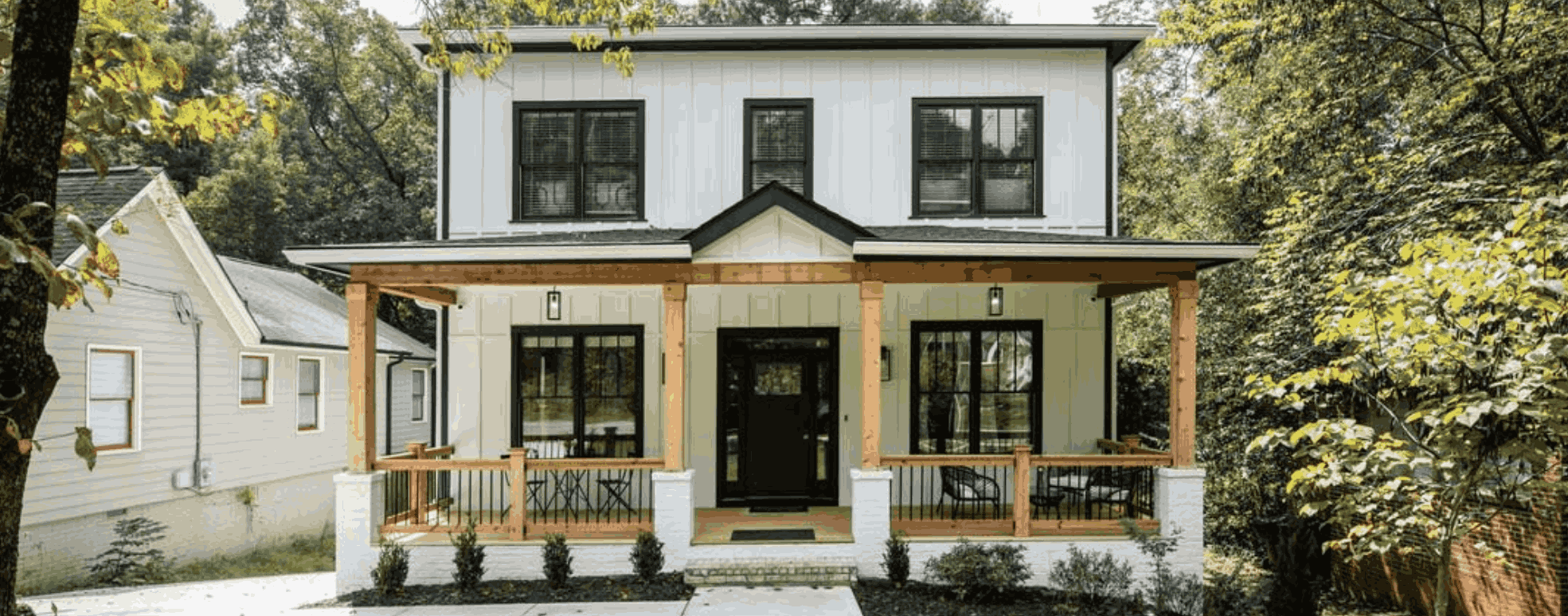
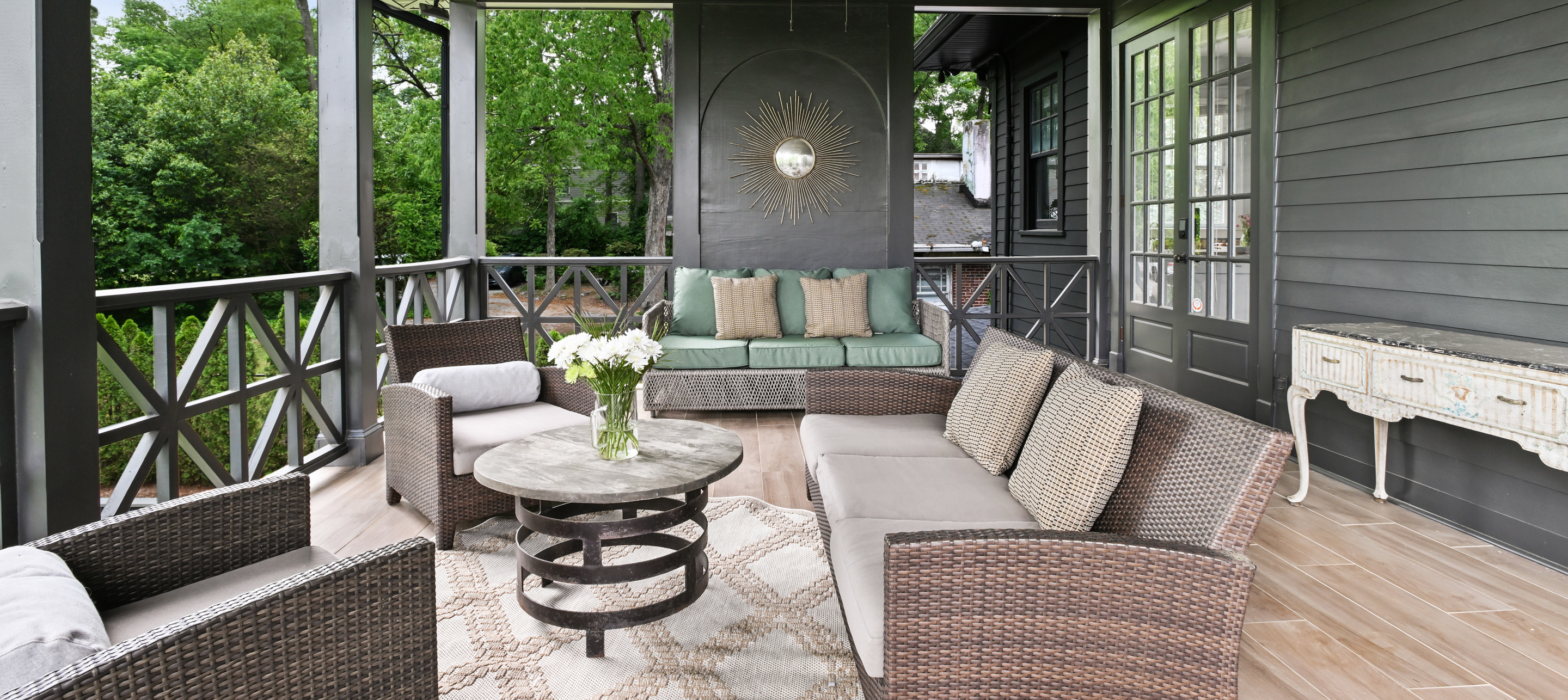
Minty Living is one of the Atlanta corporate-housing operators referenced in this article. We manage 155 active furnished properties across Atlanta's intown neighborhoods, with 114 still available for the June 14 – July 19 World Cup window as of April 16, 2026 (Guesty production data).
For procurement teams working through the 7-point checklist: we hold a current Atlanta Short-Term Rental License, carry general liability COI at the limits standard for Fortune 500 vendor approval, issue a single consolidated monthly invoice itemized by unit, and maintain 7-year record retention. W-9 and Federal Tax ID are available on request. For organizations with existing Ariba or Coupa workflows, we can typically complete the document package within 5–7 business days of a vendor request.
Contract terms include a 14-day modification window, and our World Cup monthly rate applies to any booking overlapping June 11 – July 11, 2026.
If you're running group-size scenarios or comparing vendors against the checklist, we're available to provide a property shortlist and rate sheet.

 (4).png)

 (29).png)
 (28).png)
 (33).png)
 (37).png)
 (38).png)
 (39).png)
 (40).png)
 (44).png)
 (1).png)
 (3).png)
 (55).png)
 (54).png)
 (56).png)
 (57).png)
 (58).png)
 (59).png)
 (60).png)
 (61).png)
 (63).png)
 (66).png)
 (45).png)
 (67).png)
 (68).png)
 (69).png)
 (70).png)
 (71).png)
 (72).png)
 (73).png)
 (86).png)
 (87).png)
 (89).png)
 (92).png)