


Atlanta hotel rooms near Mercedes-Benz Stadium are already pricing at $400-600+ per night for World Cup 2026 match weeks. That is not a market anomaly — it is a 344% surge above May 2025 baseline rates, per Hospitality Net.
If your corporate entertainment plan treats housing as a line item rather than a strategic asset, you will spend your entire activation budget on beds and have nothing left for the client experiences that actually build relationships.
Table of Contents
-
What the World Cup Actually Brings to Atlanta — and Why the Corporate Window Is Narrow
-
Why Hotels Don’t Work for Corporate Entertainment at Scale Events
-
The Brand House Model — Turning a Residential Property into a Corporate Entertainment Venue
-
How to Source, Evaluate, and Secure Corporate Housing for World Cup 2026
-
The Activation Advantage — What You Can Do in a Brand House That You Cannot Do Anywhere Else
The Case for a Different Model
Eight matches. 300,000+ unique visitors. A $503M projected economic impact, according to the Metro Atlanta Chamber.
World Cup 2026 at Mercedes-Benz Stadium represents a corporate entertainment window that will not repeat. The brands that activate well here will not be the ones that booked the most hotel rooms. They will be the ones that turned residential real estate into private hospitality infrastructure.
This playbook covers three things:
-
Why hotels structurally fail for corporate entertainment at this scale
-
How the brand house model works — and what it costs compared to alternatives
-
Where to source inventory before it disappears
To understand why the brand house model exists, you first need to see the full scope of what is coming to Atlanta — and how fast the activation window is closing.
What the World Cup Actually Brings to Atlanta — and Why the Corporate Window Is Narrow
Atlanta is not just hosting matches. It is hosting the July 15 semifinal — second only to the final in global prestige and viewership.
Eight total matches at Mercedes-Benz Stadium means eight cycles of global executive travel, sponsorship activation, and corporate relationship-building compressed into a single summer. 300,000+ unique visitors will move through the city between June and July 2026. Most carry expense accounts. Many represent procurement, partnership, and investment decisions.
The economic footprint confirms the scale. The Metro Atlanta Chamber projects $503M in economic impact — a figure that has attracted every major hospitality, logistics, and entertainment operator in the country.
Sponsorship spend compounds the opportunity. FIFA World Cup 2026 total sponsorship volume is projected at $2.5-3B by the Sponsorship Marketing Association. That capital needs to activate somewhere. Brand houses, hospitality suites, and client dinners are where it lands.
Now consider the inventory ceiling.
Mercedes-Benz Stadium contains 90 executive suites, with capacity ranging from 12 to 30 guests per suite. That pool is structurally capped. Once those suites sell through — which happens well before tournament kick-off for marquee events — every corporate host who wants a private environment goes off-site by default.
The official FIFA hospitality packages price that reality. Per-person costs range from $21,800 to $40,400 for premium tiers. A 10-person group at mid-tier pricing can easily reach $250,000+ before a single dollar goes toward housing, meals, or programming.
For most corporate entertainment budgets, that math leaves two options: layer hotel costs on top of FIFA hospitality spend, or find a third model entirely.
The decision window compounds the urgency. Premium residential inventory near Mercedes-Benz Stadium — the 4- and 5-bedroom properties that function as viable corporate entertainment venues — moves on a first-contracted basis. Properties available today will not be available in Q2 2026.
Against this backdrop, hotel pricing has already moved decisively. The next section explains why that pricing behavior makes hotels structurally wrong for corporate entertainment.
Why Hotels Don’t Work for Corporate Entertainment at Scale Events
The math is the starting point, but the structural problem runs deeper than cost.
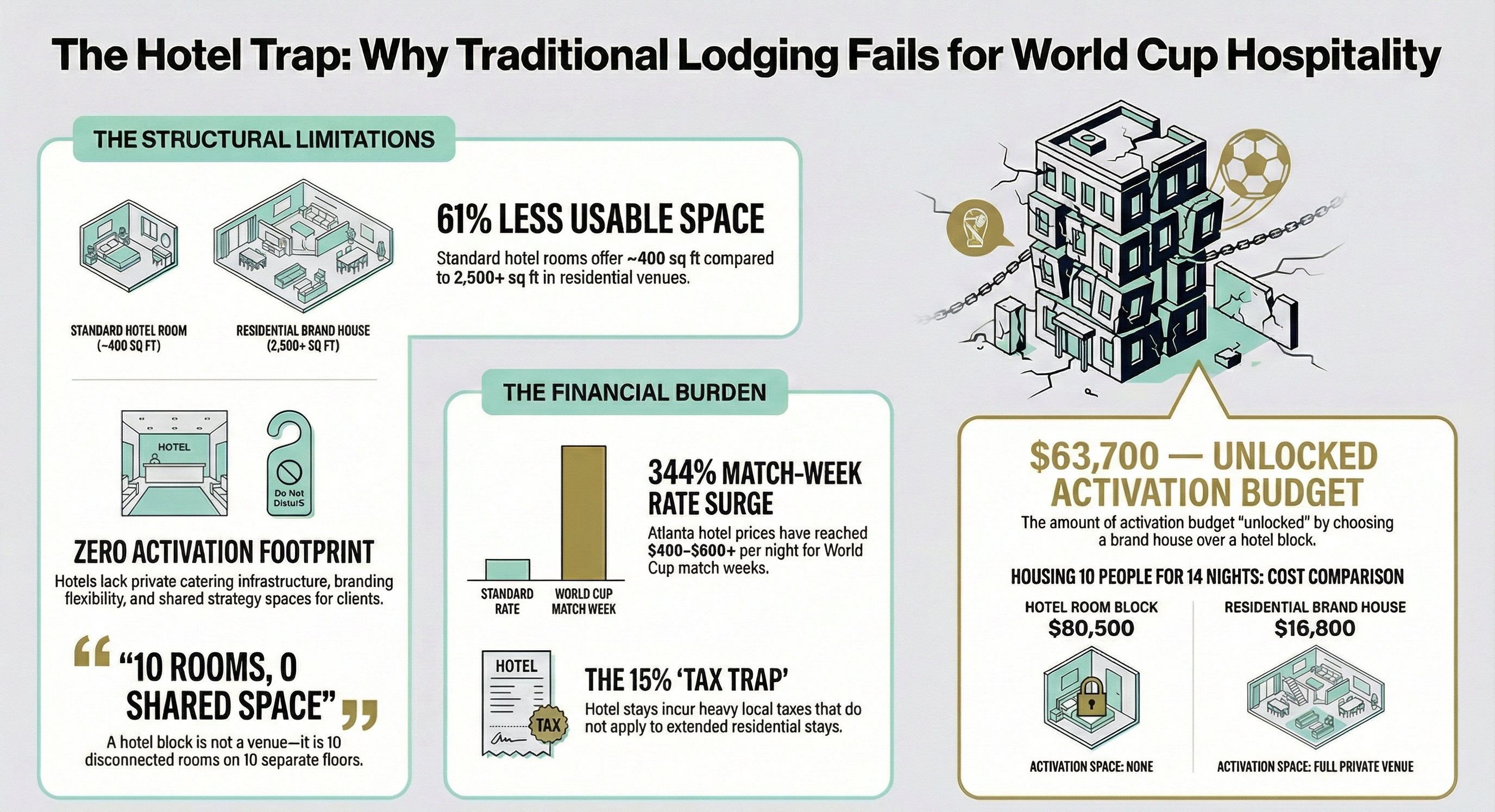
Atlanta hotel rates near Mercedes-Benz Stadium have reached $400-600+ per night during match weeks, per Atlanta Journal-Constitution reporting. Hospitality Net tracks the surge at 344% above May 2025 comparable rates. Atlanta ranks as the most rate-stable host city at a 1.73% match-day increase — meaning the current pricing is baseline, not peak.
Run the block math. Ten rooms at $500 per night across a 14-night activation window equals $70,000. Add the standard 15% Atlanta hotel tax and you reach $80,500 — for sleeping space only.
No meeting rooms. No catering infrastructure. No activation footprint.
The space problem is equally disqualifying. A standard hotel room runs 350-450 square feet. A 4-bedroom furnished residential property delivers 2,500-3,500 square feet — 61% more usable space, per BCA Furnished benchmarks. That differential is the difference between hosting a client dinner for eight and hosting a client reception for thirty.
Corporate entertainment at an event like the World Cup requires a private environment. Breakfast strategy briefings before match days. Watch parties during group stage. Client dinners after semifinal play. Team debriefs between activation events. Hotels offer none of those formats without layering on conference room rental fees that add thousands per day — for rooms that seat 12.
The suite bottleneck sharpens the argument. When all 90 executive suites at Mercedes-Benz Stadium are sold — a predictable outcome for a July semifinal — every private hosting need goes off-site. A hotel room block is not an off-site venue. It is 10 separate rooms, 10 separate floors, and zero shared activation space.
Hotels also offer zero customization. You cannot brand a hotel room, designate a preferred caterer, or reconfigure a lobby for a standing cocktail reception. The physical environment is fixed, the operating rules are the hotel’s, and the experience reads as generic to the clients you are trying to impress.
Hotels solve for sleep logistics. They do not solve for corporate relationship-building at scale.
Now that the problem is clear — what does the right model actually look like, and how does it perform financially against both hotels and official FIFA hospitality?
The Brand House Model — Turning a Residential Property into a Corporate Entertainment Venue
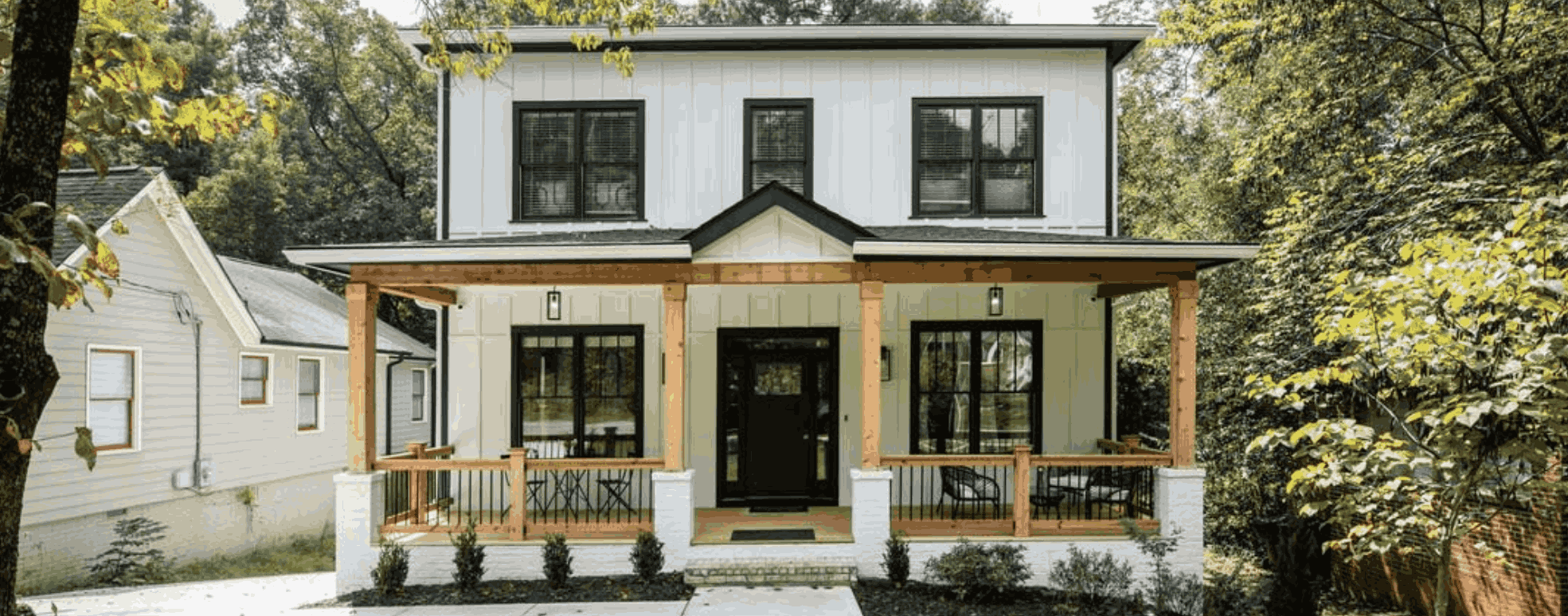
A brand house is a premium furnished residential property — typically 3 to 5 bedrooms, 2,500 to 5,000 square feet — contracted for 10 to 14 days and operated as a private client entertainment campus.
The property is not a vacation rental. The host brings catering, branding, A/V, and programming. The property is infrastructure. The experience is entirely yours to design.
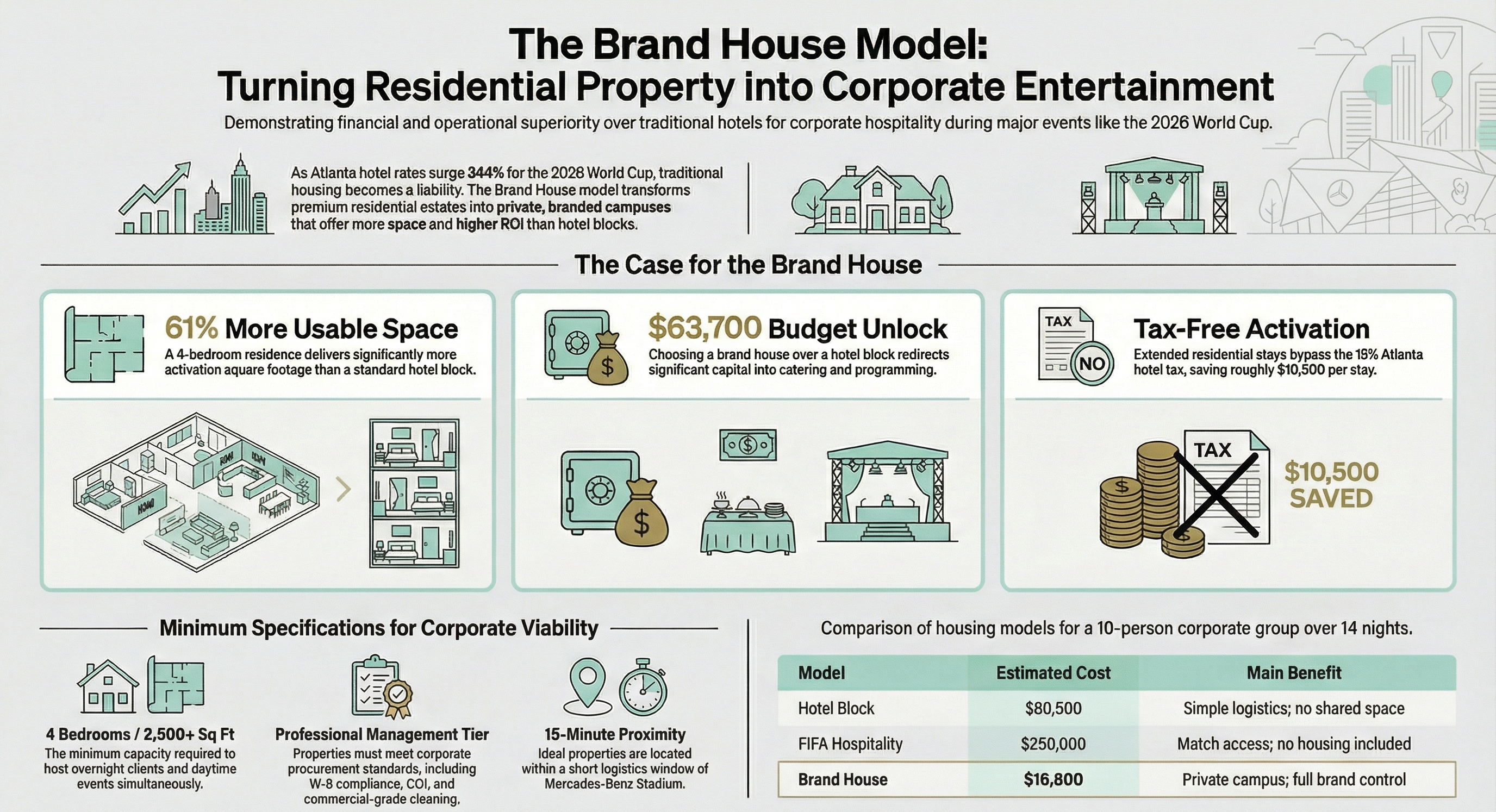
Scenario A — Hotel block: 10 rooms at $500/night for 14 nights = $70,000. Plus 15% hotel tax = $80,500 total. Hosts 10 people individually. Zero activation space.
Scenario B — Official FIFA hospitality: 10 people at $25,000 per person = $250,000. Match access only. No housing, no programming, no ongoing entertainment platform.
Scenario C — Brand house: A 4-bedroom property at $1,200/night for 14 nights = $16,800 total. Hosts 8 to 10 guests. Full activation platform included.
The delta between Scenario A and Scenario C is $63,700. That is your activation budget — catering, A/V, branded programming, client gifts — unlocked by choosing the right housing model.
The tax advantage compounds the savings. Extended residential stays do not carry the standard 15%+ Atlanta hotel tax. On an $80,500 hotel spend, tax alone represents $10,500 returned to your activation budget under the brand house model.
The brand house also functions as a content production environment, a VIP staging ground for pre-match hospitality, and a competitive differentiator in markets where every sponsor is chasing the same suite inventory.
What Makes a Property Brand-House Ready
Not every furnished property qualifies. The minimum specification for corporate entertainment viability includes:
-
4 bedrooms minimum / 2,500 sq ft minimum — enough capacity to host overnight clients and daytime events simultaneously
-
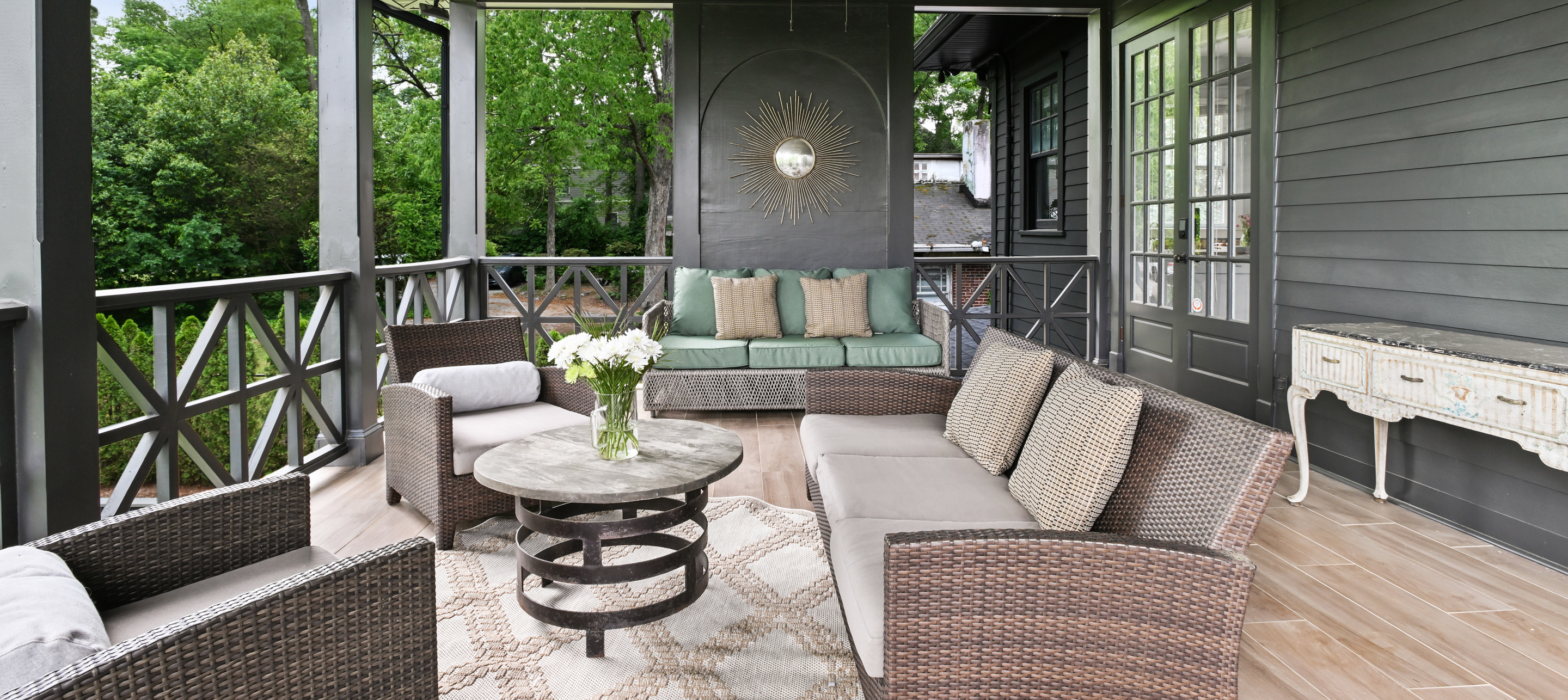
Private outdoor area — essential for receptions, catered lunches, and post-match gatherings
-
High-speed WiFi — required for hybrid programming and live-streaming match content
-
Parking for 4+ vehicles — reduces logistics friction for client transportation
-
Kitchen infrastructure — commercial-adjacent prep capability for caterer use
-
15-20 minutes from Mercedes-Benz Stadium — the outer edge of viable proximity for match-day logistics
Neighborhoods That Deliver on Proximity and Prestige
Atlanta’s residential geography offers four credible brand house zones, each with a different profile.
Buckhead sits 15 to 20 minutes from the stadium and represents Atlanta’s luxury residential corridor. Four- to six-bedroom estates here carry the ambient prestige that executive audiences read immediately.
Midtown places you within the stadium perimeter and offers walkable access to Atlanta’s densest restaurant and bar ecosystem — useful for programming flexibility between match days.
South Downtown and Castleberry Hill provide the tightest proximity to Mercedes-Benz Stadium. Approximately 30 corporate-grade apartments operate in this zone, at a lower price point than Buckhead, with travel friction close to zero on match days.
Inman Park and Virginia-Highland sit 20 to 25 minutes out and deliver the strongest residential ambience. These neighborhoods read as premium Atlanta to international visitors, and the property quality here makes them the strongest option for multi-night client hosting that extends beyond the match calendar.
How to Source, Evaluate, and Secure Corporate Housing for World Cup 2026
Once you know which neighborhood fits your brief, the sourcing question is simple: who you call first determines what you get.
The procurement logic is identical to hotel blocks: the best inventory goes to whoever moves first. For a mega-event projecting 380,000+ visitors at Atlanta venues (Sportcal), residential inventory follows the same compression curve. You are not early if you start in Q4 2025.
Define your requirements before you start any outreach.
A 10-person executive team and a 30-person activation crew have different needs — different space, different configuration, different management tier requirements. Locking in those parameters upfront eliminates wasted conversations.
Your requirement checklist should cover:
-
Headcount and nights (minimum stay, peak overlap dates)
-
Activation priorities (client entertainment, team operations, content production, or all three)
-
Neighborhood preference (proximity to Mercedes-Benz Stadium vs. prestige address)
-
Budget ceiling per night, not per person
Evaluate every property against the same criteria:
-
Space: Minimum 4BR / 2,500 sq ft for groups under 12; 5BR+ for larger teams
-
Configuration: Open-plan living and dining areas that support group programming — not a hotel suite layout reconfigured as a house
-
Furnishing quality: A managed furnished residence is not an Airbnb. Commercial-grade kitchen, professional bedding, functional workspace
-
Management tier: Professionally managed operators provide accountability; individual owner-operated listings do not
-
Contractual readiness: Invoicing capability, W-9 documentation, certificate of insurance — confirm these exist before negotiating anything
Your procurement path should follow a clear hierarchy. Direct corporate housing providers come first. Managed furnished operators come second. Short-term rental platforms sit at the bottom — lowest visibility, lowest control, highest risk for enterprise use.
Document your sourcing process. Your procurement team will require vendor credentialing, invoicing trails, and W-9 compliance. Individual hosts on consumer platforms cannot fulfill these requirements. That gap alone eliminates most of what appears available on Airbnb or VRBO at scale.
The inflection point is Q1-Q2 2026. Contracts signed six months or more before the tournament lock pricing before the final demand surge. Inventory that is not contracted by then will either be unavailable or priced at peak premium.
The Activation Advantage — What You Can Do in a Brand House That You Cannot Do Anywhere Else
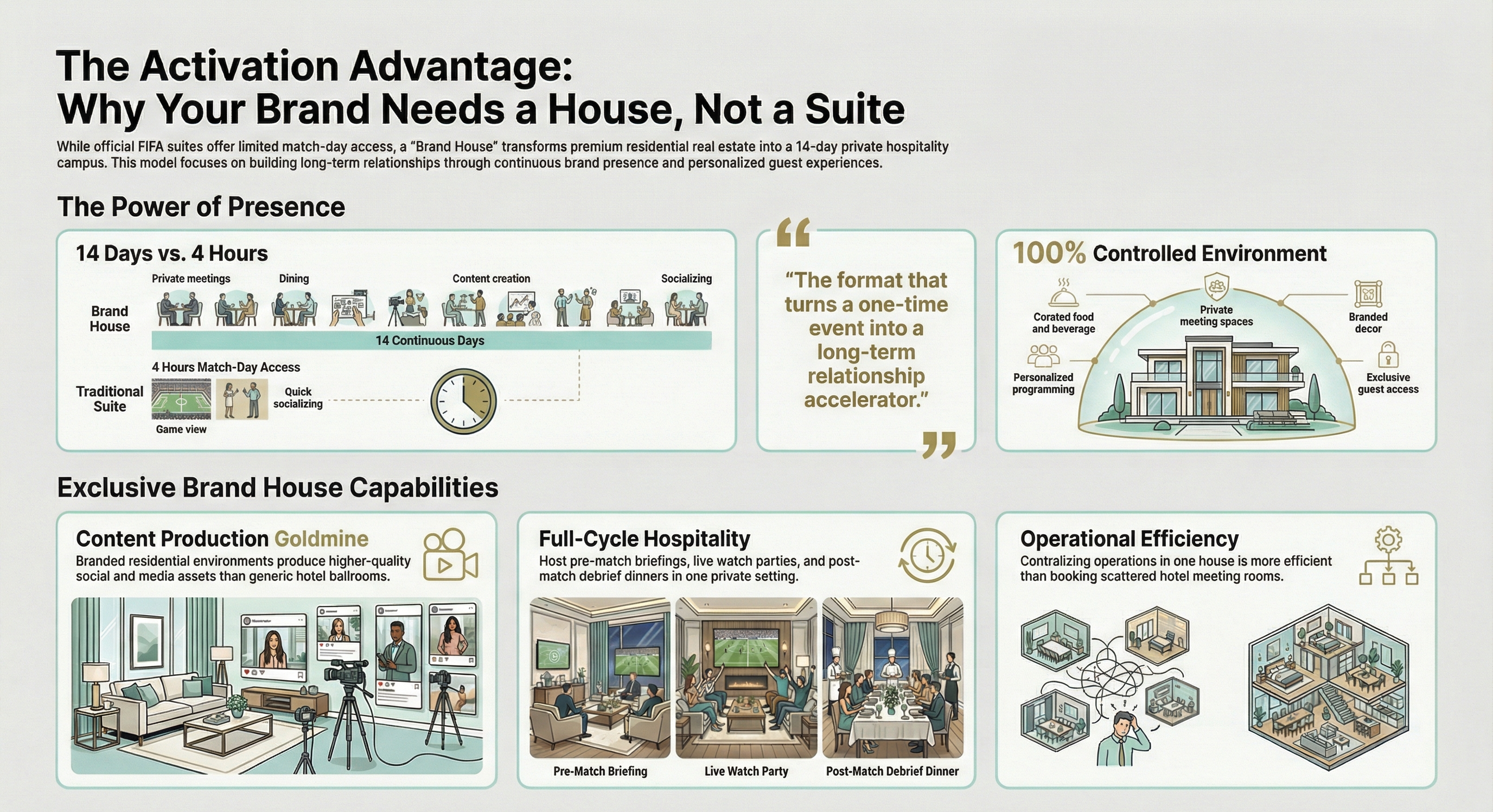
Official FIFA hospitality suites deliver three to four hours of match access. A brand house delivers 14 continuous days of brand presence. That is not a marginal difference — it is a structural one.
The match is the anchor event. Everything around it is where relationships are built.
A brand house operating across the tournament calendar supports programming that no hotel conference room can replicate:
-
Pre-match client breakfast briefings — structured, intimate, on your agenda
-
Live match watch parties with curated F&B in a private setting you control
-
Post-match debrief dinners that extend the shared experience past the final whistle
-
Recovery and strategy sessions for your internal team between match days
-
Media and content capture days — branded residential environments produce footage that a hotel ballroom cannot
-
Sponsor showcase events for prospects who are not yet clients
That last point is worth dwelling on. Activation ROI is now measured in social impressions and media value alongside direct revenue. A branded residential environment photographs differently than a hospitality tent shared with 200 other guests. Your content team will notice the difference in the first hour.
Guest experience is the differentiator that closes relationships. When clients choose which World Cup invitation to accept — and they will receive more than one — a private residence with personalized programming beats a generic hospitality package. The format signals that the relationship matters enough to invest in it.
For agencies managing activations across multiple clients simultaneously, the brand house model is also operationally superior. One base of operations, purpose-configured for briefings, entertainment, and content production, is more efficient and more impressive than booking hotel meeting rooms for each client engagement.
How to Measure Brand House ROI
Track unique guests hosted, branded content impressions generated, follow-on meetings scheduled from contacts made during the event, and hosted client NPS scores. The brand house model is not an untraceable hospitality spend — it is a measurable relationship-building investment.
The World Cup occurs once per generation in any given city. The brand house model is the format that turns a one-time event into a long-term relationship accelerator.
The playbook is straightforward. The window to execute it is not.
The July 15 semifinal is the biggest corporate hospitality moment Atlanta will host in a generation. A brand house costs less than a comparable hotel block, delivers more activation flexibility than FIFA hospitality packages, and creates guest experiences that hotels are structurally unable to match. That is the case for this model, and the arithmetic does not change regardless of group size or activation scope.
380,000+ visitors are projected to compete for Atlanta accommodation during the tournament. Professionally managed, contractually compliant inventory is finite. The properties that meet corporate procurement standards — invoicing, W-9, COI, open-plan configuration, professional management — represent a small fraction of total supply. That fraction is contracting now.
Minty Living manages a portfolio of 160+ corporate-grade furnished residences across Atlanta’s most sought-after neighborhoods. If you are planning corporate hospitality around FIFA World Cup 2026 at Mercedes-Benz Stadium, the planning window is open now — but inventory is not unlimited.
Request Your World Cup Corporate Housing Brief
Tell us your group size, match dates, and activation priorities. We will identify available properties and provide a cost comparison within 48 hours.
How Minty Living Can Help
The procurement criteria this playbook describes — invoicing capability, W-9 documentation, certificate of insurance, professional management accountability, open-plan configuration — exist precisely because most available inventory fails them. Finding a vendor who meets enterprise procurement standards and has the right properties available for a specific set of match dates is the actual challenge.
Minty Living is a technology-enabled hospitality company managing 160+ professionally designed furnished properties across Atlanta’s intown neighborhoods — including Inman Park, Virginia-Highland, Midtown, and the other areas covered in this guide. Every property in our portfolio is designed and furnished by our in-house team, led by architect and co-founder Sidra Gross.
Here is what that means in practice for corporate entertainment procurement:
Procurement-Ready Documentation. We operate as a professional management company with full invoicing capability, W-9 documentation, and certificates of insurance. The vendor credentialing requirements your procurement team will ask about are requirements we meet as standard operations.
Verified Quality at Scale. Our portfolio holds Plum Guide “Top 1%” selection — a standard that 99 out of 100 properties do not meet. We carry a 4.9 Google rating, Airbnb Superhost status, and are listed by Homes & Villas by Marriott as one of a limited set of professional management companies offering premium homes. These are third-party quality standards, not self-assessments.
Flexible Terms for Event-Based Timelines. Our rental terms run from short-stay to extended, and we have experience structuring agreements around event-based booking windows. A 10- to 14-day brand house contract for specific match weeks is a format we can accommodate and document properly.
24-Hour Placement for Urgent Needs. If your planning timeline has compressed, we have 24-hour placement capability across our portfolio. We can identify available properties that match your configuration requirements and provide a cost comparison without a drawn-out RFP process.
If you are evaluating corporate entertainment options for World Cup 2026, or if you have a specific brief and need to understand what is available against it, we are straightforward to work with. We are not the only option in Atlanta — but we are one of the few that can deliver the property quality, neighborhood coverage, and procurement documentation that enterprise corporate entertainment requires.
Reach out at mintyliving.com or call (404) 999-0841.
References
[1] Hospitality Net. “World Cup 2026 Hotel Rate Surge Analysis.” 2025.
[2] Metro Atlanta Chamber. “FIFA World Cup Economic Impact — $503M Projected for Atlanta.” 2024.
[3] Sponsorship Marketing Association. “The FIFA World Cup 2026 Sponsorship Impact — $2.5-3B Projected Volume.” December 2025.
[4] Mercedes-Benz Stadium. “FIFA World Cup 2026 at Mercedes-Benz Stadium — 90 Executive Suites.” Accessed February 2026.
[5] FIFA. “Official FIFA World Cup 2026 Hospitality Packages — $21,800-$40,400 Per Person.” Accessed February 2026.
[6] Atlanta Journal-Constitution. “Up to $40,400 Is the Cost for a Personal Hospitality Package at 2026 World Cup.” 2025.
[7] BCA Furnished Apartments. “Corporate Housing Space Benchmarks — 61% More Usable Space.” Accessed February 2026.
[8] South Downtown Atlanta. “World Cup Corporate-Grade Apartments — 30 Units Near Mercedes-Benz Stadium.” Accessed February 2026.
[9] Sportcal. “From Hotels to Homes: How Airbnb Is Reshaping the Sports Events Hospitality Model — 380,000+ Visitors Projected.” 2025.
[10] FIFA. “World Cup 2026 Host City: Atlanta Guide.” Accessed February 2026.
 (4).png)
 (29).png)
 (28).png)
 (33).png)
 (37).png)
 (38).png)
 (39).png)
 (40).png)
 (44).png)
 (44).png)
 (1).png)
 (3).png)
 (55).png)
 (54).png)
 (56).png)
 (57).png)
 (58).png)
 (59).png)
 (60).png)
 (61).png)
 (63).png)
 (66).png)
 (45).png)
 (67).png)
 (68).png)
 (69).png)
 (70).png)
 (71).png)
 (72).png)
 (73).png)
 (86).png)
 (87).png)
 (89).png)
 (92).png)