


 (1).png)
Saturday afternoon, Edgewood Avenue. A brass section rounds the corner from Hurt Street onto Euclid. The tree canopy filters the late-April light. Neighbors crowd their porches. Someone's kid is dressed like a butterfly. You have walked to this spot in under five minutes from where you slept. No rental car. No parking garage. No hotel lobby. This is the Inman Park Festival — and if you do it right, it's also the moment you decide whether this neighborhood is where you belong.
Every April, Inman Park Festival weekend pulls in three kinds of people. Someone flying in from Nashville or Charlotte who wants 48 hours of Atlanta without the downtown tourist loop. Someone who already lives here and just texted four friends "you should come for the festival" — and now has to actually plan something. And someone thinking about moving to Atlanta, using this weekend as a 48-hour thesis test before they sign anything. This guide covers all three.
These logistics come from operating furnished homes on these blocks and watching festival weekend play out firsthand.
Here's what's inside: the exact parade route with the best spots to stand, the Tour of Homes and why first-time visitors consistently call it the best part, the food and music setup, how to get here without a car, 48 hours beyond the festival, and an honest look at where to stay. Before any of that, though — the thing that makes this neighborhood unlike any other festival city.
Festival at a Glance
54th Inman Park Festival
Street Fair & Parade: Saturday–Sunday, April 25–26, 2026
Tour of Homes: Friday–Sunday, April 24–26, noon–4:00 PM daily
Admission: Free (Tour of Homes ticketed separately)
2026 Grand Marshal: R. Land
For the current music lineup and event updates: festival.inmanpark.org
Table of Contents
-
Tour of Homes: What to Expect Inside Inman Park's Best Houses
-
Where to Stay Near Inman Park: Hotels, Rentals & the Furnished Option
-
Inman Park vs. Old Fourth Ward vs. Virginia-Highland vs. Candler Park
What Makes the Inman Park Festival Different
Most neighborhood festivals exist because the neighborhood is already thriving. Inman Park's festival exists because the neighborhood almost didn't survive.
Joel Hurt founded Inman Park in 1889 on 130+ acres of land northeast of downtown Atlanta, designing it as the city's first planned suburb. He named it for Samuel Inman, a cotton merchant and civic patron who helped shape Atlanta's post-Reconstruction growth. Electric streetcar service began in August 1889 — a five-cent fare connected residents to downtown in minutes, making Inman Park the city's first transit-oriented neighborhood. Hurt hired landscape designer James Forsyth Johnson, whose Olmsted-era sensibility produced the tree-lined parkways and curving streets still visible today. Asa Candler and Ernest Woodruff — Atlanta's founding commercial class — chose Inman Park as their address. (Georgia Encyclopedia)
By the mid-20th century, the neighborhood had declined sharply. The streetcar was gone, the Victorians were subdivided, and the blocks that once drew Atlanta's civic leadership had deteriorated. The festival began in the early 1970s, during the neighborhood's preservation era, as a community-driven tool to draw attention to the restoration effort and rally residents around what the neighborhood could become. (Creative Loafing)
The butterfly — you'll see it everywhere, on floats, yard signs, and toddler costumes — is the neighborhood's symbol precisely because of that arc. Something diminishing became something rare.
Today, the Inman Park Festival is Atlanta's largest all-volunteer festival. Each edition is run by the same community-first structure that started the thing. No corporate activation zones. No VIP sections. The neighborhood puts it on and the neighborhood shows up. (festival.inmanpark.org)
For a relocating professional, the preservation story is a data point: this is a neighborhood that fought for itself and won — and has spent 50+ years proving it.
The 2026 Parade Route: Where to Stand, What to Expect
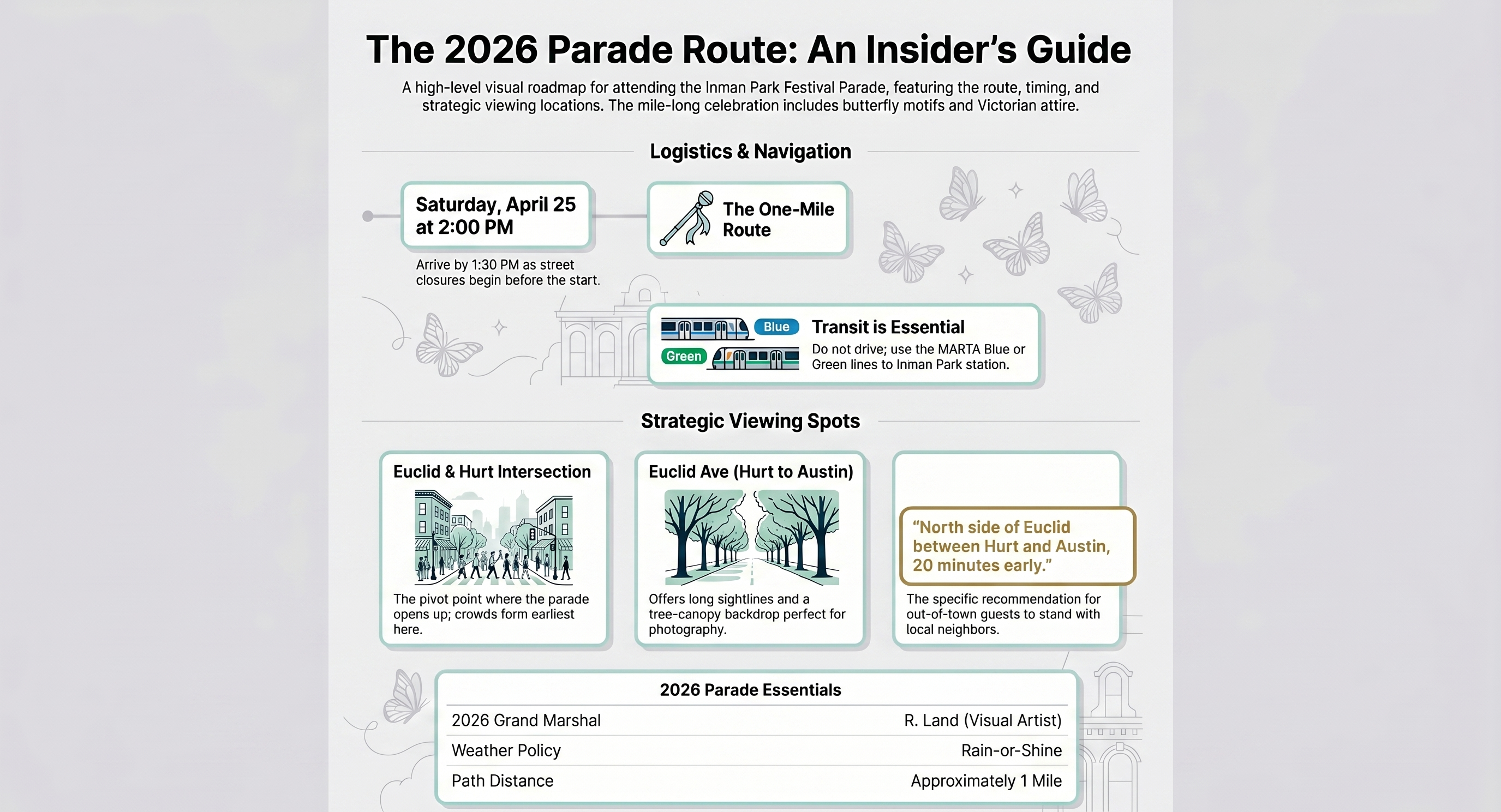
The parade starts Saturday at 2:00 PM. Street closures begin earlier, so plan to be in position by 1:30 PM.
The verified route runs approximately one mile: Edgewood Avenue at Spruce Street → Hurt Street → Euclid Avenue → Austin Avenue. (festival.inmanpark.org/events/parade/) That path takes the parade through the neighborhood's best residential blocks, which matters both for the scenery and for understanding the viewing strategy.
Three positions stand out. The Euclid/Hurt intersection is the pivot point — the moment the parade turns off Hurt and opens up onto Euclid. Crowds form early here; arrive with extra time. Euclid Avenue between Hurt and Austin gives you the full tree-canopy experience and the long parade sightline that makes the photography worth it. Austin Avenue is the finale, where the energy compresses and the last floats and bands come through.
2026 Grand Marshal R. Land, a visual artist, leads the procession. The broader costume culture is participatory: floats, marching bands, costumed community groups, butterfly wings, Victorian-era attire. This is not a spectator event with rope lines. People stand next to the street.
The parade runs rain-or-shine. (Discover Atlanta) Do not drive to a viewing spot on parade day — the streets on the route close, and parking near them closes with them. Take MARTA (covered in detail below) or find parking before closures begin and walk in.
Your out-of-town guests will ask where to stand. Tell them: north side of Euclid between Hurt and Austin, 20 minutes early. You'll be standing next to actual neighbors.
If you're scouting the neighborhood with a longer stay in mind, the parade route is also your walking tour of Inman Park's best residential blocks — Euclid and Austin are exactly the streets you'd want to live on.
Tour of Homes: What to Expect Inside Inman Park's Best Houses
The Tour of Homes runs all three festival days — Friday through Sunday, April 24–26 — noon to 4:00 PM daily. Tickets are $35 presale and $40 during the event weekend, available at festival.inmanpark.org/events/tour-of-homes/.
The 2026 debut homes — properties never previously on the tour — are at 1054 Euclid Ave, 1063 Euclid Ave, 1089 Austin Ave, and 1165 Alta Ave. For returning visitors, debut homes are the draw; these are the properties no one has seen inside before.
Inman Park's residential architecture splits between two dominant styles. The Victorian Queen Anne homes — asymmetrical facades, ornate millwork, wide porches, original late-1880s construction — descend directly from Joel Hurt's 1889 development. The Craftsman homes came later, in the early 20th century: exposed rafters, stone or brick porch columns, earthier palettes. Walking from one to the other on the same block tells the neighborhood's first 30 years of history through front elevations.
The critical thing to understand about the Tour of Homes: these are not museum properties. People live here. Current residents restored the homes and open them for this one weekend. That context changes what you're looking at — it's less a real estate display than a preservation event with a personal face on it. (Intown Elite)
Practical move: visit the debut homes first, before midday lines form. The two Euclid debut homes — 1054 and 1063 — sit directly on the parade route. A morning tour visit puts you in a natural viewing position for the 2:00 PM parade start.
Tour of Homes Logistics
Dates: Friday–Sunday, April 24–26, 2026
Hours: Noon–4:00 PM all three days
Tickets: $35 presale / $40 event weekend
2026 Debut Homes: 1054 Euclid Ave, 1063 Euclid Ave, 1089 Austin Ave, 1165 Alta Ave
Ticketing and full home list: festival.inmanpark.org/events/tour-of-homes/
If you're considering living here, the Tour of Homes answers the question no neighborhood guide can: what does it actually look like inside these houses, and do you belong in one?
Food, Music & the Street Market: How to Work the Festival
Three outdoor stages run across the festival grounds, covering rock, jazz, blues, soul, funk, Latin jazz, folk, and Americana. The full 2026 performer lineup had not been published at the time of writing — check festival.inmanpark.org for the current roster before you go. (festival.inmanpark.org/events/music/)
The dance festival is a distinct, programmed event — not background music. It runs on the main stage at 4:00 PM on both Saturday and Sunday. (Creative Loafing) Mark Saturday's slot on your calendar before you plan anything else.
The street market spans dozens of local makers selling arts, crafts, and artisan goods, alongside a nonprofit corner where local organizations set up tables. (Discover Atlanta) Food vendors run the length of the grounds — everything from local BBQ to international street food. No single vendor defines it; the variety does.
Families are well-served. Family activity zones are confirmed across the grounds, with face painting and kid-specific programming that actually keeps children occupied while you browse. The festival is stroller-friendly throughout. (Creative Loafing)
Here's the sequence that works: start at the Tour of Homes in the morning before lines form, hit the street market around noon, position yourself for the parade by 1:30 PM, then move to the main stage for the dance festival at 4:00 PM. That's a full day with nothing wasted.
One thing worth noting about the atmosphere: there are no VIP sections, no branded activation zones, no roped-off sponsor areas. It was designed that way.
The dance festival at 4 PM on Saturday is when the neighborhood reveals itself most fully — it's not a stage performance you watch, it's a block party you join. That distinction tells you something about whether Inman Park is your kind of place.
Getting There: MARTA, BeltLine, Parking & Rideshare
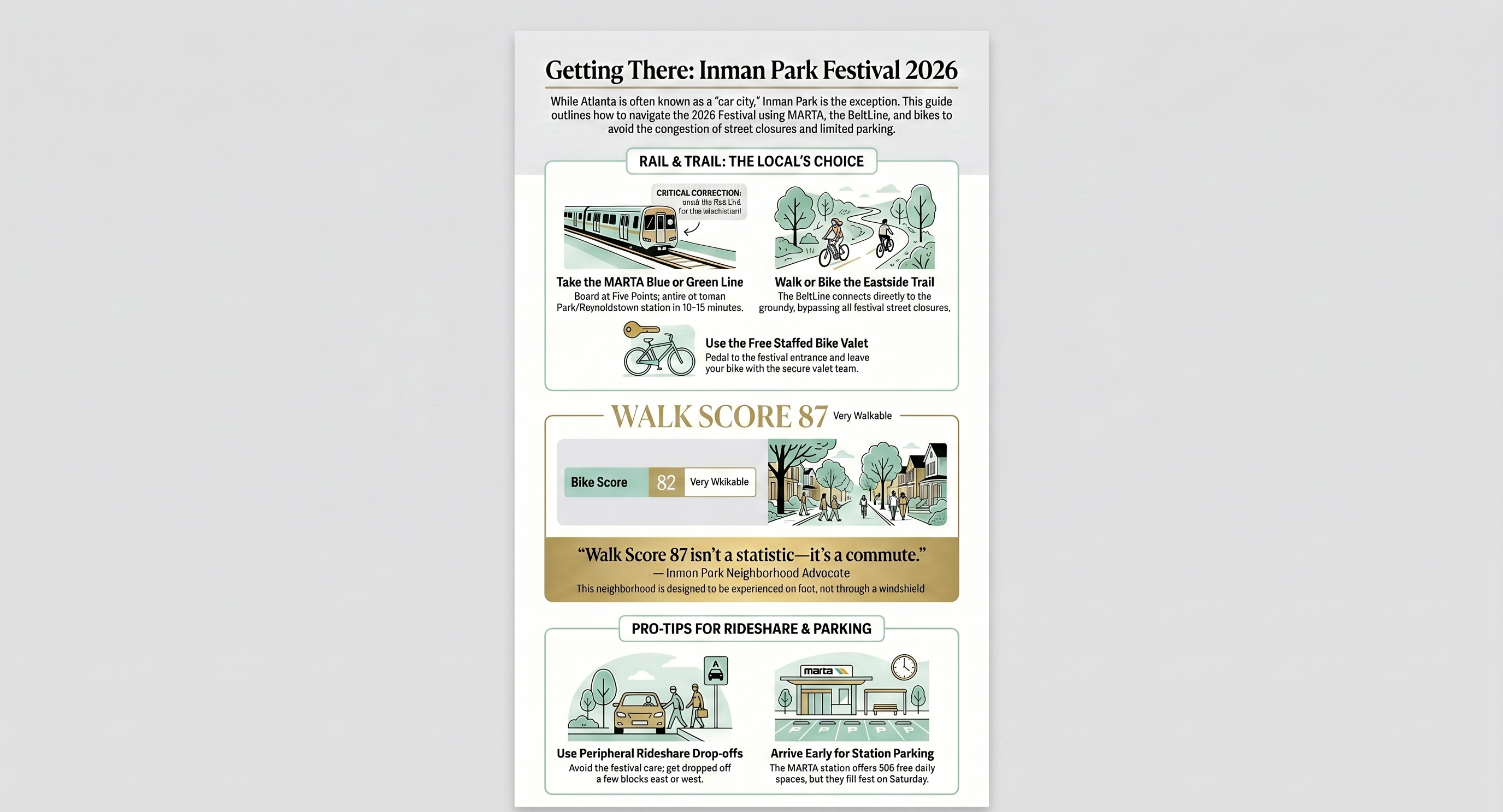
Atlanta has a reputation for being a car city. Inman Park is the exception.
The Inman Park/Reynoldstown MARTA station opened June 30, 1979, and sits at the festival's edge. Take the Blue Line or Green Line — both serve this station. Board at Five Points downtown, and you're there in roughly 10–15 minutes. The station has 366 free daily parking spaces, first-come, first-served. (MARTA) Festival weekend fills those spaces fast — arrive early Saturday or plan to be dropped off.
Common Mistake — MARTA Line
The Inman Park/Reynoldstown station is on the Blue Line and Green Line — not the Red Line. The Red Line runs north-south through Midtown and Buckhead and does not serve Inman Park. Secondary sources commonly get this wrong. Board the Blue or Green Line from Five Points. (MARTA)
If you're staying near the BeltLine — around Ponce City Market, Krog Street, or Old Fourth Ward — you can walk or bike in on the Eastside Trail, which runs directly into the festival grounds. (Atlanta BeltLine) Street closures don't affect the trail. Free, staffed bike valet is available at the festival entrance. (festival.inmanpark.org/map/)
Rideshare drop-off works, but not at the festival core. Streets close for the parade and remain congested throughout the weekend. Pick a landmark a few blocks east or west, get dropped there, and walk in. Don't plan to drive to a viewing spot on Saturday afternoon.
Inman Park's Walk Score is 87 and its Bike Score is 82. (The Atlanta Guide) Those numbers aren't decoration.
If you can reach the festival without a car, you've just proved something useful: daily life in Inman Park is possible without one. Walk Score 87 isn't a statistic — it's a commute.
Beyond the Festival: 48 Hours in Inman Park
The festival closes Sunday evening. What you do with the hours around it matters more than you think — especially if you're here to test something.
Krog Street Market is about a 10-minute walk from the MARTA station. It's a renovated 1920s warehouse reborn as a curated food hall — the kind of place you'd go on a Tuesday morning if you lived nearby, not just on a tourist weekend. (atlanta.com)
Ponce City Market sits about 25 minutes away on foot via the BeltLine Eastside Trail — a historic Sears building in Old Fourth Ward, now home to 30+ food vendors and a rooftop. (Ponce City Market) The walk there is the point: the Eastside Trail physically connects Inman Park through Old Fourth Ward to Ponce City Market and on toward Midtown. Walking it once orients you to how this part of Atlanta is actually wired.
Edgewood Avenue runs along the festival's western edge and functions as the neighborhood's bar and nightlife corridor. Little Five Points is about 15 minutes on foot — Atlanta's bohemian commercial district, distinct in character from the Victorian residential blocks you've just spent two days on.
The 10-Minute Radius
From the festival grounds, on foot: Krog Street Market (~10 min) — Ponce City Market (~25 min via Eastside Trail) — Little Five Points (~15 min) — Edgewood Avenue (adjacent).
If you're here to evaluate the neighborhood — run the Saturday-morning coffee walk first, then simulate the MARTA commute to Midtown on Sunday. Intown short-term rental demand is up 131% year-over-year in 2026, which signals a real shift: people are choosing to stay intown, not downtown. (Urbanize Atlanta, Dec 2025)
If you've walked from the festival to Krog Street to the BeltLine to Ponce City Market and back — all without a car — you've just run the proof of concept for living here.
Where to Stay Near Inman Park: Hotels, Rentals & the Furnished Option
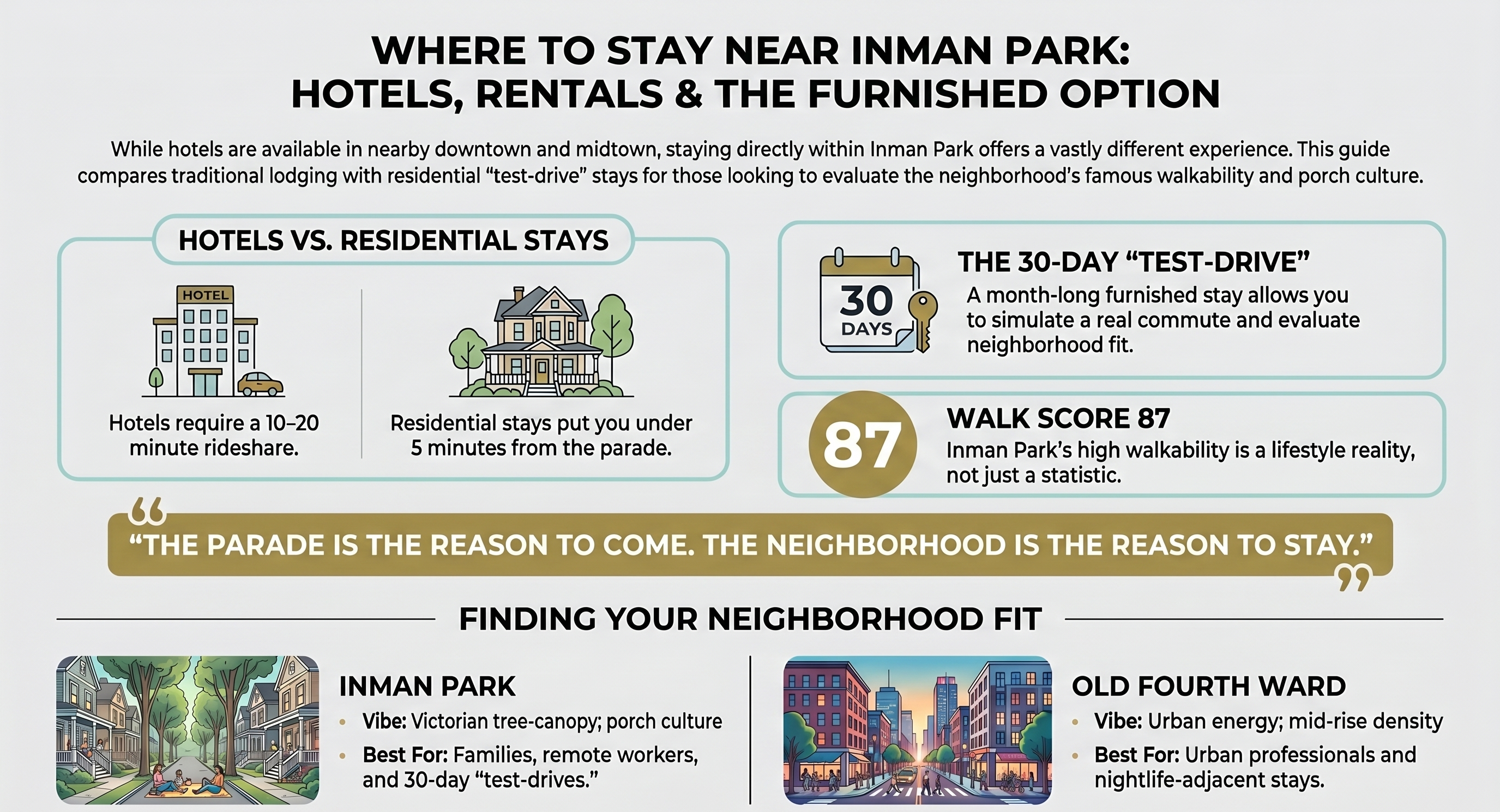
Festival weekend is high-demand in this neighborhood — book early, regardless of accommodation type. The closest hotel options are in downtown Atlanta and Midtown, neither of which is walking distance to the festival. Expect 10 to 20 minutes by rideshare and festival-weekend rate increases. Short-term rentals on standard platforms in Inman Park and immediately adjacent neighborhoods — Old Fourth Ward, Candler Park — are worth checking for a 1–3 night stay. They exist, and for a short trip they're a reasonable choice.
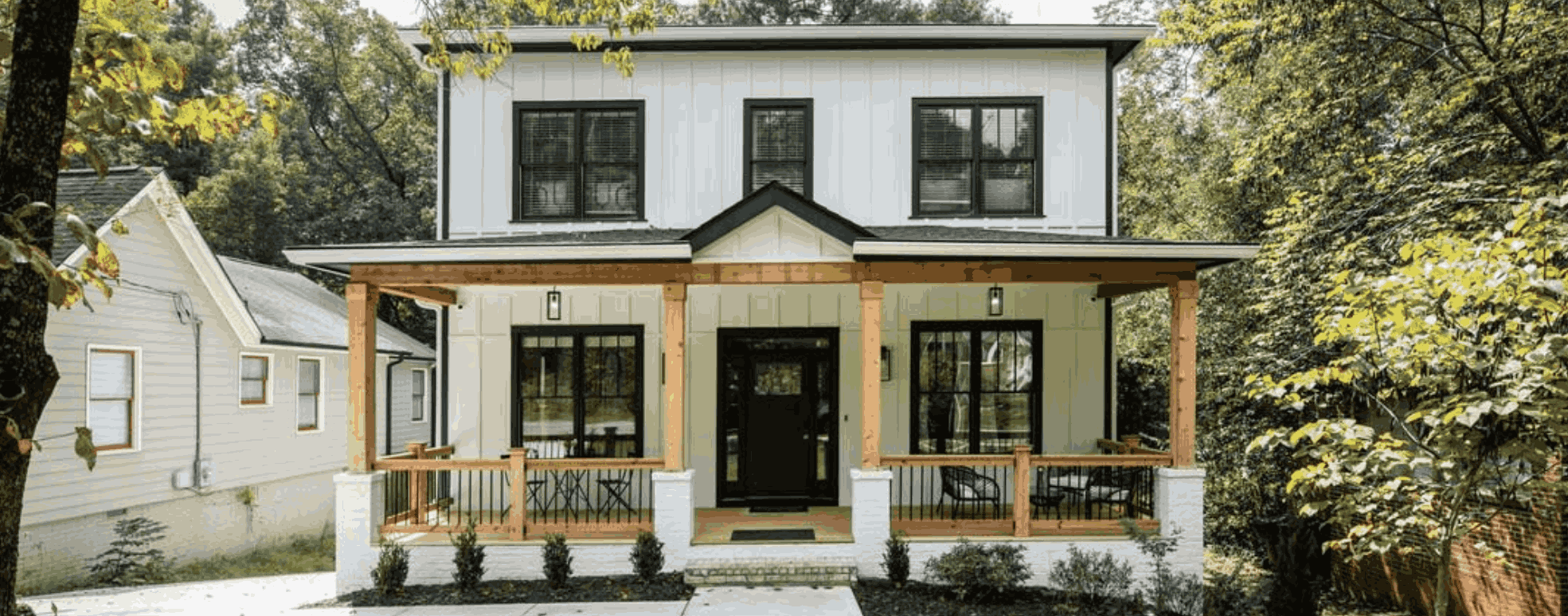
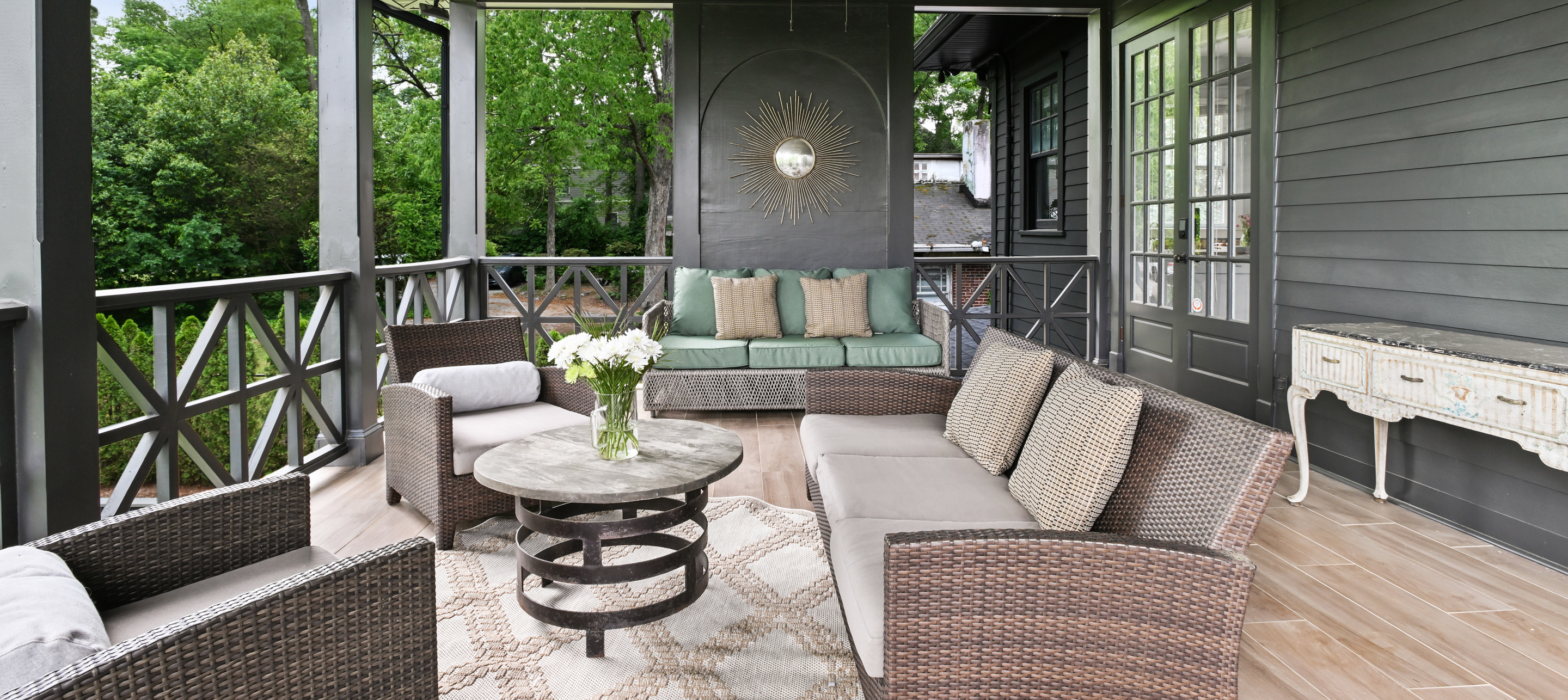
For guests who want to feel like residents rather than tourists, a furnished home in Inman Park is a different category of stay. Full kitchen. Dedicated workspace. Off-street parking, which is common in Minty properties and harder to find than the festival logistics guides let on. Residential-scale quiet. A porch or backyard. We operate furnished homes in Inman Park and have hosted hundreds of festival-weekend guests and long-stay professionals. The homes are on the residential blocks — not a hotel corridor.
From Euclid Avenue addresses, you walk to the parade route in under five minutes, Krog Street Market in 10, and the BeltLine Eastside Trail in 8.
The Test-Drive Idea
A 30, 60, or 90-day furnished stay isn't a long vacation — it's a decision tool. You test the commute to Midtown (about 15 minutes by car, 25 by MARTA). You test the walkability claim on your own feet: Walk Score 87 means something different when you've actually walked it. You test the neighborhood's social fabric — the coffee shop on a Tuesday, the farmers market on Sunday, the block after the festival clears out. A weekend tells you what Inman Park looks like. A month tells you whether it fits.
When you're ready, see which Inman Park homes are open for the dates you need.
Your guests get their own kitchen, their own porch, and their own walk to the parade. You get your weekend back — and if you're still deciding which intown neighborhood fits, the comparison below is where to start.
Inman Park vs. Old Fourth Ward vs. Virginia-Highland vs. Candler Park
All four neighborhoods feel distinctly intown compared to Atlanta's suburbs. But they're not interchangeable. The right choice depends on what you want to test.
| Neighborhood | Vibe | Walk Score | Bike Score | BeltLine Access | Best For | Short-Stay Character |
|---|---|---|---|---|---|---|
| Inman Park | Victorian tree-canopy; single-family; porch culture; preservation pride | 87 | 82 | Direct (Eastside Trail) | Festival visits; 30-day test-drives; families; remote workers | Feels like living in a neighborhood, not staying near one |
| Old Fourth Ward (O4W) | Urban energy; mid-rise condos; denser retail; faster pace | 82 | 85 | Direct (Eastside Trail / Ponce City Market hub) | Urban professionals; nightlife-adjacent stays; shorter trips | Hotel-adjacent; higher density; younger crowd |
| Virginia-Highland | Restaurant row; bungalows; strong local retail; family mix | ~78 (approx.) | ~65 (approx.) | Adjacent (no trail frontage) | Food-focused visitors; families with kids; weekend escapes | Residential and quiet; restaurant row adds evening energy, but fewer walk-everywhere options than BeltLine-adjacent neighborhoods |
| Candler Park | Residential calm; Craftsman bungalows; park-centered; true neighborhood feel | ~75 (approx.) | ~70 (approx.) | Nearby (Little Five Points connector) | Long-stay professionals; families; those prioritizing quiet | Slower pace; harder to get around without a car |
If walkability and BeltLine access are what matter most to your test-drive, Inman Park and Old Fourth Ward are your two finalists for the best neighborhood to stay in the Atlanta BeltLine corridor. Inman Park gives you single-family residential character — Victorian porches, quiet blocks, trees overhead. O4W gives you density and urban energy. Both are legitimate answers to the furnished rental question in Inman Park Atlanta and beyond — they just answer different questions about how you want to live.
The comparison matrix isn't about which neighborhood is better — it's about which one matches the kind of daily life you're considering. Festival weekend is a good time to walk all four and see which one makes you slow down.
FAQ: Everything You Still Want to Know
Is the Inman Park Festival free?
Yes — general admission to the street fair and all music stages is free. The Tour of Homes is the only ticketed element: $35 presale, $40 on event weekend.
What are the Inman Park Festival 2026 dates?
The street fair and parade run Saturday–Sunday, April 25–26, 2026. The Tour of Homes runs all three festival days — Friday through Sunday, April 24–26 — from noon to 4 PM daily.
Can I bring my dog?
The official pet policy isn't confirmed on the festival site and varies by year and section. Check festival.inmanpark.org before you arrive for the current guidance.
Is the festival good for kids?
Yes. Family activity zones are confirmed, the parade draws kids every year, and the street market is open-air and low-pressure. Strollers navigate the paved festival grounds without much trouble.
What's the rain plan?
The parade runs rain-or-shine. Street market and stage programming may adjust if weather turns severe — follow the festival's social channels the morning of for any day-of updates.
Is the neighborhood accessible for mobility needs?
The festival grounds are primarily paved. Inman Park's Victorian-era streets have uneven sidewalks in places. Check festival.inmanpark.org/map/ for detailed accessibility information before you go.
How do I get from downtown Atlanta to the festival?
Take the Blue Line or Green Line MARTA to Inman Park/Reynoldstown station. Not the Red Line — the Red Line runs north-south through Midtown and Buckhead and does not serve Inman Park. From Five Points, the ride is about 10–15 minutes.
Come for the Parade. Stay Long Enough to Decide.
Whether you're driving up from Nashville for the weekend, hosting your college friends from the couch you wish you hadn't offered, or testing Atlanta before you sign a lease somewhere — Inman Park Festival weekend is a specific kind of proof. Walk Score 87. Free parade. MARTA Blue and Green Line to the door. Krog Street Market in 10 minutes. A neighborhood that fought for itself for 50 years and has the Victorian porches and butterfly floats to show for it.
If you want to know whether Inman Park is where you belong, the 48 hours this festival fills in are a better answer than any neighborhood guide, including this one.
Check what's available for festival weekend and beyond at mintyliving.com.
The parade is the reason to come. The neighborhood is the reason to stay.
How Minty Living Can Help
The guide above covers what the festival looks like. This section covers what it feels like to be based in Inman Park while you're there — and what happens if the weekend convinces you to stay longer.
Minty Living manages 160+ furnished properties across Atlanta's intown neighborhoods, with the highest concentration in Inman Park itself. Every property is designed and furnished by our in-house team — full kitchen, dedicated workspace, residential amenities that a hotel room doesn't replicate. The portfolio holds Plum Guide "Top 1%" certification and a 4.9 Google rating, which are quality benchmarks applied across the entire portfolio, not selected listings.
Here's how we approach both kinds of stays this festival typically generates:
For festival weekend visitors: Inman Park properties put you on the residential blocks — Euclid, Austin, the streets you'll walk the parade on Saturday afternoon. Walk time to the parade route is under five minutes. Walk time to Krog Street Market is 10. You leave the festival and you're already home. Flexible terms mean a two-night stay is as easy to arrange as a two-week one.
For the 30/60/90-day test-drive: A furnished stay is a different instrument than a weekend visit. You test the MARTA commute to Midtown on a Tuesday, not a festival Saturday. You find out whether the coffee shop on DeKalb is a place you'd go twice a week. You discover whether the neighborhood's residential quiet is restoring or isolating. The questions a weekend raises, a month answers — and a furnished home in Inman Park is the lowest-friction way to run that experiment without signing a lease first.
For the host sending friends: If you've texted four people "you should come for the festival," we can give each of them their own front door. No hotel block to coordinate, no one sleeping on an air mattress. Properties are on the same residential blocks where the festival happens, so your guests can walk to you.
If we can be useful — whether that's a single festival weekend or a longer stay you're still thinking through — the starting point is mintyliving.com.
 (4).png)

 (29).png)
 (28).png)
 (33).png)
 (37).png)
 (38).png)
 (39).png)
 (40).png)
 (44).png)
 (44).png)
 (3).png)
 (55).png)
 (54).png)
 (56).png)
 (57).png)
 (58).png)
 (59).png)
 (60).png)
 (61).png)
 (63).png)
 (66).png)
 (45).png)
 (67).png)
 (68).png)
 (69).png)
 (70).png)
 (71).png)
 (72).png)
 (73).png)
 (86).png)
 (87).png)
 (89).png)
 (92).png)