


 (54).png)
Last week, every major hotel-industry outlet ran the same headline: the World Cup is a bust. The American Hotel & Lodging Association reports that roughly 80% of US hotels are missing their forecasts. Yahoo Finance found a host with an unbooked $4,500-a-week Atlanta Airbnb. NPR called it a “demand gap.”
If you're bringing executives, crews, federation staff, or supporters to Atlanta for FIFA World Cup 2026, that narrative is misleading you.
Atlanta is one of two US host cities outperforming. Here's the data, and what it means for where you stay.
Table of Contents
-
What's Already Booking Up — and Why "Wait" Is the Wrong Default
-
Where to Actually Put Your People: Neighborhoods That Match the Use Case
-
Why "Wait and See" Is the Wrong Move for Atlanta Specifically
Quick Context Before the Data
The May 2026 reporting cycle has framed the World Cup as a hotel-demand disappointment. That framing is not wrong — but it's a national average, and national averages can hide the cities where the story is moving in the other direction. Atlanta is one of those cities. By the end of this article you'll have the actual occupancy and ADR numbers for matches at Mercedes-Benz Stadium, the structural reasons demand is holding here when it isn't elsewhere, the practical implication for whichever team you're sending — sponsorship activation, broadcast rotation, federation or supporter group — and the neighborhoods you should actually be searching in.
If you want match-day basics like stadium access and stadium-side neighborhood overviews, our FIFA World Cup 2026 Atlanta Visitor Guide covers that. This piece is about a narrower question: what should you actually do with your housing decision, given the headlines you've been reading?
The "No World Cup Windfall" Story Isn't About Atlanta
Read the May 4 reports carefully and a different story shows up underneath. Skift's coverage of the AHLA report names the cities where the demand gap is real: Boston, Philadelphia, San Francisco, and Seattle, where nearly 80% of hoteliers report bookings below expectations. In the same report, Miami and Atlanta are the exceptions, with about 50% of Atlanta hoteliers reporting bookings in line with or ahead of plan — and ahead of a typical June or July.
The short-term rental data tells the same story, more sharply. AirDNA's host-city analysis puts the Atlanta numbers in plain English:
-
Group-stage occupancy is up 74% year over year (13% in 2025 → 22% in 2026)
-
Round-of-16 occupancy is up 114% (9% → 20%)
-
Round-of-16 ADR is now $383 — 133% higher than last year, the highest of the tournament for Atlanta
-
Atlanta has the fourth-highest increase in short-term rental reservations per property in the country at +264%, behind only Boston, Kansas City, and Philadelphia
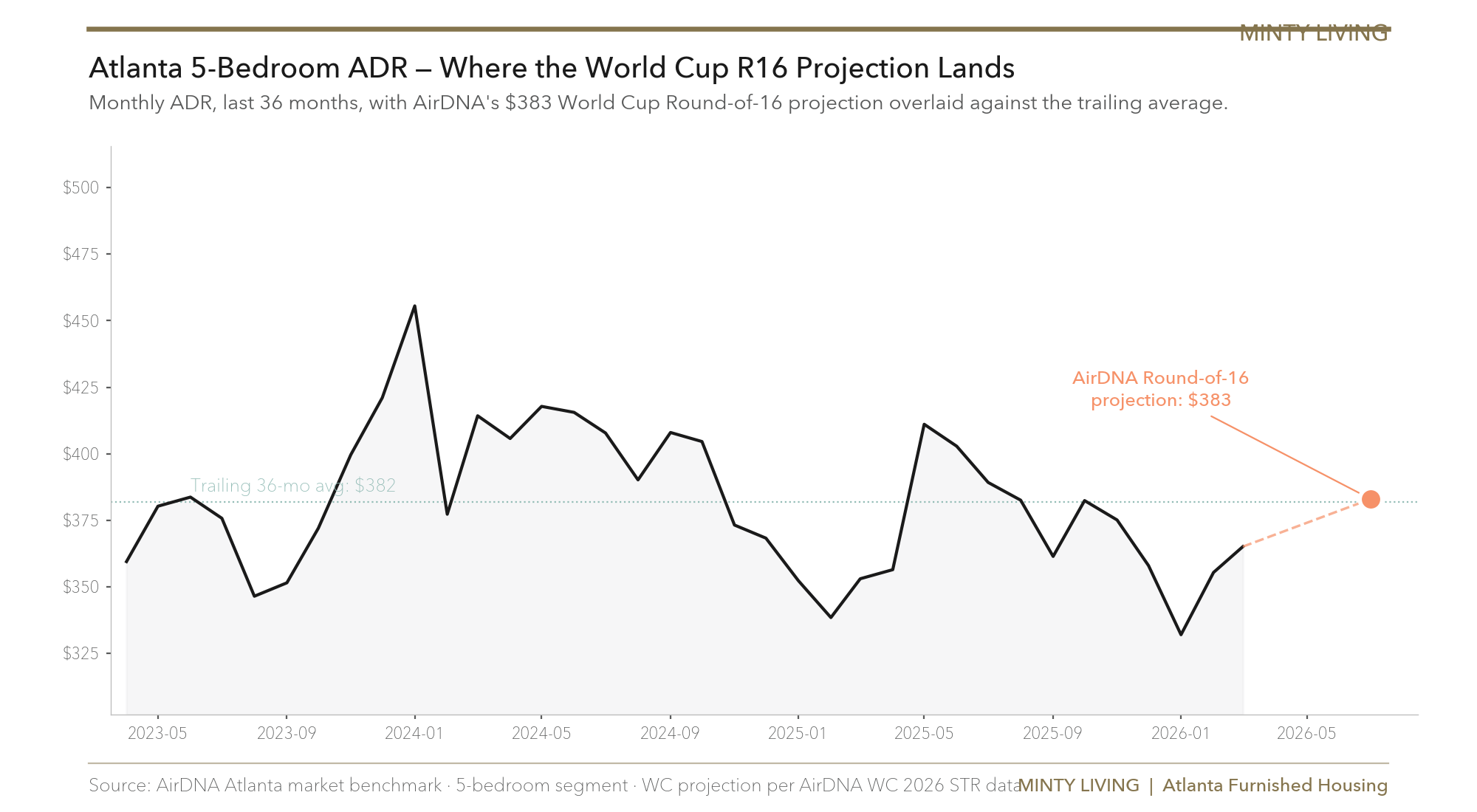
Atlanta 5-bedroom ADR, trailing 36 months. AirDNA's $383 World Cup Round-of-16 projection sits within a normal price band — the trailing average is $382. The premium is on which week, not on the price level itself. Source: AirDNA.
Inc. captured the framing the Atlanta press hasn't caught up to: "There are only two US host cities beating World Cup hotel forecasts." Atlanta is one of them.
There's a structural reason for it. Atlanta is hosting eight matches at Mercedes-Benz Stadium: five group-stage matches, a Round of 32 game on July 1, a Round of 16 on July 7, and a Semifinal on July 15. Compare that to host cities running three group-stage matches and out. Atlanta's demand isn't a one-weekend spike. It compounds across five weeks.
Three Reasons Atlanta Is Bucking the Trend
The AHLA report attributes Atlanta's outperformance to three factors. Each one matters for the housing decision in front of you.
1. Confirmed team base camps
Atlanta United Training Grounds in Marietta and Fifth Third Stadium at Kennesaw State University are official World Cup 2026 base camps. Base camps don't just bring the team — they bring federation staff, family members, national press, supporter groups, and the corporate sponsors who follow specific national programs. That demand starts before group-stage kickoff and lasts as long as that team is in the tournament. It's the kind of compounding demand a hotel block can't model with a typical RFP.
2. Air connectivity that international fans actually use
Hartsfield-Jackson is one of the busiest passenger airports in the world, and the AHLA report explicitly cites Atlanta's air connectivity as a reason demand is holding. The visa-driven friction that's hurting the rest of the country — AHLA found 65–70% of hoteliers cite visa constraints and geopolitical concerns as the biggest drag on international demand — concentrates worst in cities that require connecting flights. Atlanta is a one-stop destination from most of the world. International fans priced out of the West Coast or routed away from the Northeast keep showing up here.
3. Diversified leisure pull underneath the tournament
Most host cities depend on the tournament alone to fill summer rooms. Atlanta has a baseline of conference travel, music tourism, and corporate demand under the World Cup spike. When visa friction softens international fan volume — as AHLA's report shows it has — Atlanta has more to fall back on than cities whose summer is the tournament. That structural cushion is why operators here are using inventory fencing rather than emergency price hikes; the AirDNA data shows match-day premium of just 1.73%, which is what you see when supply, not pricing power, is the constraint.
What's Already Booking Up — and Why "Wait" Is the Wrong Default
Sit with that last point: match-day premium of 1.73% in Atlanta. In a market where pricing power was unconstrained, you'd see double-digit premiums. You don't, because operators are running out of inventory before they run out of pricing room.
Our own portfolio reflects what AirDNA is publishing at the market level. We pulled current internal data the morning of this writing: across our 130-plus furnished homes in 21 Atlanta neighborhoods, roughly a quarter of our World Cup window inventory is already on hold or booked, with the heaviest concentration in multi-bedroom homes inside walkable, MARTA-connected neighborhoods like Inman Park, Old Fourth Ward, Castleberry Hill, and Midtown. Single-bedroom inventory still has runway. Three- and four-bedroom homes for groups, broadcast crews, and federation staff are the inventory disappearing first.
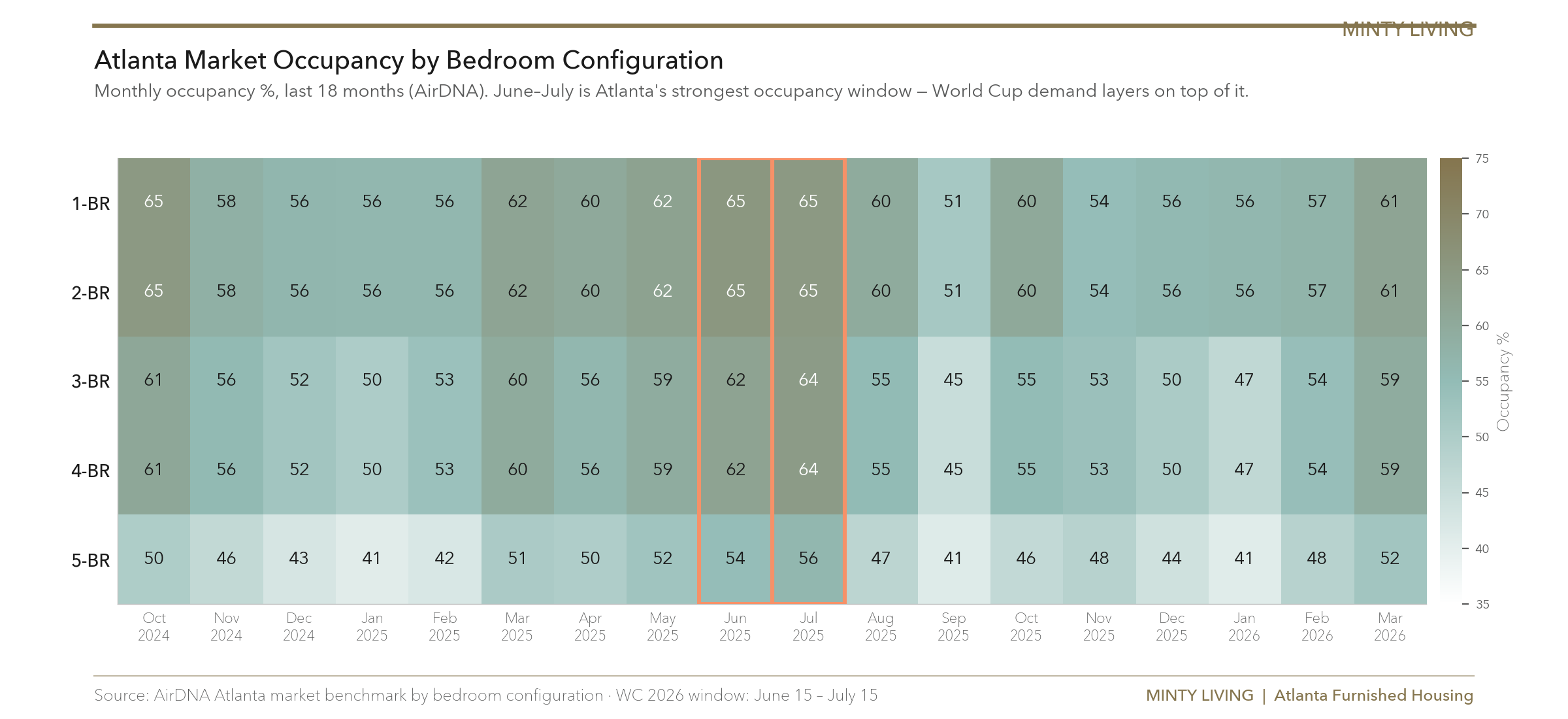
Atlanta market occupancy by bedroom configuration, last 18 months. June and July 2025 (the calendar analog to the 2026 World Cup window, highlighted in orange) was Atlanta's strongest occupancy stretch — and 1- and 2-bedroom inventory peaked at 65% while 4- and 5-bedroom occupancy lagged at 54–64%. World Cup demand layers on top of that base, which is why AirDNA reports +74% group-stage and +114% Round-of-16 occupancy gains: the segment with the most room to absorb is the segment travelers actually need. Source: AirDNA.
That asymmetry matters for your decision. The default move when you read demand-gap headlines is to wait — assume supply will sit, prices will soften, hotels will release blocks. That's a defensible bet for the cities AHLA names. It is the wrong bet for Atlanta, because the inventory category your team likely needs (group-friendly multi-bedroom) is on a different curve than the hotel-room-night category the headlines describe. You're not waiting for the same thing to come down.
Three Personas, One Decision: Where to Put Your People
The data above isn't abstract. It changes the math depending on who you're sending to Atlanta.
If you're a sponsor activation lead
Run the surge math: $383 a night for the Round of 16 (per AirDNA) × roughly 80 cumulative crew-nights for a 12-person activation team for the Round of 16 alone is $367,000 in rooms. That excludes the windows you actually want — Spain vs. Cabo Verde on June 15, Spain vs. Saudi Arabia on June 21, the Semifinal on July 15 — when group hospitality matters most for clients. And in a hotel, a brand house isn't possible; you get a ballroom on a price sheet. The decision changes when you consolidate exec hospitality and crew housing into furnished homes within MARTA range of Mercedes-Benz Stadium. Same proximity, same price point, but a brand experience hotels can't deliver. Our World Cup Corporate Entertainment Playbook and the procurement-ready alternative breakdown walk through the activation math and procurement compliance in detail.
If you're a broadcast or production logistics manager
Eight matches over five weeks means your crew rotates for thirty-plus days straight. Hotels rebook per name, per night — every rotation is its own purchase order. A multi-bedroom furnished property handles the rotation on one contract, with full kitchens for crew meals, real workspace for log-and-edit, and the swap-without-rebook flexibility you actually need. The July 15 Semifinal alone draws 30 to 80 person crews per major rights holder. Routing your crew through a single property with a single operator is the difference between a smooth deployment and a logistics fire. Our broadcast crew housing guide goes deeper on neighborhoods and crew amenity requirements, including reliable workspace and gigabit WiFi.
If you're a federation, hospitality agency, or DMC organizer
Federation staff, families, supporter groups, and VIP fan groups don't want six hotel rooms on six floors. They want a home together. Confirmed Atlanta matches give you specific group windows to plan around: Spain vs. Cabo Verde (June 15), Spain vs. Saudi Arabia (June 21), Morocco vs. Haiti (June 24), the Round of 32 on July 1, the Round of 16 on July 7, and the Semifinal on July 15. The match schedule from the host committee and FIFA's Atlanta hospitality venue page cover the official details. The housing question is the part nobody is solving for groups: a multi-bedroom property with shared living space changes a tournament trip from "we coordinated by text" to "we lived in Atlanta together for a week."
Where to Actually Put Your People: Neighborhoods That Match the Use Case
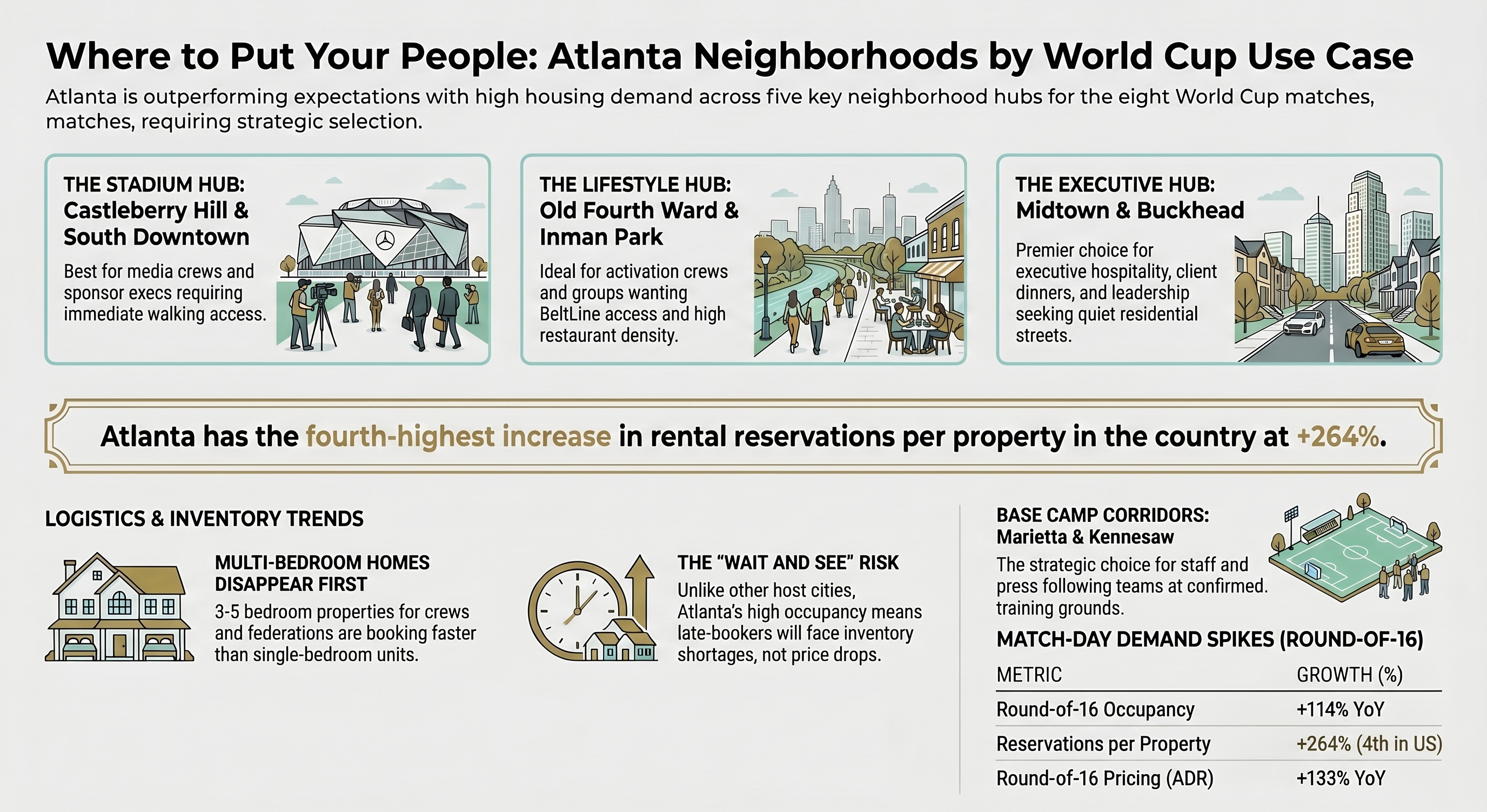
The "Atlanta housing" question is really five neighborhood questions, because the city is more decentralized than the press coverage suggests. The right neighborhood depends on whether your priority is stadium proximity, brand entertainment quality, or daily walkability for crews and supporters.
-
Castleberry Hill / Vine City / South Downtown — closest to Mercedes-Benz Stadium on foot. Best for media crews working match windows, supporter groups who want stadium walkability, and same-day-arrival sponsor execs.
-
Old Fourth Ward / Inman Park / Reynoldstown — BeltLine-adjacent, walkable to Ponce City Market, two MARTA stops to the stadium. Best for activation crews, federation staff with several days in town, and group bookings that want restaurant density.
-
Midtown / Piedmont Park area — closest to corporate Atlanta and the airport route, premier dining, walkable to MARTA. Best for sponsor executive hospitality, agency teams running activations downtown, and clients who want to stay near Atlanta's most photographed park.
-
Buckhead — premium residential, financial-district adjacent. Best for executive hospitality, client-facing dinners, and broadcast leadership who want quiet residential streets after long match days.
-
Marietta / Smyrna / Kennesaw — ten to twenty minutes from Atlanta United's training grounds and Fifth Third Stadium at Kennesaw State (both confirmed base camps). Best for federation staff, family of players, and traveling national press following a specific national team.
We mapped this out by industry use case in our Atlanta Corporate Housing by Neighborhood guide. For the World Cup specifically, the rule of thumb: if your people will move between the stadium, restaurants, and the BeltLine on foot, stay east of downtown; if they need executive privacy and corporate proximity, stay north.
Why "Wait and See" Is the Wrong Move for Atlanta Specifically
The natural read of the demand-gap headlines is to wait. If supply will sit, prices should come down. That's a defensible bet for the cities AHLA names — Boston, Philadelphia, San Francisco, Seattle. It is not a defensible bet for Atlanta, and three signals in the same data tell you why.
First, AirDNA's Atlanta-specific number isn't price — it's bookings. Short-term rental reservations per property are up 264% here, fourth highest in the country. Supply is being absorbed, not stockpiled.
Second, the Round of 16 ADR has already moved to $383, 133% above last year. Knockout-round pricing isn't waiting for a late surge to materialize; it has already absorbed material increases. Inventory fencing isn't price gouging. It's what operators use when they expect demand to keep arriving.
Third, the people quoted in the same Yahoo Finance piece that opens this article aren't ruling out a late surge. Juan David Borrero, who runs partnerships at Airbnb, told Yahoo: "I think we're going to see more demand as the tournament starts to unfold, just because that is the nature of the tournament." If he's right, the late-booking surge that hurts national averages will concentrate on the cities that still have demand and inventory. Atlanta has both. Briefly.
The practical implication: lock multi-bedroom inventory now, especially around the Spain matches, the Round of 16, and the Semifinal — the windows where group demand and price are both peaking.
Frequently Asked Questions
Is Atlanta really one of only two US host cities outperforming World Cup forecasts?
Yes. The May 4, 2026 AHLA report found roughly 80% of US hotels missing forecasts, with Boston, Philadelphia, San Francisco, and Seattle hardest hit. Skift reports about 50% of Atlanta hoteliers are ahead of expectations, alongside Miami.
How many World Cup matches are at Mercedes-Benz Stadium?
Eight: five group-stage matches between June 15 and June 27, a Round of 32 on July 1, a Round of 16 on July 7, and a Semifinal on July 15. That's the most matches outside the host of the Final. Atlanta FWC26 has the full schedule.
Are hotels in Atlanta really hitting $400 a night during World Cup?
For knockout rounds, yes. AirDNA's data puts Atlanta's Round-of-16 average daily rate at $383 — 133% above last year. Group-stage ADR is lower but climbing. Operators are using inventory fencing more than price hikes (match-day premium of 1.73%), which means inventory is what runs out first.
What's the difference between a hotel block and Atlanta corporate housing during World Cup?
Hotels charge per name per night, can't deliver branded entertainment space, and typically have rigid cancellation. Furnished corporate housing handles crew rotations on one contract, includes full kitchens and workspace, and gives sponsors a brand house instead of a ballroom. Our procurement-ready breakdown walks through the full TCO comparison.
Which Atlanta neighborhoods are best for a 4-to-10 person group during World Cup?
For stadium walkability, Castleberry Hill and Vine City. For BeltLine and restaurant access, Inman Park and Old Fourth Ward. For executive hosting, Buckhead and Midtown. For team-following federations and family, Marietta and Kennesaw (near the official base camps).
Atlanta Is the Exception. Don't Read the Average.
The May 2026 headlines describe a national hotel market with a demand gap. They do not describe the city you're traveling to. AHLA's report names two exceptions; AirDNA's data shows the exception is steeper in Atlanta than the national press has acknowledged; the match schedule alone — five group games, two knockout rounds, and a Semifinal — explains why demand here doesn't peak and disappear.
Whether you're sending a sponsor activation team, a broadcast rotation, federation staff, or supporter groups, the housing math in Atlanta is materially different from what you've been reading.
How Minty Living Can Help
The argument in this article points to a specific housing category in a specific city. Minty Living is the Atlanta operator working that market every day.
We manage 160+ professionally designed furnished properties across Atlanta's intown neighborhoods — including the MARTA-connected corridors and walkable blocks where World Cup demand is concentrating. Every property is designed and maintained by our in-house team. We hold a 4.9 Google rating and Airbnb Superhost status, and our entire eligible portfolio meets Plum Guide's Top 1% selection standard.
Here's how that applies to the three types of organizations this article addressed:
Sponsor activation teams: We place executive guests and working crews in the same property, within MARTA range of Mercedes-Benz Stadium. A multi-bedroom furnished home gives your brand a hospitality environment hotels can't replicate — full kitchen, shared living space, a residential address instead of a ballroom. One contract covers your full activation window, across whatever match dates you're working.
Broadcast and production crews: Eight matches over five weeks is a logistics problem that hotels solve badly — rebooking per name, per night, every rotation its own purchase order. We handle crew rotations on a single contract with swap flexibility built in, full kitchens for crew meals, and dedicated workspace with gigabit WiFi. Our production housing experience extends across Atlanta's film industry; the same operational model applies to broadcast deployments.
Federations, hospitality agencies, and DMC organizers: Federation staff, supporter delegations, and VIP fan groups want to be in a home together, not on separate floors. We book multi-bedroom properties for group travel across the neighborhoods mapped in this article — Inman Park, Old Fourth Ward, Castleberry Hill, Midtown, and the base-camp corridor near Marietta and Kennesaw. A single property with shared living space changes a tournament trip from logistical coordination to a shared Atlanta experience.
Roughly a quarter of our World Cup window inventory is already on hold or booked. Multi-bedroom homes in MARTA-connected neighborhoods are the first to go — which tracks exactly with what the AirDNA data shows at the market level.
If you're working through housing logistics for an Atlanta match window, we're glad to talk through your group size, dates, and neighborhood priorities — including if you're still comparing options.
→ Browse available homes for your World Cup window
→ Book a 15-minute consultation — we'll walk through your match dates, group size, and ideal neighborhood
→ Email [email protected] or call (404) 999-0841
Sources: AHLA, Skift, AirDNA, Inc., Yahoo Finance, NPR, Insider Sport, FIFA, Atlanta FWC26, Mercedes-Benz Stadium.
 (4).png)

 (29).png)
 (28).png)
 (33).png)
 (37).png)
 (38).png)
 (39).png)
 (40).png)
 (44).png)
 (44).png)
 (1).png)
 (3).png)
 (55).png)
 (56).png)
 (57).png)
 (58).png)
 (59).png)
 (60).png)
 (61).png)
 (63).png)
 (66).png)
 (45).png)
 (67).png)
 (68).png)
 (69).png)
 (70).png)
 (71).png)
 (72).png)
 (73).png)
 (86).png)
 (87).png)
 (89).png)
 (92).png)