


 (45).png)
Metro Atlanta just became the second-largest data center market on the planet. The construction is booked solid. The housing plan is usually the afterthought, and it's the one line item that quietly decides whether your commissioning agent stays twelve weeks or twelve months.
This is the guide nobody wrote yet. If you're an electrician, an MEP contractor, a commissioning engineer, a superintendent, or the relocation coordinator trying to house forty of them at once, you'll find here exactly what a data center project needs from housing in Atlanta: what it costs, where to base your crew relative to each build cluster, how long you'll actually need it, and how to book furnished mid-term housing without overpaying for a hotel or waiting on a man camp that was never going to get built in a suburb.
Executive Summary
By one industry estimate, Georgia drew more than $40 billion in data center investment in the first seven months of 2025, a figure cited by Georgia Chamber of Commerce CEO Chris Clark (Georgia Trend), and metro Atlanta now ranks #2 in the United States for data center capacity, behind only Northern Virginia (TechnologyChecker.io). That boom runs on a workforce that mostly doesn't live here. A single hyperscale campus can peak at 4,000 to 5,000 construction workers (iRecruit), and the specialty trades that matter most (electricians, MEP, and commissioning agents) travel in on assignments that run from a few weeks to 18+ months.
Unlike the rural "gigasites" in Wyoming and Texas, where operators are literally building man camps to house crews, Atlanta's data center corridor sits inside an existing, dense suburban housing market. That changes the math. For any stay past a couple of months, furnished mid-term apartments beat extended-stay hotels on total cost and beat improvised solutions on stability and crew retention.
This guide covers the whole picture:
-
The market: why Atlanta's build pipeline guarantees multi-year crew demand through at least 2028
-
The workforce: which roles travel, how long assignments run, and what commissioning timelines mean for lease length
-
The money: a real cost comparison of furnished apartments vs. hotels vs. per diem
-
The map: where to base a crew relative to the west, south, and east build clusters
-
The playbook: how coordinators book housing for a whole crew, plus a copy-paste planning checklist
Scan to the section that fits your role. Every stat is sourced.
Table of Contents
-
The Traveling Workforce: Who Needs Housing, and for How Long
-
The Real Cost: Furnished Apartments vs. Hotels vs. Per Diem vs. Man Camps
-
Where to Base Your Crew: Mapping Housing to Atlanta's Build Clusters
-
Housing by Role: Trades, Commissioning, Management, and Permanent Techs
-
The 2026 to 2028 Outlook: Moratoriums, Tax Fights, and Why Demand Holds
Why Atlanta Became the Country's #2 Data Center Market
If you've been assigned to a Georgia data center project, you're part of the fastest infrastructure buildout in the state's history. The numbers are worth understanding, because they're the reason your housing search is harder than it should be. Everyone's crew is arriving at once.
Atlanta went from the 6th-ranked U.S. data center market before 2023 to 2nd today. Data center space under construction roughly doubled every six months from mid-2023 through 2024, and the region's Development of Regional Impact filings (the formal notices large projects must file) jumped from just 6 across all of 2020 through 2022 to 44 since, with 16 filed in the first five months of 2025 alone. Under-construction activity jumped 76% year over year in the first half of 2024 (CBRE), and the metro carried roughly 3,968 MW under construction in 2025, still the most of any U.S. market, even as the record pace began to cool (The Real Deal).
The utility load tells the same story. Georgia Power's 2025 resource plan projects roughly 8,500 MW of electrical load growth over six years, the bulk of it data centers, and the utility moved to add nearly 10 GW of new generation capacity to serve that demand (Georgia Power; DataCenterDynamics). Only three years ago, that same forecast called for 400 MW.
The projects driving crew demand
This isn't one big build. It's a dozen of them, clustered in a ring of suburban and exurban counties. Here are the major campuses shaping housing demand:
| Project | Location (County) | Scale | Investment | Status |
|---|---|---|---|---|
| Google "Project Pegasus" | LaGrange (Troup) | 420 acres; up to 400 MW | $8B | Underway; phase 1 online end of 2026 |
| QTS "Excalibur" / Microsoft Fairwater | Fayetteville (Fayette) | ~7M sq ft; up to ~1,500 MW | ~$1B (QTS) | Build-out to 2032; 700+ MW online end 2026 |
| Microsoft Douglasville | Douglasville (Douglas) | 160 acres; ~1M sq ft | Not disclosed | Phase I 2024; completion ~2026 |
| Microsoft Palmetto | Palmetto (Fulton) | Up to 116 acres | Not disclosed | Broke ground July 2024; ~2028 |
| Microsoft Union City | Union City (Fulton) | 136 acres; 3 buildings | $1.8B | Under development |
| DC BLOX "Atlanta West" | Lithia Springs (Douglas) | 100 acres; up to 120 MW | $1.15B | Phase 1 delivery 2026 |
| Prologis "Project Sail" | Coweta County | 831 acres; ~900 MW | $17B | Rezoned April 2026; ~10 yrs of activity |
| Newton County Technology Park | Covington (Newton) | 317 acres; ~2.6M sq ft | $5B | DRI filing stage |
Sources: AJC on Project Pegasus; Baxtel on QTS Fayetteville; DC BLOX; AJC on Project Sail; GovTech on Newton County. AWS, Vantage, EdgeConneX, DataBank, Digital Realty, Switch, and T5 are also active in the metro. Individual dollar figures are directional. Outlets report overlapping estimates.
The takeaway for housing: several of these campuses are multi-year builds with staggered phases, and their construction windows overlap. Even if Georgia's political friction slows new approvals (more on that in the outlook section), the projects already under way lock in sustained crew demand through 2028.
The Traveling Workforce: Who Needs Housing, and for How Long
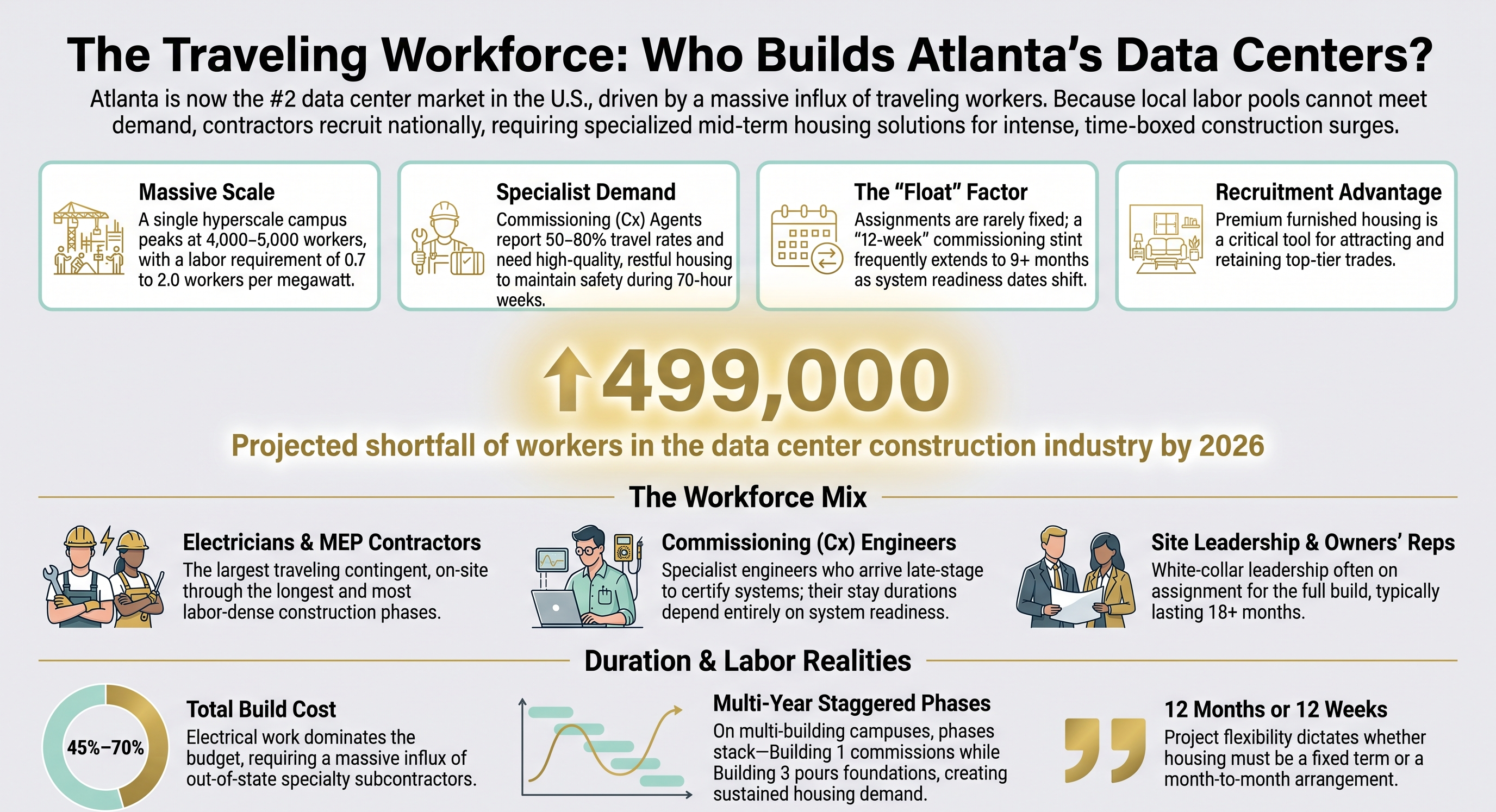
Here's the part every project underestimates: most of the people who build a data center don't live near it.
A hyperscale build concentrates labor into intense, time-boxed surges. Industry reporting puts peak headcount at 4,000 to 5,000 workers for a single large campus, with a rough planning rule of 0.7 to 2.0 construction workers per megawatt of capacity (a Hamm Institute figure, via Rinvio). A 50 MW build needs roughly 400 to 600 workers at peak; a 100+ MW campus, 800 to 1,200; and during peak mechanical-electrical-plumbing (MEP) fit-out, a single site can run 300 to 1,500 workers at once across 30 to 60 specialty subcontractors, often around the clock.
The problem is that the skilled trades to fill those roles don't exist in sufficient numbers anywhere. The data center construction industry faces a projected shortfall of up to 499,000 workers in 2026 (iRecruit). Electrical work alone can run 45 to 70% of total construction cost (an IBEW figure), and the industry needs more than 300,000 new electricians over the next decade even as roughly 20,000 retire every year (Fortune).
That shortage is exactly why crews travel. When the local labor pool can't fill a job, contractors recruit nationally, then move and house those workers. Microsoft president Brad Smith has said the company has had to ask electricians to commute as far as 75 miles to reach sites (Fortune). Housing isn't a nicety here. It's a recruiting tool.
The roles that travel (and need mid-term housing)
Not everyone on a data center site needs a furnished apartment. Local laborers and some trades commute from home. But these roles routinely travel in and stay for months:
-
Electricians and MEP contractors, the largest traveling contingent, on site through the longest construction phases
-
Pipefitters, millwrights, and mechanical trades, heavy during the mechanical fit-out window
-
Commissioning agents / Cx engineers, the specialists who test and certify every system before handover; among the highest-value, longest-tenured travelers
-
Controls, BMS, and EPMS technicians, building-management and electrical-power-monitoring specialists who arrive for integration and testing
-
Low-voltage, security, and structured-cabling techs, clustered in the final fit-out and integration phases
-
Superintendents, project managers, and owner's representatives, white-collar site leadership, often on assignment for the full build
-
Permanent data center technicians, hired as the facility approaches go-live; these roles are more often filled locally, but technicians relocating for them frequently need interim housing while they settle
Commissioning roles in particular are travel-heavy; postings routinely list 50 to 80% travel (example listing), and extended hours, including nights and weekends, are standard during active commissioning (Bluerithm). When someone is deep in a commissioning push, the quality of the place they sleep stops being a luxury and starts being a retention and safety issue.
Commissioning Timelines and What They Mean for Your Lease
The single most useful thing to understand before you book housing is when in the project your people arrive and how long they stay. Data center construction runs in overlapping phases, and each phase pulls a different crew for a different duration.
A simplified timeline for a hyperscale campus:
-
Site work and civil (months 1 to 6+): grading, foundations, utilities. Heavy equipment operators, concrete, earthwork.
-
Structural and shell (months 4 to 12): steel, envelope, roofing.
-
MEP rough-in and fit-out (months 8 to 20): the electrical and mechanical build, the longest, most labor-dense phase, and where traveling trades peak.
-
Commissioning (Cx) (months 16 to 24, overlapping): systematic testing of power, cooling, controls, and life-safety systems. Commissioning agents, controls, and BMS/EPMS techs.
-
Handover and ramp (final months): permanent technicians onboard; some travelers demobilize while others extend into the next phase or building.
On a multi-building campus, these phases stack. Building 1 is commissioning while building 3 is still pouring foundations. That's why a single campus can generate housing demand for several years, and why a traveler's "12-week assignment" so often becomes a 9-month one.
The practical lesson: match your lease flexibility to your phase, not to a guess. As one commissioning-staffing guide put it bluntly, whether travelers stay "twelve months or twelve weeks" often comes down to whether the housing solution (blocked rooms, negotiated extended-stay rates, or built camp capacity) can flex with the schedule. If your housing can't extend, your people leave when the lease ends, not when the work does.
What that means when you book:
-
Trades on a defined phase (e.g., a 4-month rough-in): a fixed furnished term with an extension option.
-
Commissioning agents whose end date depends on system readiness: month-to-month or short fixed terms with a clean extension policy.
-
Superintendents and owner's reps on the full build: a longer furnished lease, re-based near the site.
-
Anyone whose scope might jump to the next building: confirm the extension and transfer policy before you sign, not during move-out.
The Real Cost: Furnished Apartments vs. Hotels vs. Per Diem vs. Man Camps
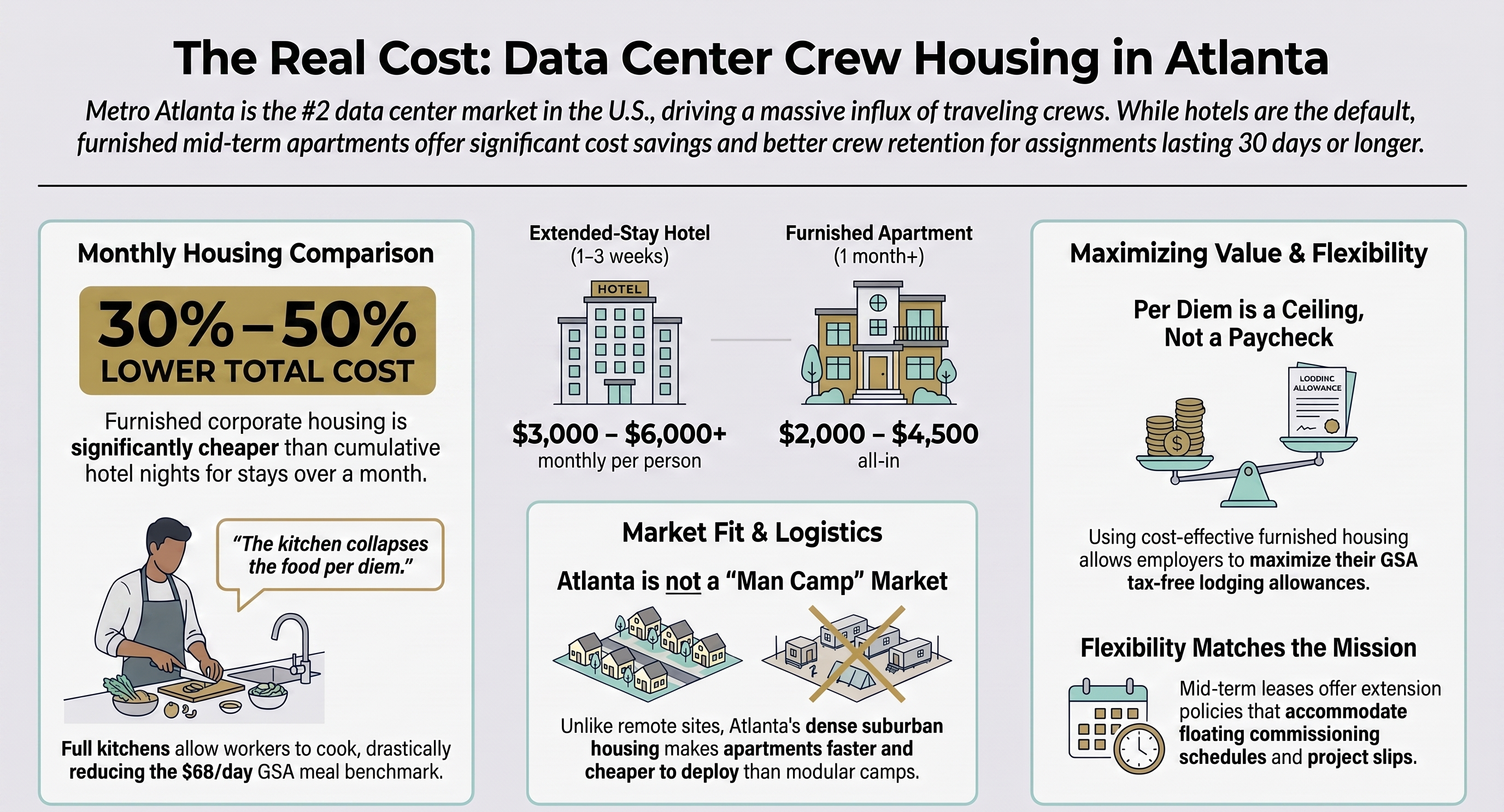
This is where most housing decisions get made, and where the most money leaks. The honest comparison for a metro Atlanta assignment looks like this.
Extended-stay hotels
The default reflex is to book an extended-stay hotel. It works for short stints, but the cost compounds fast. Extended-stay rooms in metro Atlanta range widely, roughly $70 to $200+ per night depending on submarket and brand (Extended Stay America), and a mid-tier room easily runs $3,000 to $6,000+ per employee over 30 days, before parking, occupancy taxes, and fees. And because most hotel rooms have no real kitchen, you're layering a meal per diem on top. The GSA FY2026 benchmark for meals and incidentals is $68/day on the standard rate (up to $92 in higher-cost areas), and many contractors set per diems in that range. A $150 room plus ~$68/day of food is a real cost of $218/day, well over $6,000 a month, per person.
Furnished mid-term apartments
A furnished 1-bedroom typically runs somewhere around $2,000 to $4,500 per month all-in depending on the market, and a fixed monthly rate almost always beats 30 cumulative hotel nights once you factor meals, taxes, and bundled utilities (Alamo Corporate Housing). The bigger, less-obvious win is the kitchen: a real kitchen collapses the food per diem. When workers can cook, that $68/day line item drops sharply, and over a 6-month commissioning assignment that difference alone can run into thousands per person.
The rule of thumb: hotels win for the shortest stays, but somewhere in the three-to-eight-week range furnished housing pulls ahead, and the gap widens the longer the assignment runs. For stays of a month or more, furnished corporate housing is commonly 30 to 50% cheaper than a hotel.
Per diem: understand what it actually is
"Per diem" trips up a lot of crews. It's a ceiling, not a paycheck. The GSA sets a maximum tax-free daily lodging allowance (the standard FY2026 CONUS lodging rate is about $110/night, and metro Atlanta runs somewhat higher), but that number tells your employer the maximum they can reimburse tax-free, not what they'll hand you. If your lodging per diem is fixed, a furnished apartment that costs less than the ceiling puts the difference to work: better housing for the same or lower spend. Confirm whether your contract reimburses actual cost or pays a flat allowance. It changes the whole calculation.
Man camps: built for Wyoming, not Fulton County
You may have read about the national "man camp" boom, modular workforce villages with cafeterias, gyms, and golf simulators. Target Hospitality's data center unit signed contracts it expected to generate $331 million over two years, and it has announced far larger data-center housing deals since. Cheyenne, Wyoming (population ~66,000) is bracing for a proposed camp of up to ~5,600 workers (Cowboy State Daily). Those solutions make sense where they're built: genuinely remote sites with no existing hotels or apartments for fifty miles.
Metro Atlanta is the opposite case. Its data center corridor sits inside an established suburban housing and apartment market. (This is an editorial read, not a reported finding, but the geography is hard to argue with.) When there's already an apartment inventory a short drive from the site, spinning up camp infrastructure is slower, costlier, and usually unnecessary. Furnished mid-term housing is the faster-to-deploy answer in a metro like this.
Side-by-side
| Option | Best for | Est. monthly cost (per person) | Kitchen | Flexibility |
|---|---|---|---|---|
| Extended-stay hotel | Shortest stints (days to weeks) | $3,000 to $6,000+ (before meals) | Rare / kitchenette | High (nightly) |
| Furnished mid-term apartment | Month-plus assignments | $2,000 to $4,500 all-in | Full kitchen | High (term-matched) |
| Short-term rental (Airbnb/VRBO) | Gap coverage, 1 to 3 months | $2,200 to $4,000 | Usually | Low (host can cancel) |
| Man camp / modular | Remote sites, huge headcount | Varies | Shared/cafeteria | Low (site-bound) |
Costs are 2026 metro-Atlanta estimates and vary by submarket, unit, and season.
Where to Base Your Crew: Mapping Housing to Atlanta's Build Clusters
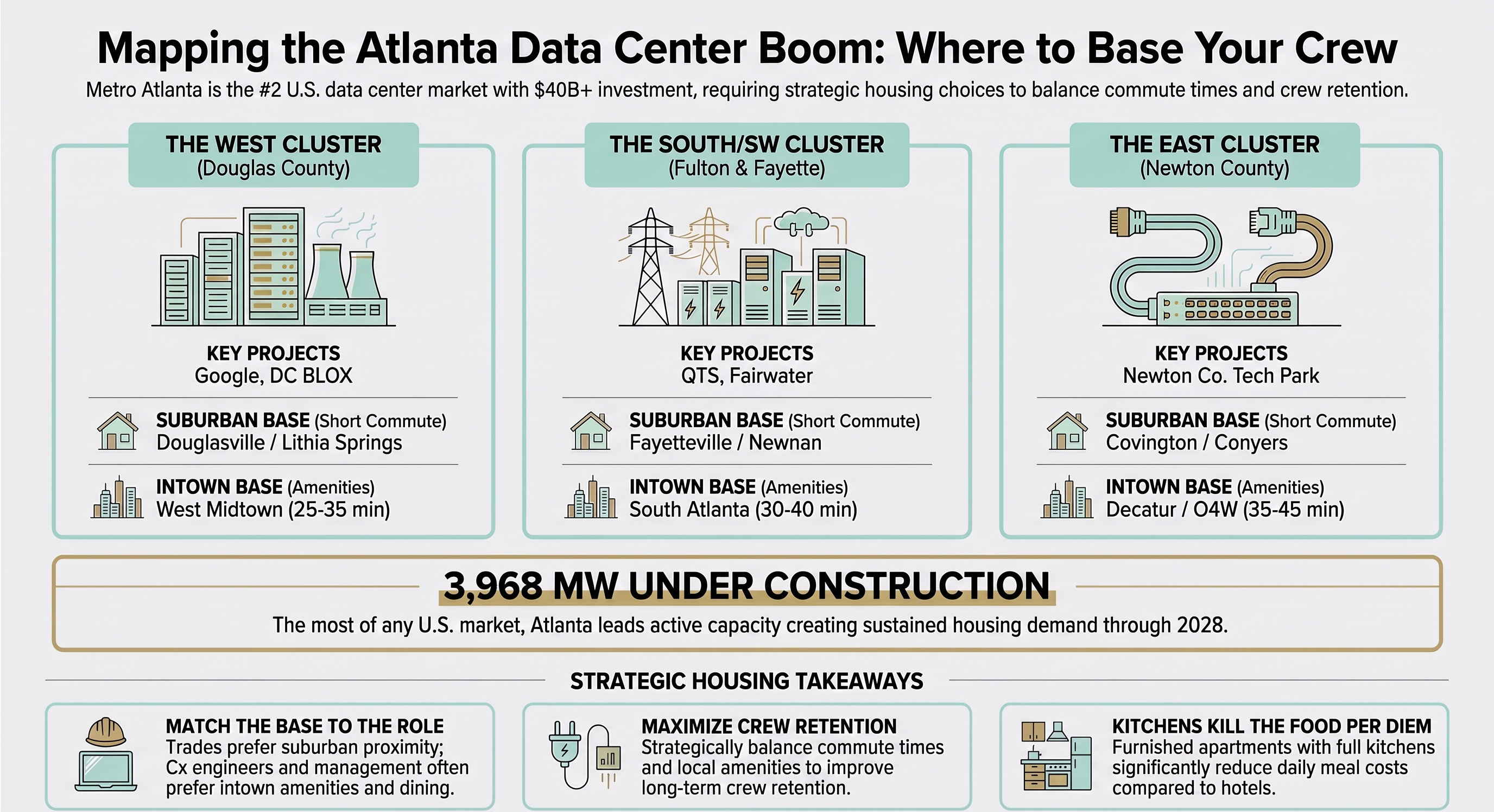
Atlanta's data centers aren't downtown. They're in a ring of suburbs and exurbs, roughly organized into three clusters plus a far-southwest outlier. Where you base your crew should work backward from the jobsite. Here's the map.
The West Cluster, Douglas County (Douglasville, Lithia Springs)
This is the heart of Atlanta's "Data Center Alley" (an AJC term, not an official designation). Google's long-standing Douglas County campus, Microsoft's Douglasville build, and DC BLOX's Atlanta West all sit here. DC BLOX's Lithia Springs site is directly adjacent to a 300-acre Microsoft facility and 2.5 miles from Google's campus (DC BLOX).
-
Base nearby: Douglasville, Lithia Springs, Austell, Mableton, Powder Springs, Hiram.
-
Base intown (west side): West Midtown, the West End, and neighborhoods along the I-20 W corridor put you roughly 25 to 35 minutes from the west cluster, the practical choice for anyone who wants city amenities on their days off.
The South / Southwest Cluster: Fulton & Fayette (Palmetto, Union City, Fairburn, Fayetteville)
Microsoft's Palmetto and Union City campuses, the QTS/Microsoft Fairwater build in Fayetteville, and T5's South Fulton project anchor this cluster near Hartsfield-Jackson airport. The Fayetteville campus sits about 20 to 22 miles south of downtown, roughly a 30-minute drive (Measured AI).
-
Base nearby: Fairburn, Union City, College Park, East Point, Peachtree City, Fayetteville, Newnan.
-
Base intown (south side): South Atlanta neighborhoods and the airport corridor keep you 30 to 40 minutes from most south-cluster sites, with a straight shot to the airport for travelers flying home between hitches.
The East Cluster, Newton County (Covington)
The $5B Newton County Technology Park and the Gregory Road project are pushing the boom east along I-20. This cluster is newer (still in filing stages) but large.
-
Base nearby: Covington, Conyers, Social Circle, Loganville.
-
Base intown (east side): Decatur, Kirkwood, East Atlanta, and Old Fourth Ward sit on the I-20 E corridor, roughly 35 to 45 minutes from Covington, the closest intown neighborhoods to the east cluster, and the most livable base for commissioning and management staff who'd rather not live in an exurb.
The Southwest Outlier, Troup & Coweta (LaGrange, Newnan)
Google's $8B Project Pegasus in LaGrange and Prologis's $17B Project Sail in Coweta are genuinely far out. LaGrange is 55 to 70 minutes from Atlanta. For these, the local markets (LaGrange, Newnan, Peachtree City) are usually the practical base; commuting from intown Atlanta daily isn't realistic.
Proximity at a glance
| Cluster | Anchor projects | Suburban base options | Intown base + approx. commute |
|---|---|---|---|
| West | Google, Microsoft Douglasville, DC BLOX | Douglasville, Lithia Springs, Austell | West Midtown / I-20 W corridor (~25 to 35 min) |
| South/SW | Microsoft Palmetto & Union City, QTS/Fairwater | Fairburn, Union City, Fayetteville | South Atlanta / airport corridor (~30 to 40 min) |
| East | Newton County Tech Park, Gregory Rd | Covington, Conyers, Social Circle | Decatur / East Atlanta / O4W (~35 to 45 min) |
| SW outlier | Google Pegasus, Project Sail | LaGrange, Newnan, Peachtree City | Not practical daily from intown |
Commute times are directional estimates for off-peak travel and vary with Atlanta traffic. Always confirm your exact jobsite address before committing to a lease: the difference between the Fayetteville and Covington campuses is more than an hour in traffic.
A note on choosing suburban vs. intown: trades crews often prefer to base close to the jobsite to shorten the pre-dawn commute. Commissioning agents, controls engineers, superintendents, and owner's reps (the white-collar, longer-tenured travelers) frequently prefer an intown base with real restaurants, gyms, and a life outside the site, and will happily trade a 35-minute drive for it. There's no single right answer; match the base to the role.
Housing by Role: Trades, Commissioning, Management, and Permanent Techs
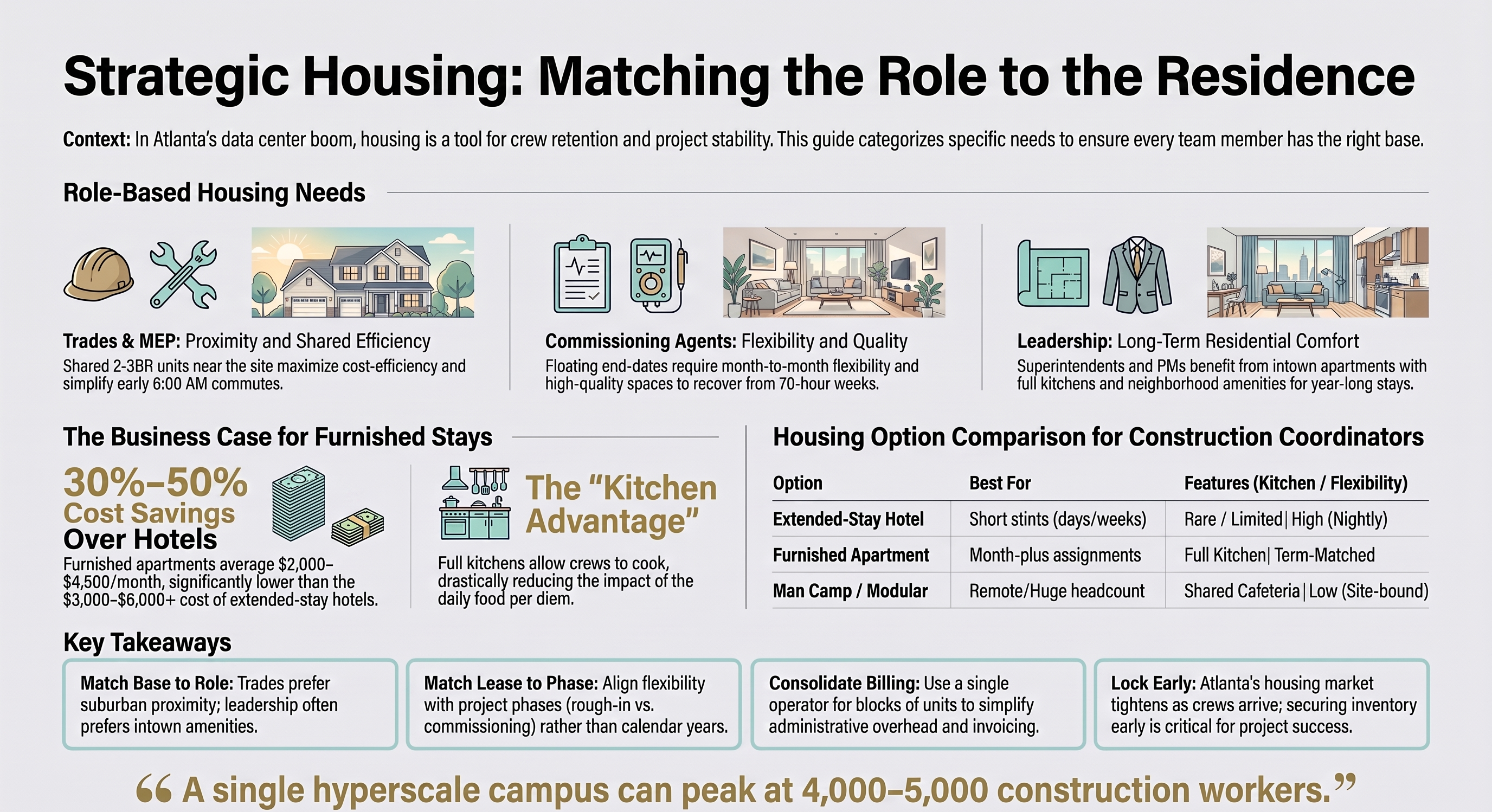
Same project, same city, very different housing needs. The main groups break down like this.
Trades crews (electricians, MEP, mechanical)
Largest group, most cost-sensitive, and often traveling as a crew rather than as individuals. What they need: proximity to the site (short commute before a 6 a.m. start), included utilities and WiFi so there's nothing to set up, and lease terms that match a defined construction phase with an option to extend. Shared 2- and 3-bedroom furnished units are the value play here: split between two or three crew members, per-person cost drops well below a single hotel room, and a shared kitchen kills the food per diem.
Commissioning agents and controls/BMS techs
The specialists. Higher-value, longer-tenured, and working brutal hours during the Cx window. What they need: flexibility above all: assignment end dates float with system readiness, so month-to-month or short fixed terms with a clean extension policy beat a rigid 6-month lease. Quality matters more here too; someone working 70-hour weeks needs a genuinely restful place, not a worn kitchenette. Many prefer an intown base for the amenities.
Superintendents, project managers, and owner's representatives
Site leadership, usually on assignment for the full build (often a year or more), sometimes bringing family. What they need: a proper furnished apartment (space, a real kitchen, a location they'd actually choose to live in) with a longer lease re-based near the site. This is the group most likely to want intown, and the most sensitive to housing quality as a quality-of-life factor over a long assignment.
Permanent data center technicians
Hired as the facility nears go-live, these roles skew toward local hiring, but the people relocating for them need interim furnished housing while they house-hunt and close on a permanent place. This is a short, predictable 1 to 3 month need with a hard end date, and it's easy to serve well with a flexible furnished term.
The Relocation Coordinator's Playbook: Housing a Whole Crew
If you're the person tasked with housing 15, 30, or 50 travelers on a project, you have a different job than an individual booking one apartment. You're managing cost, scalability, and a schedule that keeps moving. Here's the playbook.
1. Start from the schedule, not the headcount. Get the phased staffing plan from the project team: who arrives when, in what trade, for how long. Housing demand on a data center build is a wave, not a flat line: you'll need the most beds during MEP fit-out and commissioning, not at groundbreaking. Book to the wave.
2. Consolidate to a few operators, not fifty listings. Sourcing 30 units across a dozen landlords and platforms is how you lose weekends to move-in coordination and payment chaos. A furnished-housing operator that can supply a block of units on one lease, one invoice, one point of contact removes most of the administrative load. (Block/crew booking is a standard lever in commissioning staffing: blocked rooms and negotiated rates are how experienced teams control both cost and availability, though you should confirm specifics with any Atlanta operator directly.)
3. Solve for flexibility contractually. Your single biggest risk is a schedule slip. Negotiate extension terms, early-exit terms, and unit-swap/transfer terms up front. The question isn't "what does it cost this month." It's "what does it cost me if the commissioning window slips six weeks." Get that answer in writing.
4. Match unit mix to crew type. Shared 2 to 3BR units for trades crews traveling together; individual 1BRs for commissioning agents and management; a couple of family-suitable units for long-assignment superintendents. Don't put everyone in identical studios.
5. Base by cluster, not by convenience. Use the proximity map above. A block of units 40 minutes on the wrong side of the metro will cost you in overtime, fatigue, and turnover far more than the rent you saved.
6. Standardize the all-in number. Insist on furnished units with utilities, WiFi, and furnishings bundled into one monthly rate. Per-person budgeting, per-diem compliance, and reimbursement paperwork all get dramatically simpler when there are no variable utility bills to chase.
7. Build in a buffer. Housing markets near active data center builds tighten as crews arrive (documented in comparable markets like Cedar Rapids, and Georgia already carries an acute statewide housing deficit of tens of thousands of units). Lock housing early and hold a small buffer of units for late adds and overlap.
How to Vet and Book Furnished Mid-Term Housing
Whether you're an individual traveler or a coordinator, the booking mechanics are the same. Do these things and you'll avoid the two failure modes: overpaying, and getting burned by a bad listing.
The questions to ask every operator
-
What's the true all-in monthly cost? Furnishings, utilities, WiFi, and any fees: one number. If they can't give you one, keep looking.
-
What's the minimum term, and the extension policy? For phase-based work you want short minimums; for commissioning you want clean, penalty-free extensions.
-
What's the early-exit / cancellation policy? Assignments end early sometimes. Know the cost before you sign.
-
Can move-in float a few days? Crews often need to arrive before the official start to settle in.
-
For crews: can you supply a block of units on one agreement? One lease, one invoice, one contact is worth real money in saved admin.
-
Where exactly is it relative to my jobsite? Get the address and check the real commute, not the "close to Atlanta" marketing.
Red flags: walk away
Traveling workers on a deadline are a known target for rental scams. Walk away from:
-
Prices more than ~20% below comparable furnished units in the same area: the deal is the warning.
-
Wire transfer, Zelle, or Venmo requested before a signed agreement or a live video walkthrough.
-
A landlord who's "traveling" or "overseas" and can't do a live video call.
-
Only stock photos, no unit-specific detail, or an address that doesn't match Street View.
-
High-pressure "pay today to hold it" tactics.
Verify before you pay
-
Do a live video walkthrough (FaceTime/Zoom) of every room in real time.
-
Pay by credit card or ACH, never wire, never cash app. Card payments are reversible.
-
Get a written agreement before any money moves.
-
Prefer established operators and platforms over raw Marketplace or Craigslist listings.
For a crew, a single reputable furnished-housing operator solves most of this at once: verified inventory, a real lease, and a point of contact who answers the phone.
The 2026 to 2028 Outlook: Moratoriums, Tax Fights, and Why Demand Holds
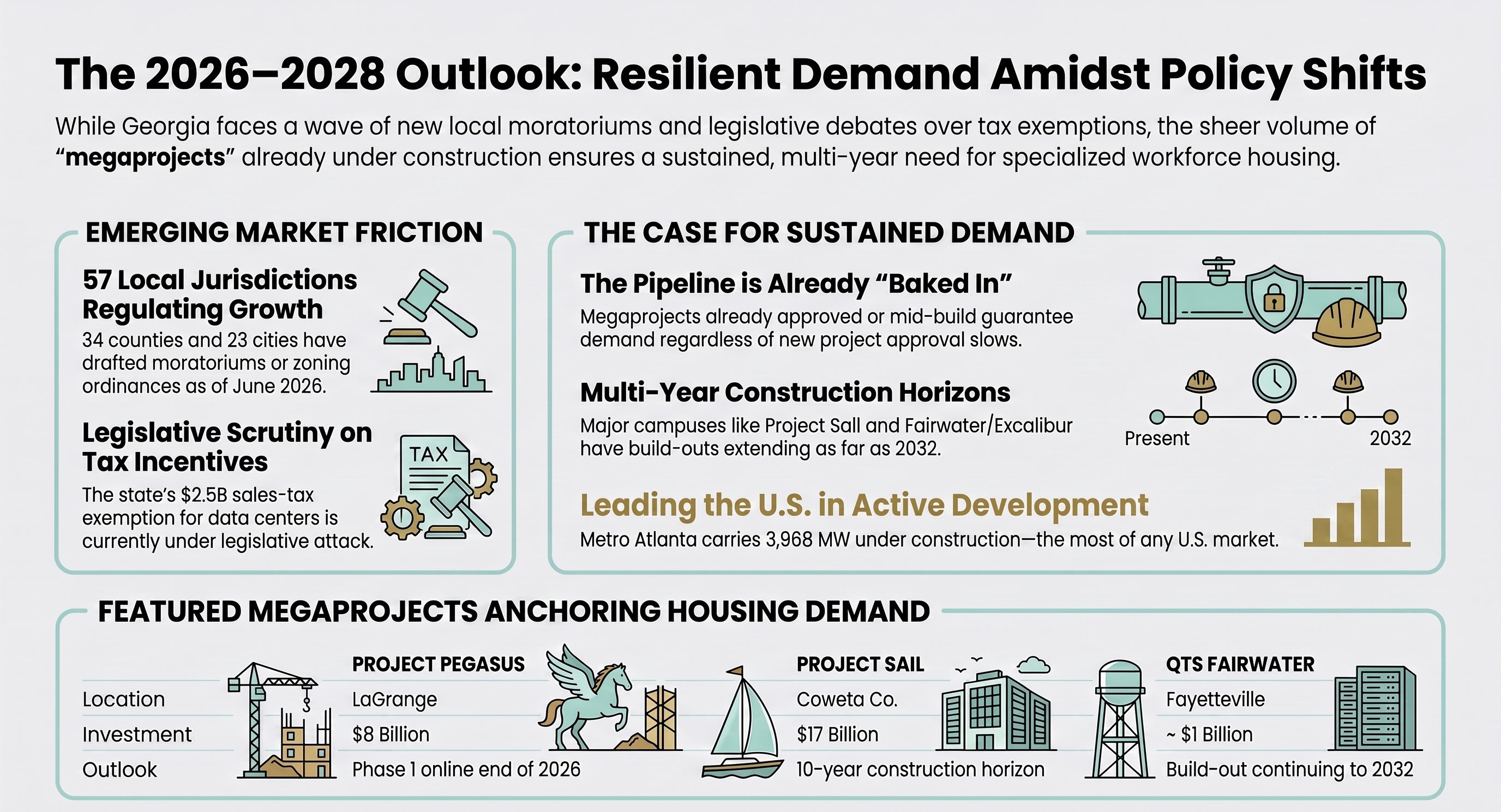
It's fair to ask whether this boom is about to hit a wall. There's real political friction, but the near-term crew demand is already baked in.
The friction is real. As of June 2026, dozens of Georgia jurisdictions, roughly 34 counties and 23 cities, have passed or are drafting data center moratoriums or zoning ordinances, about one in five Georgia counties, with Atlanta, Palmetto, and Fayetteville going as far as outright bans (Northwest Georgia News). Meanwhile, the state's data center sales-tax exemption, projected to cost Georgia more than $2.5 billion in FY2026 (AJC), is under legislative attack, with multiple 2025 and 2026 bills proposing to suspend, sunset, or pause it (Alston & Bird).
But the pipeline is already committed. Those measures mostly affect new approvals. The megaprojects already under construction or approved guarantee multi-year construction and commissioning demand regardless of whether new project approvals slow down: Project Pegasus, the Fairwater/Excalibur campus (build-out to 2032), Project Sail (a ~10-year construction horizon), DC BLOX, and Microsoft's Palmetto and Union City sites. A campus that's mid-build doesn't stop needing electricians because a neighboring county passed an ordinance.
For anyone planning housing, the read is simple: crew demand in metro Atlanta is a multi-year phenomenon, weighted toward the west, south, and east clusters, and it isn't going away before 2028.
Crew Housing Planning Checklist
Copy this into your project docs. It's the fast version of everything above.
Before you book
-
Get the phased staffing plan (who / trade / arrival / duration)
-
Identify your cluster (West / South / East / SW outlier) from the jobsite address
-
Map the housing "wave": peak beds needed during MEP + commissioning
-
Set the per-person all-in budget (furnishings + utilities + WiFi in one number)
-
Confirm per diem structure: actual-cost reimbursement vs. flat allowance
Choosing housing
-
Furnished units with full kitchens (kills the food per diem)
-
Commute under ~35 min from the jobsite for trades; intown OK for Cx/management
-
Unit mix matched to roles (shared 2 to 3BR for crews; 1BR for specialists/leadership)
-
All-in monthly pricing, no variable utility bills to chase
Contract terms
-
Minimum term matches your shortest phase
-
Extension policy in writing (penalty-free where possible)
-
Early-exit / cancellation terms known before signing
-
Move-in date can float 2 to 3 days
-
For crews: block booking on one lease / one invoice / one contact
Risk management
-
Lock housing early (markets tighten as crews arrive)
-
Hold a small buffer of units for late adds and phase overlap
-
Vet every listing: live video walkthrough, reversible payment, written agreement
Frequently Asked Questions
How long do data center construction projects last in Atlanta?
Anywhere from about 18 months for a single building to a decade for a large multi-building campus. Metro Atlanta's biggest projects, Fairwater/Excalibur in Fayetteville and Project Sail in Coweta, have build-outs running to 2032 and roughly ten years of construction activity, respectively. For an individual traveler, the practical range is a defined phase (a few weeks to several months) that frequently extends as the schedule slips or the scope jumps to the next building.
Is furnished housing actually cheaper than a hotel for construction workers?
For stays of a month or more, usually. Extended-stay hotels commonly run $3,000 to $6,000+ per person per month before meals, while furnished 1-bedrooms run roughly $2,000 to $4,500 all-in, and the furnished unit's kitchen cuts the food per diem on top of that (Alamo Corporate Housing). Hotels tend to win only for the shortest stints, and the furnished advantage widens the longer you stay.
Where should a crew live for a Douglasville or Lithia Springs data center project?
Base near the west cluster: Douglasville, Lithia Springs, Austell, or Mableton for the shortest commute. If you'd rather have city amenities, West Midtown and the I-20 W corridor put you roughly 25 to 35 minutes out. See the proximity map.
Can I get month-to-month furnished housing with no long lease in Atlanta?
Yes. Furnished mid-term operators routinely offer terms far shorter than a standard 12-month apartment lease, including month-to-month and phase-matched fixed terms. The key is confirming the extension and cancellation policy in writing before you sign, especially for commissioning work, where end dates move.
How do relocation coordinators book housing for a whole crew?
Work backward from the phased staffing schedule, consolidate to one or a few furnished-housing operators who can supply a block of units on a single agreement, and negotiate extension/exit flexibility up front. Match unit mix to role (shared units for trades, individual units for specialists and leadership), and lock housing early because markets near active builds tighten. Use the coordinator's playbook above.
Is furnished housing eligible for per diem reimbursement?
It depends entirely on your contract. Per diem is a tax-free ceiling set by the GSA, not a fixed payment. Some contracts reimburse actual lodging cost up to that ceiling; others pay a flat allowance you keep the difference on. A furnished apartment with a formal lease and a single all-in monthly cost is generally straightforward to document either way, but confirm your specific reimbursement structure with your employer or contract, and this isn't tax advice.
What's the difference between a "man camp" and furnished housing, and which fits Atlanta?
Man camps are purpose-built modular workforce villages used on remote sites with no existing housing: think rural Wyoming or Texas. Metro Atlanta's data center corridor sits inside an established suburban housing market, so furnished mid-term apartments are typically the faster, more comfortable, and more cost-effective option here. (That's an editorial read on the geography, not a claim that no operator would ever build camp capacity near Atlanta.)
Do permanent data center technicians need temporary housing too?
Often, yes. Permanent operations roles skew toward local hiring, but technicians relocating from out of the area typically need 1 to 3 months of interim furnished housing while they house-hunt and close on a permanent home. It's a short, predictable need that a flexible furnished term serves well.
Base Your Crew Right, and the Whole Project Runs Smoother
Housing is the quiet variable on every Atlanta data center project. Get it wrong and you pay for it in overtime, turnover, and commissioning agents who leave when a rigid lease ends instead of when the work does. Get it right (the correct cluster, furnished units with real kitchens, terms that flex with the schedule), and it disappears into the background where it belongs.
The market isn't slowing down. Metro Atlanta's build pipeline guarantees crew demand across the west, south, and east clusters through 2028, and the teams that dial in housing on their first project stop scrambling on every one after it.
Minty Living builds and manages fully furnished apartments across intown Atlanta, with all-in pricing, real kitchens, and lease terms built around project timelines rather than calendar years. If you're planning housing for a data center assignment or a whole crew, reach out and we'll help you find the right base for your cluster and schedule.
How Minty Living Can Help
Everything this guide covers (matching lease terms to project phase, choosing the right cluster, avoiding the hotel-and-per-diem math) plays out differently depending on which tier of the workforce you're housing. Trades crews chasing a 6 a.m. start almost always base near the jobsite, in the suburbs. Commissioning agents, controls and BMS engineers, superintendents, project managers, and owner's reps (the group working 70-hour weeks who'd rather come home to a real neighborhood than a highway frontage road) are the ones for whom an intown base makes the most sense, and that's where Minty Living operates.
Minty Living manages 160+ professionally designed, fully furnished properties across Atlanta's intown east-side neighborhoods: Inman Park, Old Fourth Ward, Midtown, Virginia-Highland, Grant Park, Cabbagetown, and others. Using this guide's own commute math: an O4W or Decatur-adjacent base runs roughly 35 to 45 minutes from the east cluster near Covington, and a Midtown base runs about 25 to 35 minutes from the west cluster in Douglas County, workable for roles whose value depends more on rest and focus than a five-minute drive to the gate. (For crews basing near the south cluster or the LaGrange/Coweta outlier, a suburban base close to the jobsite remains the more practical fit.)
A few things worth knowing if you're weighing an intown base:
All-in furnished pricing. Furnishings, utilities, and WiFi are bundled into one monthly rate, the same all-in-number simplicity this guide recommends for per-person budgeting and per diem paperwork.
Terms matched to a schedule, not a calendar year. Rentals run hourly to annual, useful for commissioning windows whose end date moves with system readiness, or for a permanent tech's interim stay while closing on a home.
Design and quality standards. Every property is designed and furnished by our in-house team, led by architect co-founder Sidra Gross. The eligible portfolio holds Plum Guide "Top 1%" certification and a 4.9 Google rating.
24-hour placement. We can place a single traveler quickly, and we're glad to talk through what a small-group arrangement would look like for your team.
If you're weighing an intown base for commissioning staff, site leadership, or a relocating technician settling in before a permanent home closes, reach out and we'll talk through your cluster, timeline, and headcount.
Reach out at mintyliving.com/atlanta or call (404) 999-0841.

 (4).png)

 (29).png)
 (28).png)
 (33).png)
 (37).png)
 (38).png)
 (39).png)
 (40).png)
 (44).png)
 (44).png)
 (1).png)
 (3).png)
 (55).png)
 (54).png)
 (56).png)
 (57).png)
 (58).png)
 (59).png)
 (60).png)
 (61).png)
 (63).png)
 (66).png)
 (67).png)
 (68).png)
 (69).png)
 (70).png)
 (71).png)
 (72).png)
 (73).png)
 (86).png)
 (87).png)
 (89).png)
 (92).png)