


 (68).png)
Thirty nights is too long for a hotel. A year long lease is too long for a project. Somewhere in that gap is where most Atlanta housing searches get stuck, and where the fine print does the most damage.
If you're searching for extended stay Atlanta options right now, you've probably noticed the problem. Hotel sites quote a nightly rate that balloons by week three. Apartment listings bury "furnished" behind an application. Nobody tells you what's actually included until you've already signed something.
Monthly furnished apartments in Atlanta solve a specific window, roughly 30 to 180 nights, that neither hospitality nor traditional leasing handles well. This guide covers that window honestly: a real comparison of furnished apartments, extended stay hotels, short term leases, and monthly Airbnb, with the costs, fine print, and lease terms that actually decide the outcome.
Whether you're starting a new job in four to six weeks, relocating a team, or working a project that keeps extending, the same four options are on your table. You'll find real numbers here, not adjectives, a comparison, not a listicle of neighborhood vibes.
Table of Contents
-
What "Furnished" and "All Inclusive" Actually Mean (And Where the Hidden Fees Hide)
-
Intown Neighborhood Cost Snapshot: Midtown, Buckhead, Old Fourth Ward, West Midtown
Why This Decision Is Harder in Atlanta in 2026
Atlanta ranks #2 nationally for multifamily rent growth in 2026. Average rents are climbing 4.1%, and vacancy is tightening to 5.2%, according to Marcus & Millichap's 2026 forecast.
That growth is colliding with a supply slowdown. Builders are on pace to deliver about 8,400 fewer apartment units than they did in 2025, roughly half last year's pace.
Meanwhile, people keep arriving. The Atlanta region added 64,400 residents between April 2024 and April 2025, per the Atlanta Regional Commission: relocating professionals, project teams, and transitioners, all competing for the same tightening inventory.
The furnished housing category is responding in kind. Hilton launched its Apartment Collection by Hilton on January 15, 2026, naming Atlanta a launch market. Marriott has 85 StudioRes properties in its own development pipeline. A Corporate Housing Providers Association report published July 2, 2026 names Atlanta among the markets driving workforce mobility and project driven housing demand through 2035.
Translation: more demand, fewer new units, and more housing categories competing for your business. That makes knowing exactly what you're comparing worth more than it used to be.
The Core Decision: Furnished Apartment vs. Extended Stay Hotel vs. Short Term Lease vs. Monthly Airbnb
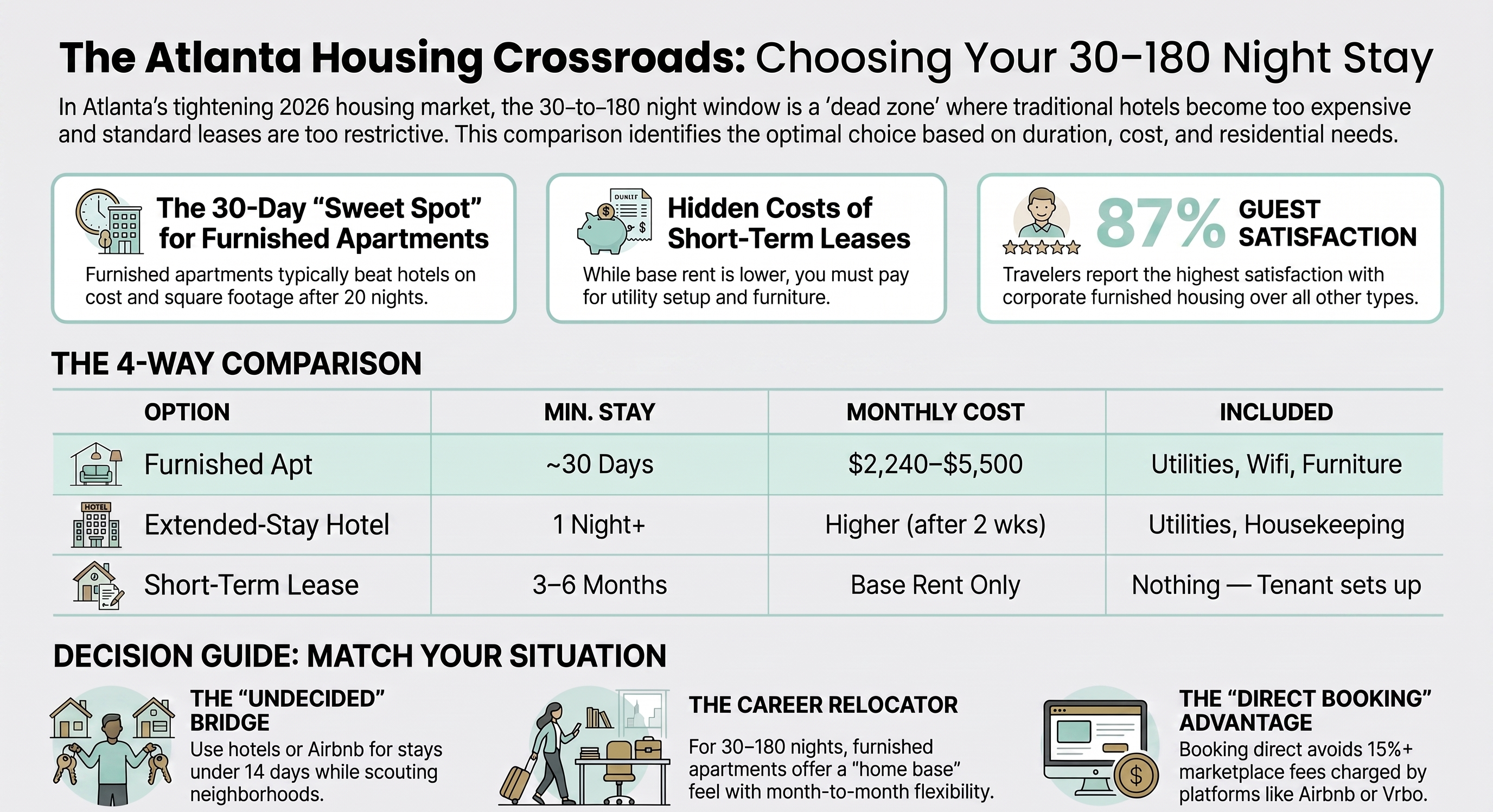
Four options cover nearly every Atlanta stay in the 30 to 180 night range, and each is built to solve a different problem.
A furnished apartment gives you a full unit, real kitchen, real bedroom, real living room, for a monthly rate. It usually carries a 30 day minimum, with everything from the couch to the coffee maker already in place.
An extended stay hotel gives you housekeeping, a compact footprint, and no commitment beyond tonight, though the nightly rate climbs fast once you're past two or three weeks.
A short term lease, typically 3 to 6 months, hands you an unfurnished apartment and the full job of setting up utilities, furniture, and a deposit yourself. Monthly Airbnb offers the most booking flexibility of the four, but pricing, quality, and cancellation terms all shift by host, with none of the legal protection a lease provides.
Here's how they stack up side by side:
| Furnished Apartment | Extended Stay Hotel | Short Term Lease (3 to 6 mo) | Monthly Airbnb | |
|---|---|---|---|---|
| Typical minimum stay | ~30 days | 1 night+ (rate drops after ~7 to 14 nights) | 3 to 6 months | Host set, often 28 to 30 days for monthly rate |
| Typical intown 1 to 2BR monthly cost | $2,240 to $5,500 (see neighborhood snapshot below) | Higher per night past week 2 to 3; often comparable or higher monthly total | Base rent plus utilities and setup costs | Highly variable; less predictable |
| What's usually included | Utilities, wifi, furniture typically bundled (verify per listing) | Utilities, wifi, housekeeping | Nothing, tenant sets up | Varies by host; utilities often included, furniture always |
| Kitchen & living space | Full kitchen, full living space | Kitchenette or none, smaller | Full kitchen, unfurnished | Full kitchen, full living space |
| Flexibility to extend or exit | Month to month renewal common | Easiest (nightly) | Hardest (lease bound) | Varies; inconsistent |
| Deposit & upfront costs | Security deposit, sometimes app fee | Minimal or none | Deposit plus setup (utility deposits, furniture) | Deposit or service fee, varies |
| Best for | 30 to 180 night stays wanting a home base | Under 2 weeks or undecided | 6+ month stays, certain duration | Short or last minute flexibility |
| Biggest risk or hidden fee | Utility caps, pet fees, early exit penalties | Nightly rate climbs fast past 2 to 3 weeks | Furniture and setup cost, 12 month lock in | Inconsistent pricing, host cancellation |
Why It Plays Out This Way
This pattern isn't random. It tracks closely with why business travelers actually choose furnished housing over the alternatives. In its 2022 study, the Global Business Travel Association found the top reasons cited include a full kitchen (45%), amenities (40%), a residential feel (36%), and cost (34%).
Travelers report 87% satisfaction with corporate furnished accommodations overall, the highest satisfaction score GBTA recorded across every accommodation type in that study.
The cost math backs that up. Extended stay hotels win on price under roughly 14 nights, because you're only paying for the nights you use. Past that point, nightly rates compound faster than a flat monthly rent. A $150 a night rate already exceeds most furnished apartment monthly totals by day 20.
Furnished apartments start winning from there on total cost, plus you get a full kitchen and meaningfully more square footage. Short term leases only pencil out past six months, once furniture and setup costs amortize. Monthly Airbnb wins on last minute flexibility but loses on price consistency and legal protection if a host cancels on short notice.
Minty's own booking data reflects where this actually lands: our average direct booking stay runs close to 60 nights, squarely inside the window where furnished housing beats every other option on cost, space, and flexibility combined.
The Case for Booking Direct
There's one more cost that never shows up in the comparison above: the platform's cut. Every booking marketplace takes a margin. Under Airbnb's 2026 pricing, the marketplace fee runs about 15.5%; Vrbo's combined host and guest fees land in the mid teens to low 20s as a percentage; Booking.com commissions average around 15%. None of them discount that cut for a longer stay. A 60 night booking pays the same percentage as a three night one.
Whether it shows up as a "service fee" at checkout or gets baked into the nightly rate, that margin is money in the price you pay. On a multi month furnished stay, it isn't a rounding error.
Booking direct with a furnished housing operator takes the marketplace out of the middle. You set terms with the person who actually controls the calendar, extensions, early exits, unit swaps, a move in date that can flex, instead of inside a platform's fixed policy. There's no host cancellation risk, one point of contact for maintenance and billing, and a single all inclusive invoice that keeps expense and per diem paperwork simple.
Which option wins for you, though, depends on one variable more than any other: how long you'll really be here. We'll walk through that by situation below, but first, two things worth understanding before you book anything: what "furnished" and "all inclusive" actually mean, and how lease terms work.
What "Furnished" and "All Inclusive" Actually Mean (And Where the Hidden Fees Hide)
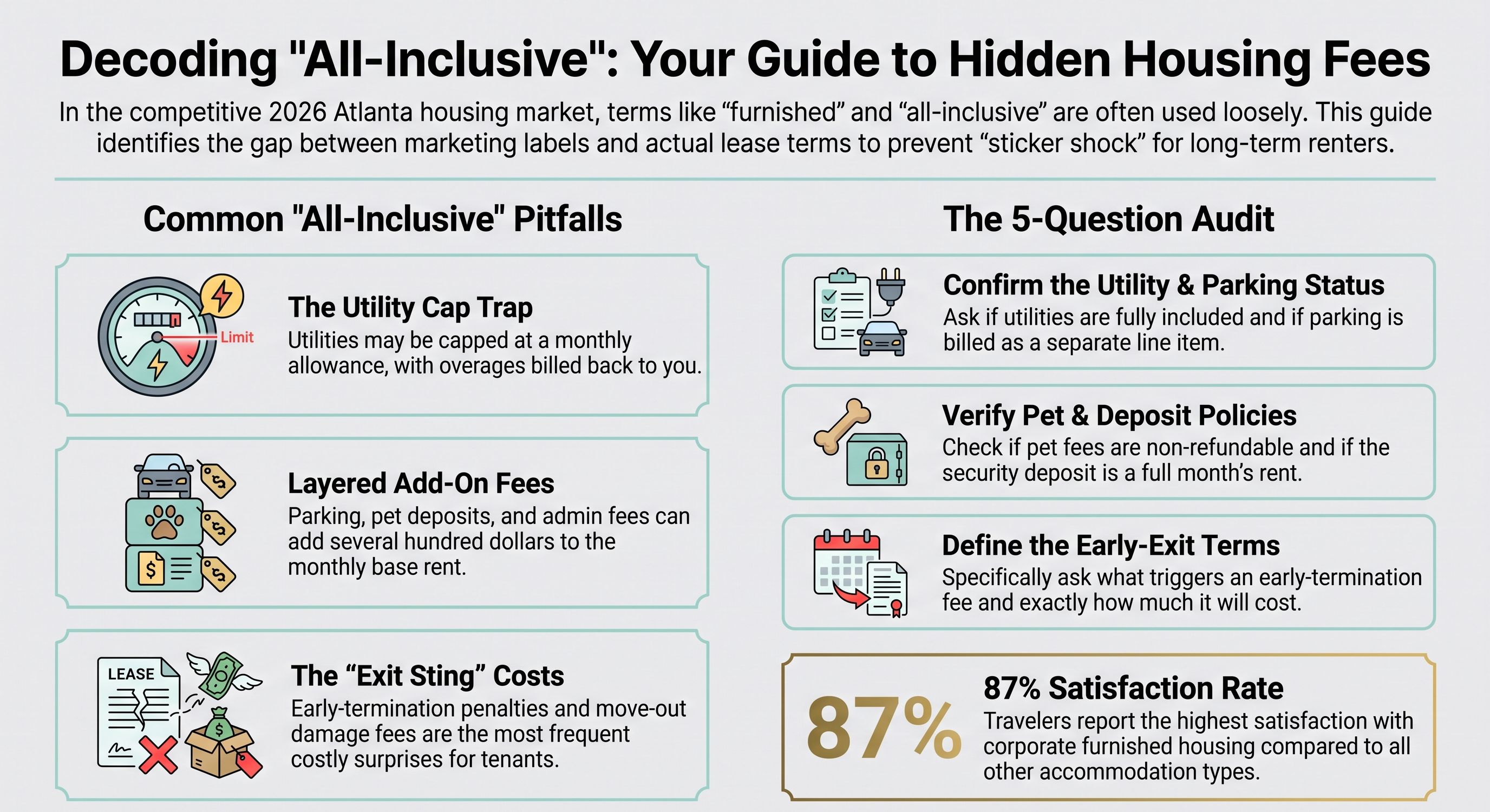
"Furnished" and "all inclusive" get used loosely across Atlanta listings, and the gap between the label and the lease is where most sticker shock happens. That $2,500 a month furnished listing that caught your eye may be base rent only, with utilities, parking, and a pet fee layered on after you've already gotten attached.
Before you book anything, find out exactly what's covered. Utilities can be fully included or capped at a monthly allowance, with overages billed back to you. Wifi is usually included, but furniture quality varies widely between providers.
Parking, pet deposits, and housekeeping cadence, whether weekly, biweekly, or none, are rarely spelled out until you ask. Application and admin fees can add a few hundred dollars before you've moved a single box, and security deposits range from a few hundred dollars to a full month's rent.
The costliest surprises tend to show up on the way out: early termination penalties and move out or damage fees that weren't obvious in the marketing copy. A unit advertised at one clean monthly number can quietly carry several hundred dollars a month in add ons once parking and a pet land on the invoice. Ask these five questions before you sign anything:
-
Is the utility allowance capped, or fully included?
-
Is parking included, or billed separately?
-
What's the pet policy, and is there a pet fee or deposit?
-
How large is the security deposit, and is it refundable?
-
What triggers an early exit fee, and how much is it?
Minty prices its furnished units all inclusive by design, with utilities, wifi, and furniture bundled into one monthly rate, specifically so you're not doing this math after the fact. Whichever provider you choose, get these five answers in writing before you commit.
Lease Terms & Flexibility, in Plain English
Minimum stays vary sharply across the four options. Extended stay hotels will take you for a single night. Furnished apartments typically require about 30 days. Short term leases run 3 to 6 months. Monthly Airbnb hosts usually set their own threshold, often 28 to 30 nights, to unlock the monthly rate.
That variation is a real source of frustration. GBTA found minimum stay requirements are the single most commonly reported obstacle to booking extended stay accommodations, cited by 29% of business travelers.
If a rigid lease term is what's holding up your search, a month to month furnished apartment is built to solve exactly that problem. You commit to 30 days, then renew or leave on your own timeline.
Two things matter once you're past the minimum: rate protection and notice periods. Some providers lock your monthly rate for the duration of your stay; others reserve the right to adjust it at renewal, so ask which applies before you sign.
Notice periods, meaning how far ahead you must tell your provider you're leaving, typically run 30 days. Missing that window is the most common way renters trigger an early exit fee.
Quick glossary: A minimum stay is the shortest booking a provider will accept. Month to month means your lease renews automatically in 30 day increments until either party gives notice. A notice period is the advance warning required before you move out. An early termination fee is the penalty for leaving before your committed term ends.
Intown Neighborhood Cost Snapshot: Midtown, Buckhead, Old Fourth Ward, West Midtown
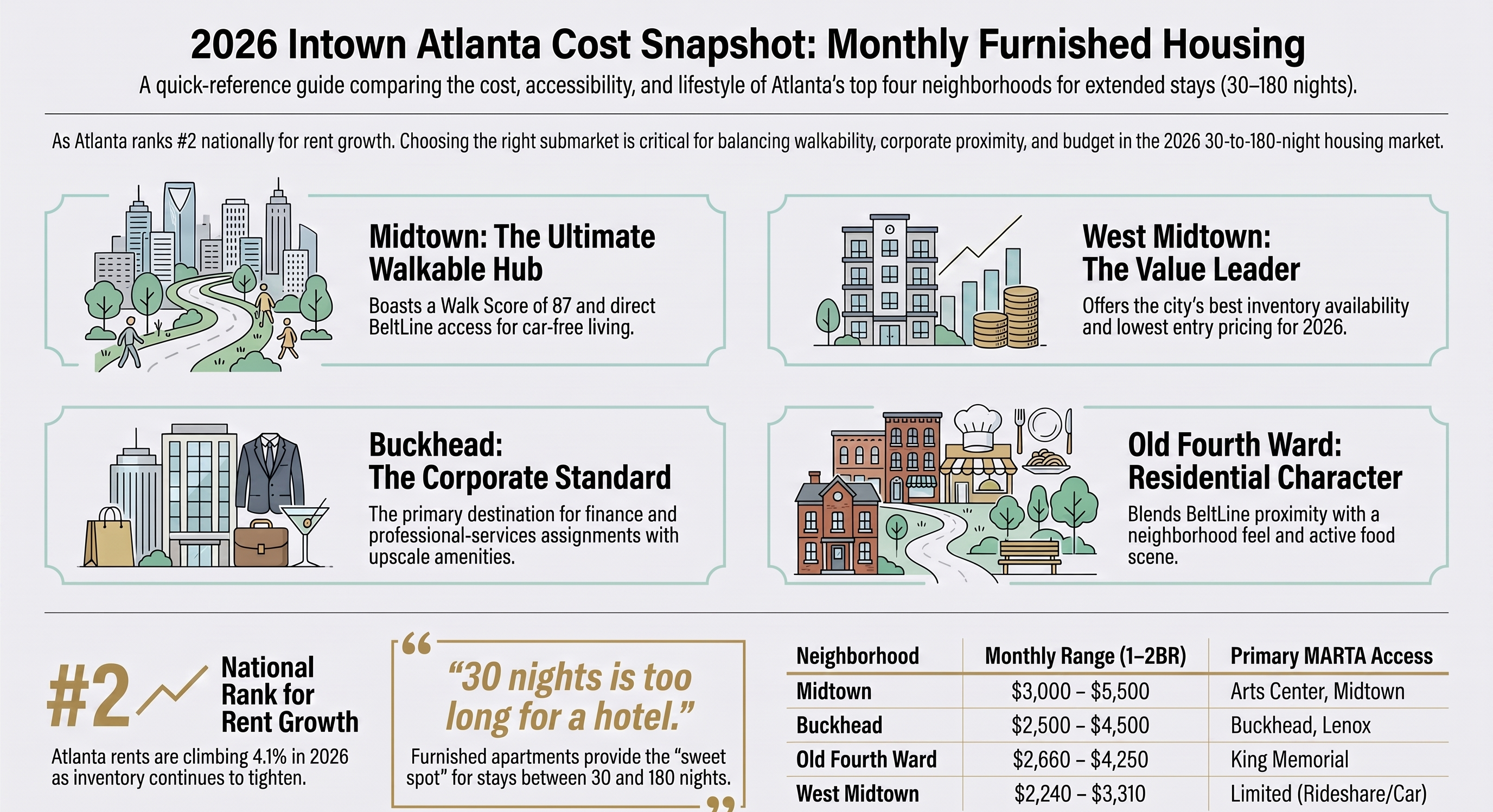
Once your minimum stay and notice terms are settled, the next variable is where you actually land, and it matters almost as much as which option you choose. Here's a snapshot of four intown submarkets where Minty and other providers concentrate furnished inventory.
Midtown is Atlanta's most walkable furnished housing hub, with 1 to 2 bedroom units typically running $3,000 to $5,500 a month. MARTA's Arts Center and Midtown stations serve it, it carries a Walk Score of 87, and it sits directly on the BeltLine, a strong fit if you want to walk to work, restaurants, and transit without a car.
Buckhead runs a bit more affordable at the low end, with furnished 1 to 2 bedrooms typically $2,500 to $4,500 a month. MARTA's Gold Line serves it via the Buckhead and Lenox stations. It skews upscale and corporate, and it's a common placement for finance and professional services assignments.
Old Fourth Ward trades corporate polish for neighborhood character, with BeltLine access, an active food and culture scene, and a more residential feel than Midtown or Buckhead. Furnished 1 to 2 bedrooms typically run $2,660 to $4,250 a month, and the nearest MARTA stop is King Memorial, a short walk or rideshare from most listings.
West Midtown is Atlanta's value and availability play, not its "hot" submarket. Heavy apartment lease up activity has left it with more inventory and more negotiating room, and furnished 1 to 2 bedrooms typically run $2,240 to $3,310 a month, the lowest of these four submarkets. Direct MARTA access is limited, though, so plan on rideshare or a car for daily commuting.
| Neighborhood | Furnished 1 to 2BR Range | Vibe or Best For | MARTA Access |
|---|---|---|---|
| Midtown | $3,000 to $5,500 | Walkable, BeltLine, young professional | Arts Center, Midtown |
| Buckhead | $2,500 to $4,500 | Upscale, corporate and finance | Buckhead, Lenox |
| Old Fourth Ward | $2,660 to $4,250 | BeltLine, food and culture, residential feel | King Memorial (nearest) |
| West Midtown | $2,240 to $3,310 | Value plus availability (not "hot") | Limited direct, plan for rideshare or car |
Furnished ranges reflect RentCafe neighborhood base rents (as of July 2026) plus a typical furnished or corporate housing premium, which varies by building and can exceed 50% for higher end inventory. Confirm current pricing with any provider before booking.
For a deeper breakdown of which submarket fits your industry and team size, see our guide on which neighborhood fits your company's industry.
How to Choose: Match the Option to Your Situation
The right choice comes down to duration and certainty, not preference.
-
Starting a new job in 4 to 6 weeks and not sure how long you'll stay? A furnished apartment gives you the flexibility to extend month to month and the cost edge that kicks in past 30 nights.
-
Booking housing for a 5 to 20 person team or project cohort that needs predictable billing? A furnished housing program with SLA backed reliability handles that at scale better than individual hotel or Airbnb bookings.
-
On a 4 to 6 month assignment, or between permanent homes? Furnished housing beats hotel costs and avoids the lease commitment a short term lease requires.
-
Staying under two weeks, or still deciding? An extended stay hotel or monthly Airbnb makes sense as a bridge while you figure out your actual timeline.
For a deeper dive into relocating to Atlanta start to finish, read our full Atlanta relocation playbook. If you're coordinating housing for a team, our guide on which neighborhood fits your company's industry breaks down the best submarket by sector.
Ready to see what's actually available? See current furnished 1 and 2 bedroom availability in Midtown, Buckhead, and West Midtown.
How Minty Living Can Help
If you're weighing these options for an actual move, not just researching them, Minty Living operates in the same 30 to 180 night window this guide covers, across the same intown neighborhoods: Midtown, Buckhead, Old Fourth Ward, and West Midtown.
Every one of our 160+ furnished properties is priced all inclusive, with utilities, wifi, and furniture bundled into one monthly rate, so the "what's actually included" question this guide raises has one answer, not five. Interiors are designed in house, led by architect cofounder Sidra Gross, and our eligible portfolio meets Plum Guide's "Top 1%" quality standard, backed by a 4.9 Google rating and Airbnb Superhost status.
Stays run month to month after the initial 30 days, so you're not locked into a term that outlasts your actual need.
See current availability or ask about a specific timeline at mintyliving.com or call (404) 999.0841.
 (4).png)

 (29).png)
 (28).png)
 (33).png)
 (37).png)
 (38).png)
 (39).png)
 (40).png)
 (44).png)
 (44).png)
 (1).png)
 (3).png)
 (55).png)
 (54).png)
 (56).png)
 (57).png)
 (58).png)
 (59).png)
 (60).png)
 (61).png)
 (63).png)
 (66).png)
 (45).png)
 (67).png)
 (69).png)
 (70).png)
 (71).png)
 (72).png)
 (73).png)
 (86).png)
 (87).png)
 (89).png)
 (92).png)