


 (39).png)
Table of Contents
- Who This Guide Is For
- Atlanta's University Housing Ecosystem
- Atlanta Neighborhood Guide
- Housing Types and Lease Structures
- The True Cost of Atlanta Student Housing
- International Students
- Medical Residents and Rotating Assignments
- Summer Interns
- FAQ
- How Minty Living Can Help
You just got your Georgia Tech research fellowship and have eight weeks to find housing before orientation. You’re an Emory medical resident starting July 1 with $150,000 in student debt and zero interest in a 12-month lease you can’t afford to break. You’re a summer intern searching “student housing Atlanta” at midnight, overwhelmed by listings that may or may not be legitimate. You’re a visiting researcher from Seoul arriving with your family in May, funded by a $120,000 grant, and you need a two-bedroom near Clifton Corridor by next month. This guide was written for all four of you — covering every neighborhood, every university program, and every lease structure across Atlanta’s four major campuses.
Atlanta is home to more than 250,000 students, residents, interns, and researchers spread across four major academic institutions — Georgia Tech, Emory University, Georgia State University, and the Atlanta University Center consortium. Yet nearly every housing guide treats them as a single, interchangeable audience. They are not.
A Georgia Tech summer intern needs a furnished studio near Midtown for 12 weeks. A GSU graduate student needs proximity to Five Points MARTA and a lease that starts August 1. An Emory medical resident needs a quiet block near Clifton Corridor and a property that doesn’t require a co-signer for every international applicant. A visiting scholar with a family needs a two-bedroom with parking, not a by-the-bed dorm arrangement.
This guide covers all of them. It maps nine Atlanta neighborhoods against 2026 rent data ($1,100 to $2,400 for a one-bedroom), explains three university-run housing programs (GT Intern Lodging, Emory SIHP, and The Ridge), and shows you exactly which MARTA lines serve which campuses. It exposes the hidden costs — parking, utilities, short-term fees, deposits — that push your true monthly budget 20 to 40 percent above the listed rent. It covers Georgia tenant rights, scam red flags, and the upfront cash crunch that surprises first-time Atlanta renters.
Use the table of contents below to jump directly to your situation. Three downloadable assets appear at the end: a neighborhood comparison worksheet, a move-in cost calculator, and a lease red-flag checklist.
1. Who This Guide Is For: Find Your Atlanta Housing Path
Atlanta’s student housing market serves four distinct populations with almost nothing in common except geography. Your stipend, your lease timeline, your credit history, your car ownership, and your family situation all point you toward completely different neighborhoods and housing types. Start here to find your path.
Quick-Reference Persona Table
| Persona | Typical University | Monthly Budget | Lease Need | Top Priority | Start Reading |
|---|---|---|---|---|---|
| Priya — International Grad Student | Georgia Tech / GSU | $900–$1,800 | 9–12 months | MARTA access, no US credit required | Sections 3, 6 |
| Dr. James — Medical Resident | Emory School of Medicine | $1,400–$2,000 | Flexible (rotating) | Furnished, <15 min to hospital | Sections 4, 7 |
| Maya — Summer Intern | Georgia Tech / GSU / Emory | $1,000–$1,500 | 10–14 weeks | Short-term furnished, no car needed | Sections 4, 8 |
| Dr. Sandra — Visiting Researcher | Emory / Georgia Tech | $1,800–$2,500 | 3–6 months | 2BR for family, parking, good schools | Sections 3, 9 |
Priya: The International Graduate Student
Your $15,000–$35,000 annual stipend is real money, but American landlords often don’t see it that way. Without a US credit score, a Social Security number with payment history, or a domestic co-signer, you’ll face rejection from properties that would otherwise fit your budget. You depend on MARTA because a car isn’t financially viable on a research assistant salary. You need a landlord willing to work with international documentation — a visa letter, bank statement, and university employment verification — or a university-run program that sidesteps the credit check entirely. Home Park, Decatur, and West End give you the most value per dollar while keeping MARTA within reach. Section 6 covers the exact documentation package that gets applications approved.
Dr. James: The Medical Resident
At $65,000–$80,000 per year, you earn more than most graduate students, but $150,000 or more in medical school debt changes the math fast. Your rotation schedule may shift every four to eight weeks, which makes a 12-month lease a liability. A lease break costs one to two months’ rent — $1,600 to $3,200 you cannot afford to lose. You need a furnished apartment near Emory’s Clifton Corridor that offers month-to-month or short-term terms at a predictable all-inclusive rate. The Ridge and Blueground both serve this need. The Druid Hills and Decatur neighborhoods put you within a 10-minute drive of Emory University Hospital without the Midtown price premium.
Maya: The Summer Intern
Your internship pays $18,000–$25,000 annualized, but you only need housing for 10 to 12 weeks. You’ve never rented an apartment on your own. You need everything furnished, you probably don’t have a car, and you need to know that your landlord is legitimate before you wire a deposit from your home state or country. Georgia Tech Intern Lodging and university-adjacent short-term furnished providers eliminate most of that risk. Section 8 was written with your situation in mind.
Dr. Sandra: The Visiting Researcher
Your $80,000–$150,000 grant budget gives you real options, but your constraints are specific. You may be bringing a partner and children. You need a two-bedroom, parking, and a neighborhood where your family can settle for three to six months without feeling stranded. Virginia-Highland, Decatur, and Druid Hills all fit this profile. Section 9 walks you through the remote arrangement process.
What Every Persona Shares
Three problems cut across all four situations, regardless of budget or university.
MARTA access determines whether you can live car-free in Atlanta. The city’s rail system is limited — only Georgia State and the Atlanta University Center campuses sit directly on MARTA rail lines. Knowing which neighborhoods require a bus transfer or a personal vehicle is essential before you sign anything.
Scam vulnerability is high for anyone searching from outside Atlanta. Fraudulent listings copy real property photos, collect application fees and deposits, and vanish. The tactics are consistent and preventable. Section 11 covers them in full.
Upfront cost crunch surprises almost everyone. First month’s rent plus a security deposit of one to two months means you need $2,800–$4,800 liquid before your first day. Add furnishing costs for unfurnished units ($1,500–$3,000), and the cash requirement before move-in exceeds what most stipend and internship programs front-load. University programs eliminate part of this burden; Section 5 shows exactly where the money goes.
Atlanta’s University Housing Ecosystem: Four Campuses, One City
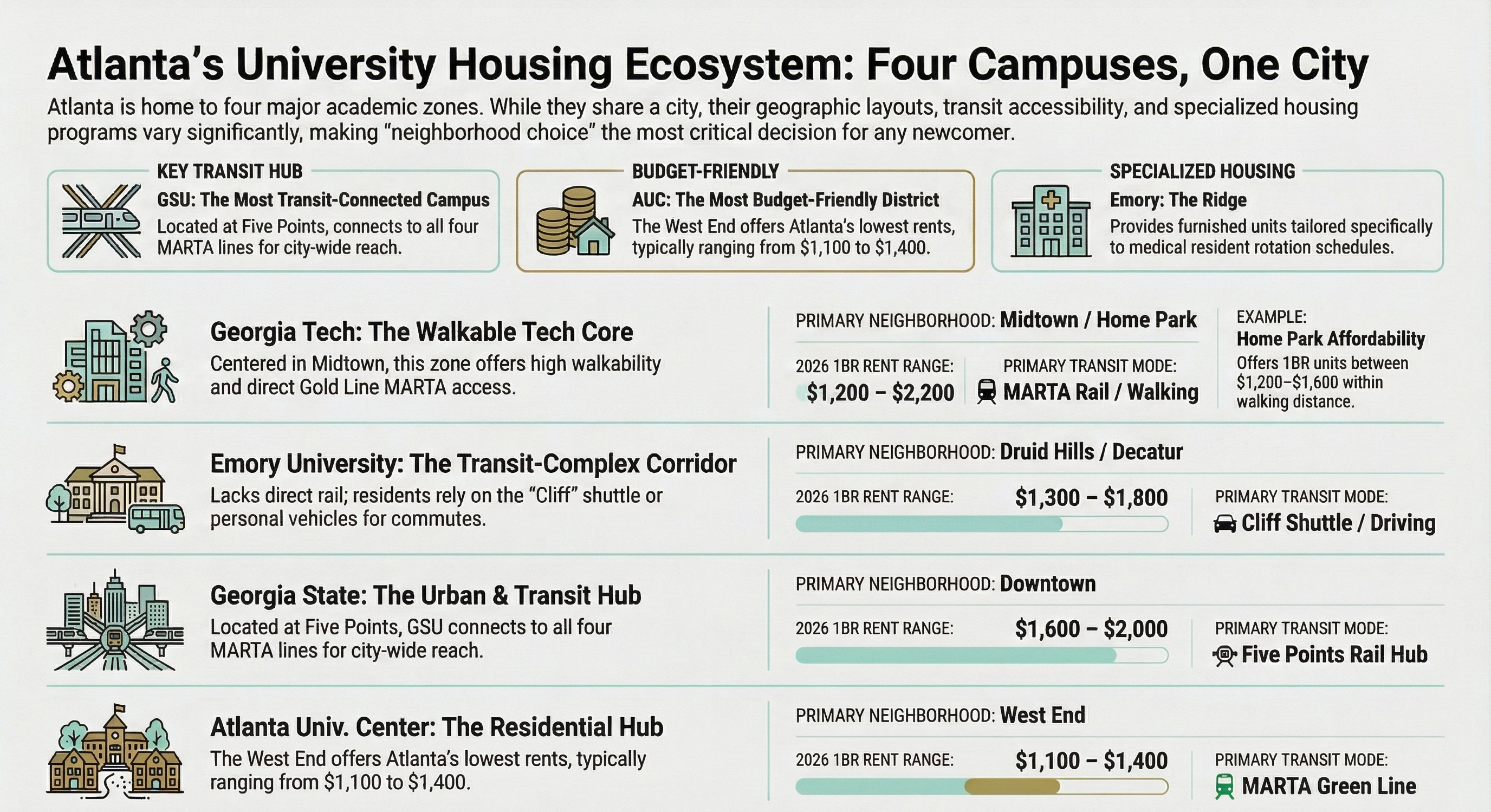
Atlanta’s four major academic institutions occupy four distinct geographic zones across the city — close enough to share a transit system, far enough apart that your campus determines your neighborhood options almost entirely.
Georgia Tech — Midtown
Georgia Tech occupies the northern edge of Midtown, one of Atlanta’s most walkable and transit-served neighborhoods. The Gold Line MARTA runs through Midtown Station and North Avenue Station, both within a 10-minute walk of the main campus.
Georgia Tech operates one of the city’s most useful programs for temporary residents: GT Intern Lodging, which provides furnished on-campus housing for summer interns and short-term researchers. Availability is limited and fills early — applications typically open in February for summer. The official off-campus housing board at offcampus.housing.gatech.edu aggregates vetted listings from landlords familiar with student documentation requirements.
The surrounding streets — particularly the Home Park neighborhood immediately west of campus — offer some of the most affordable furnished apartments near Georgia Tech, typically $1,200–$1,600 for a one-bedroom, within a 10-to-15-minute walk.
Emory University — Druid Hills and Clifton Corridor
Emory’s situation is the most transit-complex of the four campuses. There is no MARTA rail station within walking distance of the main campus. The Emory-sponsored Cliff shuttle connects campus to the Decatur MARTA station, with a ride time of roughly 4–7 minutes.
For medical residents and researchers who need housing close to Emory University Hospital, the Clifton Corridor is the epicenter. Emory operates two key programs:
-
Emory SIHP (Summer Intern Housing Program) runs May 17 through August 1, 2026, providing furnished short-term accommodations for summer students and interns — open to all college students.
-
The Ridge serves medical residents specifically, with furnished units ranging from $700 to $1,600 per month depending on unit size and term length.
If you need MARTA rail access and are willing to travel 15 minutes to campus, Decatur offers a compelling alternative — Blue and Gold Line access, walkable town center, and one-bedroom rents of $1,300–$1,700.
Georgia State University — Downtown
Georgia State is the most transit-connected campus in Atlanta. Five Points Station sits at the center of the city and serves all four MARTA lines — Gold, Red, Blue, and Green. From Five Points, you can reach the airport in 20 minutes, Midtown in 8 minutes, and Buckhead in 22 minutes, all without a car.
Downtown Atlanta’s housing stock skews toward newer high-rise apartments and converted office buildings. Short-term rental near Georgia State University exists but is competitive — landlords know they can fill units with 12-month leases. Searching early matters more downtown than anywhere else. Expect one-bedroom rents of $1,600–$2,000 for units close to Five Points.
Atlanta University Center — West End
The Atlanta University Center consortium — Morehouse College, Spelman College, Clark Atlanta University, and the Morehouse School of Medicine — clusters in the West End neighborhood. The Green Line MARTA connects West End Station directly to Five Points and Midtown.
West End offers Atlanta’s lowest rents in this guide: $1,100–$1,400 for a one-bedroom. The neighborhood is undergoing sustained reinvestment, with new restaurants and renovated housing stock improving options without yet pushing rents to Midtown levels. For AUC students on financial aid or limited family support, West End provides the widest margin between rent and budget.
The Gap That Short-Term Furnished Housing Fills
Every university in Atlanta defaults to the same lease structure: 12 months, starting August 1. That structure fits a full-time undergraduate student perfectly and almost nobody else. Medical residents rotate. Summer interns leave in August. Visiting researchers arrive in January and need housing through June. International students sometimes arrive two months before their programs start and need bridging accommodation.
The market’s answer to this gap is the short-term furnished apartment — typically priced at a 15–30 percent premium over an unfurnished annual lease, but eliminating the furnishing cost, the lease-break risk, and in many cases the credit check.
Atlanta Neighborhood Guide: 9 Areas Compared
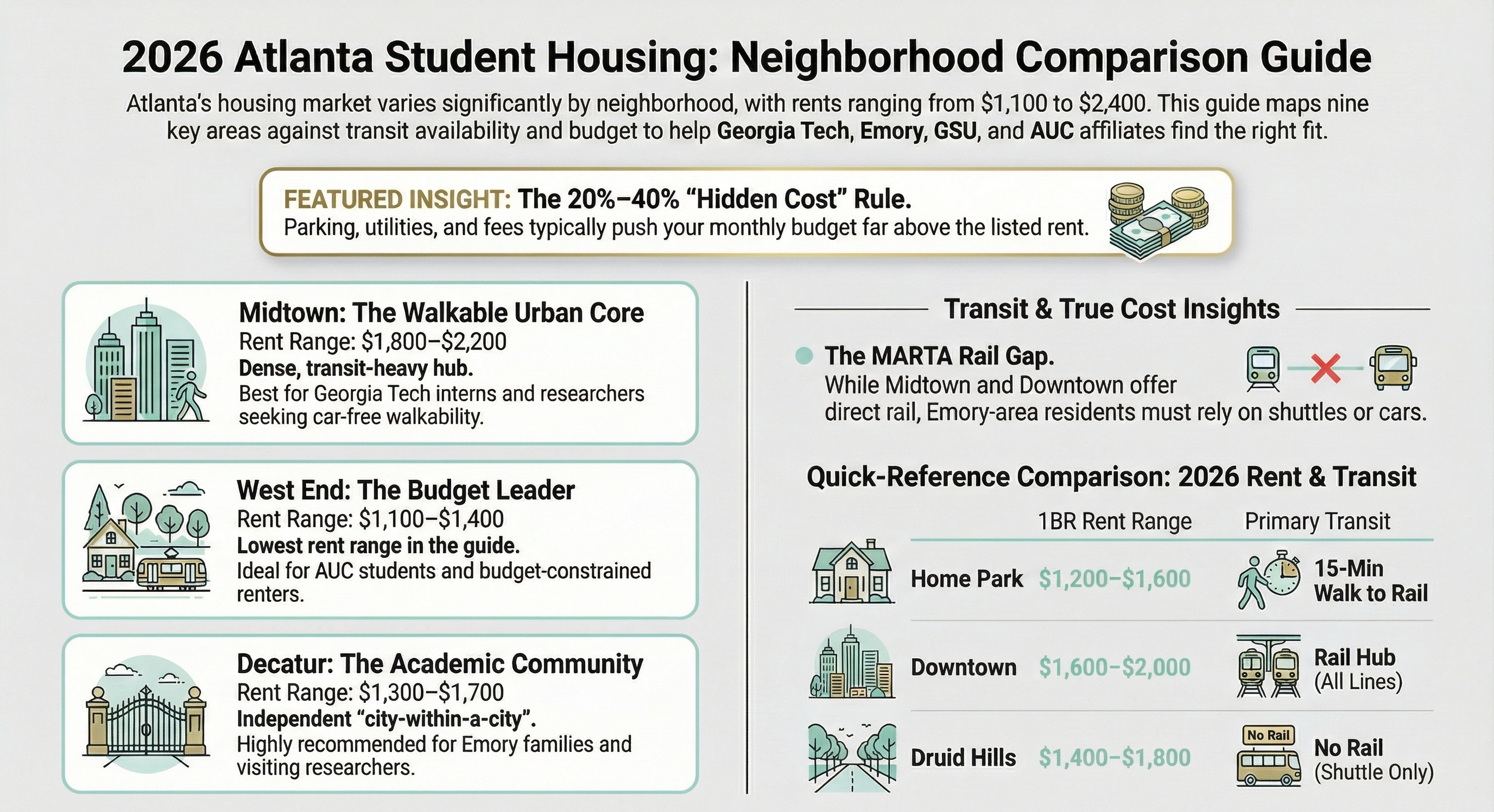
Master Comparison Table
Midtown
The Vibe. Atlanta’s densest, most walkable urban core. High-rise apartments, ground-floor restaurants, Piedmont Park two blocks away, and a concentration of tech employers that makes it a natural landing zone for Georgia Tech affiliates.
Home Park
The Vibe. The working neighborhood immediately west of Georgia Tech — a mix of rental houses, renovated bungalows, and newer apartment buildings. It lacks Midtown’s density and polish, but compensates with dramatically lower rents and a 10-to-15-minute walk to campus.
Downtown
The Vibe. An urban core in active transition. The blocks closest to Five Points and the GSU campus are dense, fast-moving, and convenient for anyone who needs multiple transit connections.
Druid Hills
The Vibe. Atlanta’s most prestigious residential neighborhood — tree-lined streets, large early-20th-century homes, and a quietness that feels removed from the city even though Emory’s campus is minutes away.
Decatur
The Vibe. A small city within a city — an independent municipality with its own downtown, its own restaurant scene, and a walkable town square. It attracts faculty, graduate students, and researchers who want community. The schools are well-regarded, which matters for visiting researchers with children.
Virginia-Highland
The Vibe. One of Atlanta’s most beloved neighborhoods — a dense grid of bungalows, independent restaurants, and walkable retail along North Highland Avenue.
West End
The Vibe. A historically Black neighborhood in active reinvestment — murals, new restaurants on Ralph David Abernathy Boulevard, and renovated bungalows alongside older housing stock.
Buckhead
The Vibe. Atlanta’s luxury commercial and residential district — high-rise apartments, upscale dining, corporate headquarters. It is decidedly not a student neighborhood, but it appears in this guide because grant-funded researchers and corporate interns are sometimes placed here.
East Atlanta Village
The Vibe. Atlanta’s indie-music, taco-truck neighborhood. Genuinely affordable, genuinely fun, and genuinely inconvenient if you need to be on a campus on the other side of the city.
Housing Types and Lease Structures
Atlanta’s rental market operates on a 12-month default. If your need falls outside that window — and for most graduate students, residents, interns, and researchers it does — you need to search deliberately and earlier than you think.
Furnished Short-Term Rentals (1–6 Months)
The furnished short-term market is served by a mix of national operators and local specialists. BCA Furnished Apartments focuses on the Georgia Tech and GSU corridors with units priced for academic budgets. Blueground operates premium furnished apartments across Midtown, Buckhead, and Decatur. TP Corporate Lodging specializes in medical placements near Emory and Piedmont Atlanta.
Expect to pay a 15–30 percent premium over a comparable unfurnished annual lease. On a $1,500 unfurnished one-bedroom, that means $1,725–$1,950 furnished. The math looks unfavorable until you factor in what the premium covers: furniture ($1,500–$3,000 to buy), housewares, setup time, and the absence of a lease-break penalty if your program ends early.
By-the-Bed Leases
By-the-bed leasing assigns each tenant individual financial responsibility for their bedroom only. You sign your own lease, pay your own rent, and your obligation doesn’t change if a roommate stops paying. Common in purpose-built student housing near Georgia Tech and GSU.
The trade-off: per-person costs run 10–20 percent higher than splitting a joint lease on a two-bedroom. The benefit: no US credit requirement for your co-residents, no shared liability for their financial behavior, and a faster application process. For international students who can’t control whether prospective roommates meet landlord income requirements, by-the-bed leasing removes a significant complication.
University-Run Programs
University-administered housing is the safest entry point for any first-time Atlanta renter. Verified by the institution, scam-proof by definition, and designed with student documentation needs in mind.
-
GT Intern Lodging: Furnished on-campus accommodations for summer interns and short-term visitors. Demand exceeds supply every year; applications open in February and fill within weeks.
-
Emory SIHP: May 17 through August 1, 2026. Serves summer students, interns, and short-term researchers. Does not require a US credit check.
-
The Ridge: Managed adjacent to the Emory medical campus. Serves residents and fellows specifically. Rates run $700–$1,600 with terms aligned to rotation schedules.
-
KSU Intern Housing: Short-term program for academic visitors — worth a direct inquiry if affiliated with Kennesaw State.
Traditional 12-Month Leases
For PhD candidates with multi-year commitments or long-term medical residents, a traditional 12-month lease delivers the lowest per-month housing cost. The risks are known: breaking a lease early typically costs one to two months’ rent. Georgia law requires landlords to make reasonable efforts to re-rent the unit if you break your lease, which can reduce your liability.
Subletting is an option if your lease permits it. Read your lease before you ask permission — some leases prohibit subletting entirely, others require written landlord approval. Never sublet without written consent.
The True Cost of Atlanta Student Housing
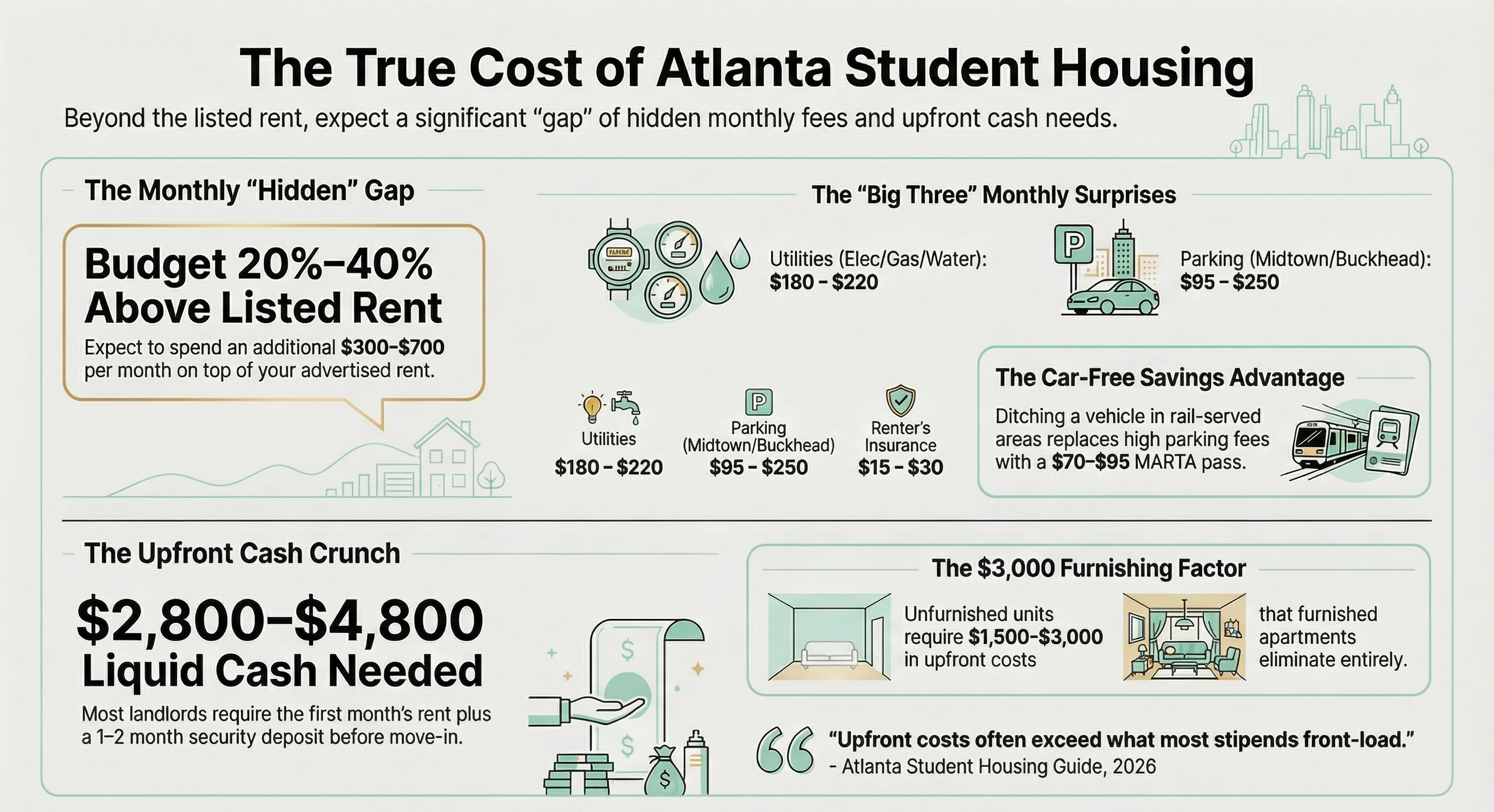
Listed rent is not your housing cost. In Atlanta’s market, the gap between what a listing advertises and what you actually spend runs $300–$700 per month depending on your situation.
The Hidden Cost Itemization
| Cost Category | Monthly Range | Notes |
|---|---|---|
| Parking | $95–$250 | Required if you own a vehicle; highest in Midtown and Buckhead |
| Utilities (electricity, gas, water) | $180–$220 | Higher in older buildings; summer AC is significant in Atlanta |
| MARTA pass | $70–$95 | Unlimited monthly; many universities offer discounted rates |
| Short-term lease premium | $30–$100 | Flat monthly fee for sub-12-month agreements |
| Application fee | $25–$75 | Per property; non-refundable |
| Security deposit | 1–2 months’ rent | $1,100–$4,800 depending on neighborhood and credit history |
| Renter’s insurance | $15–$30 | Required by most landlords |
| Internet | $50–$80 | Xfinity or AT&T Fiber; often included in furnished units |
The costs that surprise people most are parking and utilities. If you own a car in Midtown or Downtown, parking alone adds $2,400–$3,000 to your annual housing cost. If you don’t own a car, you save that amount but spend $840–$1,140 per year on MARTA passes. The math usually favors ditching the car in rail-served neighborhoods.
Four Persona Budget Samples
Priya — Home Park, 1BR, no car, Georgia Tech grad student
Rent: $1,400 | Utilities: $200 | MARTA: $85 | Insurance: $20 | Internet: $60 | Total: ~$1,765/month
On a $35,000 stipend (~$2,400/month take-home), that’s 73% toward housing and transportation. Home Park’s lower rent versus Midtown saves $300–$500/month.
Dr. James — Druid Hills, 1BR furnished, Emory medical resident
Rent (utilities included): $1,600 | MARTA: $85 | Insurance: $20 | Total: ~$1,705/month
On $80,000/year (~$6,667/month gross), that’s 26% toward housing — a healthy ratio even accounting for debt service.
Maya — Near campus, summer intern, no car
Rent: $1,200 | MARTA: $70 | Insurance: $20 | Internet: $60 | Total: ~$1,350/month for 10–12 weeks
GT Intern Lodging at all-inclusive pricing changes this picture dramatically, freeing up $2,500–$3,000 over the summer.
Dr. Sandra — Virginia-Highland, 2BR furnished, visiting researcher with family
Rent: $2,100 | Parking: $100 | Insurance: $30 | Internet: $65 | Total: ~$2,295/month
On a $120,000 grant with $2,500–$3,000/month housing allocation, the budget works.
Upfront Costs: The Cash Crunch Before Move-In
Before your first night in your Atlanta apartment, expect to spend $2,800–$4,800 in upfront costs: first month’s rent plus a security deposit of one to two months. Application fees add $25–$75 per property — budget for two or three applications.
Add furnishing costs for unfurnished units: $1,500–$3,000 for a basic setup. That pushes the total pre-move-in outlay to $4,300–$7,800 for an unfurnished unit. University programs and furnished short-term providers eliminate the furnishing cost entirely — a significant advantage for anyone without savings built up before their Atlanta tenure begins.
International Students: Housing Without a US Credit History
US landlords run credit checks because they want to predict whether you’ll pay. You have no US credit file — not because of anything you’ve done wrong, but because you’ve never had a reason to build one here. That gap is solvable before you search for your first apartment.
The Credit History Problem — and Three Solutions
Landlords evaluate credit risk through a US-based FICO score. Without one, your application gets rejected at the screening stage regardless of your financial strength. Three workarounds actually work:
Solution 1 — International guarantor services. Companies like Leap (formerly TheGuarantors) and Insurent act as your financial guarantor in place of a US co-signer. The fee runs 5–8% of your annual rent. You pay it once; the landlord accepts it as a substitute credit backing. Most large Atlanta apartment communities recognize both services.
Solution 2 — University-vetted marketplaces. The GT Off-Campus Housing Marketplace and GSU’s housing marketplace list properties from landlords who explicitly accept international students. These landlords have processed F-1 and J-1 applications before — the friction is lower.
Solution 3 — Larger upfront deposit. Many private landlords will accept 2–3 months of rent upfront in lieu of a US co-signer. Document it as a lease addendum before you sign anything.
Documentation Checklist: Prepare This Before You Search
-
Passport and F-1 or J-1 visa documents
-
University acceptance letter and I-20 (F-1) or DS-2019 (J-1)
-
Proof of funding — bank statement or stipend offer letter showing 3–6 months of housing costs
-
International student ID from your university’s OIE office, once enrolled
-
Rental history from your home country if available — translate to English with notarization
-
Note: remote lease signing before US arrival is possible via DocuSign — confirm the landlord’s process before assuming this option is open
Scam Prevention: Verify Before You Wire Anything
International students are disproportionately targeted by rental scams precisely because they’re searching remotely. Three red flags that should stop you immediately:
-
Landlord requests a wire transfer or Zelle payment before you have seen the unit. Do not proceed.
-
Listing price is 30%+ below comparable units in the same neighborhood. That gap is a signal, not a deal.
-
Landlord cannot meet in person or provide a live video walkthrough.
Verify any listing by searching the property address on the Fulton County or DeKalb County tax assessor website. Confirm the owner’s name on the public record matches the person you’re corresponding with.
For safe payment, use a personal check or certified check made out to the verified landlord. Never wire funds to a third party. The GT Off-Campus Marketplace and GSU Official Marketplace pre-vet listed landlords — use these platforms first.
F-1 and J-1 Visa Housing Considerations
Your lease start date matters for immigration compliance. SEVIS records require a US residential address within 10 days of your entry date. Short-term university housing programs — GT Intern Lodging, Emory’s SIHP — satisfy this requirement for summer arrivals while you finalize a longer-term lease.
Your university’s Office of International Education handles immigration-specific housing questions. This guide gives you the housing framework; your OIE contact gives you the immigration specifics for your individual visa status.
Medical Residents and Rotating Assignments: Housing That Survives Match Day
Match Day gives you exactly one piece of information: where you matched. It does not give you your rotation schedule, your night float assignments, or your PGY-1 calendar. Sign a lease before you have those details and you may spend your intern year commuting to the wrong hospital at 6 AM.
The Match Day Housing Timeline: March Through July
Match Day 2026 falls on Friday, March 20. Here is how to sequence your housing search:
-
Weeks 1–2 post-match: Begin your remote search immediately if relocating. Do not wait for an in-person visit.
-
Weeks 3–6: Schedule virtual tours and sign a lease via DocuSign for furnished units.
-
Weeks 10–12: Move in with enough time to settle before July 1 orientation.
One rule governs everything: do not sign a 12-month lease before you have confirmed your PGY-1 rotation schedule with your program coordinator. Ask for it. If they can’t provide it before lease signing, negotiate a shorter initial term or a documented relocation clause.
Hospital Proximity: The 15-Minute Rule
Post-call driving fatigue is a documented patient safety concern — and a personal safety concern for you. Proximity to your primary hospital is a clinical decision, not a lifestyle preference.
-
Emory University Hospital (Clifton Road): Druid Hills 1BR at $1,400–$1,800/month puts you 5–10 minutes away. Decatur is 15–20 minutes.
-
Grady Memorial (Downtown): Old Fourth Ward 1BR at $1,500–$1,800/month is 10 minutes by surface street.
-
Night float rotations at Grady: Consider a 1-month furnished unit near Downtown even if primary housing is elsewhere. BCA and TP Corporate Lodging both offer 1-month minimums.
Emory’s Medical Housing Programs
Emory-affiliated housing exists for a reason — use it:
-
The Ridge: All-inclusive, fully furnished, flexible lease terms designed for medical trainees. $700–$1,600/person. Direct Emory affiliation means the application process is straightforward.
-
Campus Crossings: A second Emory-affiliated option at comparable price points.
-
BCA Furnished: Not Emory-specific, but serves the medical training market with all-inclusive, flexible terms.
-
TP Corporate Lodging: Medical housing specialist. Furnished, near healthcare facilities, 1–6 month terms.
Apply to The Ridge or Campus Crossings first. Use BCA and TP Corporate Lodging as your backup tier.
Handling Mid-Year Rotation Changes
Rotation changes happen. Ask every prospective landlord three questions before signing:
-
Does this lease include a relocation clause for documented medical training changes?
-
Can I convert to month-to-month after the initial term, and at what rate?
-
What is the lease-break penalty, and is it negotiable with program documentation?
Corporate housing absorbs rotation disruption better than standard leases. A 1-month furnished unit costs more per night but far less than a lease-break fee.
Summer Interns: Short-Term Housing on a First Job Budget
Ten weeks in Atlanta on a first-job stipend requires the same discipline as a twelve-month lease on a senior salary — the margin for error is just smaller.
Two programs stand above everything else for summer interns:
GT Intern Lodging Program: Open to all interns, not just Georgia Tech students. Approximately 500–600 slots for 10–14 week summer terms. Located on campus. Managed by GT Conference Services. All-inclusive pricing. Slots fill by March — apply in January or February.
Scams, Red Flags, and Georgia Tenant Rights
Rental fraud cost American renters more than $350 million in 2024, according to FBI data. International students and remote housing seekers are disproportionately targeted. Knowing what to look for makes you a harder target.
Eight Rental Scam Red Flags in Atlanta’s Student Market
-
Price significantly below neighborhood average. Apply the 30% rule: if Midtown 1BRs average $1,800 and you find one at $1,100, investigate hard before sending a dollar.
-
Landlord is “overseas” and cannot meet or show the unit. Classic wire fraud setup. Legitimate landlords can arrange a showing — in person or via live video walkthrough.
-
Requests Zelle, Venmo, wire transfer, or gift cards for a deposit. No legitimate property manager requires untraceable payment.
-
Photos are stock images or pulled from another city. Reverse image search every listing photo using Google Lens. Takes 30 seconds.
-
No written lease offered. Georgia law requires written lease for 12-month terms. Insist on a written agreement regardless of duration.
-
Pressure to decide immediately. “Someone else is about to take it” is manufactured urgency.
-
Email domain doesn’t match the property name. Cross-check the domain against the property’s official website.
-
Listing appears only on Craigslist. No cross-listing on Apartments.com, Zillow, or a university marketplace means no verification layer.
Landlord Verification in 5 Steps
-
Google the property address. Search “[address] reviews” and “[address] Atlanta.”
-
Check the county tax assessor. Fulton County: fultoncountyga.gov. DeKalb County: dekalbcountyga.gov. Confirm the owner name matches the lease signatory.
-
Verify property manager licensing. Georgia requires property managers to hold a real estate license. Check: licensee.georgia.gov.
-
Request government-issued ID. A legitimate professional will not hesitate.
-
Use university-affiliated marketplaces. GT Off-Campus Marketplace, GSU Official Marketplace, and Morehouse Off-Campus Housing all have pre-vetting standards.
Key Georgia Tenant Rights Every Student Should Know
-
Security deposit return: Landlord must return within 30 days of lease end, with itemized deductions in writing (Georgia Code § 44-7-34).
-
Habitability standards: Landlord must maintain functioning heat, water, and structural integrity. Written notice triggers repair obligation.
-
Lease break: No automatic military or student exception in Georgia. Negotiate early termination clause before signing.
-
Retaliation protection: Landlord cannot raise rent or pursue eviction for exercising legal rights (§ 44-7-24).
-
Free resources: Georgia Legal Aid (georgialegalaid.org) provides free tenant rights guidance. Your university’s Student Legal Services office offers free consultations.
This is an informational summary, not legal advice. Consult a licensed attorney for your specific situation.
Featured Properties for Students & Interns
2BR · Inman Park · $4,000/mo ($2,000/person with roommate)
Near Georgia Tech via BeltLine/MARTA · Great for roommate split
2BR · Druid Hills · $4,239/mo ($2,120/person with roommate)
Walking distance to Emory University · Ideal for medical residents
FAQ: Atlanta Student Housing Questions Answered
How much does student housing in Atlanta cost per month in 2026?
A 1BR runs $1,100 (West End) to $2,400 (Buckhead). Total monthly cost with utilities and MARTA typically lands between $1,700 and $2,100 for mid-range neighborhoods. See Section 5.
What is the best neighborhood for Georgia Tech students?
Home Park for budget ($1,200–$1,600). Midtown for walkability ($1,800–$2,200). GT Intern Lodging for summer only. See Section 3.
Can international students rent without a US credit score?
Yes. Use international guarantor services (Leap, Insurent), offer a larger upfront deposit, or use university-vetted marketplaces. See Section 6.
What is the Emory Summer Intern Housing Program (SIHP)?
Runs May 17–Aug 1, 2026 on Clairmont Campus. Open to all college students. Apply at sihp.emory.edu.
Is MARTA reliable enough to commute without a car?
For GT (Gold/Red line direct) and GSU (Five Points hub): yes. For Emory: no direct rail — you’ll need the shuttle or bus. See Section 10.
What hidden costs should I budget beyond rent?
Parking ($95–$250), utilities ($180–$220), MARTA ($70–$95), short-term fees ($30–$100). Total can add $350–$600/month. See Section 5.
How Minty Living Can Help
Finding furnished short-term housing near an Atlanta university usually means choosing between overpriced corporate apartments and unverified Craigslist listings. Minty Living sits in the gap between those options.
We manage 160+ professionally designed, fully furnished properties across Atlanta’s most sought-after intown neighborhoods — Midtown, Inman Park, Old Fourth Ward, Cabbagetown, Druid Hills, and Virginia-Highland. Every unit comes move-in ready with furniture, kitchen essentials, linens, high-speed WiFi, and in-unit laundry.
Why students and interns choose Minty Living:
- Flexible terms — 1 to 6 month leases that align with academic semesters, rotations, and internships. No 12-month commitment required.
- All-inclusive pricing — rent includes furnishings, utilities, WiFi, and cleaning supplies. One monthly payment, no hidden fees.
- University-area locations — properties near Georgia Tech (Midtown), Emory (Druid Hills), GSU (Downtown/Cabbagetown), and Morehouse/Spelman (West End via MARTA).
- No US credit history required — we work with international students, visiting researchers, and first-time renters who don’t have a US credit score.
- Corporate billing available — for university-sponsored housing, medical residency programs, and corporate internship stipends.
- Professional management — 24/7 maintenance support, professional cleaning between stays, and a dedicated reservations team.
Browse Minty Living’s furnished short-term apartments in Atlanta — flexible terms, university-area locations, and all-inclusive pricing built for academic timelines.
Finding furnished short-term housing near an Atlanta university usually means choosing between overpriced corporate apartments and unverified Craigslist listings. Minty Living sits in the gap between those options.
Browse Minty Living’s current inventory at mintyliving.com or call (404) 999-0841 to speak with the reservations team about your specific timeline and needs. Mention this guide for a personalized neighborhood recommendation based on your university and budget.

 (4).png)

 (29).png)
 (28).png)
 (33).png)
 (37).png)
 (38).png)
 (40).png)
 (44).png)
 (44).png)
 (1).png)
 (3).png)
 (55).png)
 (54).png)
 (56).png)
 (57).png)
 (58).png)
 (59).png)
 (60).png)
 (61).png)
 (63).png)
 (66).png)
 (45).png)
 (67).png)
 (68).png)
 (69).png)
 (70).png)
 (71).png)
 (72).png)
 (73).png)
 (86).png)
 (87).png)
 (89).png)
 (92).png)