


 (70).png)
The Georgia Film Office listed 12 productions as of July 9, 2026. That is down from 20 a month earlier and 22 a year earlier, and it sits below the 14 counted at the floor of the 2023 writers' and actors' strikes, the lowest the state has been since the pandemic. On paper, this is the softest crew housing market in Georgia in six years.
Then look at the next four weeks. Four productions start at four different studios, in four commute geographies that share almost nothing, and one of them runs to the end of January 2027. Volume is not your constraint this August. Geography and the calendar are.
Table of Contents
The Fall 2026 Slate: Four Productions, Four Studios

Start with what is actually confirmed, and note which end of each run is confirmed, because that, more than crew size, determines how you book it.
Lizard Music is the complete one. The Dwayne Johnson fantasy adventure shoots at Trilith Studios in Fayetteville "from Aug. 3 through Oct. 14, according to IATSE 479," as the Atlanta Journal-Constitution reported in April. Both bookends are union sourced. It is the only August start where you can price a full run today.
An untitled Starz Black rodeo series starts Aug. 12 at Lionsgate Studios in Douglasville, per the AJC's July 9 report. The title is genuinely untitled. That is its public designation, not a placeholder. No wrap has been announced.
Thunder Road, the AMC stock car drama with Dennis Quaid, starts Aug. 28 in Senoia. The AJC's June report is specific: "The production start date is scheduled for Aug. 28 with Riverwood Studios in Senoia as home base, according to crew union IATSE Local 479." That is the same union sourced tier as Lizard Music's dates. No wrap has been announced.
The Challenger, the Amazon series with Kristen Stewart as Sally Ride, shoots at Assembly Studios in Doraville, and it is the one production whose start date is genuinely unsettled. The AJC contradicts itself. The July 9 piece says production begins Aug. 21, while the May piece says it is "set to start Aug. 24 this summer and run through Jan. 29, 2027, according to local crew union IATSE 479." Treat it as an Aug. 21 to 24 window until a production office confirms. The Jan. 29 wrap is single sourced and roughly six months out, so it is scheduled, not fixed.
| Production | Studio | City / zone | Start | Scheduled wrap | Approx. run |
|---|---|---|---|---|---|
| Lizard Music | Trilith Studios | Fayetteville (south) | Aug. 3 | Oct. 14 | ~10 weeks |
| Untitled Starz Black rodeo series | Lionsgate Studios | Douglasville (west) | Aug. 12 | Not announced | Not announced |
| The Challenger | Assembly Studios | Doraville (ITP northeast) | Aug. 21 to 24 † | Jan. 29, 2027 | ~23 weeks |
| Thunder Road | Riverwood Studios | Senoia (far south) | Aug. 28 ‡ | Not announced | Not announced |
† The AJC's July 9 report says Aug. 21. Its May report says Aug. 24, attributed to IATSE 479.
‡ Reported by the AJC in June, attributing the date to IATSE Local 479. On3 independently reported the same date. Same tier as Lizard Music's dates.
One caution on the 12 production figure: it is a live snapshot of a public listing that moves weekly. Cite it with its date, as above, and check it again before you use it in a budget conversation.
Why This August Is Tight Despite a Soft Market
The instinct when statewide volume drops is to assume leverage swings to you. Annually, that read is correct, and our March guide made the same argument. With production well off its 2022 peak, inventory has been easier to secure across most of 2026 and rates have been more negotiable than during the boom. That guide also noted Q2 and Q3 carry a 10 to 20% demand premium. August 2026 is where that premium and three other pressures land at once.
The first is scatter. Fayetteville, Douglasville, Doraville and Senoia are not four points on one map you can serve from a single housing block. Trilith sits about 25 miles south of downtown Atlanta. Douglasville is about 20 miles due west off I-20. Doraville is inside the Perimeter to the northeast. Senoia is another 15 miles past Fayetteville into rural Coweta County. No two of them share a furnished inventory node. A crew member housed for the Doraville shoot is not a fallback for the Douglasville shoot. The drive is over an hour in traffic, and the turnaround math does not survive it.
That matters more than it sounds, because volume leverage is the entire basis of the standard playbook. Book 20 units with one provider and you have a negotiation. Book five units with each of four providers in four separate submarkets and you have four small transactions, none of which is large enough to move a rate card.
The second pressure is the academic calendar. All four productions start inside Atlanta's student move in window. Georgia Tech runs Aug. 15 to 22, Georgia State Aug. 19 to 22, and Emory Aug. 22 to 23. Those move ins absorb exactly the furnished, mid term, walkable to transit inventory that intown crew housing competes for. The Doraville shoot, the one with the longest run and the most crew to place, starts as that window closes: an Aug. 21 to 24 start against move ins running through Aug. 22 to 23.
The third is concurrency itself. Four productions staffing at the same time means four coordinators calling the same regional providers in the same fortnight.
The Four Studio Zones
Your housing zone is set by which studio your production occupies, and this August that means four genuinely different commute sheds rather than the usual three. What follows is zone by zone: what is there, what is not, and what that means for sourcing.
Trilith / Fayetteville
Lizard Music occupies Trilith from Aug. 3 to Oct. 14. Of the four August zones, this is the only one with a purpose built housing ecosystem attached to the lot, meaning on site residential inventory plus the 193 room Trilith Guesthouse. It is south metro and car dependent, and it is also the zone where your options are best documented.
Rather than repeat it here, our Trilith crew housing guide covers the commute zones, the on site pricing tiers, and the Peachtree City and Senoia fallbacks in detail. If your production is at Trilith, start there.
Lionsgate / Douglasville
The untitled Starz series starts here Aug. 12, and this is the zone almost nobody has written about.
Check the specs carefully, because the announcement and the delivered facility differ. When the project was announced in 2023, the Georgia Film Office described 500,000 square feet and 12 soundstages. Great Point Studios, which operates the campus, currently lists eight stages and 450,000 square feet at 2553 Fairburn Road, with 145,000 square feet of that as stage space. Use the operator's figures. The difference is not academic. It is the gap between a campus that can host three concurrent productions and one that can host two, which determines how much competing crew demand you are sharing the submarket with.
Geographically this is a clean commute shed about 20 miles west of downtown with direct I-20 access, and completely separate from the other three. It shares no inventory node with Doraville, Senoia or Fayetteville.
What Douglasville does not have is a production housing market. There is no on site or purpose built crew lodging here, and no established production housing vendor presence in the west metro comparable to what has grown up around Trilith over the past decade. Your inventory is general market furnished rental stock: single family homes, garden apartments, a handful of extended stay properties along I-20, none of it sold or managed with production terms in mind. Expect to explain per diem, turnaround and roster churn to landlords who have never heard of them, and expect standard residential lease terms rather than production friendly ones unless you negotiate specifically for them.
Assembly / Doraville
The Challenger occupies Assembly from the Aug. 21 to 24 window through a scheduled Jan. 29, 2027 wrap. This is the longest run on the slate by a wide margin and the one with the most complicated housing problem, addressed in full two sections down.
Assembly is the largest of the four: 19 soundstages and just over a million square feet of stage and support space, built by Gray Television on the former General Motors assembly plant site in Doraville, within a 135 acre mixed use development.
Its real advantage for housing is position. This is the only one of the four August zones inside the Perimeter, and the only one with meaningful transit access. The MARTA Gold Line runs through Doraville, Chamblee and Brookhaven, all of which carry genuine furnished mid term inventory at a range of price points. A crew member here can plausibly live without a car, which is not true anywhere else on this slate.
The caution is that Doraville's inventory is also the most contested. It is the zone that overlaps most directly with the student move in absorption described above, and with general intown corporate housing demand. Being the easiest zone to live in makes it the hardest zone to book late.
Riverwood / Senoia
Thunder Road starts at Riverwood Studios in Senoia on Aug. 28, the former Walking Dead home on Chestlehurst Road, AMC owned since it bought the lot in July 2017 for $8.25 million.
Worth knowing before you search for it: the AJC's own reporting is inconsistent on the name. Its June Thunder Road piece calls the facility Riverwood Studios. Its July 9 roundup calls it Raleigh Studios, which was the operating brand used before the AMC sale. Same address, same backlot. Search either name, and expect vendors in the area to use both.
This is the thinnest furnished market of the four, and it is thin in a different way than Douglasville. Douglasville is suburban stock that nobody has organized for production use. Senoia is a small town in rural Coweta County, where the third party furnished inventory available at any given moment can be counted in dozens of units, not hundreds. Productions here have historically overflowed north into Peachtree City and Fayetteville, which puts them in direct competition with the Trilith zone, and this August, Trilith is occupied.
The date here is solid. The depth is not. That combination, a firm start against a shallow pool, with no announced wrap, is a different problem from a scheduling gap, and it calls for a different contract structure. That is where the next section starts.
| Studio | City | Position | On site lodging | Nearest furnished node | Inventory character |
|---|---|---|---|---|---|
| Trilith | Fayetteville | South, ~25 mi | Yes, on site residential plus 193 room Guesthouse | Peachtree City, Fayetteville | Deep, production aware, documented |
| Lionsgate | Douglasville | West, ~20 mi off I-20 | None | Douglasville, Lithia Springs | General market, no production vendor presence |
| Assembly | Doraville | ITP northeast | None on site | Doraville, Chamblee, Brookhaven | Deepest and most transit accessible, most contested |
| Riverwood | Senoia | Far south, ~40 mi | None | Senoia, Peachtree City, Newnan | Thinnest, overflows into the Trilith zone |
Coordinating Across Four Zones Without a Single Block
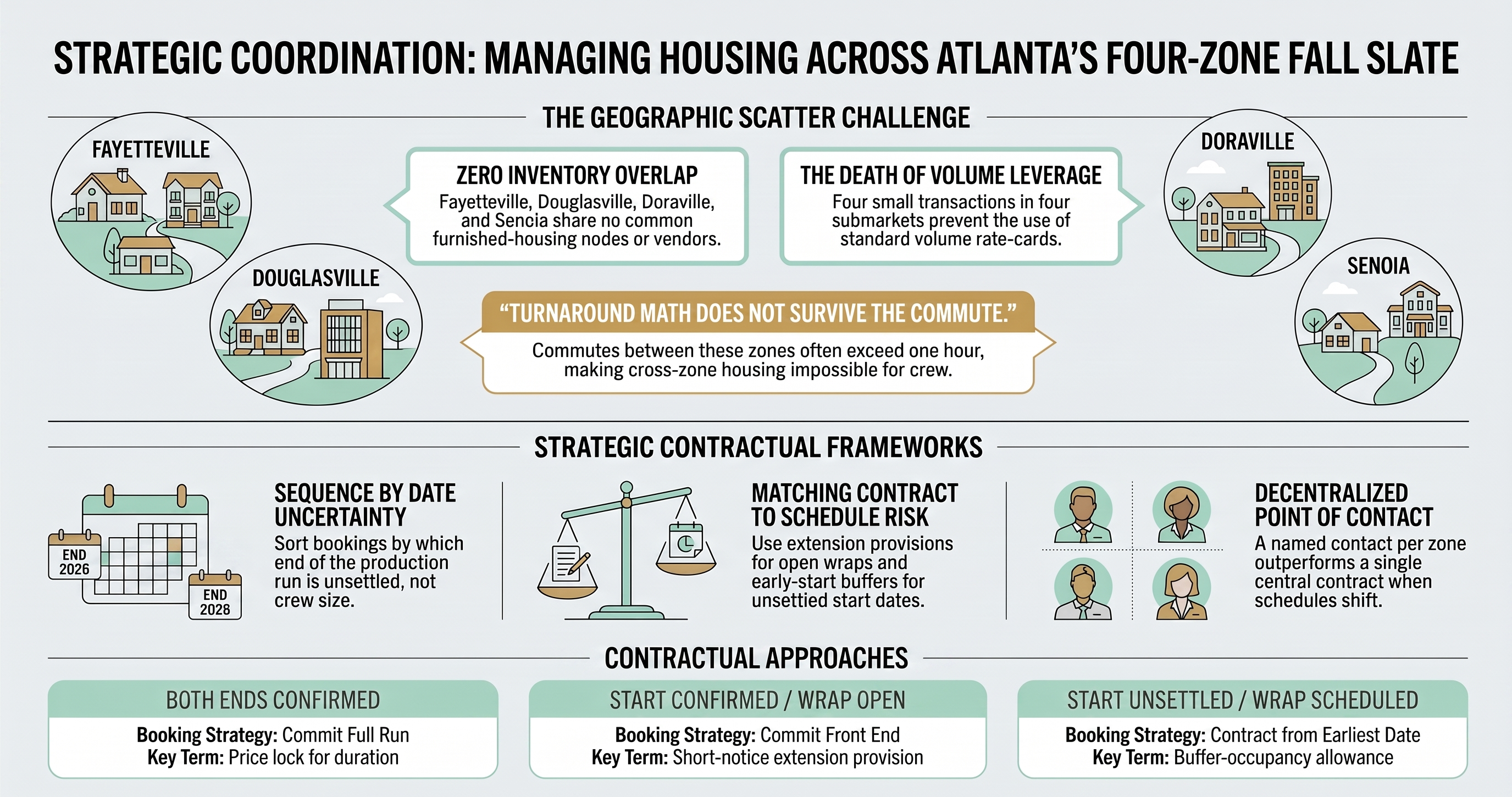
Here is the structural fact that governs everything else. No single provider covers all four of these zones well, because Atlanta's production housing inventory is itself geographically clustered. The scatter that complicates your booking also shaped the vendor landscape. Providers grew up around Trilith and intown. Almost nobody built a book of business in Douglasville or Senoia. When you call four submarkets, you are not comparing four bids on the same thing. You are running four separate sourcing exercises with different vendor types in each.
That changes the sequencing. Sort your bookings not by production size but by which end of the run is uncertain, because that is what your contract has to absorb.
Both ends confirmed, so commit the full run. Lizard Music has Aug. 3 to Oct. 14 confirmed by IATSE 479. Price and lock the whole thing now. There is no date risk to hedge against and no reason to pay for flexibility you will not use.
Start confirmed, wrap open, so commit the front and buy an extension. The Starz series on Aug. 12 and Thunder Road on Aug. 28 both have union sourced starts and no announced end. Lock the start dates with confidence and put your negotiating energy into the back end: a short notice extension provision, agreed extension pricing, and a named contact at the provider who can extend within 48 hours. In Senoia especially, where the pool is shallow, the right to extend is worth more than the rate.
Start unsettled, wrap scheduled, so contract from the earlier date. The Challenger has a three day spread between two AJC reports and a scheduled Jan. 29 wrap. Contract from Aug. 21 and absorb the buffer. Three days of occupancy before the start on a five month booking is a rounding error against the cost of crew arriving to unavailable units.
Two operating notes, offered as our own practice rather than as any industry standard, because none exists here.
The first is on contacts. Resist the instinct to consolidate four submarkets under one master agreement. A named point of contact per zone, each authorized to make release decisions, will outperform a single contract that has to be renegotiated centrally every time a call sheet moves.
The second is on reconciliation, which is the part that quietly consumes coordinator hours. Four providers means four invoice formats on four billing cycles, none of which will match your crew roster. Pick your shared key before the first invoice arrives, and make it the crew roster organized by zone rather than the vendor's occupancy report. If every provider is asked at contract stage to bill against your zone and name structure, month end reconciliation stays a reading exercise instead of a rebuild.
On the underlying economics, meaning when a furnished apartment beats a hotel and how per diem interacts with housing spend, our March guide and June market update cover the math, and it has not changed.
The Five Month Shoot: Holidays, Hold Versus Release, January Reboarding
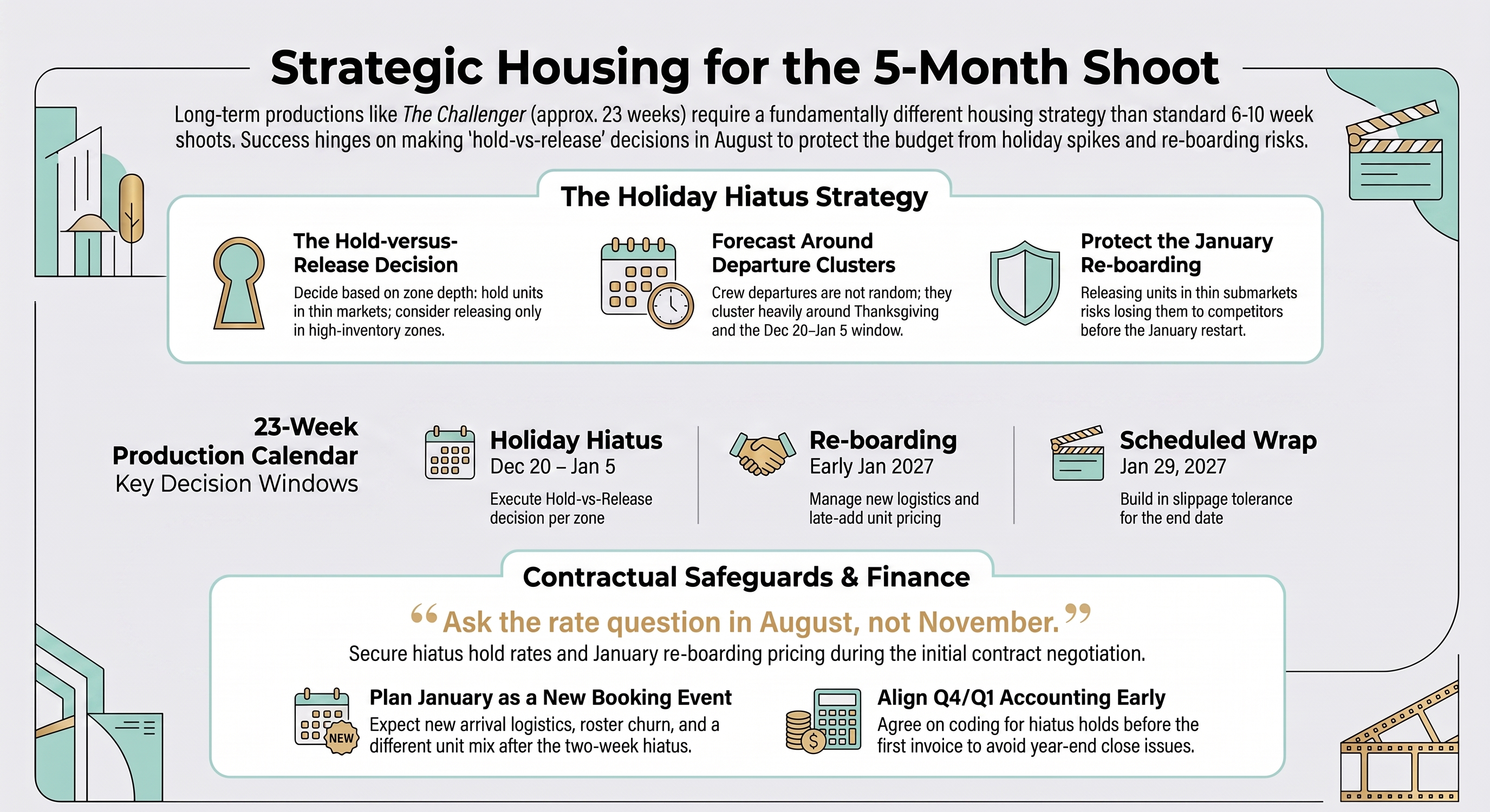
The Challenger is scheduled to run from the Aug. 21 to 24 window to Jan. 29, 2027. That is roughly 23 weeks crossing Thanksgiving, Christmas, New Year and a calendar year boundary, and it is a materially different housing product from the six to ten week shoots that make up the rest of this slate. No prior guide of ours addresses it, and no competitor page addresses it either, because there is no published standard for how furnished housing is structured across a production hiatus. What follows is how we handle it, labelled as such.
The decision that drives everything is hold versus release, and it arrives twice: Thanksgiving week, and the Dec. 20 to Jan. 5 stretch. Crew departures cluster in those windows rather than distributing randomly, which is what makes the problem tractable. You can forecast roughly how many units go dark, because you know when people leave. Holding costs you rent on empty inventory. Releasing risks not getting the unit back in January, which in a thin submarket means putting your crew somewhere worse than where they started.
There is no general right answer. There is a right answer per zone. In Doraville, where inventory is deep, releasing over the holidays is defensible. In a market like Senoia it usually is not, and any long run production in a thin zone should plan to hold.
Ask the rate question in August, not November. Specifically: does the rate lock survive a hiatus hold, and does it survive January reboarding, or does reboarding reprice at market? Most providers have not thought about it, which is precisely why you want it in the contract rather than discovered in a December email. Ask the same question about late adds in January, which are the most likely place for a five month budget to slip.
Plan January reboarding as its own booking event, not as a continuation. Returning crew after a two week hiatus involves new arrival logistics, some roster churn, and often a different unit mix than August. And build slippage tolerance into the back end. A 23 week schedule has considerably more opportunity to move than a 10 week one, and a Jan. 29 wrap reported six months in advance is a plan, not a commitment.
For the accountant on the show, the one structural point worth flagging early is that this booking straddles Q4 2026 and Q1 2027. It is worth agreeing on the coding treatment for hiatus holds before the first invoice, rather than at year end close.
| Window | Date | Decision | Ask the provider |
|---|---|---|---|
| Start | Aug. 21 to 24 | Contract from the earlier date, absorb the buffer | Is the buffer before the start billable? |
| Thanksgiving | Week of Nov. 23 | Hold or release, by zone | Does a hold preserve the locked rate? |
| Holiday hiatus | Dec. 20 to Jan. 5 | Hold or release, by zone | What is the release and return guarantee? |
| Reboarding | Early Jan. 2027 | Treat as a new booking event | Do late adds price at lock or at market? |
| Scheduled wrap | Jan. 29, 2027 | Build in slippage tolerance | What is the extension notice period? |
Four Zones, One Point of Contact
Georgia's production count is at a six year low, and this is still a hard August to house a crew. The constraint is not how much is shooting. It is that what is shooting is spread across four commute sheds that share no inventory, starting in the same three weeks that Georgia Tech, Georgia State and Emory move their students in.
The approach that holds up: work zone first rather than studio first, because your commute shed determines your options more than your studio's name does. Sequence your bookings by which end of the run is uncertain rather than by production size, and put the contract flexibility where the actual risk sits, on the back end for the two shoots with no announced wrap, on the front end for the one with a contested start. And treat the five month shoot as its own category, with the hold versus release and reboarding questions asked in August rather than in December.
This is a map of the fall slate, not a claim to be housing any of it. If you are placing crew across more than one of these zones, that is the specific problem we are set up for: block availability in multiple submarkets, consolidated billing across them, and one point of contact rather than four. We are happy to talk through the zone picture even if the booking goes elsewhere.
How Minty Living Can Help
The reconciliation burden described above, meaning four vendors, four invoice formats, four billing cycles, none of them keyed to your crew roster, is the specific cost of scatter. We cannot fix that across all four zones on this slate. Our portfolio does not reach Fayetteville, Douglasville or Senoia, and this guide's own zone table is the reason why.
Minty Living manages 160+ professionally designed properties concentrated in Atlanta's intown neighborhoods: Inman Park, Old Fourth Ward, Grant Park, Midtown, Cabbagetown, Poncey-Highland, Reynoldstown, Virginia-Highland, Little Five Points and Ormewood Park. Midtown sits on the MARTA Gold Line, the same line that runs through Doraville, Chamblee and Brookhaven, the corridor this guide identifies as Assembly's real housing advantage. That relevance is specific to the Assembly and Doraville zone and to intown placements generally. It does not extend to the other three zones.
Where we are useful:
-
Block holds within one zone. For crew placed intown, or for above the line talent and department heads regardless of studio assignment, we can hold multiple units at once instead of negotiating each one separately.
-
One invoice instead of a fourth format. We are a preferred vendor for major Atlanta film studios, and we bill against a single named contact in a roster based format rather than an occupancy report, which removes one of the four reconciliation streams described above, for whichever part of a crew falls inside our footprint.
-
Lease terms built for production schedules. Hourly to annual flexibility and standardized production friendly lease language, which is the relevant question for anyone working through the hold versus release decision on a long running block.
-
Placement within 24 hours for late adds. When a call sheet moves or a roster grows mid shoot, placement can turn around in a day rather than a week.
We are not a fit for the south and west metro zones on this slate, and we would rather say so here than have you find it out after a call. If your crew includes an intown or Doraville corridor piece, or if you are simply mapping which of your four vendor relationships could consolidate, we are happy to talk it through.
mintyliving.com/film&production · (404) 999-0841 · [email protected]


 (4).png)

 (29).png)
 (28).png)
 (33).png)
 (37).png)
 (38).png)
 (39).png)
 (40).png)
 (44).png)
 (44).png)
 (1).png)
 (3).png)
 (55).png)
 (54).png)
 (56).png)
 (57).png)
 (58).png)
 (59).png)
 (60).png)
 (61).png)
 (63).png)
 (66).png)
 (45).png)
 (67).png)
 (68).png)
 (69).png)
 (71).png)
 (72).png)
 (73).png)
 (86).png)
 (87).png)
 (89).png)
 (92).png)