


 (28).png)
Your start date is in three weeks. Your house hasn’t sold. The offer you made fell through, or the movers can’t confirm a date, or your lease ended two months before your new place is ready. Whatever the specifics, you need a place to land in Atlanta — and you need it now.
This guide covers every scenario. Whether you’re an individual searching for temporary housing Atlanta relocation options, or an HR manager designing a mobility program for dozens of employees, you’ll find the full picture here: four housing types with real cost comparisons, Atlanta’s five best neighborhoods for short-stay living, how to handle the gap between start date and lease signing, international worker requirements, tax treatment, and how to build a corporate relocation housing program that doesn’t collapse under pressure. Minty Living operates across Atlanta’s key corporate corridors and has helped hundreds of relocatees make this transition. What follows is what they wish they’d known on day one.
What This Guide Covers
Atlanta is home to 15 Fortune 500 headquarters — more than Boston or Seattle — and consistently ranks among the top US metros for corporate relocation volume [Source: KNOWAtlanta]. That concentration creates a continuous flow of relocating employees.
The core financial case: corporate housing saves 37–40% compared to extended hotel stays while delivering 61% more living space [Source: AR National]. For HR managers, the stakes go beyond cost — housing that fails triggers early voluntary attrition.
This guide covers:
-
Four housing types — hotels, corporate housing, furnished month-to-month apartments, and standard leases — with a direct cost comparison
-
Five neighborhoods with commute times, rent ranges, and the profile of relocatee each suits best
-
Gap housing for the period between start date and permanent lease
-
International workers — credit history barriers and visa-compatible options
-
Tax treatment — what employers can deduct and what employees must report
-
HR program design — vendor evaluation, policy templates, and common structural failures
Both individual relocatees and HR managers will find sections written directly to their needs.
Table of Contents
Why Atlanta Keeps Attracting Corporate Relocations
Atlanta’s appeal to corporations goes well beyond warm weather and low state taxes. The city holds 15 Fortune 500 headquarters, including Coca-Cola, Delta Air Lines, Home Depot, UPS, and Cox Enterprises — a density of major employers that creates its own gravity [Source: KNOWAtlanta]. When anchor companies of that scale cluster in one metro, suppliers, technology partners, logistics firms, and professional services follow.
The industries driving that growth cut across sectors: technology (Microsoft, NCR Voyix, Salesforce, and a dense fintech cluster around Georgia Tech), film and media production (Georgia’s film tax credit has made Atlanta a top global production market), logistics (anchored by Hartsfield-Jackson, the world’s busiest airport), and healthcare (Emory, Piedmont Health, the CDC). That diversity insulates the job market from single-industry downturns.
It also shapes the case for temporary housing. Atlanta’s neighborhoods shift rapidly in character and price, and a 12-month lease signed under pressure in the wrong ZIP code can define — or undermine — an employee’s first year. Temporary housing lets a relocatee test the city before committing.
Now that the economic picture is clear, the most important question becomes: which type of temporary housing actually makes sense — and what will it cost you?
The Four Housing Options — A Real Cost Comparison
Not all temporary housing is the same product. The options range from fully serviced hotel rooms billed by the night to unfurnished apartments on year-long leases. Each sits at a different point on the spectrum between flexibility and cost, and the right choice depends almost entirely on how long you’ll need temporary accommodation.
| Factor | Hotel | Corporate Housing | Furnished Apt (M-to-M) | Standard Lease |
|---|---|---|---|---|
| Monthly Cost | $4,500–$7,500 | $3,000–$5,000 | $1,800–$2,800 | $1,164–$2,538 |
| Min. Stay | 1 night | 30 days | 30 days | 12 months |
| Utilities Included | Yes | Yes | Usually no | No |
| Hotel Tax (13–16%) | Yes (<30 days) | No (30+ days) | No | No |
| Furnished | Yes | Yes | Yes | No |
| Housekeeping | Yes | Often | No | No |
| US Credit Required | No | No | Sometimes | Yes |
| Best For | <2 week stays | 30–120 day relocations | Budget-conscious, 90+ days | 6+ months, known neighborhood |
Hotels
At $4,500 to $7,500 per month, hotels are the most expensive temporary housing option in Atlanta. Stays under 30 days trigger Georgia’s hotel occupancy tax — 13–16% on top of the nightly rate [Source: Georgia Department of Revenue]. The other cost multiplier is food: without a kitchen, three meals a day in Midtown or Buckhead runs $80–$120 per person, adding $4,800–$7,200 over a 60-day stay. Hotels make sense for stays under two weeks. For anything longer, the math breaks against them.
Corporate Housing
Corporate housing is the strongest option for standard 30–120 day relocations. At $3,000–$5,000 per month in Atlanta, it delivers 37–40% savings compared to extended hotel stays [Source: AR National], along with 61% more living space — a furnished one- or two-bedroom apartment with a full kitchen, living room, and in-unit laundry.
The savings compound in two ways: the base rate is lower, and stays of 30+ days avoid Georgia’s hotel occupancy tax entirely. A full kitchen cuts food costs by 60–70%. Utilities, internet, and housekeeping are typically bundled into one predictable monthly line item.
For HR departments, the operational advantage matters just as much. A single vendor provides consistent quality, centralized billing, and accountability — none of which exist when employees book their own hotel rooms on a corporate card.
Furnished Apartment Month-to-Month
At $1,800–$2,800 per month, furnished month-to-month apartments are the lowest-cost flexible option. Utilities are typically billed separately ($150–$250/month), and housekeeping is not included, putting the effective all-in cost at $2,000–$3,000 monthly — still below corporate housing rates.
This option suits relocatees who need 90+ days of temporary accommodation and prefer more autonomy. Inventory is concentrated in Midtown, Old Fourth Ward, and Sandy Springs. The same operators who serve Atlanta’s film production crews — whose demand profile mirrors corporate relocation precisely — also serve the corporate market. See our guide to film crew housing in Atlanta for a closer look at that parallel inventory.
Standard Lease
A standard 12-month lease runs $1,164–$2,538 per month [Source: RentCafe] — the cheapest per-month option, but the total cost picture is different. You’ll need US credit history (a barrier for international workers), $2,000–$5,000 for furniture, and you’re locked into a neighborhood for 12 months before you know what living there is like.
Breaking a Georgia lease typically costs two to three months’ rent plus forfeited deposit. A wrong-neighborhood decision can cost $6,000–$10,000 to correct. Standard leases make sense only after six months of direct Atlanta experience.
The decision framework is straightforward. Under 30 days: a hotel is your only practical option. 31–90 days: corporate housing wins on every metric — cost, space, tax treatment, and operational simplicity. 90 days or more: a furnished month-to-month apartment becomes competitive on cost, and a standard lease enters the conversation only when you’ve done the neighborhood due diligence that a temporary stay enables.
Cost is only half the equation. The other half is location — and where you spend your first 90 days shapes whether your permanent lease becomes a great decision or an expensive regret.
Atlanta’s Best Neighborhoods for Corporate Relocations
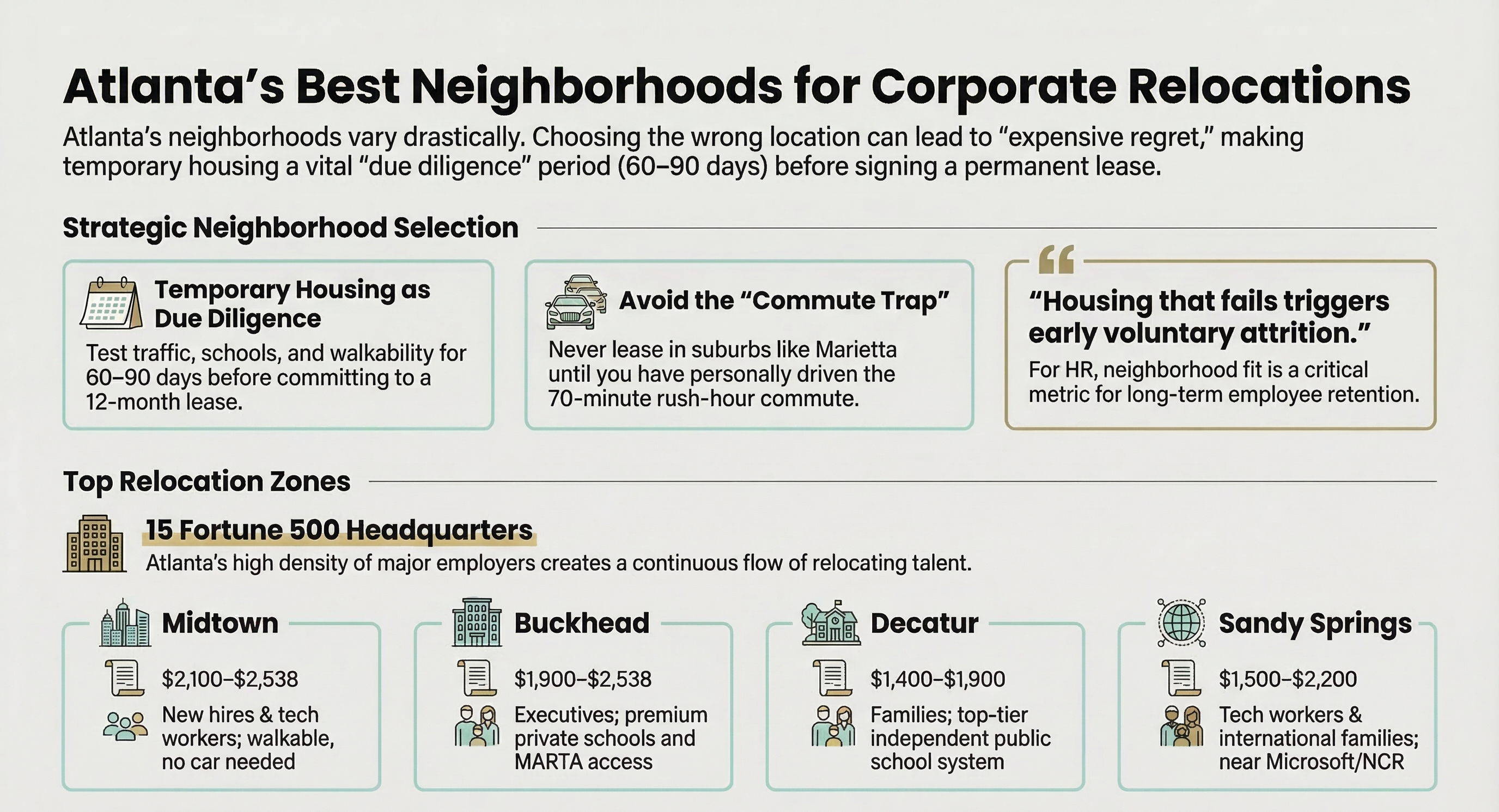
The advantage of temporary housing is that it buys you time to make the permanent decision correctly. Atlanta is not a city where the right neighborhood is obvious from the outside. Traffic patterns, school quality, walkability, and commute times vary dramatically between districts that appear close on a map. Spending 60–90 days in a furnished apartment before signing a 12-month lease is not indecision — it is due diligence.
The five neighborhoods below account for the majority of corporate relocation placements in Atlanta. Each serves a distinct relocatee profile.
| Neighborhood | Commute to Downtown | Monthly Rent | Best For |
|---|---|---|---|
| Midtown | 5–10 min | $2,100–$2,538 | New hires, international workers — walkable, no car needed |
| Old Fourth Ward | 6 min | $1,600–$2,100 | Young professionals — BeltLine, arts district |
| Buckhead | <20 min (MARTA) | $1,900–$2,538 | Executives with families — premium, private schools |
| Decatur | 15–25 min | $1,400–$1,900 | Families — top public schools, walkable town center |
| Sandy Springs | 15–20 min | $1,500–$2,200 | International families, tech workers — near Microsoft/NCR |
Midtown
Midtown is the default placement for new hires and international workers without a car. The neighborhood is genuinely walkable, and MARTA connects it to the airport in 30 minutes without a transfer. Corporate housing supply here is the densest in the metro — high-rise furnished apartments along Peachtree Street cater specifically to relocation demand. Proximity to Georgia Tech makes it the natural landing zone for tech sector relocatees.
Note for 2026: Atlanta is a primary host city for the World Cup, and Midtown’s short-term inventory is absorbing early corporate bookings. Relocatees arriving between June and August 2026 should secure housing by Q1.
Old Fourth Ward
Old Fourth Ward sits six minutes from downtown and directly on the Atlanta BeltLine’s Eastside Trail. The neighborhood suits young professionals better than families — residential density is high, and school options favor private or charter over traditional public. Ponce City Market anchors the area as a de facto community center. Furnished inventory here is newer and less expensive than Midtown, averaging $1,600–$2,100 per month [Source: RentCafe]. Note: parking is limited and expensive.
Buckhead
Buckhead is Atlanta’s executive neighborhood. The private school infrastructure — Pace Academy, Westminster, Atlanta International School — is among the strongest in the Southeast, making it the primary placement for senior hires with families. MARTA’s Gold Line connects Buckhead directly to downtown and the airport. Temporary housing inventory skews toward high-rise units in the Lenox and Phipps Plaza corridors, with consistently high quality.
Decatur
Decatur is the choice for families who prioritize public school quality. The City of Decatur school system is independent from DeKalb County, consistently ranking among Georgia’s top public systems. Rents run $1,400–$1,900 — the value proposition is high-quality public schools at a lower price point than Buckhead private schools. The town center is genuinely walkable with a farmers market and independent restaurants. MARTA’s Blue and Green Lines serve Decatur station for downtown commuters (15–25 minutes). Furnished temporary inventory here is smaller than Midtown or Buckhead — plan earlier.
Sandy Springs
Sandy Springs sits north of Buckhead and hosts Microsoft, NCR Voyix, and several other major tech employers — eliminating the reverse commute for tech workers. It has the highest concentration of international families in the metro, driven by H-1B workforces and multilingual services. Rents run $1,500–$2,200.
One firm caution: do not sign a 12-month lease in Marietta or Kennesaw without driving the rush-hour commute first. What looks like 25 minutes on Google Maps regularly runs 55–70 minutes southbound during morning peak. Temporary housing in Sandy Springs or Buckhead first — then lease further out with open eyes.
For HR managers: build a recommended neighborhood list into your relocation policy. Employees who land in the wrong neighborhood leave sooner. A one-page guide segmented by family situation, budget, and office location materially reduces early attrition.
Choosing a neighborhood is straightforward with time. But for many relocatees, the hardest part is the gap between when their job starts and when their home is ready.
The Gap Housing Problem — When Your Start Date and Closing Date Don’t Align
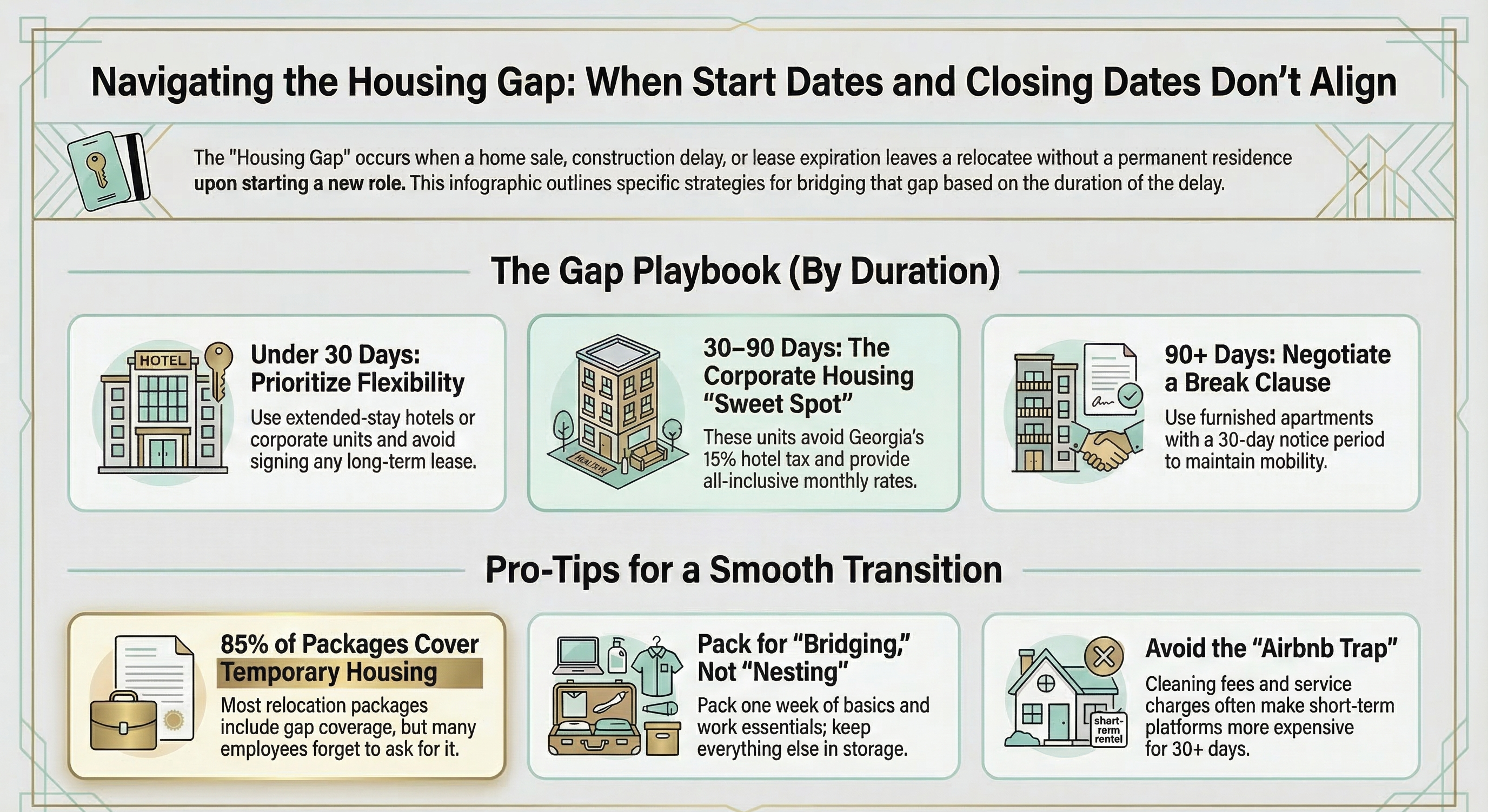
Your home sold faster than expected. You start your new Atlanta role in two weeks. Your closing date is 45 days out. This is the gap scenario — and it catches more relocatees off guard than any other part of the move.
The good news: there’s a clear playbook for each version of this problem.
Under 30 days. Extended-stay hotels and corporate furnished apartments both work here. The key rule: do not sign a lease. You need flexibility above everything else, and a flexibility premium — paying slightly more per night for month-to-month terms — is worth it every time.
30 to 90 days. Corporate furnished apartments win decisively. You get an all-inclusive monthly rate (utilities, Wi-Fi, and furnishings bundled), you avoid the 15% hotel/motel tax that Georgia applies to stays under 30 days, and you get month-to-month exit terms. This range is where corporate housing providers are purpose-built to operate.
90 days or more. A longer gap usually signals something went wrong — a sale fell through, new construction hit delays, or a lease expired before the replacement was ready. Here, a furnished apartment with a break clause is your instrument. Lock in the monthly rate, but negotiate an exit window (typically 30 days’ notice) so you’re not trapped if circumstances change.
One detail most relocatees never think to ask about: gap housing coverage. According to industry data, 85% of corporate relocation packages include provisions for temporary housing [Source: relocation industry data]. The majority of employees who don’t get it simply never asked. Review your relocation letter and request it explicitly before your move date.
What to pack vs. what to store. Gap housing is furnished, so clothing, toiletries, work essentials, and one week of kitchen basics are enough. Everything else — furniture, kitchen equipment, linens, seasonal items — goes into storage. You’re not nesting; you’re bridging.
One platform to avoid: Airbnb rarely competes on cost for 30-day-plus stays once you account for cleaning fees, service charges, and nightly rate inflation. Many corporate relocation policies also exclude short-term rental platforms from reimbursable expense categories. Check your policy before booking.
The gap scenario applies to most domestic relocatees. But if you’re coming from outside the United States, you’re dealing with a different set of complications entirely.
International Relocatees — Visa, Credit, and Community
The gap problem is logistical. For international relocatees, the first problem is structural: US landlords require US credit history, and you have none. You haven’t lived here long enough to build it. But you need housing to get established enough to build it. This catch-22 stops many international hires before they ever reach the negotiation stage.
Corporate housing providers solve it directly. Most do not require US credit history at all — they work with international relocatees routinely and have underwriting processes built around it. This single fact justifies choosing corporate housing for your first 60 to 90 days, even if other options appear cheaper on paper.
For situations where you do need to qualify for a standard rental, here’s what landlords will typically accept in place of a US credit report:
-
Employment letter on company letterhead, confirming your role, salary, and start date
-
Work visa documentation (H-1B, L-1, and O-1 are well-recognized by Atlanta landlords)
-
First and last month’s deposit paid upfront at signing
-
A company guarantor letter, in which your employer assumes liability for the lease
Your HR team may have template letters for the first and fourth items. Ask.
Banking. Open a US bank account before you arrive if possible. Several major banks allow remote account opening with visa documentation and a passport. A US bank account accelerates credit building the moment you land, which shortens the window during which you’re dependent on corporate housing or employer guarantees.
Community by neighborhood. Atlanta has significant international communities concentrated in specific areas. Midtown draws tech and consulting expats, with easy access to the dense corporate office footprint. Sandy Springs has a well-established Indian-American community, including restaurants, grocers, and cultural organizations. Duluth, roughly 30 miles northeast, anchors the largest Asian-American community in the metro, with Korean, Chinese, and Vietnamese communities particularly well-represented.
Two resources worth bookmarking: the Atlanta Global Studies Center provides programming and connections for newly arrived internationals. The International Community School in Decatur serves K-12 students from international families with multilingual instruction and a globally oriented curriculum.
One legal point: the Fair Housing Act prohibits discrimination based on national origin. Visa status is not a lawful basis for rejection. If a landlord refuses to rent to you because of your visa type while accepting otherwise similar applicants, that is a federal fair housing violation. Document any such interactions.
Whether you’re domestic or international, one aspect of temporary housing catches almost everyone off guard: taxes.
Tax Implications Most Relocatees Miss
A necessary disclaimer: consult a CPA or tax attorney for your specific situation. What follows is orientation to the landscape, not tax advice.
The Georgia 30-day hotel tax rule. Stays under 30 days at a hotel or extended-stay property in Georgia carry combined hotel/motel taxes of 13–16%, depending on jurisdiction [Source: Georgia Department of Revenue]. Stays of 30 days or more have historically been exempt (verify current local rules, as ordinances may vary). This is the direct reason why corporate housing contracts are frequently written as 31-day minimums. If you’re booking a 28-night stay and a provider offers to structure it as 31 days at a slightly higher base rate, run the math — the tax exemption often makes the 31-day contract cheaper in total.
Employer-paid housing as taxable income. When your employer pays a corporate housing provider directly on your behalf, the IRS may treat that payment as W-2 wage income subject to income tax. The exception applies when your assignment qualifies as temporary — generally defined as expected to last under one year [Source: IRS Publication 463]. Assignments expected to last longer than one year lose the temporary designation, and housing benefits become taxable regardless of structure.
The “away from home” rule. For housing costs to be deductible as a business expense, the IRS requires that your tax home — generally where you primarily work and have economic ties — exists somewhere other than Atlanta. This rule matters most for consultants and contractors on project-based assignments. If Atlanta is your new permanent work location, you cannot deduct temporary housing costs.
Georgia state income tax. Georgia levies a flat income tax rate (reduced to approximately 5.39% for 2025, with further reductions planned) [Source: Georgia DOR]. If your housing benefit is treated as taxable income at the federal level, it compounds at the state level as well.
Gross-up vs. employee-bears-it. For HR managers: whether a housing allowance is grossed-up — meaning the employer covers the tax liability on the benefit — or leaves the employee to absorb it has real recruiting implications. A $4,000/month housing benefit that triggers $1,800 in combined federal and state tax liability is worth considerably less than its face value. Grossed-up packages attract and retain talent more effectively.
| Scenario | Taxable? | Notes |
|---|---|---|
| Employee books and expenses, assignment under 1 year | Generally not taxable | Qualifies as temporary assignment |
| Employer pays provider directly, assignment under 1 year | Often taxable as W-2 income | Treated as compensation |
| Employer pays provider directly, assignment over 1 year | Taxable as W-2 income | Temporary designation lost |
| Employee self-funds from lump sum relocation payment | Taxable as W-2 income | Lump sum is compensation |
| Contractor, tax home in another city, under 1 year | May be deductible | “Away from home” rule applies |
For individuals, the tax section is a checklist item. For HR and mobility managers, it’s a policy design question — and that distinction matters when you’re designing a program for 20 or 200 relocating employees.
How to Design a Corporate Relocation Housing Program
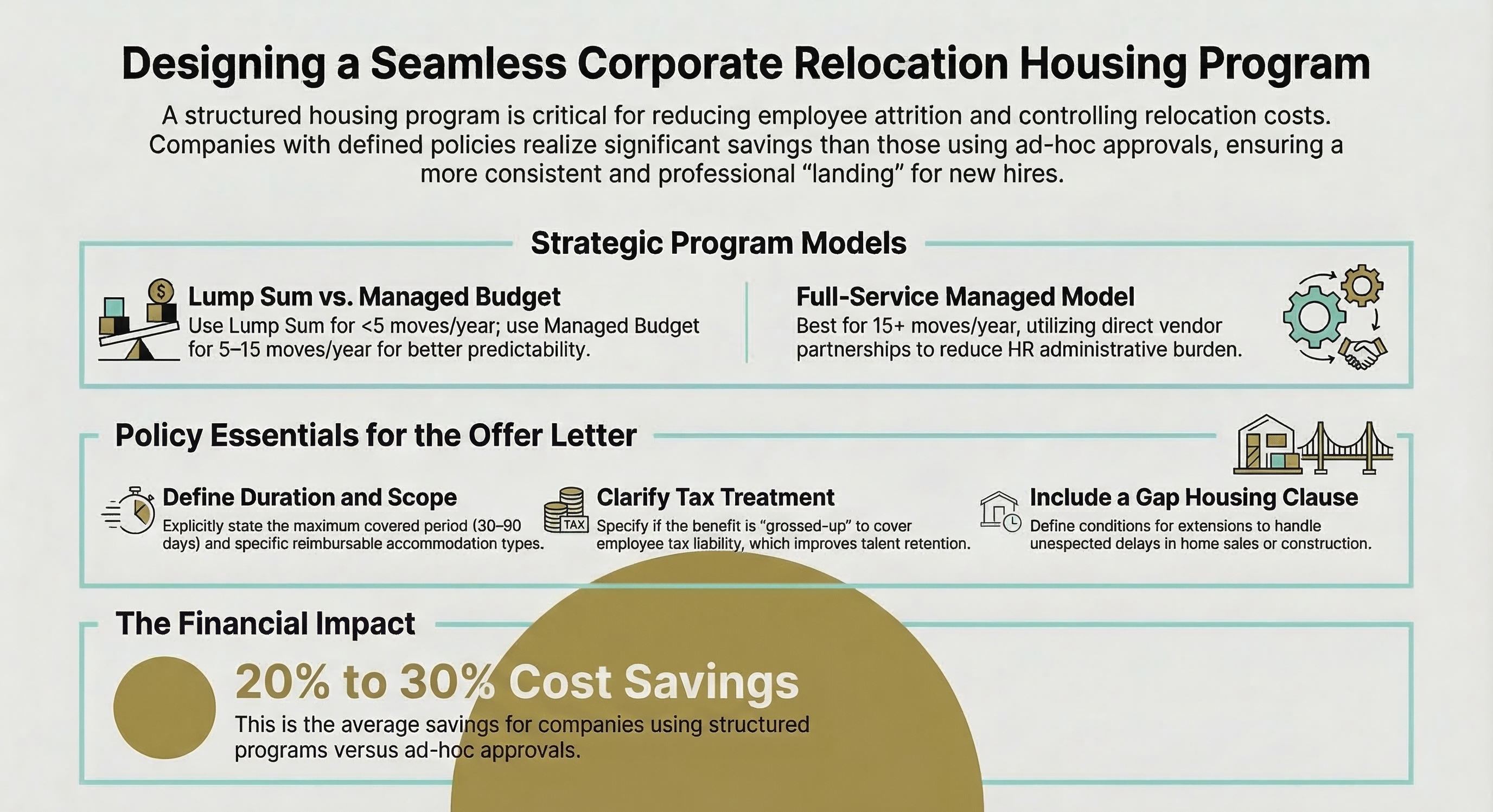
This section is for HR managers, mobility coordinators, and office managers at companies relocating five or more employees per year to Atlanta. If you’re an individual relocatee, the program model your employer uses determines how much flexibility you have — and what you can negotiate.
Three Program Models
Every corporate relocation housing program falls into one of three models. The right choice depends on your volume, internal capacity, and how much consistency you need across moves.
Lump sum gives each employee a fixed dollar amount to manage their own housing. Minimal admin, but inconsistent outcomes — some employees book extended-stay hotels for 60 days, burn the allowance, and return to HR frustrated. You also lose cost visibility and volume negotiating leverage.
Managed budget sets a per-diem or monthly cap. Employees book within guardrails; finance gets predictability; HR flags out-of-policy bookings early. Works well for 5–15 moves per year.
Full-service managed means your company works directly with a housing provider who handles sourcing, move-in coordination, and billing. Initial setup requires procurement work, but each additional move becomes near-zero effort. For 15+ moves per year, the per-move savings and employee experience lift make this the clear choice.
| Factor | Lump Sum | Managed Budget | Full-Service |
|---|---|---|---|
| Admin Burden | Low | Medium | High (initially) |
| Cost Predictability | Low | Medium | High |
| Employee Experience | Variable | Good | Best |
| Best For | Under 5 moves/year | 5–15 moves/year | 15+ moves/year |
What to Put in the Relocation Offer Letter
Disputes about relocation housing almost always trace back to an offer letter that was vague about scope. Seven items prevent the most common conflicts:
-
Duration cap — State the maximum covered period explicitly. Most policies run 30 to 90 days.
-
Reimbursable accommodation types — Specify which categories qualify (corporate furnished apartments, extended-stay hotels) and which do not (Airbnb, standard nightly hotel rates).
-
Tax treatment — State clearly whether the benefit is grossed-up or whether the employee bears income tax liability.
-
Family and spouse coverage — Does the housing allowance cover accommodations for a relocating family, or just the employee?
-
Gap housing extension clause — Include the conditions under which the employee can request an extension and the approval process.
-
Approved vendor list — If you have preferred providers or negotiated rates, list them.
-
Expense documentation requirements — Specify what receipts or invoices are required and the submission deadline.
Industry data shows 85% of companies offer some form of housing benefit in relocation packages [Source: relocation industry data]. Companies with structured programs — defined policies, preferred vendors, documented terms — spend 20 to 30% less per move than those approving housing ad-hoc. For Atlanta specifically, budget $3,000 to $5,000 per month as a baseline for furnished corporate housing, with Midtown and Buckhead trending toward the upper end.
One operational note: the corporate housing providers who manage Atlanta relocations operate the same furnished apartment inventory that serves corporate entertainment housing for World Cup 2026. If your company is hosting clients or executive guests during the tournament, your existing relocation vendor relationship may already cover it.
Whether you’re the employee or the HR manager, the moment housing becomes concrete is when you’re reviewing a booking confirmation. Here’s what to verify before you sign anything.
Your Move-In Checklist — What to Confirm Before You Sign
This is the one section to screenshot or print before your call with any housing provider.
Corporate housing agreements are not standardized. Two providers in the same Atlanta neighborhood can structure the same unit at the same price — with radically different terms underneath. The checklist below closes the gap between what the listing says and what you actually sign.
Cost Verification
-
Is the monthly rate all-inclusive or base plus utilities?
-
What is the move-in/move-out fee?
-
Is the security deposit refundable?
-
Is housekeeping included? How often?
-
Is parking included or a separate charge?
Flexibility Terms
-
What is the minimum stay?
-
What is the early termination penalty?
-
Can the lease extend month-to-month after the initial term?
-
What is the notice period required to vacate?
Unit Verification
-
Request a photo of the actual unit (not a model)
-
Confirm WiFi speed (minimum 100 Mbps for remote workers)
-
Confirm all appliances are functional before move-in
-
Ask about parking type (garage vs street) and security access
Policy Compliance (for HR-Managed Moves)
-
Is the provider on your company’s approved vendor list?
-
Will they invoice the company directly or require employee reimbursement?
-
Is the agreement in the company’s name or the employee’s name? (This has tax implications.)
International relocatees should also confirm that the provider does not require a US credit check and that a company guarantor letter is acceptable.
Print or screenshot this checklist before every housing inquiry.
The checklist handles the practical side. What follows are the questions we hear most often from relocatees — answered directly.
Frequently Asked Questions
How much does corporate housing in Atlanta cost per month?
Expect $3,000–$5,000 per month for a fully furnished, all-inclusive unit. Hotels run $4,500–$7,500 per month once tax and incidentals are factored in — making corporate housing 37–40% cheaper [Source: AR National]. Pricing varies by neighborhood: Midtown commands a premium over Decatur or Sandy Springs.
What is gap housing and does my relocation package cover it?
Gap housing is temporary accommodation when your start date arrives before your permanent home is ready — whether due to a pending home sale, closing delay, or construction timeline. Most relocation packages cover it: 85% of companies include temporary housing benefits [Source: relocation industry data]. Ask HR explicitly — many employees don’t know to request it.
What is the best neighborhood in Atlanta for a corporate relocation?
It depends on your priorities. Midtown for walkable urban living without a car. Buckhead for families with children needing top private schools. Old Fourth Ward for culture and the BeltLine. Decatur for the best public schools. Sandy Springs for a quiet suburban feel near tech employers. Use temporary housing to test before committing.
Can I get corporate housing in Atlanta without a US credit history?
Yes. Most corporate housing providers do not require US credit history. Acceptable alternatives: employment letter on company letterhead, work visa copy, company guarantor letter, and first/last month deposit. Standard apartment leases often do require US credit — another reason international relocatees should start with corporate housing.
Is corporate housing cheaper than a hotel in Atlanta?
For stays of 30 days or longer, yes — 37–40% cheaper on average [Source: AR National]. Hotels cost $4,500–$7,500 per month including 13–16% hotel tax. Corporate housing runs $3,000–$5,000 per month with no hotel tax at 30+ days, plus you get a kitchen (saving $1,500–$3,000 per month in restaurant costs) and 61% more space.
How far in advance should I book temporary housing for an Atlanta relocation?
Minimum 2–3 weeks for most situations. For Buckhead or Midtown in peak season, 4–6 weeks is safer. Summer 2026 carries unusual demand due to FIFA World Cup events in Atlanta — book earlier than normal if your relocation falls between June and July [Source: Atlanta FWC26].
What does a fully furnished corporate apartment in Atlanta include?
Standard: all furniture, full kitchen with cookware, bed linens and towels, utilities, and WiFi. Premium packages add weekly housekeeping, parking, gym access, and building amenities. Always verify WiFi speed before booking — critical for remote workers. Not typically included: personal groceries, phone service, and premium cable.
What is the minimum stay for corporate housing in Atlanta?
Most providers require a 30-day minimum. Some offer 14-day stays at a premium rate. Month-to-month flexibility is usually available after the initial term. Stays under 30 days revert to hotel-tax territory (13–16% in Georgia), so a 31-day contract often costs less than a 28-day one.
How Minty Living Can Help
For 30–90 day Atlanta relocations, furnished corporate housing wins on cost, comfort, and flexibility — every time. The math is not close: 37–40% cheaper than hotels, 61% more space, and no daily checkout. If you’re an individual relocatee, use the move-in checklist before signing anything. If you manage relocation programs, a structured housing policy costs less per move than ad-hoc approvals and delivers a measurably better employee experience.
The challenges this guide covers — tight timelines, gap housing, international credit barriers, HR program design — are the day-to-day reality of what we work on in Atlanta.
Minty Living manages 160+ professionally designed furnished properties across Atlanta’s key corporate corridors, including Midtown, Old Fourth Ward, Buckhead, Sandy Springs, and Decatur.
Flexible Terms Built for Relocation Timelines: Our rental terms run from short-stay through annual — structured to accommodate the gap period, extended timelines when sales fall through, and the uncertainty inherent to any relocation. Month-to-month extensions are standard.
Direct Company Invoicing: For HR-managed moves, we invoice companies directly rather than requiring employee reimbursement. Centralized billing means cleaner expense tracking and a simpler experience from day one.
No US Credit History Required: We work with international relocatees regularly. An employment letter and visa documentation are sufficient.
Quality That Reduces Attrition Risk: Every property is designed and furnished by our in-house team, and our eligible portfolio meets Plum Guide’s “Top 1%” selection criteria. We carry a 4.9 Google star rating. Housing quality in the first 90 days affects how an employee feels about their move decision.
Reach out at mintyliving.com or call (404) 999-0841.
Planning an Atlanta relocation around the World Cup window? See our World Cup 2026 Atlanta visitor guide for event-specific logistics.



 (4).png)

 (29).png)
 (33).png)
 (37).png)
 (38).png)
 (39).png)
 (40).png)
 (44).png)
 (44).png)
 (1).png)
 (3).png)
 (55).png)
 (54).png)
 (56).png)
 (57).png)
 (58).png)
 (59).png)
 (60).png)
 (61).png)
 (63).png)
 (66).png)
 (45).png)
 (67).png)
 (68).png)
 (69).png)
 (70).png)
 (71).png)
 (72).png)
 (73).png)
 (86).png)
 (87).png)
 (89).png)
 (92).png)