
12 min read · Last updated October 22, 2026
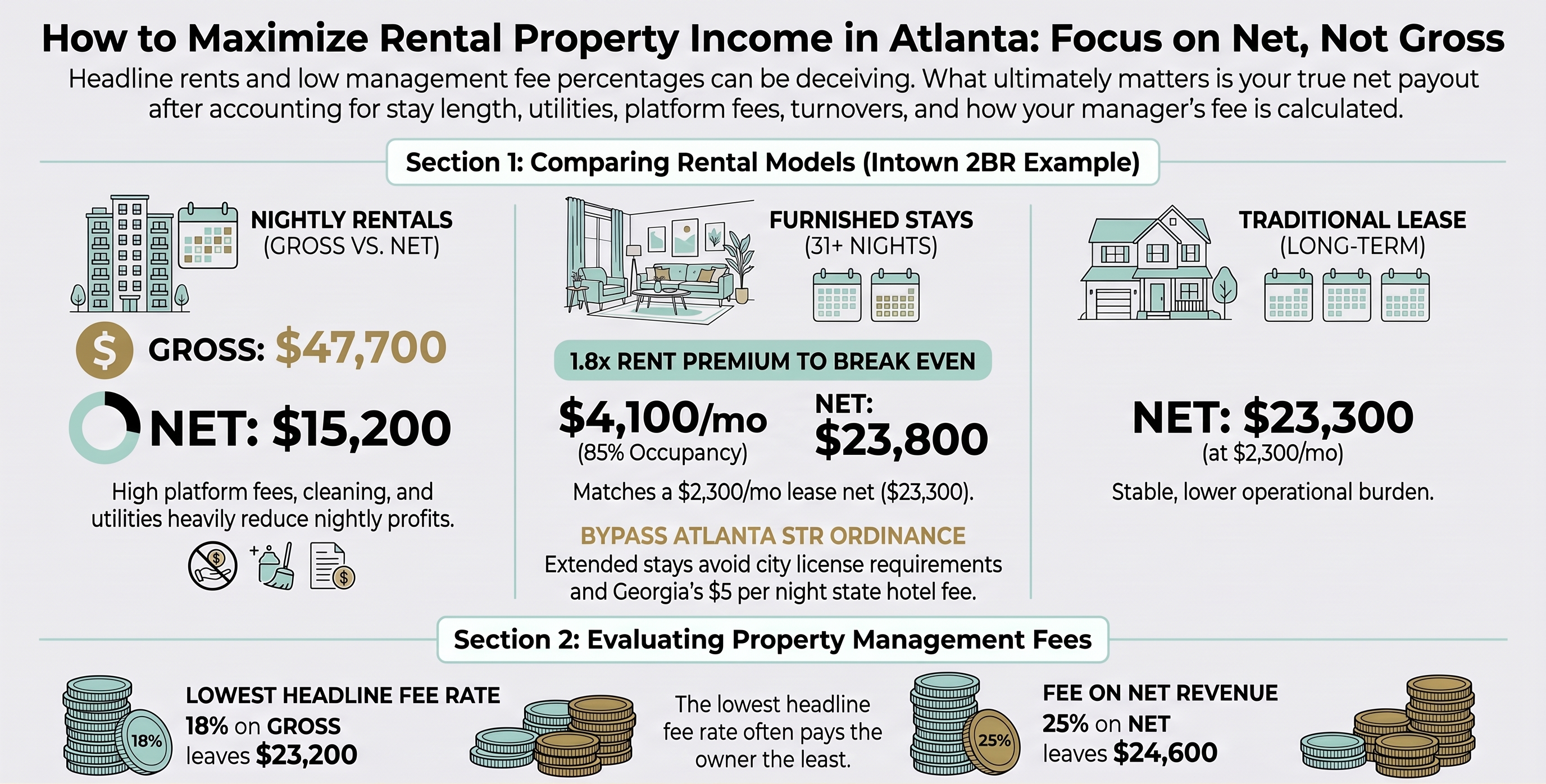
Two managers can quote you similar fees and send you very different checks. One charges 18%, the other 25%, and the 25% offer pays you more. That sounds backward until you see what each percentage is charged on.
The fee is not the number. The net is. It holds for choosing a manager, and it holds for choosing how to rent the house in the first place.
This guide shows how to maximize rental property income in Atlanta by comparing options on what reaches your account: the levers that move your net, how stay length changes the math, one intown two bedroom home rented three ways, and how to compare management offers on the fee base.
One note before we start. The example is illustrative, and every input is labeled. This is not tax or legal advice. Tax rules in particular turn on details, so confirm anything that affects you with a CPA.
What rental yield really means for an Atlanta owner
Rental yield is income as a share of the home's value. Gross yield uses rent before costs. Net yield uses what you keep after them. SFR Analytics puts Atlanta metro gross yield at 8.02%, but two owners with the same gross can end the year thousands apart on net.
For context, SFR Analytics reports a metro median asking rent of $2,200 and an average home value of $327,846, updated July 2026. Those numbers describe the market. They say nothing about your costs.
Ben Gross of Minty Living put it in investing terms on a recent owner call:
"Should I get a corporate bond that I'm going to have to pay state taxes or should I get, you know, a government bond, right? Where the taxing is different. I can come up with their tax equivalent yields. Well, same thing in the world of vacation rental management. You're trying to maximize the yield on your asset."
A bond investor compares a taxable bond and a tax free bond after taxes, not before. A rental owner should compare a lease, a furnished home, and a nightly rental after costs. We call the gap between them the furnished yield premium: what a furnished setup earns over an unfurnished lease once you subtract everything furnished adds.
Five levers decide most of that gap:
- Stay length. It sets which rules apply, who pays utilities, and how often the home turns over.
- Furnishing and turnovers. Furniture wears out, and every checkout needs a cleaning.
- Utilities. A tenant on a lease usually pays them. With furnished or nightly guests, you do.
- Channel fees. Booking platforms take a share of each reservation.
- The fee base. What your manager's percentage is charged on, which matters more than the percentage.
Mid term rental vs long term rental vs nightly: what changes with stay length
In Atlanta, 31 nights is the line that matters. A stay of 30 consecutive days or less is a short term rental under the city ordinance and needs a license. A furnished stay of 31 nights or more sits outside that ordinance. A 12 month lease follows ordinary landlord and tenant law.
| 12 month lease | Furnished, 31+ nights | Nightly, 30 nights or less | |
|---|---|---|---|
| City rule | Landlord and tenant law | Outside the short term rental ordinance | City license required |
| Who pays utilities | Usually the tenant | Usually the owner | The owner |
| Turnovers a year (our estimate) | About one every year or two | A handful | Dozens |
| Typical channel cost | None | Low | Airbnb 15.5% host only fee; Vrbo 12% from Oct 29, 2026 |
| Owner effort | Low | Medium | High |
Taxes shift with stay length too. Georgia's $5 per night state hotel fee stops applying once a guest reaches 31 consecutive nights; the Georgia Department of Revenue treats day 31 onward as an extended stay. That is the hotel fee only. Sales tax follows its own rules, so do not assume a long stay is tax free. Stay length can also change how the IRS treats the income (IRS Publication 527 covers when services push a rental onto Schedule C). That is a conversation for your CPA.
Channel costs are moving. Under Airbnb's host only fee, most hosts pay 15.5% of each booking, per Airbnb's help center. Vrbo is moving US hosts to a flat 12% commission on October 29, 2026, according to industry coverage of Vrbo's notice to hosts, up from roughly 8% for pay per booking hosts.
The nightly option is also opening up. In September 2026, Atlanta's council voted 9 to 5 to remove the primary residence plus one cap on short term rental licenses, effective January 1, 2027. Once it takes effect, many owners who could not license a second home should be able to apply. Our post on Atlanta's 2027 license change covers what it takes.
Furnished vs unfurnished rental: one Atlanta home, three ways
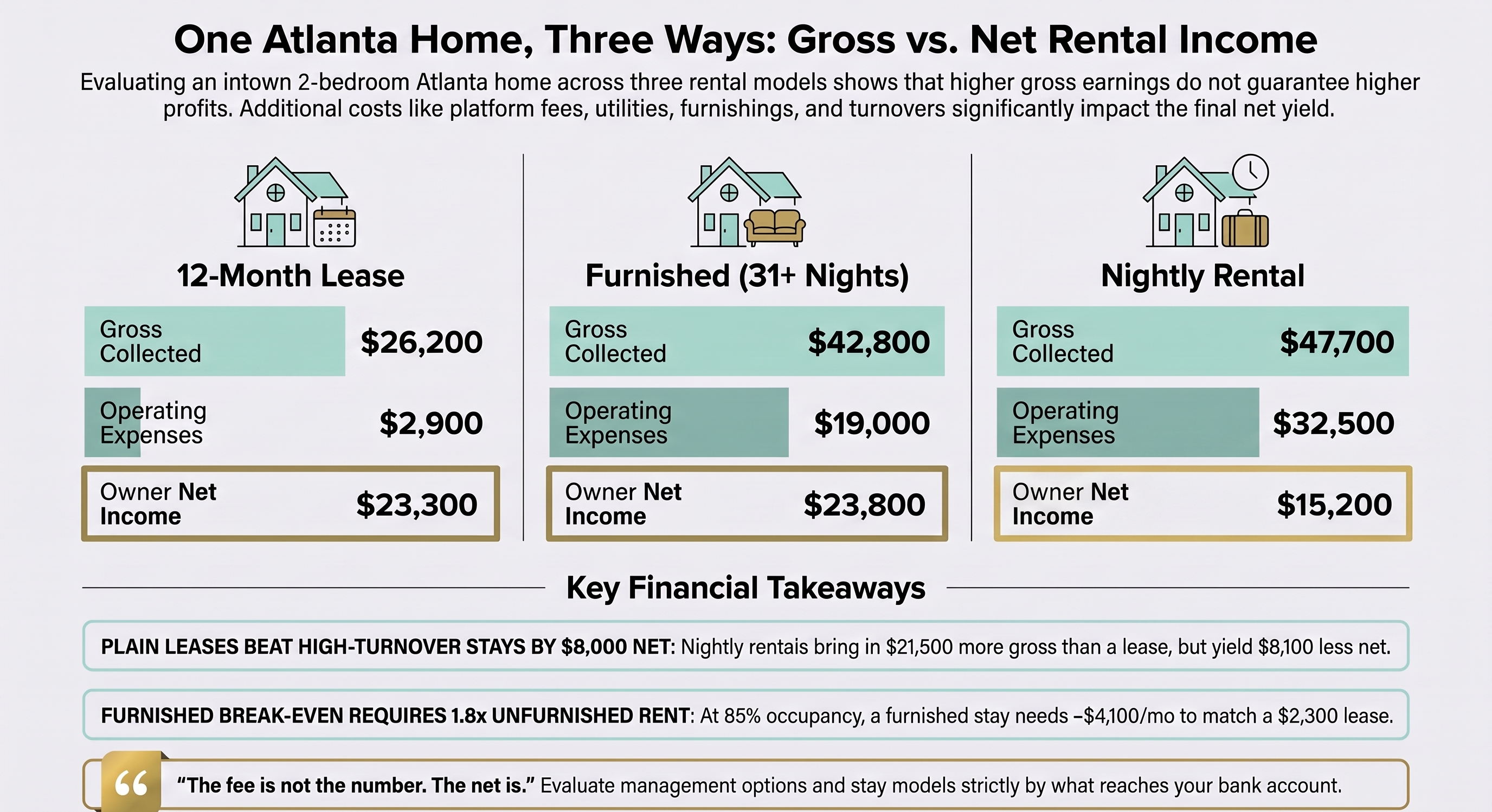
This example is illustrative, not a forecast. It takes one intown two bedroom home and rents it three ways, with every input labeled. Costs that do not change with the model (mortgage, property tax, base insurance, and your maintenance reserve) are left out so the comparison shows only what the model changes.
The assumptions
| Input | 12 month lease | Furnished, 31+ nights | Nightly |
|---|---|---|---|
| Rent or rate | $2,300 a month | $3,600 to $4,500 a month (our assumption) | $200 a night |
| Occupancy | 95% | 80% to 85% | 55% |
| Management fee | 8% of collected rent, plus a leasing fee of 75% of one month every two years | 20% of rent after platform fees | 25% of commissionable revenue (structure C below) |
| Platform fees | None | 3% | 15.5% of rent and cleaning |
| Owner paid utilities | $0 | $350 a month | $350 a month |
| Cleaning and turnovers | Part of make ready | 5 a year at $250 | Guest pays $150 per stay; cleaning costs $130 plus $20 restock; 4 night average stay |
| Furnishing | $0 | $20,000 spread over 5 years | $20,000 spread over 5 years |
| Extra insurance and license | None | None | $1,000 insurance plus $150 license a year |
Where the inputs come from: the $2,300 lease rent sits near Rentometer's Atlanta two bedroom average of $2,335 (February 2026). The $200 nightly rate and 55% occupancy run slightly above AirDNA's Atlanta figures for the 12 months to June 2026 (about $214 a night and 49% occupied), so the nightly case is a little generous. The 8% lease fee is close to the 8.03% Georgia average in a 2022 iPropertyManagement survey. We found no reliable public figure for Atlanta furnished monthly rents, so the furnished range is our own assumption. It sits at or a little below what we see: our recent quotes for intown homes have run $4,000 to $5,000 a month, including $4,000 for a two bedroom carriage house in our low season.
The results
Figures are yearly and rounded to the nearest $100, so columns may not sum exactly.
| 12 month lease | Furnished, $4,200 at 85% | Nightly, $200 at 55% | |
|---|---|---|---|
| Gross collected | $26,200 | $42,800 | $47,700 |
| Platform fees | $0 | $1,300 | $7,400 |
| Management and leasing fees | $3,000 | $8,300 | $8,200 |
| Utilities | $0 | $4,200 | $4,200 |
| Cleaning and turnovers | $0 | $1,300 | $7,500 |
| Furnishing | $0 | $4,000 | $4,000 |
| Extra insurance and license | $0 | $0 | $1,200 |
| Owner net | $23,300 | $23,800 | $15,200 |
The nightly home grosses the most and keeps the least. Even a little above market performance, platform fees, cleaning, utilities, and furniture eat the extra revenue, and the plain lease comes out about $8,000 ahead.
The furnished home only roughly ties the lease at $4,200 a month and 85% occupancy. At $3,600 and 80%, it nets about $17,400, well behind. At $4,500 and 85%, it nets about $26,200, roughly $2,900 ahead.
Each model has a weak spot. A lease suffers from long vacancies, furnished homes from a slipping rate, and nightly rentals from costs that grow with every booking.
How much more can you charge for a furnished rental? Find your break even
In this example, a furnished home needs about 1.8 times the unfurnished rent, roughly $4,100 a month at 85% occupancy, just to match the lease. Below that, the lease wins. Above it, furnishing starts to pay. Your multiple depends on your costs.
| Furnished occupancy | Break even monthly rate | Multiple of the $2,300 lease |
|---|---|---|
| 75% | $4,700 | 2.0x |
| 80% | $4,400 | 1.9x |
| 85% | $4,100 | 1.8x |
| 90% | $3,900 | 1.7x |
The management fee moves this a lot. Drop the furnished fee from 20% to 15% and the break even at 85% falls to about $3,900, or 1.7 times the lease.
Many landlord blogs say furnished homes earn a 10% to 50% premium. We could not verify those figures, and this example shows why a flat percentage is the wrong question. A 30% premium on $2,300 is $3,000 a month, which loses money here. So should you furnish your rental property? Only if your home can clear its own break even rate, and you can see real comparable bookings that prove it.
So are mid term rentals profitable? They can be, when the home commands enough of a premium to cover furniture, utilities, and turnovers. Check your home against the break even table.
Is a property manager worth it? Compare the net, not the fee
A manager is worth it when the income they add exceeds what they cost. In our nightly example, an 18% fee leaves the owner about $2,800 less than a 20% fee and about $1,400 less than a 25% fee.
Here is the same nightly home under three fee structures, before utilities, furnishing, and insurance, which do not change.
| Structure | What the percentage is charged on | Fee | Owner keeps |
|---|---|---|---|
| A: 18% | All booking revenue including cleaning ($47,700). The manager also keeps the $7,500 guests pay for cleaning and pays the cleaners | $8,600 | $23,200 |
| B: 20% | Rent after platform fees ($33,900). Cleaning passed through at cost | $6,800 | $26,000 |
| C: 25% | Rent plus cleaning income, minus cleaning cost, restocking, and platform fees ($32,800) | $8,200 | $24,600 |
The lowest headline rate pays the owner least. Structure A charges its percentage on cleaning fees the owner never receives, then keeps the cleaning fees too. Guesty, a property management software company, describes the pattern plainly: managers often take a cut of reservation revenue "often including the cleaning fee", and a cleaning markup is "an extra revenue stream for them and a hidden cost for you" (Guesty).
Structure C does not win this example; B does. Structure C's advantage is alignment. The manager is paid on what is left after the direct costs of each stay, so it earns more only when your net revenue rises, and it makes no margin on cleaning. At stronger performance the gap between A and B grows to about $3,900, so the base matters more as a home earns more.
Is a property manager worth it compared with doing it yourself? Run it as a net calculation. Self managed at the same performance, our nightly home keeps about $23,400, and you handle around 50 checkouts a year. Under structure C it keeps about $15,200. A manager earns its fee only by lifting rate and occupancy enough to cover it, or by giving you back hours worth more than the fee.
At $240 a night and 75% occupancy, the same home nets about $31,100 under structure C, roughly $7,800 more than the lease. That is a home performing far above the market average, so underwrite the average case first.
Before you compare offers, ask every manager the same four questions:
- What exactly is your percentage charged on, line by line?
- Who keeps the cleaning fee guests pay, and do you mark up cleaning, supplies, or repairs?
- Can you show my home's projected year under your fee, at the same occupancy as the other offers?
- How much of your booking volume comes through low fee channels?
For the rest of the vetting process, including licenses, deposits, and contract terms, see our guide on how to choose a property management company in Atlanta. Short term managers commonly charge 15% to 30% of booking revenue, per Hostfully's summary of AirDNA data.
How to increase rental income without guessing
The fastest way to increase rental income is to stop comparing gross numbers. Run your own furnished yield premium, one home at a time, with the same cost list for every option. Four steps get you there.
- Price your current setup honestly. Write down last year's collected rent, vacancy, fees, and every cost the model adds.
- Build the alternatives with real comparables. Use booked rates for similar furnished homes near yours, not listing prices.
- Find your break even. Calculate the furnished rate and occupancy that match your lease, then ask whether your home can clear it.
- Check the channel mix. If you run nightly stays, shifting bookings from Airbnb's 15.5% to Vrbo's 12% saves up to 3.5 points. On this example home that is about $1,700 a year before your manager's share, if Vrbo applies its 12% to the full booking.
If your home is outside the city's current license limit, rerun the nightly column for January 1, 2027.
Frequently asked questions
Is Airbnb still profitable in Atlanta? It can be, but not at the average. In our example, a two bedroom at $200 a night and 55% occupancy, a little above AirDNA's market figures, nets about $15,200 after costs, below a $2,300 lease. At $240 and 75%, the same home nets about $31,100.
Should I furnish my rental property? Furnish only if your home can beat its break even rate. In our example that is about 1.8 times the unfurnished rent at 85% occupancy and a 20% management fee. Check booked rates for comparable furnished homes before you buy furniture.
Are mid term rentals profitable? Yes, when the furnished premium clears the added costs: furniture, utilities, turnovers, and a higher management fee. In our example, $4,500 a month at 85% occupancy nets about $2,900 more than the lease, while $3,600 at 80% nets about $5,900 less.
Do stays of 31 nights or more avoid Georgia's $5 state hotel fee? Yes. Georgia's $5 per night state hotel fee does not apply from the 31st consecutive night. Sales tax follows different rules, so a long stay is not automatically tax free. Ask a CPA how your stays are taxed.
The number to compare
Rent, rate, and the headline fee are the numbers everyone quotes. The one that matters is what reaches your account after every cost the model adds. Compare the lease, furnished, and nightly options on that number. Then ask each manager to show that number for your home, on the same assumptions.
How Minty Living Can Help
The best model for your home is the one that nets you the most. Minty Living runs all three: 12 month unfurnished leases, furnished stays of 31 nights or more, and nightly rentals. We will recommend whichever nets you the most, including a plain lease when the numbers point there. When furnished has not panned out for a home, we have switched it to unfurnished, and for a 12 month lease we charge 8%, in line with what long term managers charge.
We manage 160+ properties across Atlanta's intown neighborhoods. For an owner, that looks like this:
Design. Our in house team, led by architect and cofounder Sidra Gross, furnishes homes with rental performance in mind.
Distribution. We list across several channels, including direct, so a home is not tied to one platform's fees.
Quality. We hold a 4.9 Google rating, Airbnb Superhost status, and Plum Guide Top 1% selection.
Fee base. Minty charges its management fee on net commissionable revenue (rent and cleaning income minus cleaning cost, restocking, and platform commissions), so it makes no margin on cleaning.
If you want to see the numbers for your own home, we will run a furnished yield premium analysis: your home's long term unfurnished yield next to its furnished yield, including the utilities you take on when you furnish.
Get a free property evaluation: owners.mintyliving.com Call us: (404) 999-0841