


 (60).png)
Your interns land this month. So do hundreds of thousands of FIFA World Cup fans. Atlanta hosts 8 matches between June 15 and July 15 — including a semifinal — and every furnished short-term apartment in the city is being hunted by both audiences at once. University intern housing programs, the traditional budget backstop, historically sell out by spring. If you haven't locked summer intern housing in Atlanta yet, this guide covers costs, neighborhoods, and what actually has availability right now.
Table of Contents
-
Why 2026 Is the Hardest Summer for Intern Housing Atlanta Has Seen
-
For HR and Early-Careers Managers: Placing a Cohort Without the Scramble (HR managers: start here)
-
For Interns: Housing With No Credit History on a Stipend Budget (Interns: jump straight here)
Why 2026 Is the Hardest Summer for Intern Housing Atlanta Has Seen
Atlanta is simultaneously one of the Southeast's most active intern markets and, this summer, one of the most disrupted short-term rental markets in the country.
The FIFA World Cup 2026 schedule places 8 matches in Atlanta between June 15 and July 15, including a semifinal (Atlanta FWC26 match schedule). That window maps almost perfectly onto peak intern arrival season: Home Depot's cohort began May 18 and runs through July 31, Emory's program spans June 1 through August 7, and the Atlanta Federal Reserve's internship runs mid-May through July (ZipRecruiter; Emory HR). Interns and tournament fans are competing for the same furnished, short-term, move-in-ready inventory.
The AJC reported in June 2026 that extended-stay hotel residents were already being displaced by surge pricing ahead of the matches (AJC). The Super Bowl LIII precedent is the clearest benchmark: Atlanta nightly hotel rates climbed from roughly $90 to $400-plus during that event (AJC). The World Cup runs a full month.
The university programs that historically absorb overflow demand are largely unavailable. Georgia Tech's Intern Lodging program (conference.gatech.edu/internlodging) accepts any college student for stays from May 24 through August 5 at $50.93 per night, with a 14-night minimum and a $50 application fee — when spots remain. Emory's Summer Intern Housing Program (sihp.emory.edu), which runs May 17 through August 1, historically sells out by spring; check the site for current status before counting on it.
That leaves corporate furnished apartments and the unstructured market — subletting, Craigslist, and short-stay platforms — as the practical options for anyone booking now. The next section puts numbers on those options.
What a 10–12 Week Stay Actually Costs
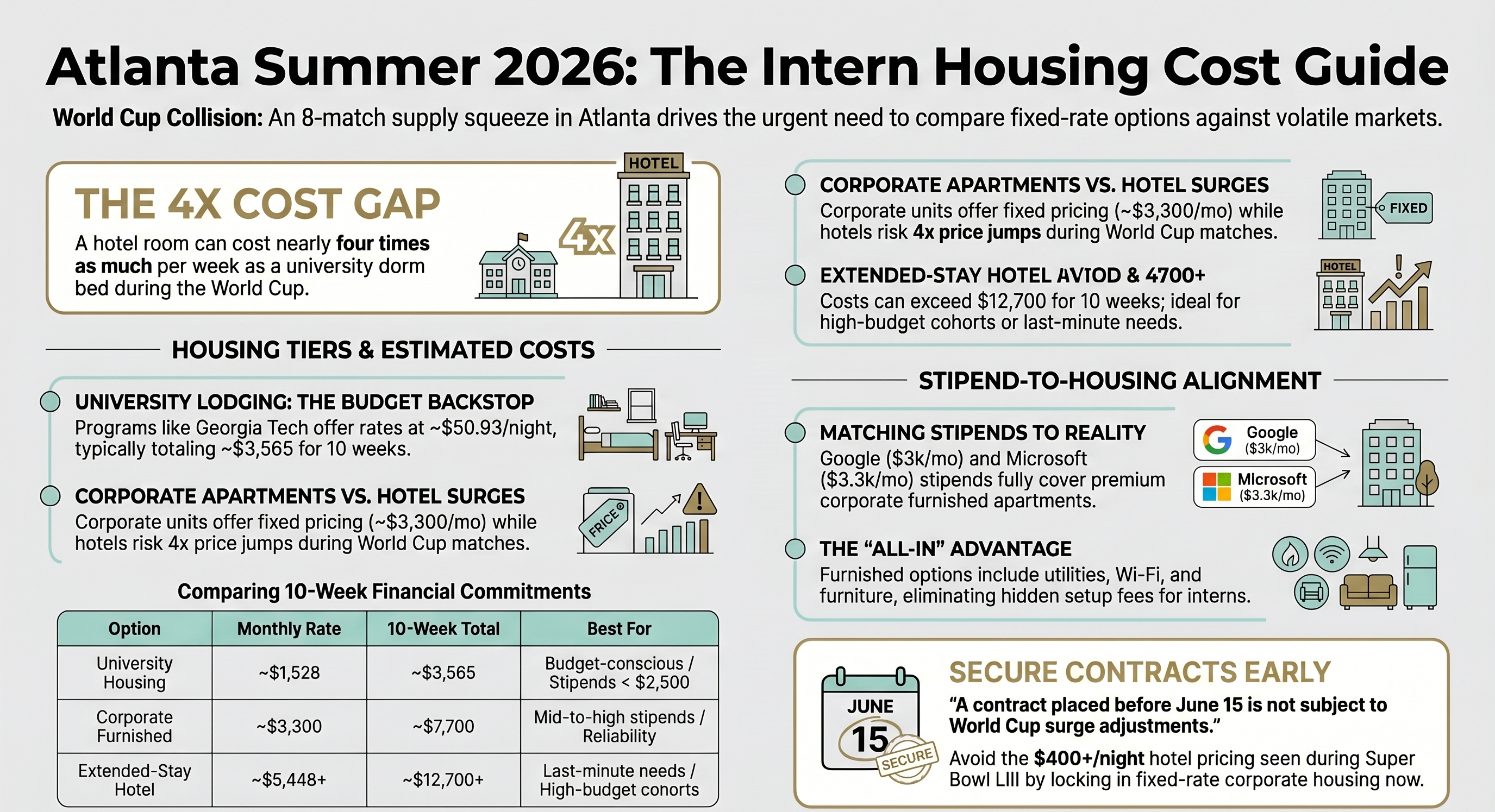
How much does intern housing cost in Atlanta? Roughly $1,500–$3,300 per month for university programs and corporate furnished apartments, and $5,400-plus per month for extended-stay hotels — before any World Cup surge pricing.
The gap between the cheapest and most expensive options is substantial. A university dorm bed and a hotel room are both "furnished and short-term," but they represent nearly a 4x difference in weekly cost.
| Option | Typical Monthly Rate | 10-Week Estimate | What's Included | Source / Notes |
|---|---|---|---|---|
| Georgia Tech Intern Lodging | ~$1,528/mo ($50.93/night) | ~$3,565 | Furnished room, utilities, campus Wi-Fi | Official 2026 rate (GT); availability limited — check site |
| Emory SIHP | Check sihp.emory.edu | Check site | Furnished, utilities | Official program; historically sells out by spring — availability unconfirmed |
| Corporate apartment (Minty tier) | ~$3,300/mo | ~$7,700 | Furnished, utilities, Wi-Fi, no deposit | Industry estimate — verify independently |
| Extended-stay hotel | ~$181.62/night baseline | ~$12,700+ | Daily housekeeping, no lease | Industry estimate — verify independently; surge likely June 15–July 15 (Super Bowl LIII precedent) |
| Airbnb or sublet | $1,500–3,500/mo variable | Variable | Varies; often no lease, no recourse | No lease protection; scam risk; rates may surge during World Cup window |
The table anchors everything, but the stipend math is where the decision gets made.
Interns receiving a Google housing stipend of approximately $3,000 per month or a Microsoft stipend of $3,333 per month (2026 recruiting cycle — confirm with your offer letter) can cover a fully furnished corporate apartment all-in, with little or no out-of-pocket cost (Blueground; Extern). A Goldman Sachs intern receiving $2,000 for the 10-week period lands in a different category: the university programs or a roommate arrangement are the realistic path.
The hotel comparison warrants a direct note. The $181.62 per night baseline figure represents pre-event pricing; the Super Bowl LIII pattern suggests the June 15–July 15 World Cup window will push that higher (AJC). A corporate apartment under a fixed contract is priced before the event pressure hits.
For a broader look at student and intern housing in Atlanta, including options outside the summer window, that companion guide covers the full landscape.
For HR and Early-Careers Managers: Placing a Cohort Without the Scramble
The structural problem with intern housing is timing. Cohort headcounts firm up in May and June — the exact window when a World Cup year removes available inventory fastest. By the time you have confirmed numbers, the options that made sense in March are gone or premium-priced.
The mechanics compound that problem. An intern has no credit history and typically no guarantor. A standard 12-month lease requires income documentation that a 10-week stipend doesn't satisfy. A landlord managing individual units has no incentive to absorb that underwriting risk. Corporate housing for interns solves this: the provider contracts with the employer, not the intern — one invoice, one lease counterparty, one point of contact.
The administrative math alone justifies the coordination. Twenty interns placed in individual apartments means 20 application reviews, 20 security deposits, 20 utility account setups, and 20 move-out inspections. A consolidated cohort placement removes all of that from your team's task list and your accounting team's reconciliation queue. Approximately half of employers now offer some form of housing support or stipend as a recruiting differentiator (Blueground).
Duty-of-care is the less-discussed but increasingly scrutinized dimension. When you place interns through a vetted provider, you have a documented paper trail: the provider's address, their maintenance response SLA, their safety procedures. Midtown Atlanta, where most Fortune 500 intern programs are based, carries a Walk Score of 91 (The Agency Atlanta) — walkable to offices, transit, and amenities without requiring a car. That's a concrete, verifiable quality marker you can include in offer communications.
2026 planning checklist for HR managers:
-
June 2026 (now): Confirm your headcount and contact corporate housing providers immediately. Ask explicitly whether June 15–July 15 move-ins are covered at fixed contract rates, or whether World Cup pricing applies.
-
Contract terms to request: Fixed rate through August, consolidated billing, clear early-termination clause in writing.
-
For 2027: Lock by February. The World Cup passes, but Atlanta's intern market doesn't shrink — and the lesson from this summer is that late cohort placement costs significantly more per head.
For teams already thinking about fall placement, the fall 2026 student housing guide covers the September–December window with similar employer-facing framing.
For Interns: Housing With No Credit History on a Stipend Budget
If you tried to rent a standard Atlanta apartment and got turned away — or found out the process requires 12 months of income documentation you don't have — that's not a personal failure. It's a structural mismatch between what most landlords require and what a 10-week internship arrangement can provide.
The options that actually work for your situation start with the stipend you're receiving.
Stipend math ladder (2026 recruiting cycle — confirm with your offer letter):
-
Goldman Sachs ~$2,000 / 10 weeks: Georgia Tech or Emory programs are the realistic path; a roommate arrangement brings corporate options into range (Blueground)
-
Stripe ~$2,300/month: University programs or shared furnished unit (Extern)
-
Meta ~$2,600/month: Entry point for a furnished corporate option depending on unit configuration (Extern)
-
Google ~$3,000/month: A fully furnished corporate apartment is within range all-in (Blueground)
-
Microsoft ~$3,333/month, Palantir ~$3,500/month: Multiple furnished options open up; budgeting for a single unit becomes straightforward (Extern)
The "all-in" framing matters here. Furnished apartments for interns roll furniture, utilities, Wi-Fi, and sometimes parking into one monthly number. What you're not paying separately: a moving truck, a furniture rental subscription, a deposit (typically), a $150 utility setup fee, and the first month of service for broadband. Those line items add up faster than most stipend budgets anticipate.
For university program availability, check directly: Georgia Tech's program page is conference.gatech.edu/internlodging and Emory's is sihp.emory.edu. Both have application requirements and availability windows — confirm current status on the site.
Scam checklist — stop if you see any of these:
-
Landlord claims to be overseas and can't show the unit in person
-
Payment requested by wire transfer or gift card before a signed lease
-
No physical address for the building or management company
-
No maintenance contact line or documented response time
-
Monthly rate significantly below every comparable listing
Legitimate providers have a physical address, a lease you can read before paying, and a maintenance line with a named contact. If a listing doesn't have all three, keep looking.
For more on student and intern housing options in Atlanta, that guide covers additional furnished options across price points.
Where to Live, by Employer — Neighborhoods and MARTA
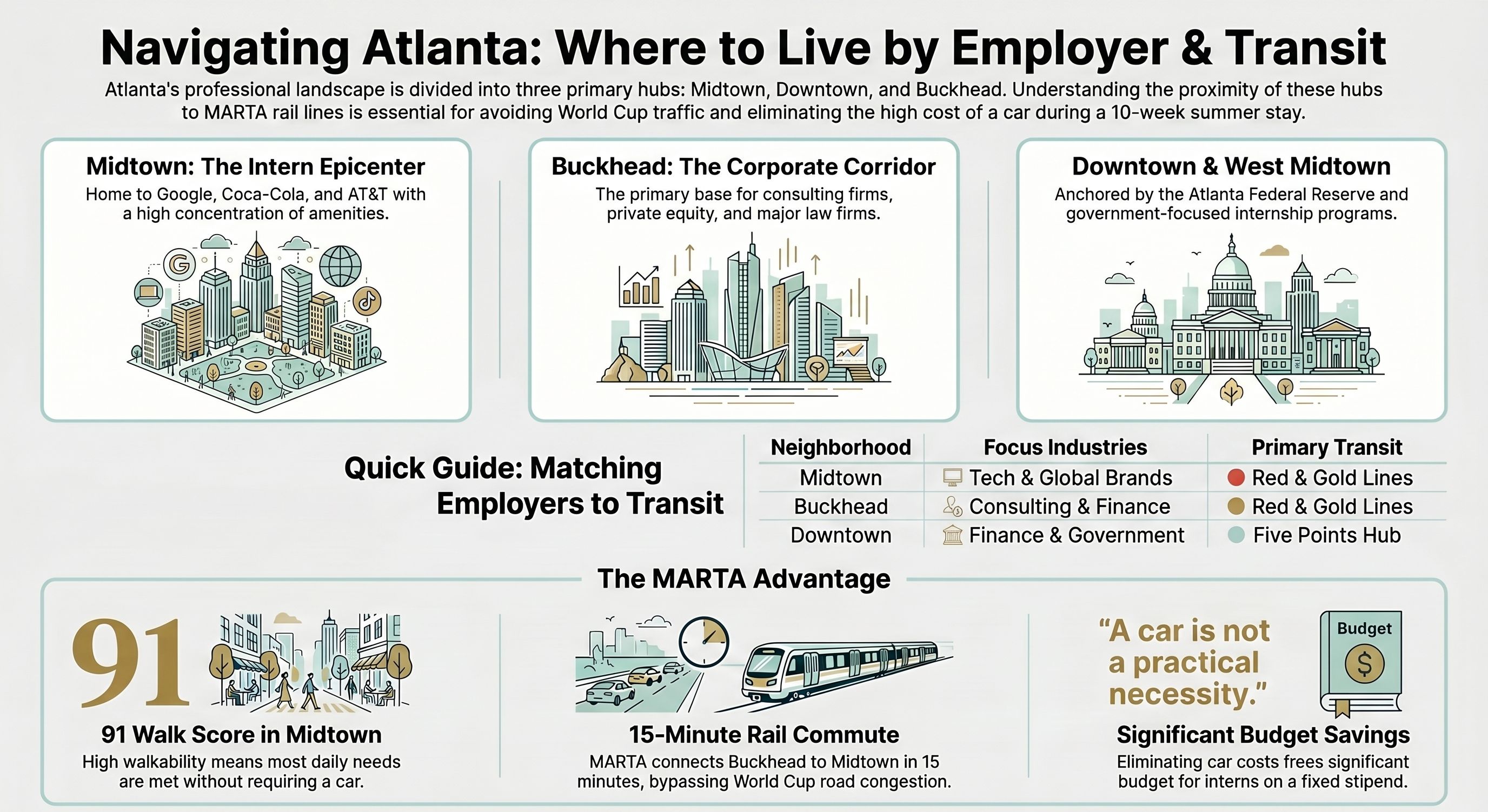
Atlanta's intern employers cluster by neighborhood, and the neighborhood you choose affects commute time, walkability, and cost. Here is where most programs land.
Midtown — The Intern Epicenter
Midtown is where most of Atlanta's large-company intern programs are based. Coca-Cola, Google's Atlanta office, Wells Fargo, and AT&T all have significant Midtown or adjacent footprints (The Agency Atlanta). The Walk Score of 91 means most daily needs — coffee, lunch, grocery runs — are on foot. MARTA's Red and Gold lines serve Midtown Station and Arts Center Station, connecting directly to the airport and to Buckhead. Note that World Cup match days between June 15 and July 15 will increase foot traffic and transit congestion in Midtown significantly.
Downtown and West Midtown — Finance and Government
The Atlanta Federal Reserve's internship program anchors Downtown (ZipRecruiter), alongside the Carter Center and several financial services firms. West Midtown runs slightly more affordable on rent than Midtown proper and has seen significant mixed-use development over the past several years. MARTA's streetcar and bus connectors serve both corridors; the Five Points hub is a central transfer point for most Downtown-based commutes.
Buckhead — Consulting, Finance, and Law
Buckhead carries a higher price point than Midtown, reflecting the concentration of consulting firms, private equity offices, and law firms. It is well-served by MARTA's Red and Gold lines, with Buckhead Station offering direct service to Midtown and Downtown — roughly 15 minutes on the train. Interns at firms in Buckhead can typically avoid owning a car entirely if they choose a MARTA-adjacent building.
A note on MARTA
Ten weeks of rideshare adds up. Atlanta's MARTA system connects Midtown, Downtown, Buckhead, and the airport on the Red and Gold lines, with bus service filling gaps in West Midtown and other corridors. If your office is within a five-minute walk of a rail station, a car is not a practical necessity for a summer stay — and eliminating that cost frees meaningful budget.
FAQ — What Parents Are Asking
These are the questions that come up most when out-of-state parents are reviewing housing options for a child's Atlanta internship.
Is Midtown safe for a 20-year-old living alone?
Midtown has a Walk Score of 91, meaning most daily needs are walkable and the neighborhood has consistent street-level activity throughout the day (The Agency Atlanta). Purpose-built corporate housing buildings typically have staffed lobbies, key-card access, and documented maintenance protocols. Those structural features — staff on-site, managed entry — are the things worth verifying, not just the neighborhood name.
Do I need to co-sign or guarantee the lease?
It depends on the housing type. University programs (GT and Emory) are contracted directly with the student applicant; there is no parent co-sign required. Corporate housing arranged through an employer is a contract between the housing provider and the company — the intern's parents are not party to it and have no co-signing liability.
What is actually included, and are there surprise charges?
Ask the provider in writing for a full list of what is and is not included — specifically: security deposit (amount and return timeline), cleaning fee, and early-termination penalty. Reputable furnished apartment providers include utilities, Wi-Fi, and furniture in the monthly rate; the surprises tend to come from cleaning fees and early-departure clauses. Get those in writing before signing.
Who does my child call when something breaks?
Ask the provider for their maintenance contact number and their documented response time before committing. A legitimate provider has a dedicated maintenance line with a tracked response SLA. "Contact the host through the app" is not sufficient for a 10-week stay — you want a building management number with a named contact.
What happens if plans change mid-summer?
Early-termination clauses vary significantly by provider. Some corporate housing providers offer a 30-day notice period; others require payment through the contracted end date. Request the early-termination clause in writing as part of your initial agreement review, before signing.
The Decision Is Made in the Next Few Weeks
The World Cup has compressed Atlanta's summer housing timeline in a way that has no recent parallel. The inventory that was plentiful in March is gone or priced at event rates. The university programs that absorb late-deciding interns historically sell out by spring — and this is not a normal spring. The practical options — corporate furnished apartments and the unstructured sublet market — are not equivalent: one comes with a lease, a maintenance line, and pricing locked before match day; the other does not.
If your intern arrival is in June or July, the decision about housing is not something to revisit after the tournament ends. The cost table in Section 2 shows what waiting costs in dollar terms. Acting now, with confirmed headcount and a direct conversation with a provider, is the path to a predictable summer.
How Minty Living Can Help
The dynamics covered in this guide — a compressed inventory window, interns with no credit history, and the administrative overhead of placing a cohort — are what we work through with companies and individuals every summer.
Minty Living manages 160+ fully furnished properties across Atlanta's intown neighborhoods, including Midtown, Old Fourth Ward, Inman Park, and Buckhead — the corridors where most Atlanta internship programs are based. Here is how we approach it:
Cohort placement: We contract with the employer, not the intern. One invoice, one lease counterparty, one point of contact — no individual credit checks or deposit tracking for your team.
Flexible terms: Lease lengths can be matched to your program calendar, from 10-week summer stays to semester-length arrangements.
Fixed pricing: Rates are set at signing. A contract placed before June 15 is not subject to World Cup surge adjustments.
MARTA-accessible buildings: Our Midtown and intown inventory is concentrated in neighborhoods where rail service is walkable — relevant for interns without cars and for the duty-of-care documentation HR teams need.
HR managers placing a cohort can reach us at mintyliving.com/contact for a consolidated proposal. Interns looking for a move-in-ready unit can browse current availability at mintyliving.com/availability.
Where do you want to go from here?
For HR and early-careers managers placing a cohort: Get a pricing breakdown for your intern cohort — share your headcount, arrival dates, and per-intern budget target, and we will send you a consolidated proposal.
For interns looking for a move-in-ready unit: See move-in-ready furnished units near your office — filter by neighborhood, availability date, and price to find options that fit your stipend.
For parents with questions about safety, lease terms, or pricing: Reach out with your questions — we can walk through specific building details, lease terms, and what's included before your child commits to anything.



 (4).png)

 (29).png)
 (28).png)
 (33).png)
 (37).png)
 (38).png)
 (39).png)
 (40).png)
 (44).png)
 (44).png)
 (1).png)
 (3).png)
 (55).png)
 (54).png)
 (56).png)
 (57).png)
 (58).png)
 (59).png)
 (61).png)