


 (59).png)
33 active productions as of March 2026 — the most Georgia has seen in nearly two years. By June, 19 cameras were rolling, a normal mid-summer figure that reflects seasonal churn, not reversal. The harder number sits inside the rebound: 22% of approved productions hit start-date delays — not for lack of script, financing, or stage space, but for crew. This is a housing story. When local crew rosters can't fill key positions, out-of-state specialists get imported on six-to-fourteen-week stints — and imported crew needs a place to live.
Table of Contents
The Rebound by the Numbers
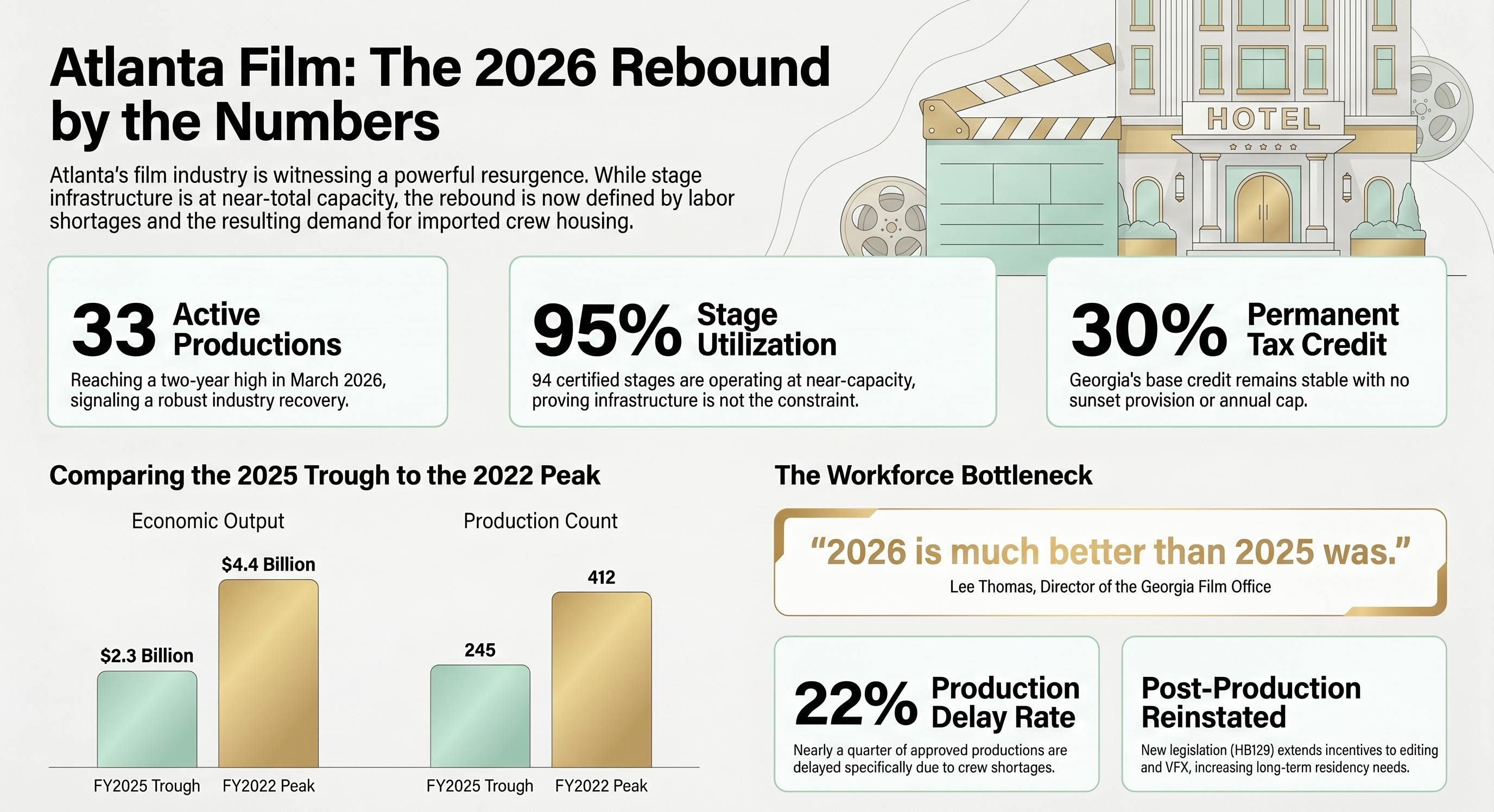
Georgia film production peaked at $4.4 billion in economic output across 412 productions in FY2022. The post-strike correction brought it down hard: FY2025 closed at $2.3 billion across 245 productions, a 47% revenue decline and a 41% drop in production count (AtlantaFi). The trough was a correction, not a collapse — the infrastructure stayed, the incentives stayed, and the productions came back.
Georgia had 33 active film productions in March 2026 — the most in nearly two years — with 19 actively filming as of June 2026. It is the clearest signal that the Atlanta film industry's recovery is real (Georgia Entertainment, corroborated by Project Casting). Lee Thomas, Director of the Georgia Film Office, put it plainly: "We are busier now than we have been in some time. 2026 is much better than 2025 was." (Georgia Entertainment, March 2026).
The infrastructure picture supports that assessment. According to a KiTalent industry analysis, approximately 94 certified stages are operating across the state, with Trilith Studios holding 32, Assembly Atlanta 19, and Tyler Perry Studios 12. Stage utilization has reached roughly 95% (KiTalent). At that utilization rate, the stages are not the constraint.
The tax architecture reinforces the structural character of the recovery. Georgia's 30% production credit — a 20% base plus a 10% Georgia Entertainment promotion uplift — carries no cap and no sunset (Shamel Studio). The post-production tax credit, which had lapsed, was reinstated effective January 1, 2026 under HB129, extending the incentive's reach into editing and VFX work. That matters for housing: post-production brings a different crew profile than principal photography, with longer, calendar-driven residencies. The full implications appear in Section 6. For now, the baseline is set: 33 productions in March, 94 stages near capacity, and a credit structure that shows no sign of contraction.
Full Stages, Thin Crews — The 2026 Bottleneck
When Georgia Entertainment reported 33 active productions in March, the headline read as a straightforward recovery story. The subtext is more complicated. According to a KiTalent industry analysis, 22% of approved productions hit start-date delays — not because of financing gaps or stage conflicts, but because key positions couldn't be staffed from the local labor pool.
The shortage is not evenly distributed. Three roles are driving the most acute production impact (KiTalent):
| Role | Shortfall / Vacancy | Production Impact |
|---|---|---|
| Production Accountant | 34% shortfall; 127-day avg. time-to-fill vs. 45-day historical norm | Delays greenlight-to-camera timeline; housing must be arranged before the hire is confirmed |
| Senior VFX Artist | 28% vacancy; $40M in contract value rejected or deferred | Pushed VFX-dependent productions toward offshoring or deferred principal photography |
| Virtual Production Technician | 60% supply shortfall | Stage time booked but dark; Prysm-class LED volumes require specialized operators (NEP/Trilith) |
Source: KiTalent industry analysis. Figures represent reported shortfalls across Atlanta-based productions.
The production accountant figure deserves particular attention. A 127-day time-to-fill for a role that historically fills in 45 days means the hire often isn't confirmed until deep into prep — or past it. For any UPM building a housing block, this creates a cascade: you can't confirm accommodation for a crew member whose start date is still uncertain, which compresses the sourcing window and drives up per-head cost.
Below the line, grip and electric departments are experiencing general tension as production volume climbs against a local BTL pool that has not scaled proportionally. Variety's coverage of Georgia's production sector validates the structural character of the shortage: the labor gap is not a temporary byproduct of the rebound, it is a feature of it (Variety).
The logical response is to recruit from outside Georgia — and that decision is what connects the production rebound to above-the-line talent housing in Atlanta and mid-term furnished demand more broadly.
Why the Shortage Is a Housing Story
The causal chain is short: stages near full capacity, local crew rosters insufficient, out-of-state specialists imported for six-to-fourteen-week stints. Every imported crew member requires furnished mid-term housing. That demand is arriving against a residential market that was already under pressure before the rebound accelerated.
The studio-adjacent residential capacity figure is striking. According to a KiTalent industry analysis, the combined on-campus housing at Trilith Studios and Tyler Perry Studios accommodates less than 5% of the workforce those facilities generate. The remainder — the other 95-plus percent — competes for furnished inventory in the surrounding submarkets, in a market where available mid-term furnished supply has not expanded in proportion to production demand.
The housing burden calculates as follows. IATSE theatrical per diem currently sits at $70 per day (up from $59.50 under the previous rate schedule, per TopSheet/IATSE rate sheets). Against that allowance, production-adjacent neighborhoods saw a 24% rent increase between 2022 and 2024 (KiTalent). The resulting housing-burden ratio for out-of-state crew reaches approximately 45% of income — against the 30% standard that payroll allocation frameworks use as a ceiling. At 45%, the quality of housing stops being a comfort question and becomes a retention mechanism. Crew who find their accommodations inadequate relative to what the same per diem buys in other markets have options. In a market where 22% of productions are already delayed for staffing, mid-season defections compound an existing problem.
There is also a prep-window constraint that tightens the housing sourcing challenge. A typical episodic greenlight-to-camera timeline runs six to eight weeks. Housing should lock in weeks two and three of prep. With a 127-day accountant time-to-fill and compressed sourcing windows across key roles, the housing block is often being assembled at the same time the crew roster is still being confirmed — which is when inventory availability and vendor responsiveness have the most direct impact on production timelines.
The Atlanta short-term rental market update for Q1 2026 documents the broader mid-term demand context. At $70 a day in per diem, the question becomes: what does the housing actually cost, and what does the gap between the allowance and the market look like across a full shoot?
The Economics — Per Diem vs. Hotel vs. Furnished Apartment
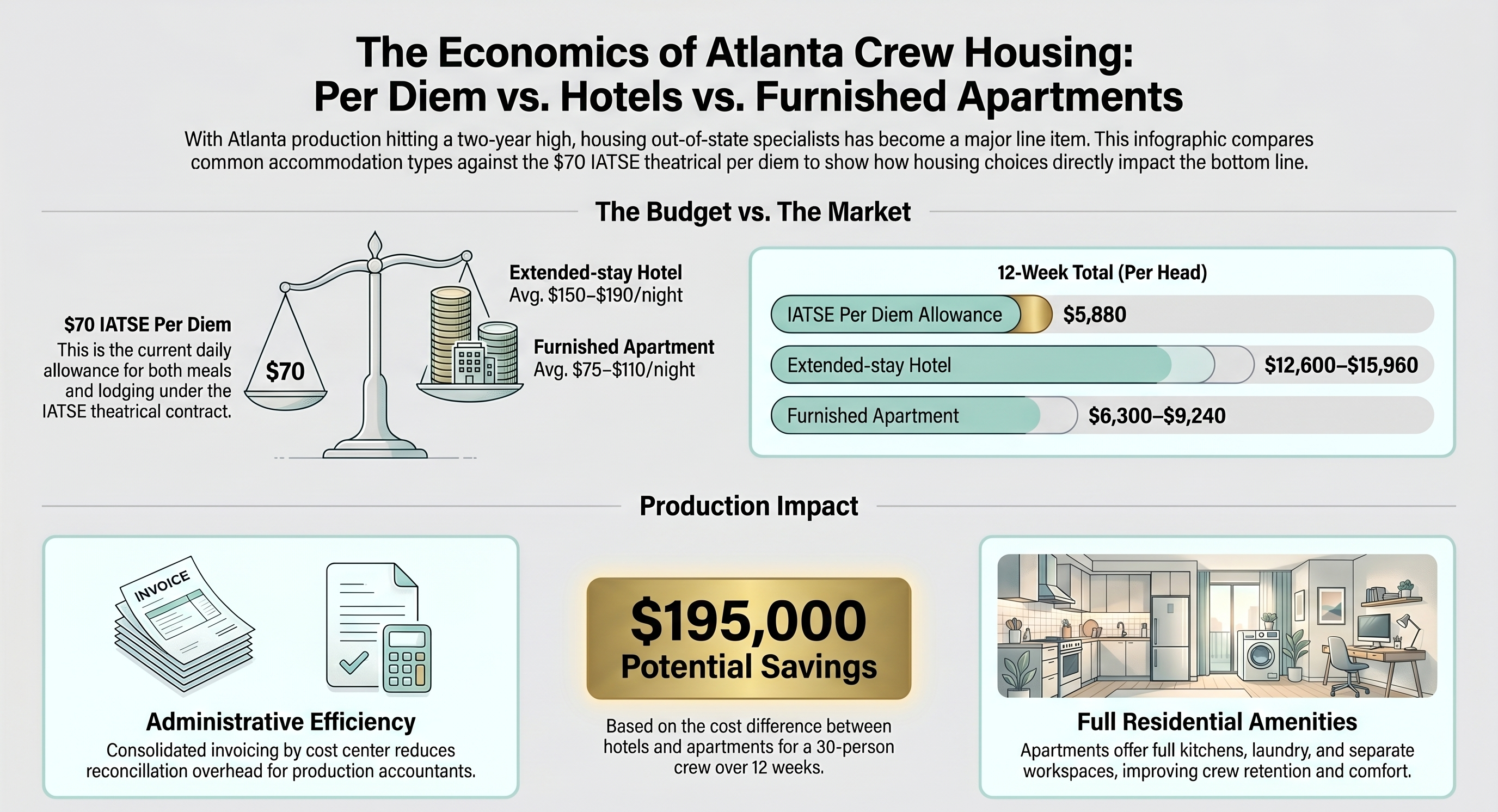
Every production housing budget is built around a single number: $70 per day, the IATSE theatrical per diem rate under the current contract (TopSheet). That is the allowance a crew member receives to cover accommodation and meals on location. For a UPM or production accountant, it is the per-head ceiling against which every vendor quote gets evaluated.
The Atlanta market in 2026 offers three realistic accommodation structures for a six-to-twelve-week shoot, each with meaningfully different economics:
| Accommodation Type | Typical Daily Rate (Atlanta) | 6-Week Total (42 days) | 12-Week Total (84 days) | Notes |
|---|---|---|---|---|
| IATSE per diem allowance | $70/day | $2,940 | $5,880 | The per-head budget ceiling (meals + lodging combined) |
| Extended-stay hotel | $150–$190/night | $6,300–$7,980 | $12,600–$15,960 | Standard rack rate; limited kitchen access |
| Furnished apartment | $75–$110/night equivalent | $3,150–$4,620 | $6,300–$9,240 | Full kitchen, separate work space, laundry |
Illustrative market-rate ranges, Atlanta metro, 2026.
The hotel-versus-apartment delta on a 12-week episodic is not a rounding error. For a 30-person crew, the difference between the extended-stay hotel midpoint and the furnished apartment midpoint is approximately $195,000 over the production cycle — a six-figure line item that sits entirely above what the per diem covers and therefore lands on the production budget directly.
For a production accountant, the economics table above is the starting point, not the conclusion. The per-head cost is one variable. The billing structure is another. Consolidated invoicing — one line item per person per night, assigned to the correct budget code and production phase — reduces reconciliation overhead materially compared to a multi-vendor hotel arrangement where folios arrive at wrap with varying line-item granularity. A single vendor contact who understands the production calendar and can issue itemized documentation by cost center is worth real overhead reduction at close.
A note on terminology: the per diem allowance is a combined housing and meals figure under IATSE theatrical rates. Productions that provide accommodation directly typically negotiate a housing component separate from the meals portion, which changes the effective per-head cost calculation. A production accountant running this math against a $70/day total allowance should factor the split before comparing it to market rates.
What's Filming Now — and Where Crews Stay
The production driving the largest current housing demand in Atlanta is Scooby-Doo: Origins (Netflix). Principal photography began April 24 and runs through September 10, 2026, at Cinespace Atlanta — an eight-episode order with a 2027 premiere target (Deadline). At nearly five months of photography, it represents sustained mid-term housing demand concentrated in the in-town Atlanta submarket.
Tulsa King Season 4 recently wrapped at Eagle Rock Studios, completing a production run from November 2025 through June 2026. The season is set for a fall 2026 Paramount+ debut. Four seasons at Eagle Rock establishes that facility as one of Atlanta's reliable long-run episodic homes — relevant for anyone planning around multi-season demand patterns, including location scouts working Atlanta.
The broader June count of 19 actively filming productions (Project Casting) reflects the episodic and mid-budget segment that Georgia.org identifies as the resilient core of Georgia's production base. These productions don't generate headlines at the scale of a Marvel feature, but they generate consistent, rolling housing demand — prep crews arriving as prior-season crews wrap, creating a near-continuous occupancy signal in production-adjacent submarkets.
Minty Living currently manages 160+ furnished properties across production-adjacent submarkets in the Atlanta metro, with inventory positioned to serve the studio geography below.
Studio Housing Proximity Guide
| Studio | Location | Scale | Drive from Midtown Atlanta | Housing Context |
|---|---|---|---|---|
| Trilith Studios | Fayetteville, GA | 32 stages; Prysm VP cluster | 25–35 min south | Largest VP footprint; crew housing near Trilith typically draws from Fayetteville and Peachtree City corridors |
| Assembly Atlanta | Doraville, GA | 19 stages | 15–20 min northeast | Northeast Atlanta and Chamblee submarkets; accessible for crew housing in Buckhead/Dunwoody |
| Tyler Perry Studios | Fort McPherson (in-city) | 12 stages | 10–15 min southwest | Southwest Atlanta; in-city furnished inventory in Westside and Capitol View submarkets |
| Eagle Rock Studios | In-city, Atlanta | Multi-stage facility | 10–15 min | Tulsa King wrap site; central location draws from Inman Park, Old Fourth Ward, Grant Park |
| Cinespace Atlanta | In-town | Active through Sept 10 | ~10 min | Scooby-Doo: Origins through September; Eastside and Edgewood submarkets |
Outlook — Tax Credits, Virtual Production, What Comes Next
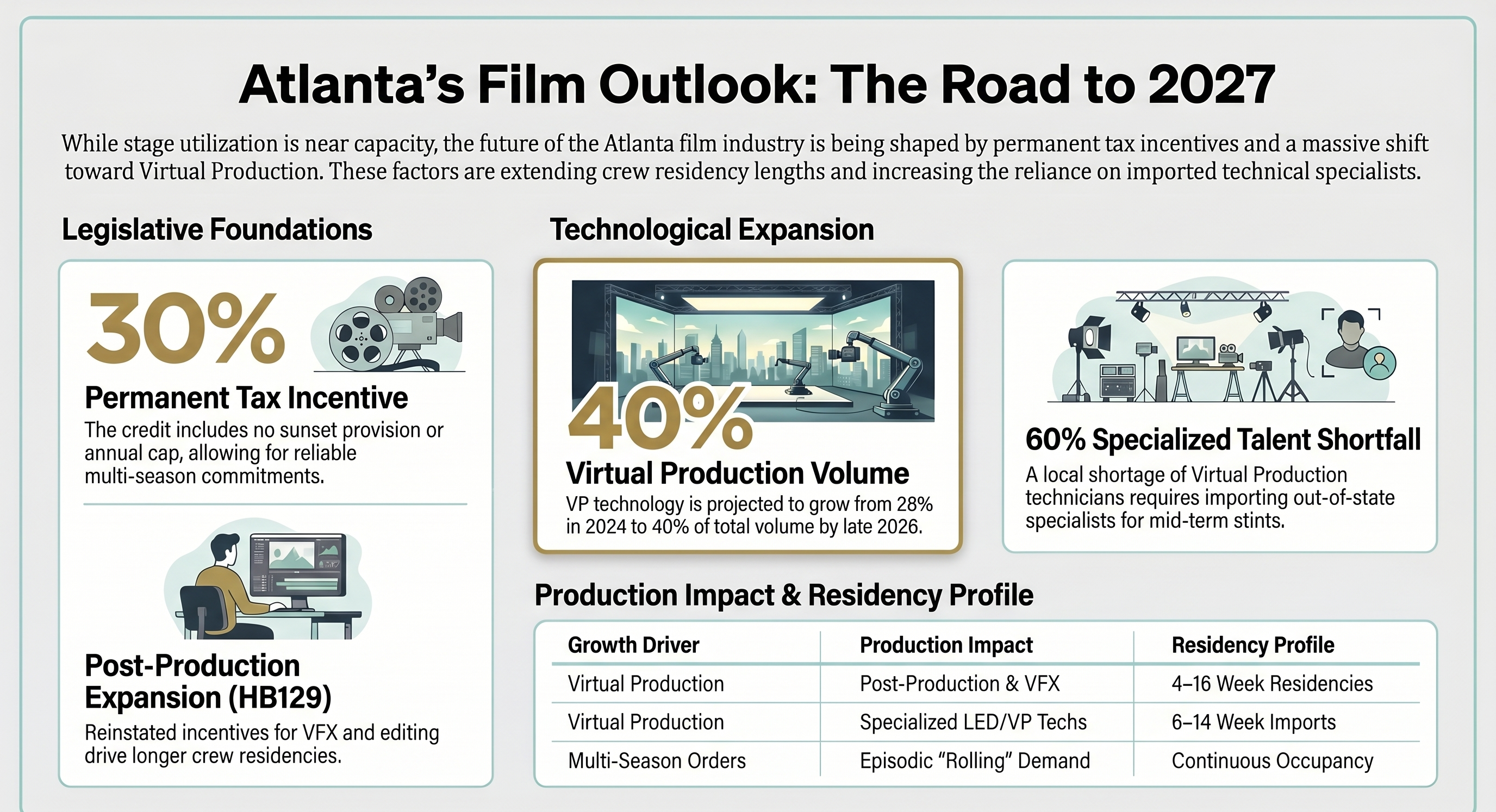
The structural argument for continued production activity in Georgia rests on two pillars: credit stability and virtual production growth.
On credit stability: Georgia's 30% production incentive carries no sunset provision and no annual cap, which means productions can model multi-season commitments against a reliable cost structure (Shamel Studio). The reinstatement of the post-production credit under HB129 extends that certainty to editing and VFX workflows. Post-production crews typically operate on calendar-driven residencies of four to sixteen weeks — a distinct housing profile from principal photography, and one that will grow as the credit encourages more post work to remain in-state.
On virtual production: the trajectory is measurable. VP technology accounted for approximately 28% of Atlanta production volume in 2024. According to a KiTalent industry analysis, it is projected to reach 40% of 2026 volume. The Prysm stage at Trilith — developed in partnership with NEP — is the infrastructure confirmation: purpose-built LED volumes at scale require a specialized operator class that currently faces a 60% local supply shortfall (KiTalent). That shortfall means VP technicians will continue to be imported for the foreseeable future, sustaining mid-term housing demand in the Trilith submarket specifically.
The multi-season episodic pattern reinforces the longer-term picture. Tulsa King's four-season run at Eagle Rock and Scooby-Doo: Origins' eight-episode order at Cinespace are examples of the recurring commitment structure that Georgia.org identifies as the backbone of the state's production base.
The closing read: the infrastructure is in place, the credit is stable, and virtual production is building a new category of imported specialist demand. The variable is whether the local crew pipeline recovers fast enough to reduce out-of-state reliance — or whether the rebound deepens it.
Conclusion
33 productions in March, 22% start-date delays, and a 45% housing-burden ratio — three numbers that describe the same problem from different angles. Stage utilization is not the constraint. Crew availability is. And when the local pipeline can't fill the roster, the production imports the crew. Housing stops being a logistics item and becomes a production risk variable: slow to source, and the compressed-prep problem compounds; poor in quality, and retention suffers in a market where alternatives are one phone call away.
Housing a production in Atlanta this year? Minty Living manages 160+ furnished properties across production-adjacent submarkets, with block availability, flexible add/drop terms, and consolidated itemized billing. Talk to our production housing team.
How Minty Living Can Help
Minty Living is a preferred vendor for major Atlanta studios, managing 160+ production-ready furnished properties across the submarkets covered in the studio proximity guide above — from Fayetteville and the Trilith corridor to Inman Park, Old Fourth Ward, and the Eastside neighborhoods adjacent to Cinespace and Eagle Rock.
For line producers and UPMs sourcing film crew housing in Atlanta during compressed prep windows: we work on production-friendly lease terms, accommodate block bookings with add/drop flexibility, and issue consolidated itemized billing by cost center. Billing documentation is formatted to support production accounting close.
Contact our production housing team at mintyliving.com/contact or (404) 999-0841.
Methodology and Sources
Production count data sourced from Georgia Entertainment (March 2026) and Project Casting (March and June 2026); both accessed June 2026. Economic trajectory figures ($4.4B peak, $2.3B trough) sourced from AtlantaFi. Tax credit details from Shamel Studio. IATSE per diem from TopSheet. Production-specific data: Scooby-Doo: Origins from Deadline (April 2026); Tulsa King S4 from production reports. VP infrastructure from NEP/Trilith Prysm stage announcement. Trade context from Variety. Episodic resilience narrative from Georgia.org.
Single-source acknowledgment: Most role-level crew shortfall statistics in this report — production accountant shortfall and fill time, senior VFX vacancy and deferred contract value, virtual production technician shortfall, stage utilization, housing-burden ratio, rent appreciation, and VP volume projections — derive from a single KiTalent industry analysis. These figures are attributed explicitly throughout and corroborated where possible against Georgia Entertainment and Variety. KiTalent figures were published in the period January 2025–early 2026 and may not fully reflect conditions during the March 2026 production peak. Readers evaluating any single statistic for production-budget purposes should treat KiTalent-sourced figures as directional indicators and verify against current market conditions.

 (4).png)

 (29).png)
 (28).png)
 (33).png)
 (37).png)
 (38).png)
 (39).png)
 (40).png)
 (44).png)
 (44).png)
 (1).png)
 (3).png)
 (55).png)
 (54).png)
 (56).png)
 (57).png)
 (58).png)
 (60).png)
 (61).png)