


 (58).png)
Your home just became unlivable. Tonight is not the night for a 40-page insurance guide. What you need right now is a clear answer to one question: will insurance pay for somewhere safe to stay?
The short answer is yes — for most standard homeowners policies. Most include something called Additional Living Expense (ALE) coverage, though policy terms vary, so confirming with your insurer is worth a two-minute call. Below is how insurance-covered temporary housing in Atlanta actually works: what ALE covers, how to activate it fast, and how to find a furnished place for your family — pets included — without fronting a dollar.
Table of Contents
-
Wait — Does Homeowners Insurance Actually Pay for Temporary Housing?
-
Your First 72 Hours: A Calm Checklist When Everything Feels Urgent
-
Furnished Housing vs. a Hotel: What Actually Works for a Displaced Family
-
How to Get Placed in Atlanta Quickly — Without Fronting the Cost
-
Atlanta's Storm Season: Why This Happens Here, and Why It's Normal
Wait — Does Homeowners Insurance Actually Pay for Temporary Housing?
Yes. If a covered disaster — a storm, a burst pipe, a fire — makes your home unlivable, the part of your homeowners policy called Additional Living Expense coverage (sometimes "Loss of Use") is designed to pay your extra living costs while you're displaced. It's built into most standard policies. You very likely already have it.
Here's the key idea: ALE covers the difference between your normal living costs and the higher costs you face while displaced. According to the National Association of Insurance Commissioners, that typically includes temporary housing, restaurant meals above your usual grocery budget, and other reasonable extra costs. Bankrate's breakdown goes further, listing temporary rentals, hotel stays, pet boarding, laundry, storage, extra fuel, and rental-car costs among covered expenses.
How much is available? ALE is usually set as a percentage of your home's dwelling coverage — generally 20 to 30 percent, per Bankrate. On a home insured for $400,000, that's roughly $80,000 to $120,000 set aside for the cost of being displaced. Some policies also cap how long they'll pay. Both NAIC and Bankrate are clear that the exact limit and any time restriction live in your policy — so your declarations page and your adjuster are the final word.
One thing ALE does not cover: costs you'd owe anyway. Your mortgage, your utilities, your regular groceries — those remain yours. ALE is for the extra, not the everyday.
Want the full walkthrough of the process from start to finish? See our complete guide to insurance displacement housing.
Your First 72 Hours: A Calm Checklist When Everything Feels Urgent
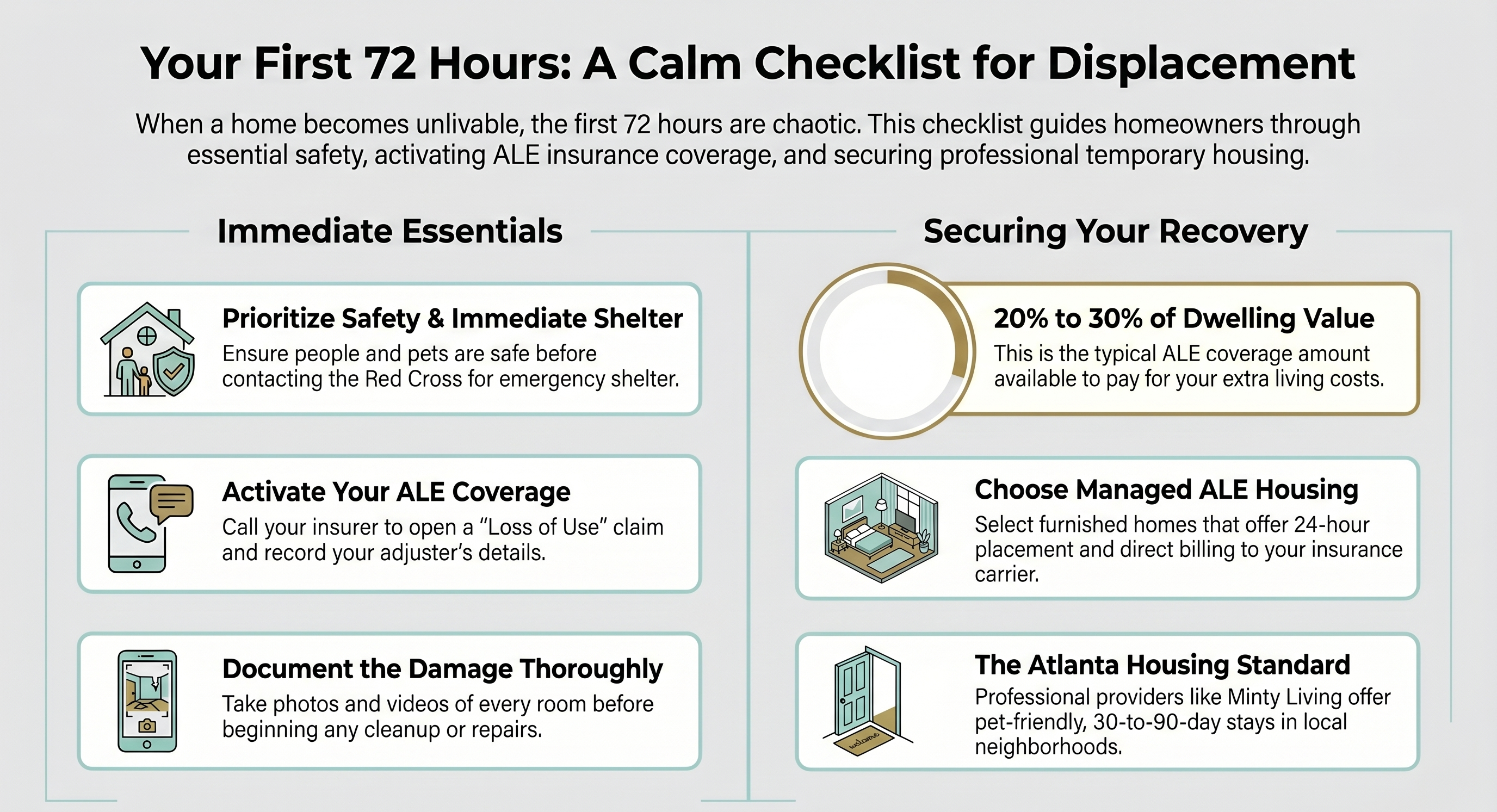
When everything feels urgent at once, it helps to do things in order. Here's a sequence you can follow, starting tonight.
-
Make sure everyone is safe. People first, then pets. If there's any structural or fire risk, don't go back inside for belongings. If you have nowhere to go tonight, the Red Cross and local agencies provide emergency shelter — you can find options through USA.gov's disaster housing page.
-
Call your insurer and open a claim. Do this as soon as you reasonably can; insurers expect prompt reporting (NAIC). Say plainly that your home is unlivable and you want to open your ALE / Loss of Use coverage. Write down your claim number and ask for your adjuster's direct phone and email.
-
Document everything before any cleanup. Photograph and video every room and every angle of the damage. Make a list of damaged items. Save receipts for anything you buy in the scramble — a few nights in a hotel, clothes, toiletries. This is what supports your ALE claim later.
-
Prevent further damage — if it's safe to do so. Tarp an exposed roof breach or shut the water off at the main. NAIC notes that taking reasonable steps to limit further damage is part of your responsibility as a policyholder — and small steps now can prevent thousands in additional damage later.
-
Line up temporary housing. This is where ALE goes to work. You don't have to wait weeks — you can start looking for furnished temporary housing now. The next two sections show you exactly how.
You will not get all five done perfectly tonight, and you don't have to. Safety and the phone call to your insurer are what matter first. The rest can follow tomorrow. Once the claim is open, the next decision is what kind of housing to choose for the weeks ahead.
Furnished Housing vs. a Hotel: What Actually Works for a Displaced Family
The instinct is to book a hotel. For a night or two, that's fine. For the weeks or months a real repair takes, the math stops working for most families.
A standard hotel room runs 300–400 square feet, with no real kitchen and everyone sharing one space. Three meals a day out, for two months, adds up fast — and many hotels won't take your dog or cat. None of that is a knock on hotels; they're just not built for a displaced household living out of suitcases for weeks on end.
Furnished temporary housing is. A furnished apartment or home gives you a full kitchen, separate bedrooms, a washer and dryer, and room to actually live for a 30-to-90-day stretch — the kind of stay the Corporate Housing Providers Association describes as standard for displacement situations. For families with kids, a place near their school keeps a hard season as normal as possible. For families with pets, furnished rentals are far more likely to say yes than a hotel — which matters when a dog or a cat is part of the household.
There's a practical money difference, too. Providers who work with insurance can often bill your carrier directly, so you're not putting thousands on a credit card and waiting on reimbursement. We'll cover exactly how that works next.
Not sure what separates a good provider from a risky one? Here's what to look for in an ALE housing provider.
How to Get Placed in Atlanta Quickly — Without Fronting the Cost
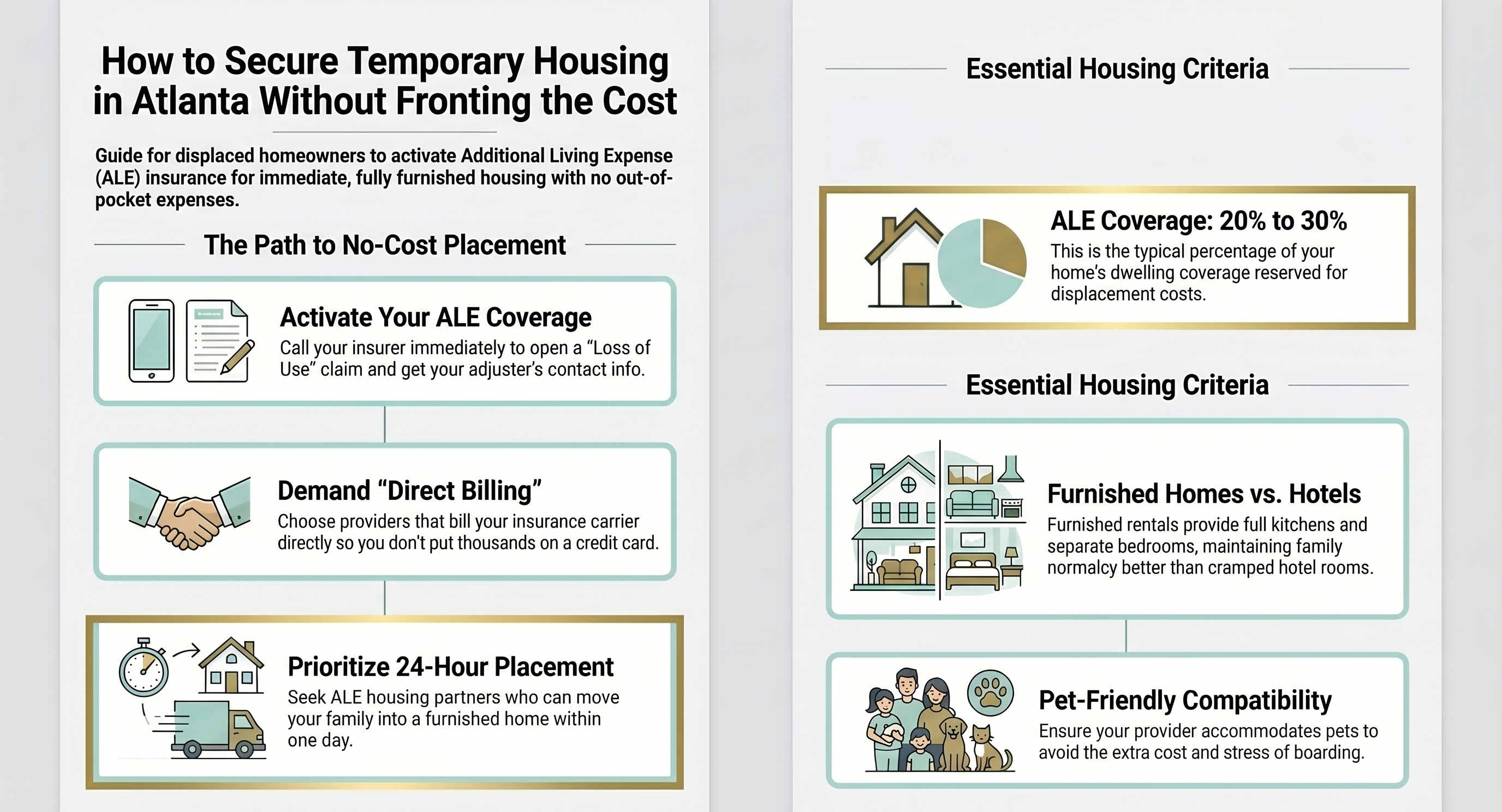
There are two ways into temporary housing, and both are normal.
Path one — your adjuster refers you. Some adjusters keep a list of ALE housing partners. Ask directly: "Do you work with any ALE housing providers in Atlanta who can direct-bill the carrier?"
Path two — you find it yourself. If your adjuster doesn't offer a referral, you're allowed to find a provider and propose it; the insurer then reimburses you or bills directly. Before you commit to anyone, ask five questions:
-
Do you direct-bill the insurance carrier, so I don't pay upfront?
-
Can you place me within 24 hours?
-
Do you have furnished units available for 30 to 90 days?
-
Are pets allowed?
-
What do you need from my adjuster to get started?
Getting settled quickly matters. Significant storm or fire repairs can take weeks to several months, depending on scope and contractor availability — and a stable furnished home beats burning that time in a hotel while approvals grind on. Leading ALE housing providers offer 24-hour placement as a baseline, so it's worth asking any provider upfront whether they can meet that timeline.
One Atlanta option that fits this exact need: Minty Living runs an insurance-displacement program with 24-hour placement, insurer direct-billing, and pet-friendly furnished homes available for 30-to-90-day stays across a portfolio of 160+ properties. Whether your adjuster makes the call or you do, they can work either way.
A practical tip worth its own line: before you sign any lease, get written confirmation from your adjuster of your ALE limit. Knowing the number protects you from accidentally outspending your coverage.
Atlanta's Storm Season: Why This Happens Here, and Why It's Normal
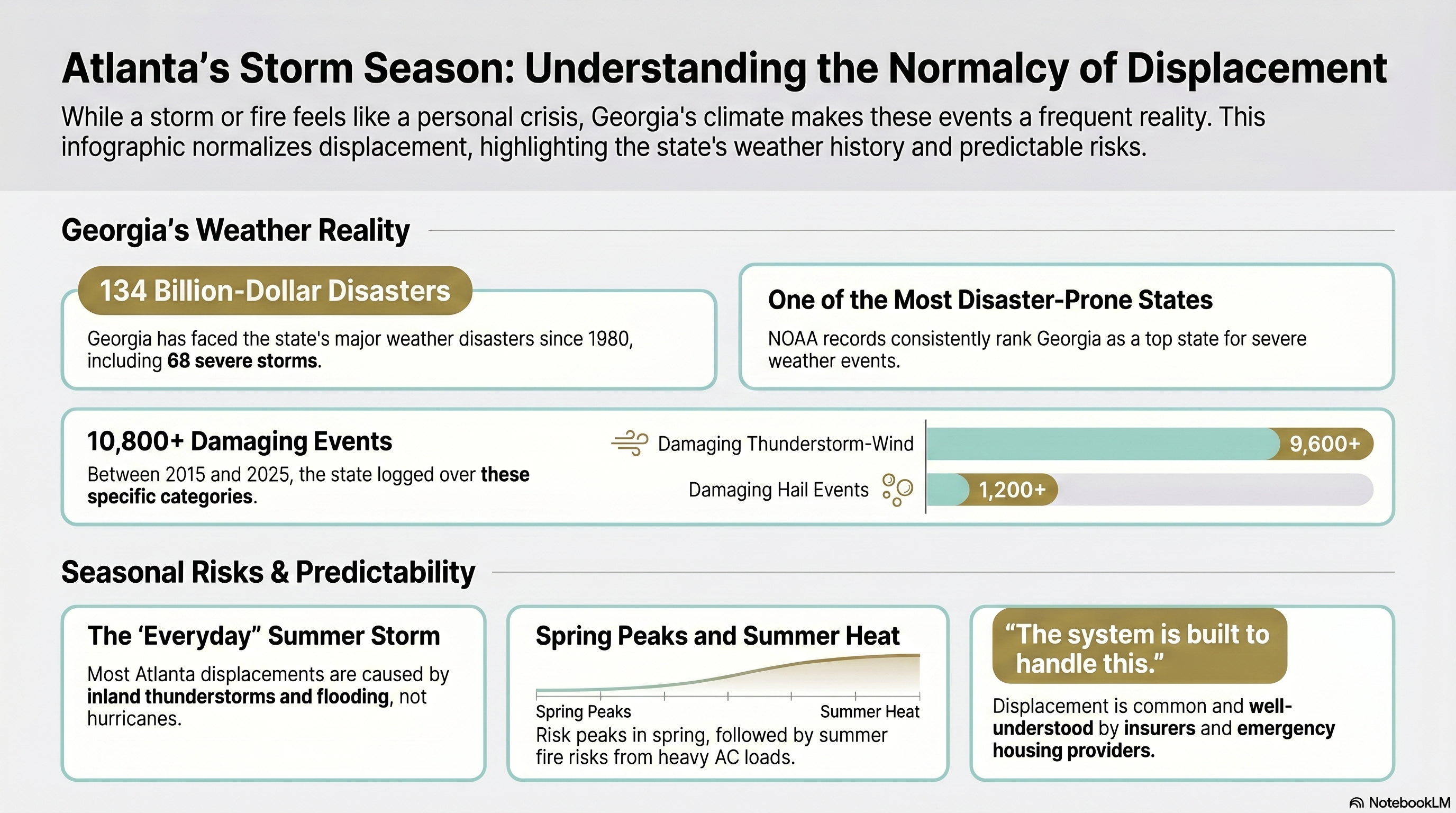
If you're feeling blindsided, know that displacement is far more common in Georgia than most people realize. The state has seen 134 billion-dollar weather disasters since 1980 — including 68 severe-storm events — making it one of the most disaster-prone states in NOAA's records (NOAA NCEI). Between 2015 and 2025 alone, Georgia logged more than 9,600 damaging thunderstorm-wind events and over 1,200 hail events.
That risk peaks in spring and stays active right through summer — severe thunderstorms, straight-line wind, hail, and flash flooding — while the summer months add elevated house-fire risk from heat, grilling, and heavy AC load. To be clear, this is not a hurricane story: Atlanta sits well inland, and NOAA forecasts a below-normal 2026 Atlantic hurricane season. The everyday summer storm — not the tropical one — is what displaces Atlanta families.
The point isn't to alarm you. It's the opposite: what happened to you is common, well understood, and something the system is built to handle. A clear first-72-hours plan and knowing your ALE coverage exists are what separate a manageable disruption from a drawn-out crisis.
You've Got This — and You Don't Have to Figure It Out Alone
If you remember only two things tonight, make it these. One: you almost certainly have ALE coverage — call your insurer today and ask for it by name. Two: furnished temporary housing exists in Atlanta that can be arranged within 24 hours and billed directly to your carrier, so you're not fronting the cost.
Most homeowners never file a claim until a disaster forces them to. Feeling overwhelmed doesn't mean you're doing it wrong — it means this is new. But you now have the checklist, you know ALE exists, and you know what to ask. That's most of the battle.
If you'd like help finding furnished housing in Atlanta and want it billed directly to your insurer, Minty Living's displacement team is here when you're ready. And if you want the complete, step-by-step version of everything above, read our Ultimate Guide to Insurance Displacement Housing.
How Minty Living Can Help
Being displaced from your home — even temporarily — is one of the more disorienting things a family can go through. Having a comfortable, fully furnished place to land while repairs happen doesn't fix the damage, but it does make the weeks ahead more manageable for everyone in the household.
Minty Living is an Atlanta-based furnished housing company that works with displaced residents and their insurance carriers. Here's what that looks like practically:
24-hour placement. When the claim is open and you need somewhere to go, we can typically place a family within 24 hours across our portfolio of 160+ furnished properties spanning 10+ intown Atlanta neighborhoods — from Inman Park and Old Fourth Ward to Grant Park, Midtown, and Virginia-Highland.
Direct billing to your carrier. We work with insurers directly, so your family isn't fronting the cost and waiting on reimbursement. The goal is that your ALE coverage works the way it was designed to — you move in, the billing goes to your adjuster.
Flexible stays. Repair timelines are unpredictable. We offer rental terms from short-term through extended stays, so you're not locked into something that doesn't fit your claim timeline. If repairs run longer than expected, adjusting your stay is a conversation, not a problem.
Pets welcome. Our properties are pet-friendly. If your dog or cat is part of the household, they're part of the move.
Professionally designed, fully furnished homes. Every property in our portfolio is designed and furnished by our in-house team — a full kitchen, separate bedrooms, washer and dryer, a real home rather than a hotel room with a kitchenette. We hold Airbnb Superhost status and a 4.9 Google rating, and our eligible portfolio meets Plum Guide's Top 1% quality standard. Not things to lead with in a moment like this — just quiet reassurance that the place your family is moving into has been vetted carefully.
There's no pressure here. When you're ready to look at options, or if you just want to talk through what your situation might require, reach out. We're here to help.
Visit mintyliving.com or call (404) 999-0841.

 (4).png)

 (29).png)
 (28).png)
 (33).png)
 (37).png)
 (38).png)
 (39).png)
 (40).png)
 (44).png)
 (44).png)
 (1).png)
 (3).png)
 (55).png)
 (54).png)
 (56).png)
 (57).png)
 (59).png)
 (60).png)
 (61).png)