
Most owners shopping for property management in Atlanta start by comparing fees. Fees are the third decision. Two firms charging the same percentage can run your house in very different ways. They may serve different guests, under different rules, with different results at year end.
This guide is for people who own one to ten homes or condos in intown Atlanta and are deciding whether to hire a manager, or whether to replace the one they have. It walks through the decisions in the order we would make them ourselves.
Start by choosing the management model (long term lease, short term stays, or furnished stays of 31 nights or more). Then choose a firm that specializes in that model and passes a few Georgia specific checks. Then read the contract before you sign it.
One note before we start. We link the statutes and rules we rely on, but this is a practical guide, not legal advice. For anything that turns on your specific situation, check with a Georgia real estate attorney.
Step one: decide which kind of property management you need
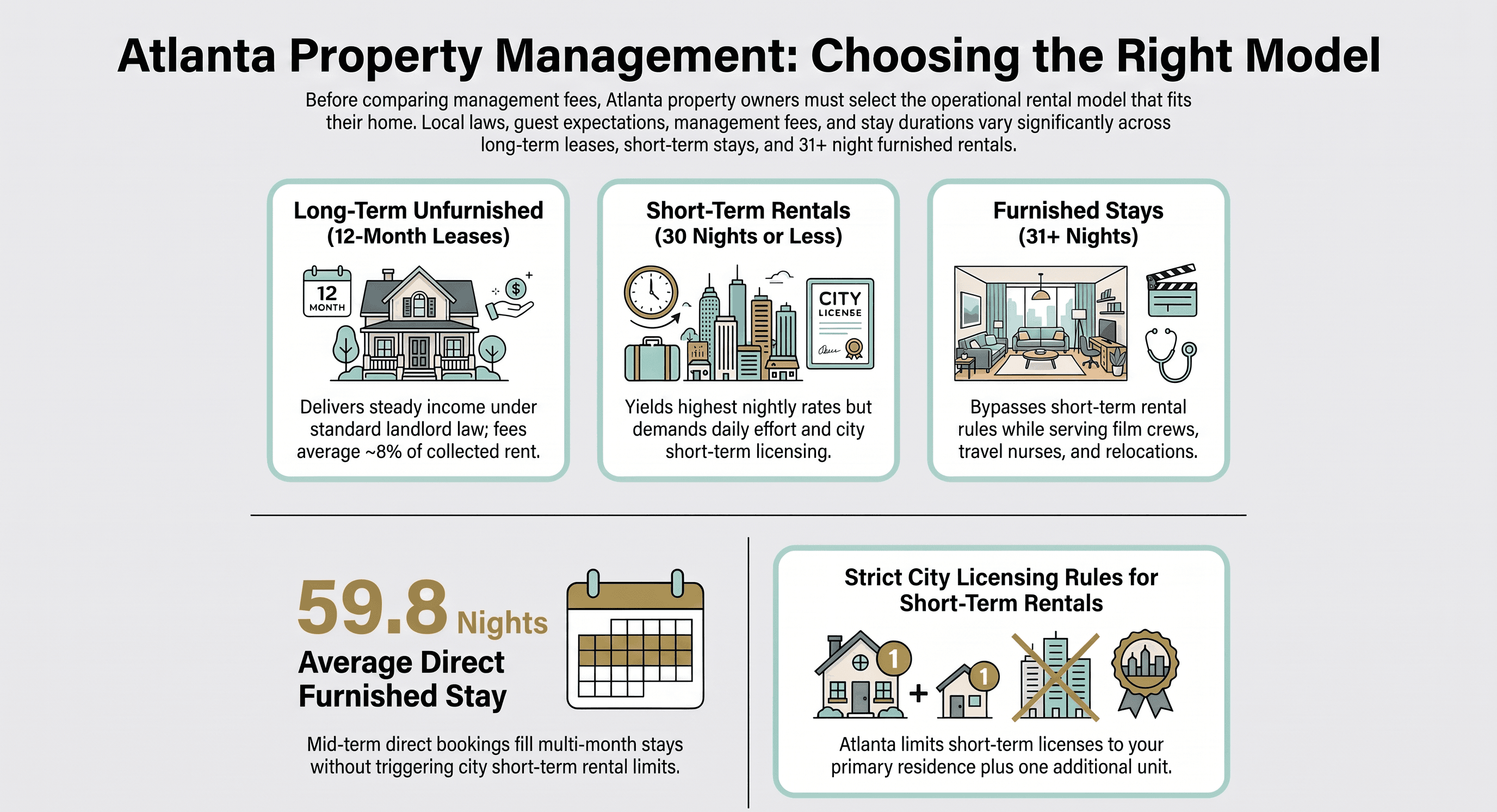
Atlanta owners have three common ways to rent a home, and each one needs a different kind of manager.
| Long term unfurnished | Short term | Furnished, 31+ nights | |
|---|---|---|---|
| Typical stay | 12 month lease | A few nights | One month to several months |
| Atlanta rule | Standard landlord and tenant law | City license required; covers your primary residence plus one additional unit | Outside the city's short term rental ordinance |
| Who lives there | A tenant who furnishes the home | Travelers and event visitors | Relocating employees, film and healthcare professionals, families displaced by insurance claims |
| How the fee is usually charged | Percentage of collected rent, plus a leasing fee | Percentage of booking revenue | Varies widely; ask how the base is defined |
| Who does it well | Firms built around leasing, screening, and tenant relations | Firms built around pricing, guest messaging, and turnovers | Firms with corporate and industry placement channels plus furnishing skills |
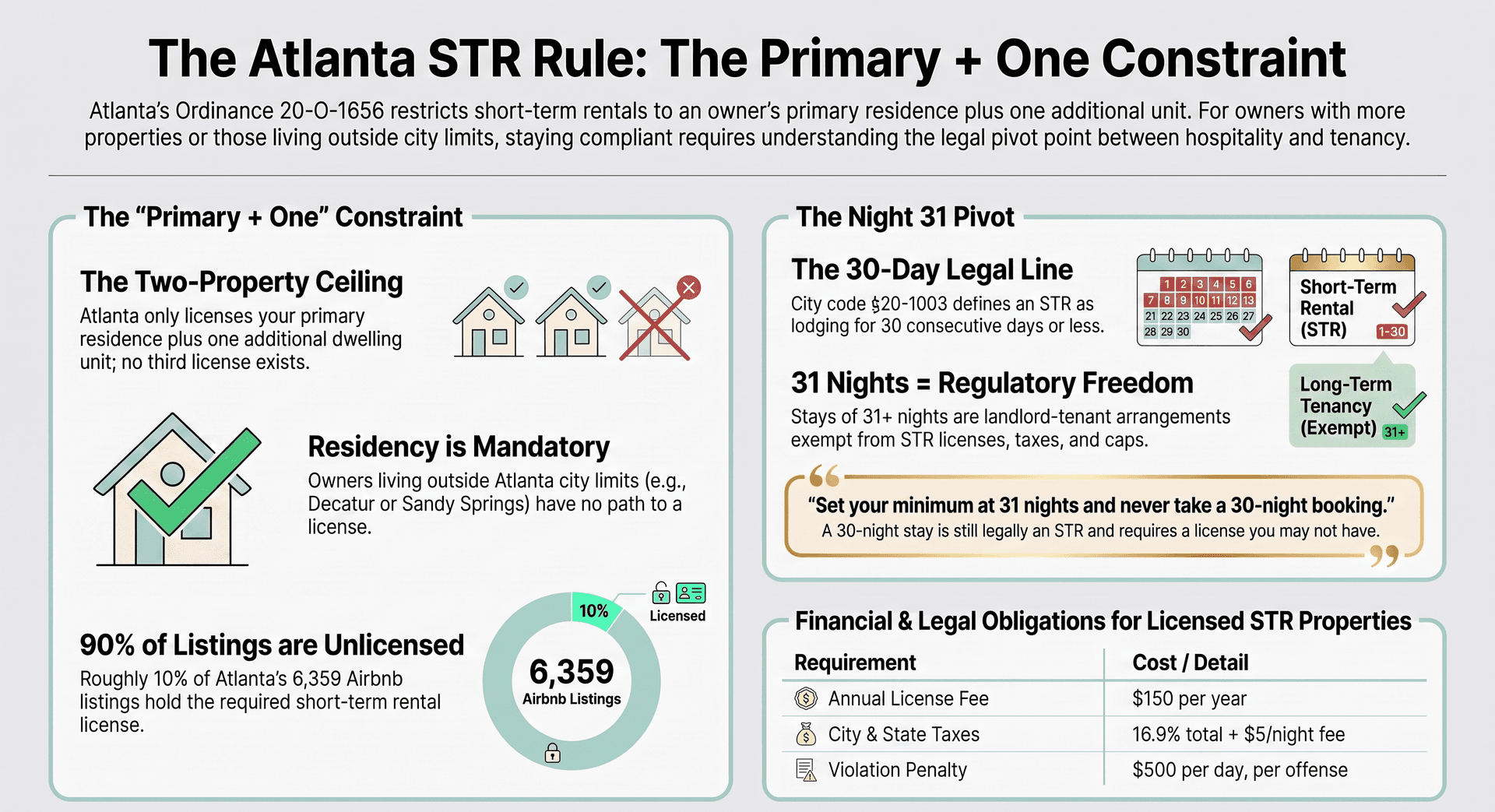
The middle column is the one that changes most owners' plans. Atlanta's short term rental license covers your primary residence plus one additional unit, and a stay of 30 consecutive days or less counts as a short term rental. Some houses cannot get that license. That includes a house you don't live in when your one additional unit is already licensed. It also includes any Atlanta house you own while living outside the city. Under the current code, those homes cannot be rented short term. We cover the rules in detail in our owner's guide to Atlanta short term rental laws.
Long term unfurnished
This is the classic model. The manager markets the home, screens applicants, signs a lease, collects rent, and handles repairs and renewals. Income is steady and owner effort is low. It is wrong for you if you want to use the house yourself during the year, or if the home's value is in its design and furnishings, which a tenant will not pay a premium for on an unfurnished lease.
Short term
Nightly stays usually carry the highest rate per night and demand the most work: dynamic pricing, fast guest replies, a cleaning after every checkout. It fits owners who live in Atlanta and want to rent their primary residence or their one additional licensed unit. It is wrong for any property that cannot hold a city license.
Furnished, 31 nights or more
Stays of a month or longer sit outside the short term rental ordinance. Guests are usually professionals on assignment or families between homes, and they treat the house like a home. In our own portfolio, direct bookings from January through May 2026 averaged 59.8 nights, per our midyear market report. This model fits a well furnished intown home that cannot be licensed for short stays. It is wrong for you if you have no appetite for furnishing, or if you need a single tenant locked in for a year.
Who rents furnished homes for 31 nights or more in Atlanta
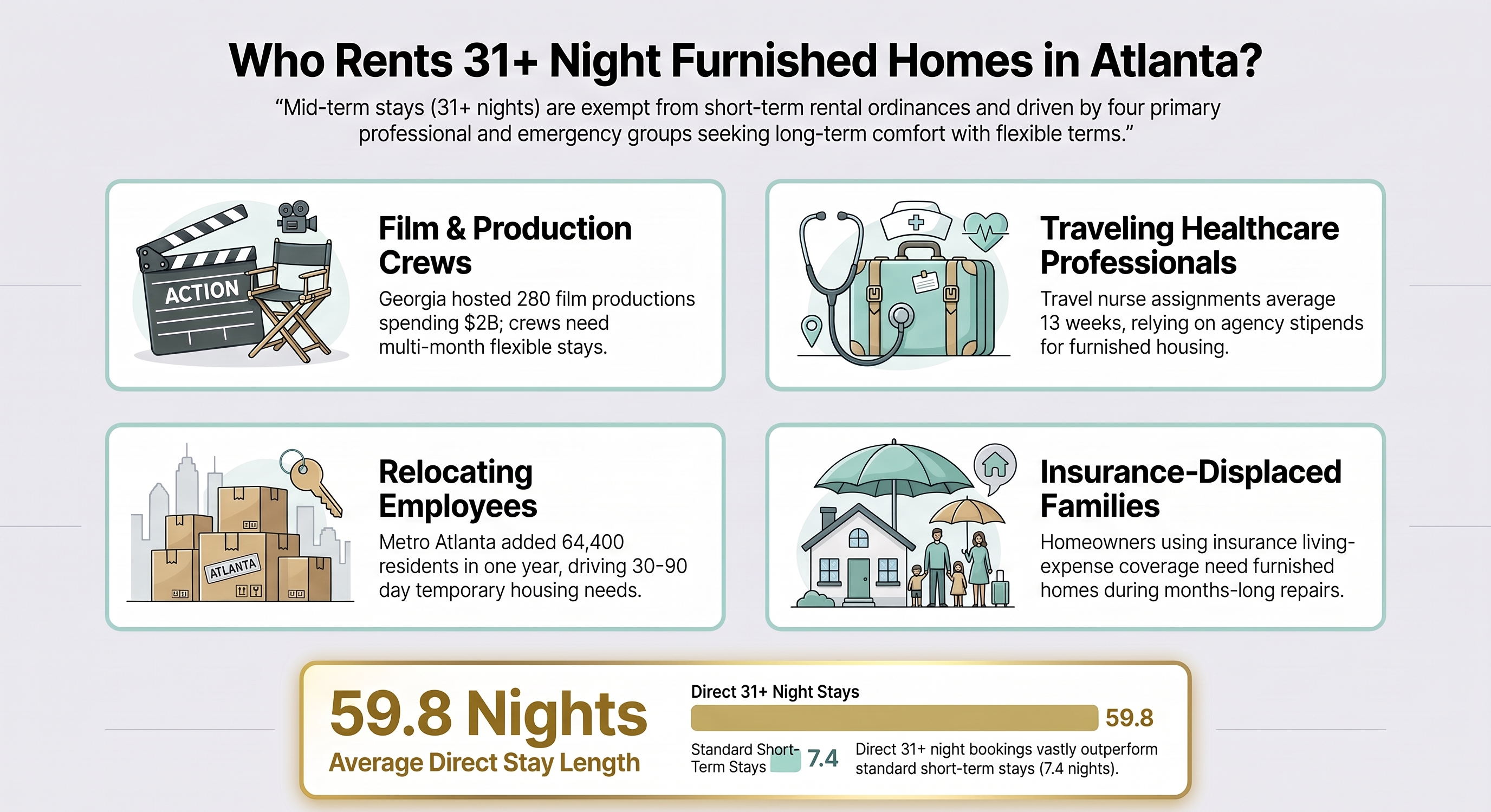
If you are weighing the furnished model, the real question is whether anyone will book your home for a month or longer. In Atlanta, four groups do it regularly, and each one has a structural reason to stay that long.
Film and production crews
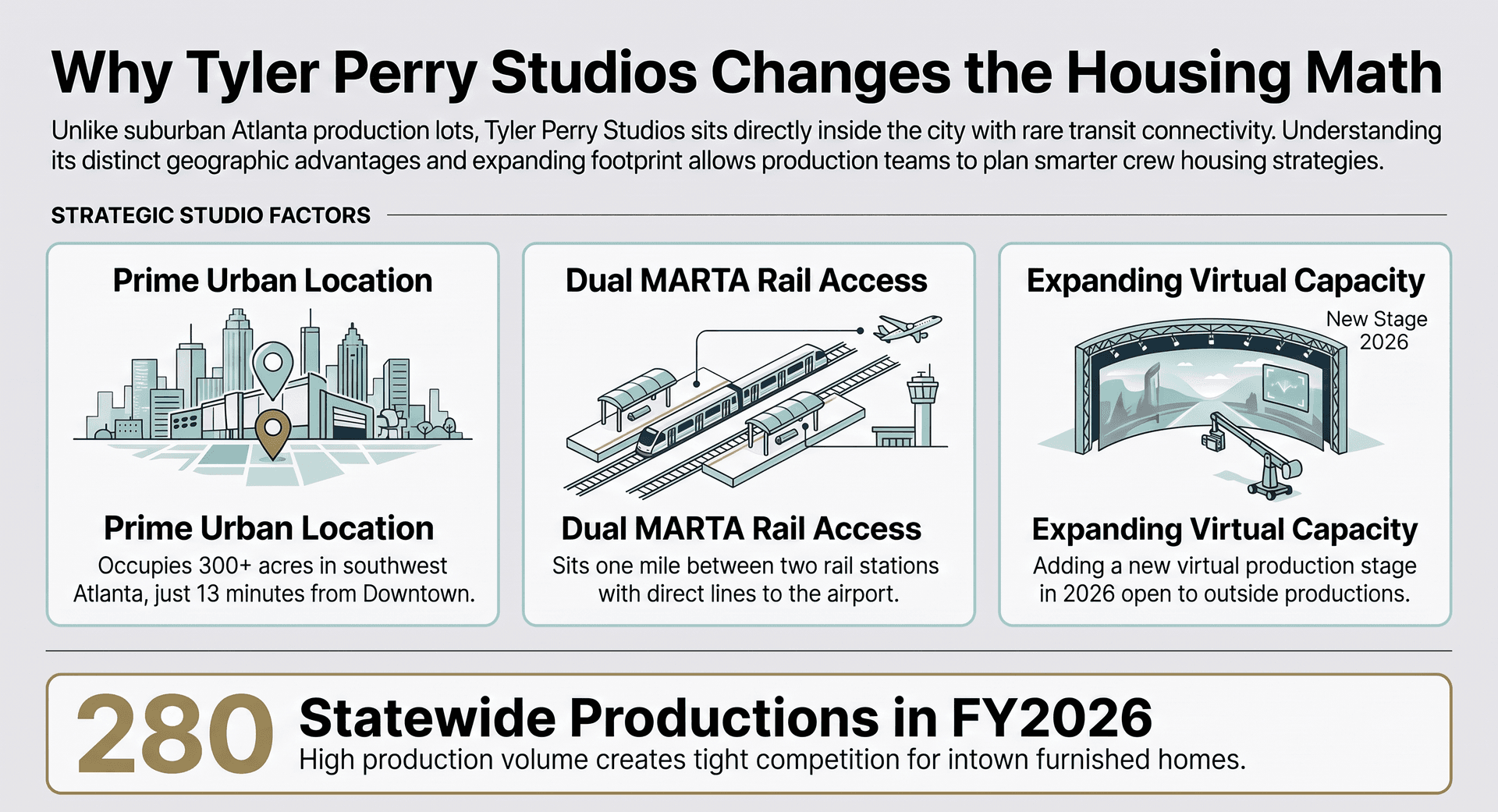
Production work in Georgia is holding steady. The Georgia film office reported 280 productions in fiscal year 2026, which ran from July 2025 through June 2026, a slight increase over the year before, according to the Georgia Department of Economic Development. The same report puts production spending in the state at a combined $2 billion for the year.
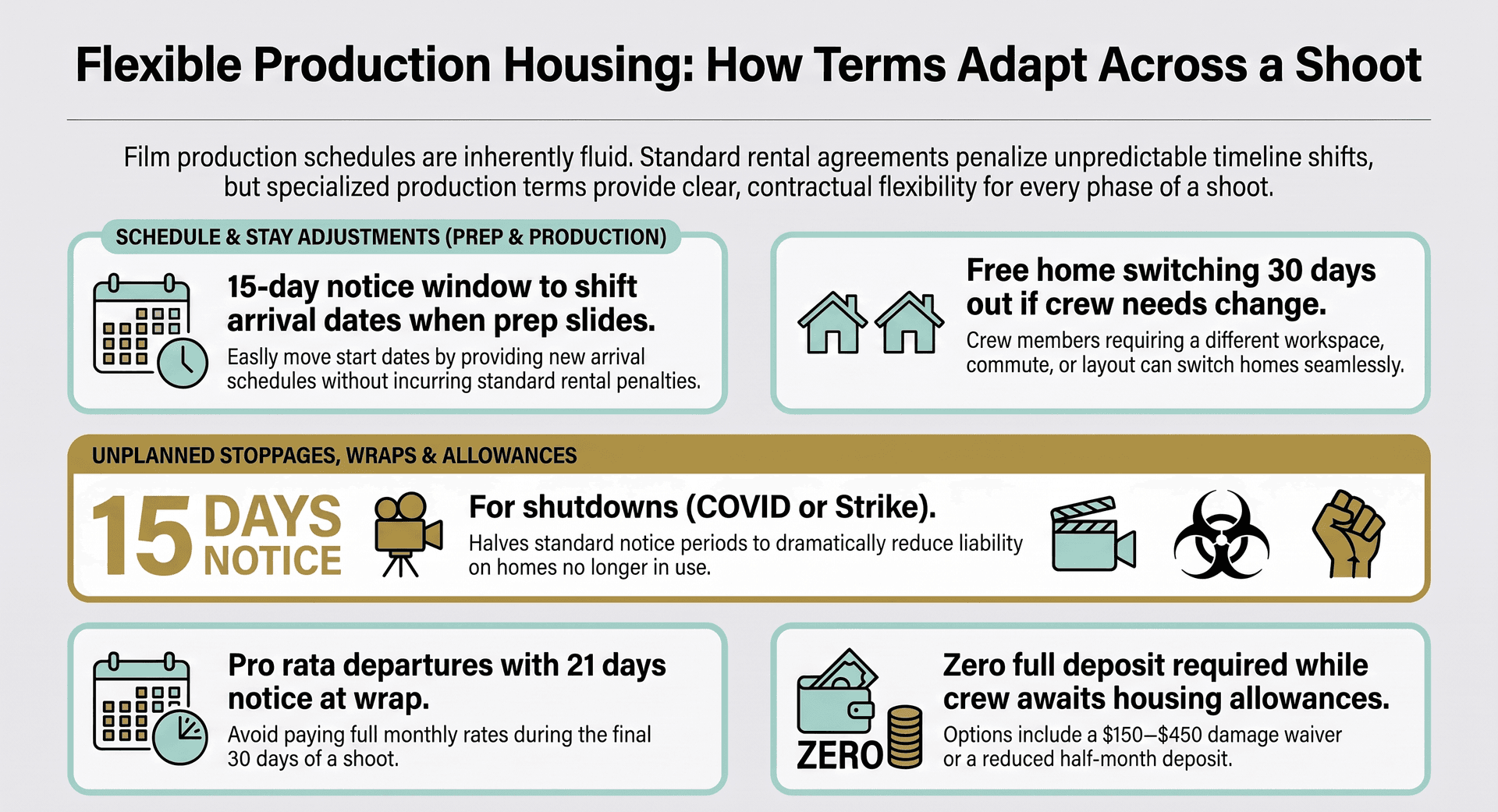
Shoots last weeks or months, not nights. Lizard Music was scheduled to film at Trilith Studios in Fayetteville from August 3 through October 14, 2026, per the AJC. Amazon's The Challenger was scheduled to start in late August and run through January 29, 2027, also per the AJC. Traveling crew members on schedules like these need a kitchen, laundry, parking, and a lease that can bend when the schedule moves.
What this means for your manager: production housing is usually booked by a coordinator for a group, often on short notice, and billed to the production. Ask whether the firm already works with productions, whether it can invoice a production company, and how it handles early wraps and extensions.
Traveling healthcare professionals
Travel nurse assignments typically last 13 weeks, according to the travel nursing marketplace Vivian. On October 9, 2026, Vivian listed 4,733 open travel nursing jobs in Atlanta; that count changes daily. Locum tenens physicians follow a similar pattern. A housing guide from Locumstory notes that stays longer than 30 days usually mean a furnished one bedroom apartment, and that clinicians who book their own housing receive a stipend from their agency.
What this means for your manager: these guests compare your home against their stipend and their commute to the hospital. Ask how the firm prices month long stays and how it reaches clinicians.
Relocating employees
People keep moving to metro Atlanta. The Atlanta Regional Commission reports the 11 county region added 64,400 residents between April 2024 and April 2025, and Atlanta ranked second on Penske Truck Rental's 2025 list of top moving destinations. Many new arrivals need somewhere to land while they look for a permanent home; a relocation firm, GMS Mobility, describes corporate housing stays of 30 to 90 days for that purpose.
What this means for your manager: relocation stays often come through employers and relocation companies, not Airbnb. Ask which corporate channels the firm books through.
Families displaced by insurance claims
When a fire, storm, or water leak makes a home unlivable, many homeowners policies include additional living expenses coverage. The National Association of Insurance Commissioners describes it as covering temporary housing in a hotel or apartment while the home is repaired or rebuilt. Policies may carry a dollar limit, a time limit, or both, and repairs often take months, which is why these families book furnished homes rather than hotel rooms.
What this means for your manager: these bookings are often arranged through adjusters or housing placement companies and paid by the insurer. Ask whether the firm works with them and how quickly it can place a family.
What we see in our own portfolio
Our midyear 2026 market report covers 1,521 bookings across our homes from January through May 2026. Three numbers from it bear on this decision:
Occupancy: our portfolio ran at 72.3% occupancy, against 58.2% for the full Atlanta metro AirDNA benchmark over the same months.
Stay length: our 115 direct bookings averaged 59.8 nights, against 7.4 nights for our 1,008 Airbnb bookings.
Booked nights: those 115 direct bookings filled roughly 6,880 nights, close to the roughly 7,460 nights from Airbnb.
Our direct inquiries in 2026 have come from corporate, insurance, production, and relocation sources, the same four groups above.
Two caveats keep these numbers honest. Our homes are professionally designed and concentrated in intown neighborhoods, so an average Atlanta listing should not expect the same results. And these are five months of data, not a forecast. The report's methodology section explains how each figure was calculated.
What property management in Atlanta costs, by model
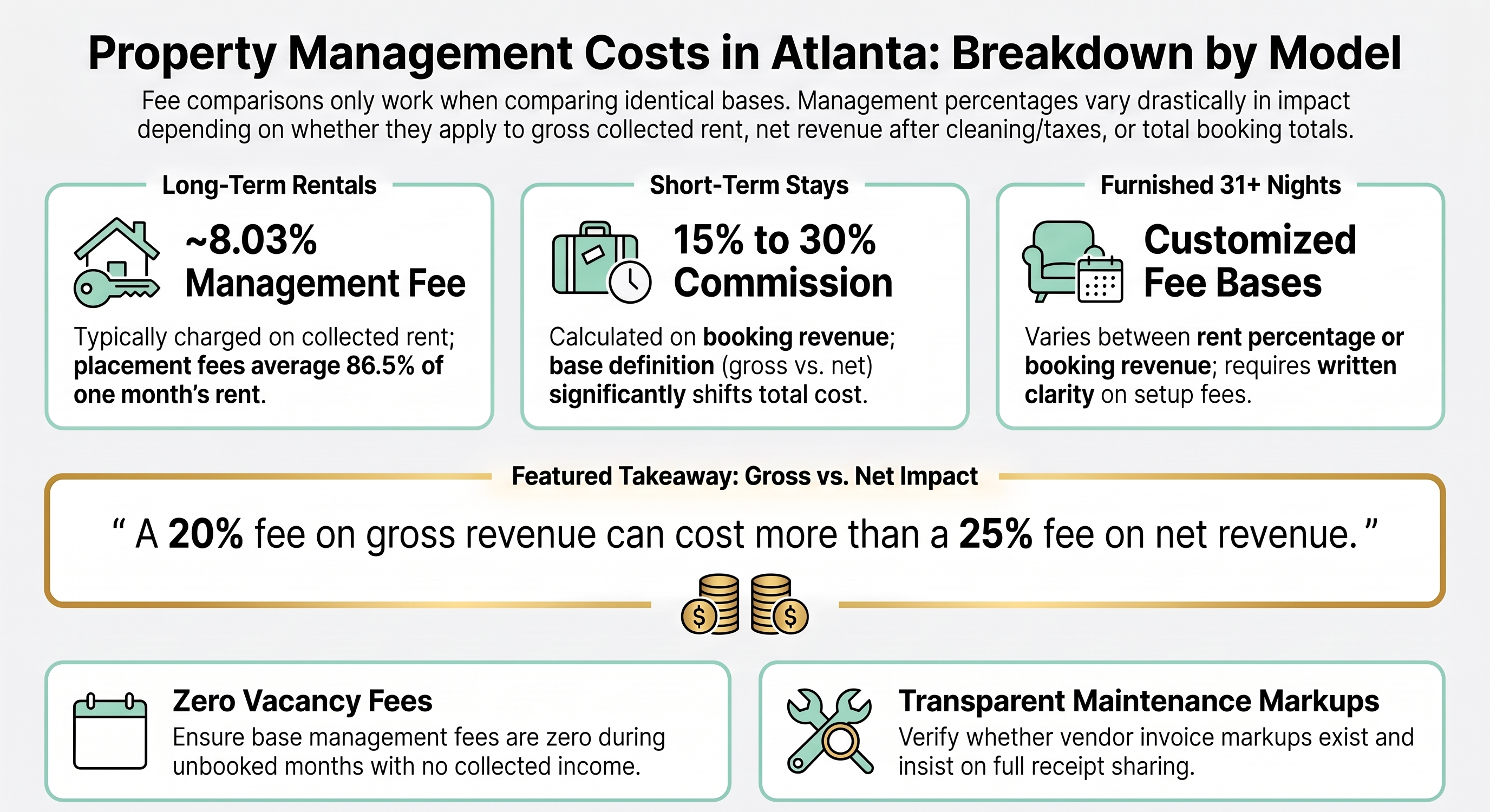
Fee comparisons only work when you compare the same thing. A percentage means nothing until you know what it is a percentage of.
Long term. The management fee is a percentage of the rent actually collected, so the base fee is usually zero in a month with no rent. Confirm there is no minimum monthly fee. A survey by iPropertyManagement found Georgia firms averaged 8.03% of collected rent. Georgia firms that bundle tenant placement with management charged an average placement fee of 86.5% of the rent. That survey dates from 2022 and covers Georgia, not Atlanta alone, so treat it as a benchmark. Expect proposals near 8%, with leasing, renewal, and setup fees on top, and confirm with real quotes.
Short term. Managers usually take a commission on booking revenue. Hostfully, summarizing a 2025 AirDNA report, puts the common range at 15% to 30%. The base matters as much as the rate. Ask whether the percentage applies to gross bookings, to revenue after platform fees, or to revenue after cleaning fees and taxes. Depending on platform fees, cleaning fees, and taxes, a 20% fee on gross can cost you more than a 25% fee on net.
Furnished, 31+ nights. We could not find a published fee benchmark for this model that we would trust, so we will not invent one. Some firms charge a percentage of rent, some a percentage of booking revenue, and some bundle furnishing and setup into the arrangement. Get the fee base in writing, and ask who pays for furniture, linens, and replacements.
Whatever the model, ask about every line item before you compare proposals.
| Line item | What to ask | Good sign |
|---|---|---|
| Management fee | A percentage of what, exactly? | One base, written in the agreement |
| Leasing or placement fee | When is it charged, and is it refunded if the tenant leaves early? | A clear rule for early departures |
| Renewal fee | Is there a charge when a tenant or guest extends? | Flat and disclosed, or none |
| Setup or onboarding fee | What does it cover? | Itemized work, not a vague charge |
| Maintenance coordination | Do you add a markup to vendor invoices? | Markup disclosed, invoices shared |
| Vacancy fee | Do you charge anything when the home is empty? | No fee on empty months |
| Early termination fee | What does it cost me to leave? | Short notice period, modest or no fee |
| Furnishing and design | Who chooses, buys, and replaces furniture? | A written budget you approve |
| Cleaning | Who keeps the cleaning fee guests pay? | Pass through, stated plainly |
Georgia checks most owners skip
Georgia law has three provisions every owner should understand before hiring anyone.
Who needs a broker license depends on the model
Under Georgia's license law, a person who collects rents or performs property management services for others for a fee is acting as a real estate broker (O.C.G.A. 43-40-1). A long term manager who signs leases and collects rent on your behalf should hold a Georgia broker license.
Short stay managers are different. The same law carves out managers of properties "available for less than 90 days' occupancy," but only when ten conditions are all met (O.C.G.A. 43-40-29(a)(11)). Among them: a written agreement with the owner, no authority to rent or lease the property, a guest agreement that is not a lease, and a stay that is not the guest's permanent residence.
Here is the practical version. Ask every firm, "Do you hold a broker license, or do you operate under the short stay exemption, and can I see the basis?" Then look the firm up on the Georgia Real Estate Commission's online license search. Furnished stays of 31 to 89 nights may fit the short stay exemption, but only if all ten conditions are met, including a guest agreement that is not a lease. If that is your model, ask the firm to show how its agreements meet them, and check with a Georgia real estate attorney.
Where your tenants' deposits sit
A licensed broker must deposit rents and security deposits in a federally insured trust account registered with the Real Estate Commission. The balance in that account must always cover the deposits it holds (Rule 520-1-.08). Georgia's landlord law also requires deposits to be kept in an escrow account used only for that purpose, and tenants must be told in writing where it is (O.C.G.A. 44-7-31).
Ask which bank holds the trust account and how deposits are reconciled.
Hiring a manager switches on the full deposit rules
Georgia exempts individual owners with ten or fewer rental units from several security deposit rules. Those include the escrow account and the move in inspection list. That exemption "does not apply to units for which management, including rent collection, is performed by third persons ... for a fee" (O.C.G.A. 44-7-36).
So if you pay a firm to manage a rental and collect the rent, that unit loses the exemption. The escrow account, the written notice of where it is, and the move in inspection rules all apply. Your manager should run that process from the first lease. Ask to see their move in inspection form.
Know the 2024 tenant law changes
Georgia's Safe at Home Act took effect July 1, 2024. It caps security deposits at two months' rent, requires rentals to be fit for human habitation, and, according to the National Low Income Housing Coalition, requires at least three days' notice before an eviction filing (Georgia Appleseed has a plain language summary). Ask any long term manager how they updated their lease and notice process after the change.
Small property management vs a large firm in Atlanta
Searches for small property management in Atlanta come from two groups. Some owners want a small firm. Others own a few homes and wonder whether a big firm will pay attention. In both cases, match the firm's size to how much attention your property needs.
A small or boutique firm tends to put fewer homes in each manager's hands, so you are more likely to know who picks up the phone. The tradeoff is a thinner bench. Ask what happens when your contact is on vacation, and how many vendors they can call on a holiday weekend.
A large firm usually brings more systems, more vendors, and wider coverage across the metro. The tradeoff is that a one or two home owner can become a ticket number. Ask how many properties each manager carries, and whether you get a named contact.
Use these questions to compare the two:
Attention: how many homes does my day to day contact manage?
Bench depth: who covers emergencies at 2 a.m. and on holidays?
Coverage: how many homes do you manage within a mile of mine?
Reporting: can I see a real owner statement before I sign?
Specialty: which of the three models is most of your portfolio?
That last question matters more in intown Atlanta than most owners expect. Inman Park, Cabbagetown, Candler Park, and Little Five Points sit close together, yet their housing stock runs from historic bungalows to new townhomes. A manager who already runs homes on your streets knows what similar homes rent for, which vendors can work in older houses, and what guests or tenants expect there.
A small firm is wrong for you if you own across the whole metro and want one contract. A large firm is wrong for you if you own one distinctive home and want a manager who knows it by heart.
The questions to ask on the first call
Treat the sales call as a preview of the service. In Buildium's 2026 survey of 300 small portfolio owners, communication problems were the top reason owners switched managers, cited by 57%. Declining service quality followed at 54%, and lack of transparency at 34%. Only 23% said their manager delivers excellent value. And 84% want to approve large repairs before the work starts.
So put communication and money questions first.
| Question | Good answer | Red flag |
|---|---|---|
| How fast do you respond to owners, and in writing? | A specific commitment, such as same business day | "We're very responsive" with no number |
| Who is my contact, and who covers for them? | A name and a backup | A general inbox only |
| Above what amount do you need my approval for a repair? | A dollar threshold written into the agreement | "We handle it all" |
| Can I see a sample owner statement? | They send one immediately | Reluctance, or a summary with no line items |
| Where are deposits and rents held? | Named trust or escrow account, reconciled monthly | Vague answer |
| Broker license or short stay exemption? | A clear answer and a way to verify it | Confusion about the question |
| How do you set rent or nightly pricing? | Data from comparable homes, reviewed on a schedule | "We know the market" |
| What happens to listings, photos, and reviews if I leave? | A written answer you are comfortable with | They keep everything, and you start from zero |
| How many homes do you manage near mine? | A number and a few examples | No local homes |
| Can I speak with two owners you manage for now? | Yes, with contact details | Only written testimonials |
Contract terms to read before you sign
A written management agreement protects both sides, and it is where most surprises hide. Georgia's short stay exemption itself requires one. Read these clauses before you sign:
Term and renewal. How long is the first term, and does it renew automatically?
Termination. How much notice do you have to give, and is there a fee? Can you leave for cause right away?
Placement fee on exit. If you leave mid lease, do you owe the rest of a leasing fee?
Repair approvals. Is there a dollar threshold, and an exception for true emergencies?
Markups. Are vendor markups or coordination fees disclosed in the agreement?
Account ownership. Who owns the listing accounts, photos, guest reviews, and tenant records when the agreement ends?
Insurance. What coverage does the manager carry, and what must you carry?
Reporting. How often will you get statements, and what will they show?
If a firm will not clarify an unclear clause, treat that as your answer.
Which kind of company fits you
| If this is you | Hire this | Ask first |
|---|---|---|
| You moved away and are keeping one intown house | A long term manager with a broker license, or a 31+ night furnished manager if the home is furnished and you may come back | Termination terms, and what a vacant month costs you |
| You own two to six homes and are unhappy with your manager | A firm whose core model matches yours, with a named contact | A sample statement and a repair approval threshold |
| You own a second home that cannot get a short term license | A furnished manager with corporate and industry placement channels | How they find guests for 31+ night stays, and the fee base |
| You live in Atlanta and want to rent your home plus one unit short term | A short term manager who knows the city license process | Fee base, pricing method, and their license or exemption |
| Your home is design forward or high end | A firm with in house design and furnishing experience | Who owns furniture decisions and replacement costs |
Our recommendation: if your property cannot hold a short term license, do not let anyone talk you into nightly stays anyway. Choose between a strong long term manager and a strong furnished manager, and let the home's condition and your plans for it decide.
FAQ
How much do property management companies charge in Atlanta?
For long term rentals, expect a percentage of collected rent in the high single digits plus a leasing fee; a 2022 survey of Georgia firms averaged 8.03%. Short term managers commonly take 15% to 30% of booking revenue, per AirDNA data cited by Hostfully. Always confirm what the percentage is calculated on.
Do I need a license to Airbnb my house in Atlanta?
Yes, for stays of 30 consecutive days or less. The city license covers your primary residence plus one additional unit. See our Atlanta short term rental laws guide.
Does a property manager in Georgia need a real estate license?
Managing rentals for others for a fee is broker activity under Georgia law, unless an exemption applies. Managers of stays under 90 days can operate under a narrow exemption if they meet all ten conditions. Ask which applies and verify it.
Can I switch property managers in the middle of a lease?
Usually, yes. Your management agreement sets the notice period and any fees. The tenant's lease stays in force. Ask both firms how the security deposit will be transferred and documented.
Who rents furnished homes for a month or longer in Atlanta?
Mostly film and production crews, traveling nurses and physicians, relocating employees, and families displaced by insurance claims. Each group has a work or insurance reason to stay 30 nights or more.
What is the difference between short term and mid term rental management?
Short term management runs stays of 30 nights or less, which need a city license in Atlanta. Mid term management runs furnished stays of a month or longer, which sit outside that ordinance and attract professionals and families who need a home base.
The order that saves you money
Pick the model your property can legally and practically support. Then pick a firm that specializes in it and passes the Georgia checks. Then read the contract line by line. Owners who follow that order compare property management in Atlanta on how each firm will run the home, and then compare fees on equal terms.
How Minty Living Can Help
We manage more than 160 homes across Atlanta's intown neighborhoods, most of them on the east side: Inman Park, Old Fourth Ward, Cabbagetown, Grant Park, Reynoldstown, Little Five Points, Virginia Highland, and nearby streets. Our work sits mostly in two of the three models above. We run furnished short term stays for owners with a licensed property, and furnished stays of 31 nights or more for owners whose homes cannot hold a short term license.
What that looks like in practice:
Design first. Our in house design team, led by architect and cofounder Sidra Gross, furnishes and styles each home for the guests it will attract.
Placement beyond Airbnb. We list across Airbnb, Vrbo, direct booking, and corporate channels, and we run a dedicated film and production housing program. That is how a furnished home finds guests for month long stays.
Upkeep you can see. Quarterly walkthroughs, 24/7 maintenance response, and detailed, transparent owner reporting.
We are not the right fit for every owner. If you want a traditional unfurnished long term lease, or your property sits well outside intown Atlanta, a firm built around long term leasing will likely serve you better, and the questions above will help you find a good one.
If your home is intown and you are weighing furnished management, we will walk through the numbers with you, including the questions in this guide.
Get a free property evaluation: owners.mintyliving.com
Call us: (404) 999-0841