
18 min read · Last updated October 16, 2026
This is how the ordinance reads and what we see as operators of 160+ Atlanta properties; it isn't legal advice.
In late September, the Atlanta City Council voted 9 to 5 to remove the rule that limited a short term rental license to a host's primary residence plus one other unit. The ordinance, sponsored by Councilmember Matt Westmoreland, takes effect January 1, 2027, according to the Center for Civic Innovation. If you own an Atlanta property you don't live in, or you live outside the city, there was nothing for you to apply for under the 2021 rules. Starting in January, there should be.
That is good news for a lot of owners we talk to, and it changes our own advice. In August we published a guide to Atlanta's two property ceiling that treated the cap as the central fact of owning a rental here, and recommended that owners of a property they didn't live in look hard at stays of 31 nights or more. A month later the council removed the cap. The longer stay strategy still holds up, for reasons we'll get to, but it is no longer the only legal way to earn from a home you don't live in.
The same vote also made the ordinance enforceable in a way it wasn't before. So the honest summary for 2027 is that more owners can get licensed, and every licensed owner will be expected to run their property like a professional. That second part is the work we do every day, and most of this post is about what it involves, what it earns when it's done well, and how we'd set up a property for 2027.
The short version
From January 1, 2027, owning a property you don't live in no longer rules out an Atlanta short term rental license.
The license itself, the 24/7 agent, the noise and occupancy rules, the fines, and the taxes all remain.
The council's stated reasons point toward more enforcement, not less.
A stricter bill from Councilmember Byron Amos is still held in committee, so plan for a property that can earn from both nightly and 31+ night stays.
Across January to May 2026, our portfolio ran 72.3% occupancy against a 58.2% Atlanta market, and our direct channel averaged 59.8 nights per booking.
What the council changed
Atlanta's 2021 short term rental ordinance let an owner license their primary residence and one additional dwelling, with the primary residence registered first. An owner with a third property had no license available for it. An owner whose primary residence was in Decatur, Sandy Springs, or another state had no Atlanta primary residence to register, and so no license to apply for at all.
The September vote removes that limit. The Center for Civic Innovation reports the vote as 9 to 5, and notes that an amendment from Councilmember Kelsea Bond to keep a two unit cap failed. WABE covered the same vote under the headline "Atlanta City Council clears way for short term rental enforcement," and reported Bond's concern that the change could open the door to "unlimited amounts of short term rentals per person." Rental Scale Up reported on October 1 that the change takes the residency limit out while leaving the license, noise, and occupancy rules in place.
In practical terms, the question an owner asks changes. Under the 2021 rules it was "am I allowed to apply?" From January it becomes "am I set up to hold a license and keep it?"
Why the city changed it, and what that means for enforcement
The reasoning the council heard is worth reading closely, because it tells you what comes next. According to CCI, the city's Department of Law told members the residency requirement had been "the subject of successful challenge in other jurisdictions," and Westmoreland said the 2021 ordinance had never been enforced. Rental Scale Up reported that officials had held off on enforcement because of court rulings on residency requirements elsewhere.
Our reading of that (an interpretation, not something the council said in these words) is that the residency cap was the part of the law the city could not confidently defend in court, and that uncertainty made the whole ordinance hard to enforce. Removing the cap gives the city a version it can stand behind. WABE's framing, that the vote "clears way" for enforcement, points the same direction.
For owners, that has two consequences. First, an unlicensed listing in 2027 carries more risk than it did in 2025, because the main reason the city gave for not acting is gone. Second, the enforcement the city has described is aimed at conduct: hosts who let a property become a neighborhood problem. A license you can't keep is worth very little, and you keep it by running the property well. That is the same thing that earns good reviews and repeat bookings, so the incentives line up.
What did not change
Removing the cap did not remove the license. Here is what an owner should expect to still apply in 2027, based on the existing ordinance and the city's published process:
| Rule | Where it stands |
|---|---|
| An annual short term rental license, applied for online | Still required |
| A $150 nonrefundable application fee (set in the 2021 ordinance) | No reported change |
| Your license number on every listing and advertisement | Still required |
| A designated short term rental agent who responds 24/7 | Still required |
| Noise, occupancy, and nuisance rules | Still apply, and are the focus of enforcement |
| Fines per violation, and loss of the license after repeated violations | Still apply |
| A short term rental is a stay of 30 consecutive days or less (City Code Sec. 20 1003) | No reported change |
That last row matters more than it looks. Because the city defines a short term rental as 30 consecutive days or less, a 30 night stay is still a short term rental, and the line falls at night 31. Stays of 31 or more nights are a landlord and tenant arrangement under a lease, outside the short term rental license entirely, with their own legal obligations.
Taxes follow the stay, not the license. Georgia's $5 per night state hotel motel fee applies to short term stays, and the Department of Revenue says marketplace platforms like Airbnb and Vrbo collect and remit it for stays booked through them. Stays of 31 or more consecutive nights are treated as extended stays and fall outside that fee. Atlanta's own hotel motel tax also applies to licensed short term stays. If you take bookings directly rather than through a platform, the filing is yours to handle, so confirm your obligations with your accountant before your first direct guest arrives.
What is still pending
Two things can still change the picture in 2027.
The first is the bill Councilmember Byron Amos introduced in January. As CCI described it, it would create an Office of Short Term Rentals, allow short term rentals only in a primary residence the host occupies at least 275 days a year, cap unhosted stays at 90 nights a year, and put new permit, insurance, and reporting requirements on platforms, with fines of $1,000 per listing per day for platforms that don't comply. It points in the opposite direction from the September vote, and as of CCI's September report it remains held in committee. It is not law. But if a version of it passed, a property built only for nightly guests would lose most of its calendar, while a property that already earns from 31+ night stays would barely notice. We think that asymmetry should shape how owners set up for 2027, and we come back to it below.
The second is neighborhood rules. In August 2025 the council approved limits on short term rentals in Home Park, near Georgia Tech, and Rental Scale Up reports those limits still apply. In November 2025 the council rejected a ban covering northeast Atlanta by a 7 to 6 vote. The citywide rule is only half the answer; your block may have its own.
The city has not yet published updated 2027 application details. Anything about fees, forms, or timing beyond what is listed above should be checked on the city's short term rental page as January approaches.
What it means for your property
| If this is you | Under the 2021 rules | From January 1, 2027 | What to do now |
|---|---|---|---|
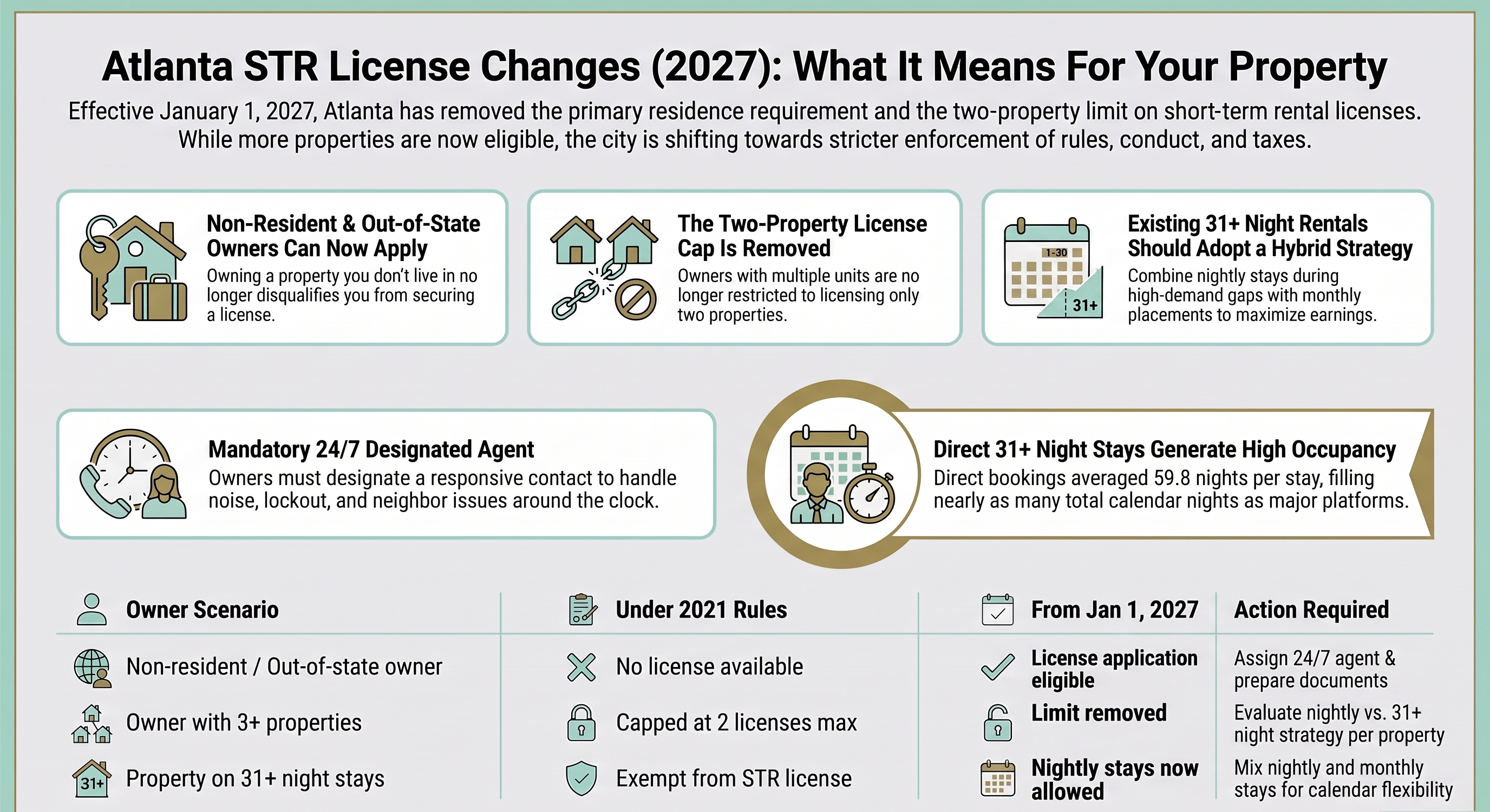
| You own an Atlanta property you don't live in, or you live outside the city | No license available | You should be able to apply | Prepare your application and decide who your 24/7 agent is |
| You own three or more Atlanta properties | Two at most could be licensed | The two property limit no longer applies | Decide which properties suit nightly stays and which suit longer stays |
| You moved a property to 31+ night stays because of the cap | Your best legal option | Nightly becomes an option again | Consider running both rather than switching back |
| The property is your primary residence | Licensable | Licensable | Renew as usual |
If you don't live in the property. This is the group the change was made for. The application itself is the easy part. The harder question is who answers the phone when a guest is locked out at midnight or a neighbor calls about noise, because the license requires someone to, and that person's responsiveness is what keeps the license. If you live out of state, plan that before you apply, not after.
If you own several properties. The cap used to decide your mix for you. Now you choose, and the choice should be property by property. In our portfolio, configuration matters as much as location: two bedrooms ran 80.7% occupancy in the first five months of 2026, while three bedrooms ran 63.5% (more on that below). A portfolio that puts every unit on the same nightly strategy leaves money on the table.
If you already moved to 31+ night stays. Don't throw away what you built. Furnished monthly demand in Atlanta is real and steady, and it is the part of the calendar the Amos bill can't touch. The better 2027 setup for most of these properties is a mix: nightly stays where the calendar has gaps and the rate is strong, and monthly placements where they fill weeks at a time.
Getting the license is the easy part
Everything the license requires turns into a daily operating job. Here is what each one looks like in practice, and how we handle it across our portfolio today.
The 24/7 agent. The ordinance requires a designated agent who responds around the clock. In practice that means someone who picks up at 2 a.m. when a guest can't find the lockbox, a smoke detector is chirping, or a neighbor is upset about a car on their lawn, and who can resolve the problem rather than just log it. Our team provides 24/7 guest support across every property we manage, so these are the calls we already answer every night of the year.
Noise, occupancy, and nuisance rules. These are the rules that generate complaints, and complaints are what lead to fines and, eventually, a lost license. Most problems are prevented before the guest arrives: screening who is booking and why, setting clear house rules on guest counts, parking, quiet hours, and parties, and pricing and setting minimum stays in a way that doesn't attract the wrong group on a holiday weekend. We screen guests and set house rules for every stay, and our calendar strategy takes neighborhood fit into account, not only the nightly rate.
Your license number on every listing. Simple, but it has to be on every platform and every advertisement, and it has to stay current when the license renews. A property listed on Airbnb, Vrbo, Booking.com, and a direct website has four places to get it right. We manage listings across all of those channels.
Taxes. Platforms handle the state fee for the stays they book. Direct bookings, which in our portfolio are some of the most valuable stays we have, are a different matter, and someone has to track and file them. If you work with a manager, ask exactly which taxes they handle and which stay with you.
Turnovers and condition. None of this shows up in the ordinance, but it decides whether guests leave good reviews and whether neighbors see a well kept house or a revolving door. Cleaning, linens, restocking, and maintenance between stays are the bulk of the daily work. Our in house team handles cleaning and maintenance, and every property we manage is designed and furnished by our design team, led by cofounder Sidra Gross, an architect.
None of this is beyond a committed owner who lives nearby. But it is a job, and the license puts your name on the record if it isn't done.
What well run Atlanta properties earn
The reason to go through all of this is the income, so it's worth being specific about what the market pays and what the gap between an average listing and a well run one looks like.
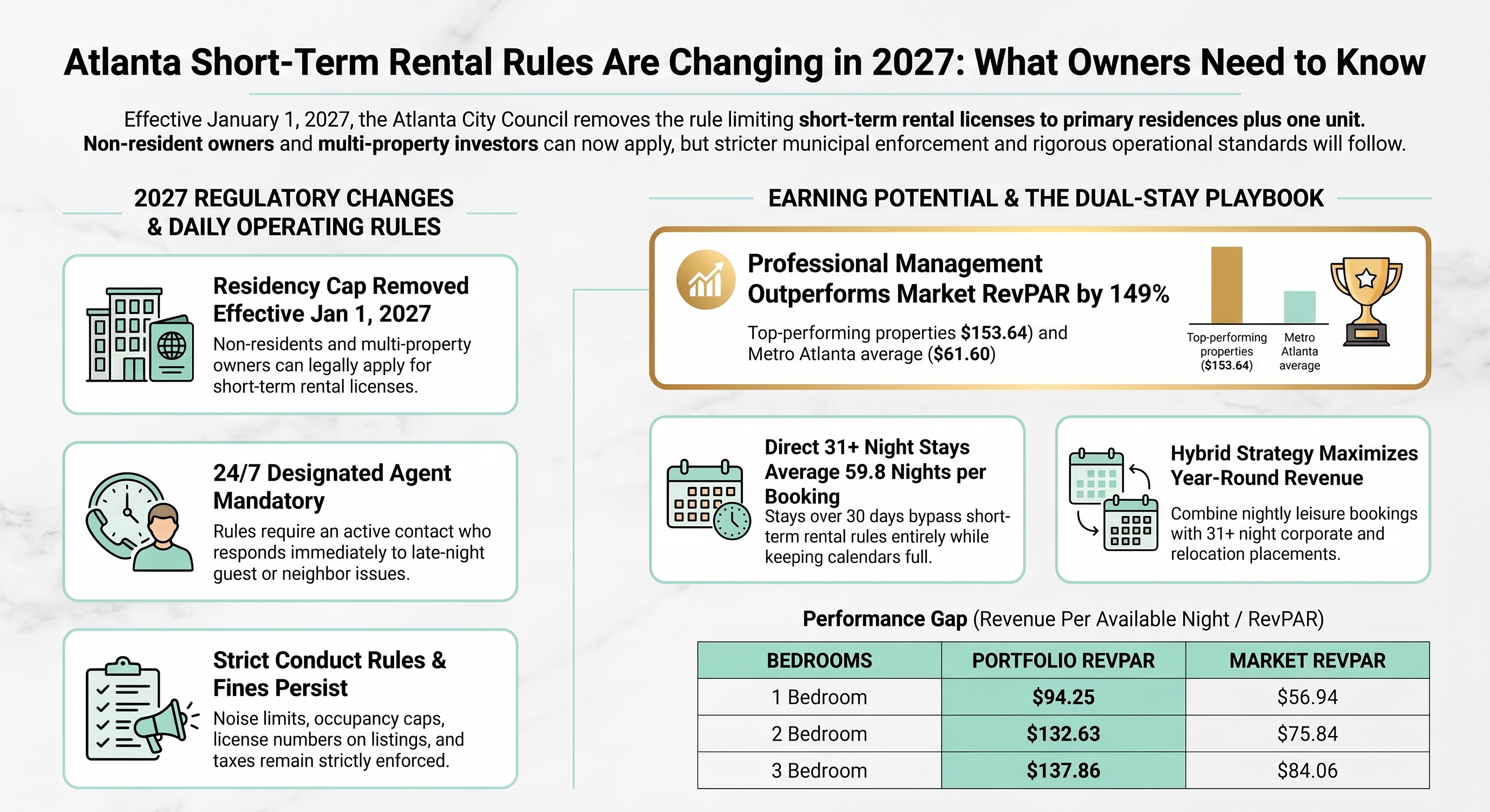
Our mid year 2026 report measured January through May 2026 against AirDNA's full Atlanta metro panel of about 12,600 listings. Over those months, the market averaged $106 a night, 58.2% occupancy, and $61.60 in revenue per available night. Our portfolio averaged $218 a night, 72.3% occupancy, and $153.64 in revenue per available night over the same months.
Broken out by size, we cleared the market in every configuration:
| Bedrooms | Our occupancy | Market occupancy | Our revenue per available night | Market revenue per available night |
|---|---|---|---|---|
| One | 77.3% | 58.8% | $94.25 | $56.94 |
| Two | 80.7% | 57.3% | $132.63 | $75.84 |
| Three | 63.5% | 51.5% | $137.86 | $84.06 |
| Four | 67.8% | 43.6% | $249.83 | $76.37 |
| All | 72.3% | 58.2% | $153.64 | $61.60 |
A few caveats belong with those numbers. The market figures are a full metro benchmark, which includes many suburban and lower priced listings, so the comparison flatters any intown portfolio; an intown only comparison would show a smaller gap. The four bedroom market sample is thin (roughly 19 active listings in May), so treat that row as directional. And these are five months, not a full year.
With those caveats, the pattern is still clear. Most of the gap comes from selection and operation: where the properties are, how they're furnished, how they're priced, and which channels fill them, rather than from the market lifting everyone. Two bedrooms are the strongest example. They ran 80.7% occupancy against a 57.3% market on a deep sample, because a well located two bedroom works for leisure travelers, business travelers, relocating families, and medical stays in the same calendar. Three bedrooms are the opposite case. They hold a strong nightly rate but struggle to keep the calendar full, in our portfolio and across the market, which is why we flagged them in the report as candidates for longer minimum stays and corporate and relocation placements.
For an owner deciding whether to license a property in 2027, that is the useful takeaway. The average Atlanta listing earns a modest amount, and the outcome depends far more on how the property is set up and run than on the market as a whole.
Nightly, 31+ nights, or both: our playbook for 2027
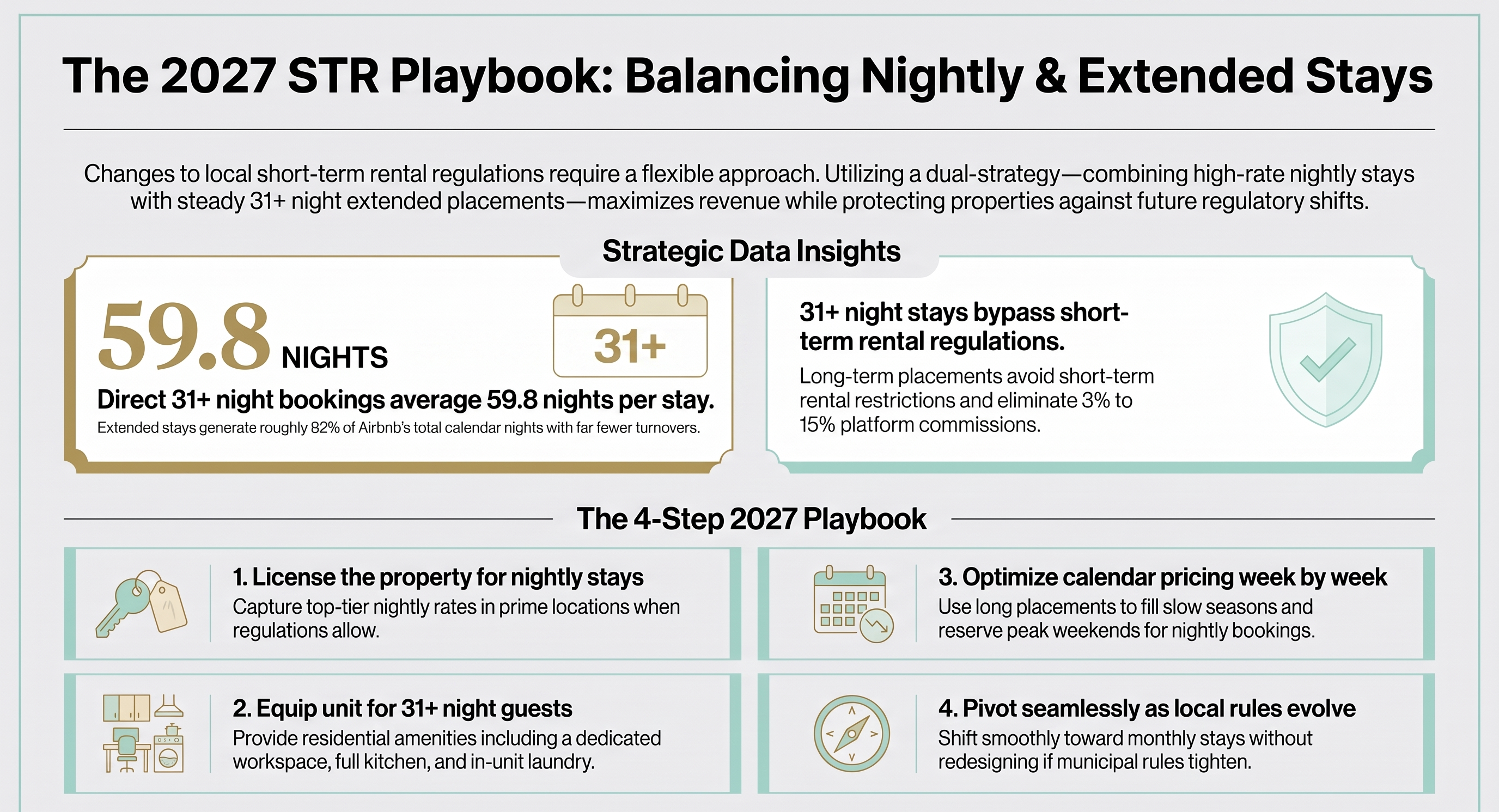
The strongest argument for not choosing between nightly and longer stays comes from our own booking data.
| Channel | Bookings, Jan to May 2026 | Average stay |
|---|---|---|
| Airbnb | 1,008 | 7.4 nights |
| Vrbo | 150 | 5.0 nights |
| Direct | 115 | 59.8 nights |
| Our website | 103 | 7.3 nights |
| Booking.com | 61 | 5.5 nights |
Airbnb sent us about nine times as many bookings as our direct channel. But at 59.8 nights each, our 115 direct bookings filled roughly 6,880 nights, about 92% of the roughly 7,460 nights Airbnb filled. Stays that long come from corporate relocation, insurance placements, traveling healthcare workers, and film and production crews, and because they run past 30 nights, they sit outside the short term rental definition entirely. Those direct stays also don't carry a marketplace commission, which our report put anywhere from 3% to 15% depending on the platform split.
This demand isn't unique to us. Furnished Finder, which serves the traveling nurse market, reports that US bookings of 28 nights or more grew about 136% from 2019 to 2025. In Atlanta, with its hospitals, film studios, and corporate relocations, that demand is steady and largely independent of the leisure calendar.
So here is how we'd set up a property for 2027:
License it for nightly stays if the property, the block, and the HOA allow it, because nightly rates in good intown neighborhoods are the highest rates the property will earn.
Keep it ready for 31+ night guests at the same time: furnished to a standard someone can live in for two months, with a workspace, a real kitchen, and laundry, and listed where monthly guests actually look.
Let the calendar decide week by week. A two month placement that starts in a slow season is worth more than a string of uncertain weekends; a big event weekend is worth more nightly.
Revisit the mix as the rules move. If the Amos bill or something like it advances, the property can shift toward longer stays without a redesign or a new audience.
This is how our portfolio already runs, and it is the part of the 2027 change that matters most for owners. The license opens the nightly market to more owners, and the longer stay market protects them if the rules tighten again.
A checklist for the next ten weeks
Check your neighborhood and zoning. Confirm the property isn't covered by a neighborhood restriction like Home Park's.
Read your HOA covenants, lease, and mortgage terms. The city doesn't check them, and they can prohibit short term rentals on their own.
Decide who your 24/7 agent is. It can be you, someone you designate, or a management company. Whoever it is has to actually answer at 2 a.m.
Get insurance written for short term rentals. A standard homeowner or landlord policy may not cover paying guests. This is our recommendation, not a stated city requirement.
Gather your documents. Proof of ownership and a government ID are part of the application; owners applying through an agent may need additional paperwork.
Sort out taxes. If you plan to take direct bookings, register for the state hotel motel fee and confirm your Atlanta filing obligations with your accountant.
Furnish for both kinds of guest. A property that works for a weekend and for a two month stay has more ways to earn.
Decide your mix of nightly and 31+ night stays before you list, so your pricing, minimum stays, and listings match the guests you want.
Watch the city's short term rental page for the 2027 application details.
Talk to an attorney if your situation involves an LLC, a partnership, or a property with an existing tenant.
Run it yourself, or hire a manager
Plenty of owners will run a licensed property themselves, and if you live nearby, enjoy hospitality, and can be the person who answers at night, that's a reasonable choice. You keep the full revenue and you control every decision.
Hiring a manager makes more sense when you live out of town, own several properties, or want to earn from both nightly and 31+ night guests without building two separate businesses. The questions worth asking any manager in 2027 are specific: who is the 24/7 contact and how fast do they respond, how do they screen guests and prevent noise complaints, which taxes do they file and which stay with you, can they fill 31+ night stays and not just weekends, and what did their properties actually earn last year compared with the market. Our guide to choosing a property management company in Atlanta goes through those questions in detail.
Frequently asked questions
Can I get an Atlanta short term rental license for a home I don't live in?
Under the 2021 rules, only if it was the one additional unit attached to your registered primary residence. The council removed that limit in September 2026, effective January 1, 2027, so owners who don't live in the property should be able to apply from that date.
When does the change take effect?
January 1, 2027, according to the Center for Civic Innovation's report on the vote. Check the city's short term rental page for the updated application process.
Can out of state owners get an Atlanta short term rental license?
The primary residence requirement was what excluded owners who live outside the city, and it is being removed. You will still need a designated agent who can respond around the clock.
Is there still a limit on how many Atlanta properties I can license?
The two property limit is what the council removed, and no replacement limit has been reported. Check the city's 2027 application details when they're published.
Do I need a short term rental license for stays of 31 nights or more?
Atlanta's code defines a short term rental as a stay of 30 consecutive days or less, so stays of 31 or more nights fall outside it. Georgia also treats stays of 31 or more consecutive nights as extended stays for the state hotel motel fee. Longer stays bring their own obligations under landlord and tenant law.
Is the 90 night cap on unhosted rentals law?
No. It is part of Councilmember Byron Amos's bill, which as of late September 2026 remained held in committee.
Did the license fee change?
No change has been reported. The 2021 ordinance set a $150 nonrefundable application fee; confirm the 2027 amount on the city's site.
What happens if I keep operating without a license?
The ordinance provides for fines per violation and loss of the license after repeated violations, and the council's stated purpose in September was to make enforcement possible. We'd treat 2027 as the year to get licensed.
The bottom line
From January 1, owning a property you don't live in no longer rules out an Atlanta short term rental license. The license, the conduct rules, and the taxes all remain, and the city now has an ordinance it means to enforce. The owners who do best in 2027 will be the ones who get licensed early, run their property so it never generates a complaint, and set it up to earn from both nightly and 31+ night guests. You have about ten weeks to get there.
How Minty Living Can Help
Whether a property should run nightly, take 31+ night stays, or do both is a question we work through with Atlanta owners every week, and the answer depends on the property, the block, and what the owner wants from it.
Minty Living manages 160+ furnished properties across intown Atlanta, including Inman Park, Old Fourth Ward, Grant Park, Midtown, Cabbagetown, and Virginia Highland. Founded in 2021 by Benjamin Gross and Sidra Gross, we run full service management: guest screening and 24/7 guest support, cleaning and maintenance, pricing, photography, and in house design led by Sidra. Our properties hold a 4.9 Google rating and Airbnb Superhost status, and our eligible portfolio meets Plum Guide's "Top 1%" selection criteria.
For an owner who couldn't license a property before, the useful part is that we already sell both kinds of stay. Our nightly calendar runs through the major platforms and our own website, and our direct channel serves corporate relocation, insurance placements, traveling healthcare, and film and production crews, the demand a 31+ night strategy depends on.
To be clear about what we don't do: we don't file short term rental licenses on an owner's behalf, and we can't tell you whether your specific property is compliant. Those are questions for the city and your attorney. What we can do is look at your property and give you a straight read on how it would run in 2027, including if the answer is to manage it yourself.
Tell us about your property, or call (404) 999-0841 if you'd rather talk it through.